

Vitamin B6 deficiency: which symptoms support it and which do not
The essentials at a glance
Vitamin B6 deficiency has been described as causing microcytic anemia, inflamed corners of the mouth and scaly dermatitis, a swollen tongue, depressed mood and confusion, and impaired immune function (National Institutes of Health, Office of Dietary Supplements, as of 2026). The crucial qualification is missing from almost every text on the subject: A deficiency affecting vitamin B6 alone is rare.
This topic has two directions, and the second is usually left unmentioned. Too little vitamin B6 occurs. Too much does too, through supplements. In 2023, the European Food Safety Authority lowered the tolerable total intake for adults from 25 to 12 milligrams per day because high intakes over a prolonged period have been associated with nerve damage. A provider that sells tests has every reason to mention this as well.
First, you will read what vitamin B6 does in the body and the numerical range in which the topic falls. This is followed by the symptoms that have been described, the question of how specific they are, four steps for assessing your own situation, the risk groups, and the section on overdose. The final part covers diet, what at-home testing can accomplish, a comparison of the options, and the limitations of a single number.
What to expect in this article
1. What vitamin B6 actually does in the body
2. How much vitamin B6 the body needs and where the upper limit lies
3. Which symptoms have been described in vitamin B6 deficiency
4. Why a deficiency affecting only B6 is rare
5. Four steps to help you assess the suspicion in your own case
6. Who is at increased risk and why
7. The other direction: when too much vitamin B6 becomes a problem
8. Where vitamin B6 comes from in everyday life
9. What you can have measured at home for this question
10. Three ways to clarify the suspicion, compared
11. What the PLP lab value indicates and what it does not
12. For whom testing makes sense—and for whom it does not
13. Limitations: what remains unresolved on this topic
14. What matters in the end
Frequently asked questions
Sources
What vitamin B6 actually does in the body
Vitamin B6 is not a single substance but a group of compounds. Pyridoxine, pyridoxal, and pyridoxamine are part of it, and the body converts them into the same active form: pyridoxal 5'-phosphate, abbreviated as PLP. This abbreviation becomes important later because it is measured in the laboratory.
In the cell, PLP works as a cofactor for enzymes. Enzymes are the tools of metabolism, and a cofactor is what a tool needs to engage properly in the first place. Without PLP, certain tools stop working, even when they are present.
The largest area of activity is protein metabolism. Whenever the body converts, breaks down, or transforms amino acids into one another, PLP is almost always involved. That is why the need for vitamin B6 increases with the amount of protein in the diet—a relationship that hardly any other vitamin demonstrates so clearly.
Two other areas explain why the complaints described vary so widely. The formation of heme, the iron-containing component of the red blood pigment, requires PLP. The production of several neurotransmitters also requires it, because these neurotransmitters are formed from amino acids.
This leads to a rule that underpins the entire article: A substance that contributes in so many places does not produce one typical complaint when it is in short supply. It produces many nonspecific ones. Anyone who reads a single symptom and concludes that it is caused by vitamin B6 is working backward, and the calculation does not work in reverse.
Why the body does not build up a reserve
Vitamin B6 is water-soluble. What the body does not need is excreted through the kidneys instead of being stored. This is why intake must be regular and why one particularly large meal does not create a reserve for the week.
Its water solubility was long considered reassuring, even at high amounts from supplements. That reassurance is no longer tenable, and why is explained in the chapter on the other direction.
How much vitamin B6 the body needs and where the upper limit lies
Before looking at symptoms, it is worth considering the range of figures. At a glance, it shows that this topic has two ends and that the two ends are closer together than most people expect.
The German Nutrition Society specifies a recommended intake for adults of 1.6 milligrams per day for men and 1.4 milligrams per day for women (recommendation basis as of 2019). These values apply to all age groups from 19 years onward; they are higher for pregnant and breastfeeding women.
At the other end is the tolerable total intake, known technically as the Tolerable Upper Intake Level. It describes the amount at which, from a risk assessment perspective, no adverse effects are expected over a prolonged period. In 2023, the European Food Safety Authority revised this value and lowered it for adults from 25 to 12 milligrams per day.
A third figure lies between them, and it is the most important in practice. In 2024, the German Federal Institute for Risk Assessment proposed a maximum amount for food supplements: 0.9 milligrams per daily recommended intake for people aged 15 and over. This figure is deliberately below the recommended intake because a supplement is added to the diet rather than replacing it.
Vitamin B6 in three figures
1.6 mg
Recommended daily intake for men aged 19 and over; for women, 1.4 mg (DGE, recommendation basis as of 2019)
12 mg
Tolerable total daily intake for adults, reduced in 2023 from the previous 25 mg (EFSA, 2023)
0.9 mg
Proposed maximum amount per daily recommended intake in food supplements for people aged 15 and over (BfR, 2024)
Sources: German Nutrition Society, basis of derivation as of 2019 · European Food Safety Authority, 2023 · German Federal Institute for Risk Assessment, Opinion 008/2024
Together, these three figures say something that none of them says on its own. The gap between what the body needs and what is considered safe is less than tenfold. For many other water-soluble vitamins, this gap is several times larger. Vitamin B6 has a narrow margin.
Key message
For vitamin B6, the gap between the recommended intake of 1.4 to 1.6 milligrams per day and the tolerable total intake of 12 milligrams per day is less than tenfold. The margin is narrow, which is why the question of deficiency must always be accompanied by the question of excess.
Why an upper limit may be below the recommendation
The proposed 0.9 milligrams seems contradictory at first glance. It is below the amount specified by the dietary recommendation. The reason is the way the calculation works: An upper limit for supplements does not describe the requirement; it describes the room remaining alongside the usual intake from food without reaching the tolerable total intake.
So anyone wondering why a supplement containing 25 milligrams is on the shelf has asked the right question. The answer appears in the chapter about the other direction, and it is uncomfortable.
Which symptoms are described in vitamin B6 deficiency
The Office of Dietary Supplements at the National Institutes of Health lists the symptoms associated with vitamin B6 deficiency. The list is short and deliberately matter-of-fact. It includes microcytic anemia, abnormalities in the electroencephalogram, skin inflammation with cheilosis and glossitis, depressed mood and confusion, and impaired immune function.
These terms need to be translated before they are useful. Cheilosis means cracked and inflamed corners of the mouth; glossitis means a swollen, reddened tongue. Microcytic anemia is anemia in which the red blood cells are smaller than usual. All three are findings identified by a doctor, not sensations that you can reliably interpret yourself.
What stands out on the skin and mucous membranes
The skin is a sensitive indicator when it comes to nutrient-related issues because it renews itself quickly and therefore needs a constant supply of nutrients. A scaly, often reddened skin inflammation is described, frequently on the face and scalp. Cracked corners of the mouth and an inflamed tongue may also occur.
The catch: Exactly the same signs are also described in iron deficiency, zinc deficiency, riboflavin deficiency, and vitamin B12 deficiency. Cracked corners of the mouth are not a telltale sign of a specific vitamin deficiency. They indicate that something is wrong with overall nutritional status—or that there is an entirely different cause, such as a fungal infection.
What is described about the nervous system
The nervous system is particularly confusing, for a reason that hardly any guide mentions. Both severe deficiency and prolonged excessive intake have been linked to symptoms affecting the peripheral nerves. Tingling in the hands and feet can therefore point in either direction.
For personal interpretation, this means that anyone who reaches for a high-dose vitamin B supplement because of tingling in the fingers, without knowing what is causing the tingling, may make the problem worse rather than better. This possibility belongs at the beginning of every consideration, not at the end.
For infants, the Office of Dietary Supplements describes a distinct picture: irritability, unusually acute hearing, and seizures. This is a medical matter, not something to resolve through a self-test.
What stands out in mood and blood counts
Depressed mood and confusion appear in the same list. The connection is biochemically plausible because several neurotransmitters are made from amino acids, and this conversion requires PLP. Plausible does not mean reversible: depressed mood does not imply a vitamin deficiency.
Microcytic anemia is the finding most likely to be helpful because it is visible in a blood count. However, small red blood cells are far more often a sign of iron deficiency than of vitamin B6 deficiency. Anyone with such a finding should first investigate the most obvious cause.
Why a deficiency affecting only B6 is rare
This section is why this article looks different from most articles on the subject. The Office of Dietary Supplements of the National Institutes of Health states: “Isolated vitamin B6 deficiency is uncommon; inadequate vitamin B6 status is usually associated with low concentrations of other B-complex vitamins, such as vitamin B12 and folic acid.” In other words: Isolated vitamin B6 deficiency is unusual; inadequate vitamin B6 status is usually accompanied by low concentrations of other B vitamins, such as vitamin B12 and folic acid.
This one sentence reorganizes the entire symptom list. If vitamin B6 deficiency almost never occurs alone, then the question “do I have too little vitamin B6?” is already the wrong one. The useful question is: Is something wrong with my overall nutritional status, and if so, what is causing it?
The difference is not linguistic. It determines the next step. Anyone looking for a single value buys a supplement containing a single substance. Anyone asking about the pattern looks at several values together—and more often finds the causes that actually explain something.
There is one exception, and it is important enough to warrant its own line. Certain medications specifically affect vitamin B6 metabolism. In such cases, a largely isolated deficiency is possible. Which medications these are is explained in the risk chapter.
Chapter at a glance
According to the Office of Dietary Supplements of the National Institutes of Health, vitamin B6 deficiency rarely occurs on its own. It is usually accompanied by low levels of other B vitamins, especially vitamin B12 and folate. For your own assessment, this means that a single value explains little, while looking at several values is more informative. Certain medications that specifically affect vitamin B6 metabolism are an exception.
Four steps to help you sort out your suspicion
The order of these four steps is not arbitrary. Each step rules out explanations that would otherwise obscure the later ones. The steps prepare you for a medical consultation; they do not replace it.
Check whether you are already taking anything
Vitamin B complexes, energy supplements, fortified drinks, and protein powders often contain vitamin B6, frequently far above the recommended intake. This step comes first: If you are already taking supplements, you may have the opposite problem.
Review your medication list
Some drug classes affect vitamin B6 metabolism. The list belongs in a conversation with your doctor, not in a search engine. Do not stop any medication on your own because of this.
Write down symptoms for two weeks
What exactly, when, and for how long. Without evaluation and without changing your diet at the same time; otherwise, nothing can be attributed later. Only the pattern shows whether there is one at all.
Get tested only afterward
A test answers a question that must first be clear. Anyone who skips the first three steps gets a number without context—and that creates more unease than it resolves.
Who is at increased risk and why
Vitamin B6 deficiency rarely results from a single cause. Usually, increased use and impaired absorption occur together. The following groups are therefore not diagnoses, but reasons to take a closer look.
Impaired kidney function
People with impaired kidney function, particularly those undergoing dialysis, are among the best-documented groups. The reason is obvious: A water-soluble substance is processed through the kidneys, and a procedure that cleans the blood removes it as well. In these cases, nutritional intake is medically supervised.
Autoimmune diseases and chronic inflammation
Lower vitamin B6 levels are observed in inflammatory and autoimmune diseases. However, the direction of the relationship is not clearly established: the low level may be a consequence of the inflammatory process rather than its cause. Anyone reading about this connection should understand the difference, because it determines whether increasing intake would make any difference at all.
Diseases of the digestive tract
Chronic inflammatory bowel diseases and celiac disease interfere with the absorption of nutrients in the small intestine. Here, impaired absorption coincides with a frequently increased need. Anyone with such a diagnosis already discusses their nutritional needs regularly with a doctor; self-testing is not the right approach here.
Certain medications
Some active ingredients directly affect vitamin B6 metabolism. The best-known is an active ingredient used in tuberculosis treatment, for which concomitant vitamin B6 supplementation is part of standard medical practice. Certain medications for epilepsy and inflammatory joint diseases are also mentioned in this context.
The crucial point is not medical but practical: The doctor who prescribed the medication knows about these connections. They belong there, not in self-treatment.
Very unbalanced diet and chronic alcohol consumption
Chronic alcohol consumption acts in several ways at once: It impairs absorption in the intestines, accelerates breakdown, and is often accompanied by an unbalanced diet. This is the situation in which the supply of several B vitamins becomes insufficient at the same time—and therefore exactly the pattern described by the Office of Dietary Supplements.
The other direction: when too much vitamin B6 becomes a problem
An article about vitamin B6 deficiency that leaves out this aspect is incomplete. People who search for deficiency symptoms usually look for a supplement right afterward—and that is precisely where the greater documented risk lies with this vitamin.
The issue has been known for decades. The Office of Dietary Supplements of the National Institutes of Health states that taking one to six grams of pyridoxine daily for twelve to forty months can cause severe and progressive sensory neuropathy characterized by ataxia—that is, a loss of control over body movements. The severity depends on the dose.
These amounts in grams seem far removed from what is contained in a capsule. That is why the development over the past few years is the truly interesting part: The assessment of when it becomes critical has shifted downward, not upward.
Documented source
“The BfR recommends a maximum amount of 0.9 mg of vitamin B6 per recommended daily serving for people aged 15 and over when adding vitamin B6 to food supplements.”
German Federal Institute for Risk Assessment
2024 update: Proposed maximum levels for vitamin B6 in foods, including food supplements, Opinion 008/2024 of February 22, 2024
In this statement, the abbreviation NEM stands for food supplements. The figure of 0.9 milligrams is a proposal by the German Federal Institute for Risk Assessment, not a legally applicable upper limit. That is precisely why it is informative: It describes what would be acceptable from a risk-assessment perspective, regardless of what is actually sold.
Why the 2023 European assessment was revised downward
In 2000, the European Commission's Scientific Committee on Food derived a tolerable total intake for vitamin B6, with a focus on the risk of peripheral sensory neuropathies. This value was 25 milligrams per day for adults.
In 2023, the European Food Safety Authority reassessed this value and halved it to 12 milligrams per day. The endpoint remained the same: nerve damage to the peripheral nerves. What changed was the assessment of the amount at which the risk begins.
A halving is not an everyday occurrence in risk assessment. It indicates that the body of evidence has shifted in one direction, and that direction was not reassuring.
A halving is not an everyday occurrence in risk assessment.
What this means for everyday life
It is practically impossible to consume too much vitamin B6 through ordinary foods. The risk comes from supplements, fortified products, and the fact that several sources can unknowingly add up: a vitamin B complex in the morning, a fortified drink in the afternoon, and a protein powder after training.
We are deliberately not giving our own dosage recommendation here. What is right for you depends on your nutritional intake, your medications, and your kidney function, and those are three things a doctor knows—not a guidebook. What we can say is what the institutions have published as figures, and those appear above.
One final point that is easy to overlook: According to the Office of Dietary Supplements, the symptoms generally recede once intake is stopped when neurological symptoms appear. So anyone who notices tingling while also taking a high-dose supplement has a very specific reason to speak with a doctor—and to do so promptly.
Where vitamin B6 comes from in everyday life
Vitamin B6 is widely distributed throughout the diet, and that is the second reason an isolated deficiency is rare. It is found in both animal- and plant-based foods, and there is no single source without which nutritional intake would collapse.
Rich sources include fish, poultry, and organ meats on the animal side. On the plant side are legumes, potatoes, whole-grain products, nuts, and some vegetables. Bananas and avocados are often mentioned, but they contribute less than their reputation might suggest.
Two limitations should be noted. First, vitamin B6 is sensitive to heat and water-soluble; during prolonged cooking, some of it passes into the cooking water. Using the cooking water, for example in soups and stews, reduces the loss. Second, vitamin B6 from plant sources is partly utilized less efficiently than from animal sources because it occurs there in bound form.
This does not lead to any dietary prescription. It only leads to a straightforward observation: anyone who eats a very one-sided diet, eats very little, or follows a diet without careful planning has a valid reason to assess their status of several B vitamins together. Vitamin B12 follows its own logic, which we describe in the article on vitamin B12 deficiency—there, the focus is on stores accumulated over years and on plant-based diets; here, it is on a nutrient that must be replenished daily.
What you can have measured at home for this question
This is the most candid paragraph in the article, and it reflects poorly on our own product. mybody®x (MYBODY Lab GmbH) does not offer a test that measures vitamin B6.
The VitalCheck Complete is the test in the range that comes closest to answering this question. It determines 18 values from a capillary blood sample: vitamin D3, vitamin B12, and folate; iron status based on ferritin, iron, and transferrin; plus calcium, magnesium, phosphate, selenium, and zinc, as well as cholesterol, long-term blood sugar, and CRP. Vitamin B6 is not included. If you need a PLP measurement, you will not get it here.
The reason this test nevertheless appears in this article relates to the section on rarity. If vitamin B6 deficiency typically occurs together with low levels of other B vitamins, vitamin B12 and folate are the two values that come closest to this pattern. They do not answer the question about B6. They answer the question of whether anything about your overall nutritional status is abnormal.
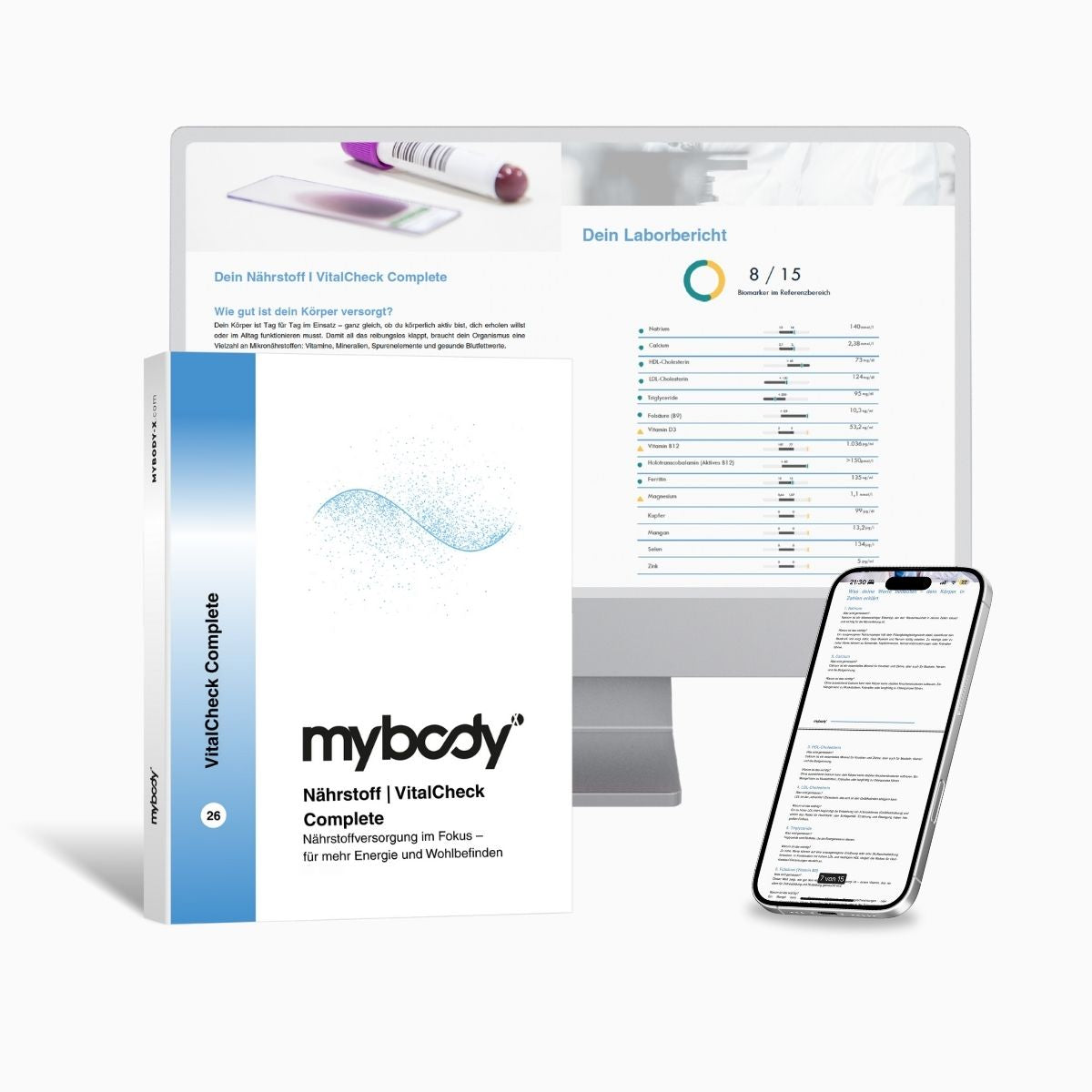
Capillary blood test
VitalCheck | Complete Nutrient & Mineral Test
Determines 18 values: vitamin D3, vitamin B12, and folate; iron status based on ferritin, iron, and transferrin; plus calcium, magnesium, phosphate, selenium, and zinc, as well as cholesterol, long-term blood sugar, and CRP. Vitamin B6 is explicitly not included. If you are looking for a PLP measurement, this is the wrong test; if you want to know whether your overall B-vitamin status is abnormal, vitamin B12 and folate are two values that fit the pattern. The test provides a snapshot, not a diagnosis, and does not replace medical evaluation.
Laboratory analysis 3–5 business days after receipt of the sample
The product page does not name a laboratory location; accessed 27 August 2026
Being open about this gap costs us a sale in some cases. Concealing it would cost something more. Someone who buys a test expecting to know their vitamin B6 level afterward opens the report and does not find it—and that is a loss of trust no discount can make up for.
Anyone who actually needs a PLP measurement must go through a primary care practice or a laboratory with a doctor's request. The chapter on the laboratory value explains when this is necessary at all.
Three ways to investigate the suspicion, compared
There is not one right route for this question, but three that answer different questions. The comparison shows which one fits which starting point—and where each one ends.
| Criterion | Estimate intake yourself | At-home blood test | Medical evaluation |
|---|---|---|---|
| Answers the question | Is my diet plausibly adequate? | Is my status for several nutrients abnormal? | What is causing my symptoms? |
| Vitamin B6 measured directly | no | no – PLP is not among the 18 values in the VitalCheck Complete | possible if requested by a doctor |
| Sample and effort | no sample, two weeks of recording | Capillary blood from a fingertip, collected at home | Venous blood drawn at the practice; appointment required |
| How long until the result | immediately evaluable | Kit shipping 1–3 business days, laboratory analysis 3–5 business days after receipt of the sample | No reliable general time estimate in the source material used |
| Costs | none | €169.00 for the VitalCheck Complete (as of 27 August 2026) | depends on the indication and the payer; the practice will clarify this |
| Limit of this route | estimates intake, not absorption by the body | Snapshot, not a diagnosis, no B6 value | requires a reason recognized by the practice |
The table shows one thing above all: if you are looking exclusively for a vitamin B6 value, you have only one route, and it requires a doctor's request. If you want to assess your overall nutritional status, you have three. This distinction is the difference between a useful and a disappointing test purchase.
What the PLP laboratory value does and does not tell you
When vitamin B6 is measured, it is usually measured as pyridoxal 5'-phosphate in blood plasma. The Office of Dietary Supplements describes plasma PLP as the most common measure of vitamin B6 status. This wording is more cautious than it sounds: it says that PLP is the usual measurement, not that it fully reflects tissue status.
Regarding the thresholds: concentrations above 30 nanomoles per liter were traditionally considered a sign of adequate supply in adults. When deriving the reference values, however, the Food and Nutrition Board used 20 nanomoles per liter as the relevant indicator of adequate supply.
Two different thresholds for the same question—that is not carelessness, but the normal state of laboratory medicine. Reference ranges depend on the method, the laboratory, and the question for which the value was derived. The figures on your own lab report are therefore always decisive, not a number from an article.
There is a second catch, and it concerns precisely the people in whom low levels are measured most often. During inflammation, the plasma PLP level falls even when intake is not inadequate. A low level may then be a consequence of the inflammation rather than its cause. Anyone unaware of this distinction may supplement in response to a number that returns to normal on its own once the inflammation subsides.
The same caution applies to other minerals, by the way. We have described in more detail, using magnesium and the nervous system as an example, why a blood value generally shows only part of the picture.
Who a test makes sense for—and who it does not
Based on everything stated so far, the decision can honestly go either way. The right-hand column contains genuine reasons not to proceed, not softened advantages.
Makes sense for you if …
your symptoms have persisted for weeks and you want to know whether anything is generally unusual about your nutrient supply—not whether a single value is borderline.
your diet is very one-sided or severely restricted and you want an assessment of your current status before adding anything.
you are preparing for a medical consultation and want to bring numbers rather than a guess.
Probably not if …
you only want to know your vitamin B6 level. It is not one of the 18 values included in VitalCheck Complete, and no purchase will change that.
you already have neurological symptoms, such as persistent tingling or unsteadiness when walking. These should be medically evaluated before any self-testing.
you have a known kidney disease, a chronic inflammatory bowel disease, or are taking medication that already requires medical supervision.
Limitations: what remains unresolved about this topic
This article does not clarify three things, and they clearly belong here rather than in a footnote.
First: The prevalence of inadequate vitamin B6 status in Germany cannot be reliably quantified using the sources reviewed here. The figures circulating on this topic come predominantly from a 2008 dietary survey and describe estimated dietary intake, not measured blood status. We therefore give no percentage rather than presenting an old estimate as a current finding.
Second: A blood value describes a point in time. It says nothing about what nutritional status was like over the previous six months, and nothing about the condition of the tissue. This is not a weakness of any particular provider, but a property of this measurement.
Third: Whether supplementation changes anything in an individual case depends on causes that a measurement does not reveal—medications, digestive-tract disorders, and kidney function. A test measures and assesses. It does not treat, and it does not establish a diagnosis.
What matters in the end
Those who search for vitamin B6 deficiency symptoms are usually looking for permission: permission to buy a supplement and check the matter off their list. This article does not give it, and the reason is contained in three numbers. Between the recommended intake of 1.6 milligrams, the tolerable total intake of 12 milligrams, and the proposed maximum amount of 0.9 milligrams in the supplement lies a narrower corridor than for most other water-soluble vitamins.
This leads to something that has not yet been stated explicitly in this article: With vitamin B6, doing nothing is a serious option. For most nutrient-related questions, “paying more attention” is almost always the right answer. Here, it applies in only one direction. Anyone who takes high-dose supplements without a measured reason trades an unproven problem for a documented one.
The specific next step is therefore not to buy anything, but to look at your own shelf: What are you already taking, and how much vitamin B6 is listed on the packaging? This one number answers the question that brought surprisingly many people to this article.
And if the symptoms persist and the packaging provides no explanation, the next step is to measure several values together or consult a medical practice. If you are unsure which option fits your question: The consultation is free, and it will not try to sell you anything.
Frequently asked questions
Which symptoms point to a vitamin B6 deficiency?
A microcytic anemia, abnormalities in the electroencephalogram, scaly skin inflammation with cracked corners of the mouth and a swollen tongue, depressed mood and confusion, as well as impaired immune function are described (National Institutes of Health, Office of Dietary Supplements, as of 2026). None of these signs is typical of vitamin B6 deficiency—they also occur with several nutrient deficiencies and other causes. A single symptom therefore does not substantiate suspicion.
Can too much vitamin B6 be harmful?
Practically not through ordinary foods, but yes through supplements. In 2023, the European Food Safety Authority lowered the tolerable total intake for adults from 25 to 12 milligrams per day because of the risk of peripheral sensory neuropathy. The German Federal Institute for Risk Assessment proposes a maximum amount of 0.9 milligrams per recommended daily serving for food supplements for people aged 15 and over (opinion 008/2024). We do not provide our own dosage recommendation; that belongs in a medical consultation.
When should I have these symptoms evaluated by a doctor?
Persistent tingling, numbness, unsteadiness when walking, or burning abnormal sensations in the hands and feet should be evaluated at the beginning, not the end. This is especially true if you are also taking a vitamin B supplement: in that case, excessive intake is a serious possibility. An unusual anemia on a blood count, known kidney disease, or chronic inflammatory bowel disease are also reasons to speak with a doctor rather than take a self-test.
Does the VitalCheck Complete measure vitamin B6 levels?
No. The VitalCheck Complete measures 18 values, including vitamin D3, vitamin B12, folate, iron status, and several minerals and metabolic markers. Pyridoxal 5′-phosphate is not among them. Anyone who needs only the vitamin B6 value can obtain it through a physician’s order. The test can show whether overall B-vitamin status is concerning because it includes vitamin B12 and folate—the two values that, according to the Office of Dietary Supplements, are typically also affected.
What does PLP mean on a lab report?
PLP stands for pyridoxal 5′-phosphate, the active form of vitamin B6. Plasma PLP is the most commonly used measure of vitamin B6 status. Traditionally, values above 30 nanomoles per liter were considered a sign of adequate status in adults, while 20 nanomoles per liter was used as the key indicator when reference values were derived. Reference ranges depend on the laboratory and method; the value reported on your own test result is always the decisive one. Inflammation can cause the value to fall even when intake is not inadequate.
Next step
The pattern first, then the individual value
If you have gone through the four steps and want to know whether anything about your overall nutrient status is concerning, the VitalCheck Complete provides 18 values from a capillary blood sample. Vitamin B6 is not one of them—that is also stated on the product card above. If you are concerned about B vitamins overall, the second pathway goes deeper.
VitalCheck | Nutrient & Mineral Complete What a Vitamin B Test CoversRead more
You might also be interested in
The neighboring B vitamin with a different logic: storage over years, its own risk groups, and a value that the VitalCheck actually includes.
If you are interested in B vitamins as a group rather than just one of them.
Sources
- German Federal Institute for Risk Assessment: 2024 Update – Proposed maximum levels for vitamin B6 in foods, including food supplements, Opinion 008/2024 of February 22, 2024 – bfr.bund.de
- European Food Safety Authority (EFSA): Scientific opinion on the tolerable upper intake level for vitamin B6, EFSA Journal 2023;21(5):8006 – efsa.onlinelibrary.wiley.com
- German Nutrition Society: Reference Values for Nutrient Intake, Vitamin B6 (derivation status 2019) – dge.de
- National Institutes of Health, Office of Dietary Supplements: Vitamin B6 – Fact Sheet for Health Professionals (accessed 2026) – ods.od.nih.gov
The proposed maximum of 0.9 milligrams per recommended daily intake, the institute quotation reproduced verbatim, and the information on the Scientific Committee on Food’s earlier derivation from 2000 are taken from [1]. The reduction of the tolerable total intake for adults from 25 to 12 milligrams per day in 2023 is reproduced in [1] and documented in the original source in [2]. The recommended intakes of 1.6 and 1.4 milligrams per day are taken from [3]. The list of symptoms, the statement on the rarity of an isolated deficiency, the information on plasma PLP with thresholds of 30 and 20 nanomoles per liter, and the information on sensory neuropathy with one to six grams of pyridoxine daily over twelve to forty months are taken from [4]. Information on price, values, sample type, and laboratory comes from the mybody®x product page, accessed on 27.08.2026; processing times follow the central guideline for blood tests. All sources were accessed and reviewed on 27.08.2026.

mybody®x Editorial & Expert Team
Laboratory diagnostics Blood analysis interpretation Nutritional science Micronutrients
This article was created by the mybody®x editorial and expert team. The team combines laboratory diagnostics, blood analysis interpretation, and nutritional science. Those who contribute to it are listed on the authors page.
Published on 17.09.2025 · Last updated on 27.08.2026
The content is for general information and does not replace medical advice, diagnosis, or treatment. Reference ranges depend on the laboratory, method, and age; the information on your test report is always authoritative.




Share now:
Find your hormone balance for greater well-being this autumn
What to do about estrogen deficiency? Ways to achieve greater balance and well-being