

Vitamin Drops: Effects, Dosage, and Safety in 2026
Vitamin drops are liquid dietary supplements that provide fat-soluble vitamins such as vitamins D3 and K2 in a precisely dosable form. Compared with tablets or capsules, they offer greater ease of administration and flexible dosing, especially for children, older people, and those with difficulty swallowing. At the same time, a Stiftung Warentest test from December 2025 showed that only 2 of 25 vitamin D products tested were unreservedly recommended, while 5 products were classified as harmful when taken long term. This means that not every bottle of drops is automatically useful or safe. Anyone wishing to use vitamin drops wisely needs to understand dosage, quality, and their own needs.
How should vitamin drops be dosed and taken correctly?
Dosing vitamin drops is not a matter of guesswork, but of the concentration per drop. The Mayo Clinic recommends that adults taking vitamin D drops use a daily dose of 1 drop containing 1,000 IU, taken directly by mouth or mixed with a liquid. This sounds simple, but it involves a common source of error: the potency varies considerably from product to product. One drop may contain 200 IU, while another contains 2,000 IU. Anyone who does not know the concentration is dosing blindly.
Correct use follows these steps:
- Read the product label and note the number of IU per drop.
- Use the included dropper, as it reduces dosage fluctuations and improves adherence to the treatment.
- Place the drops directly on the tongue or dissolve them in a teaspoon of oil, as vitamin D is fat-soluble.
- Take in the morning with breakfast to improve absorption with a fatty meal.
- Never increase the daily dose on your own, even if symptoms persist.
The EFSA and BfR set the tolerable upper intake level at 100 µg/day, equivalent to 4,000 IU. This limit applies to total intake from all sources, including food and supplements. With combination products containing vitamin K2, the amount of vitamin D remains decisive for the safety assessment despite claims of synergy.
Pro tip: Write down the number of IU per drop of your product and compare it with the recommended daily dose. Many people unknowingly take two to three times the appropriate amount because they do not know the concentration.

For children, the dosage should always be clarified with a doctor. In Germany, infants generally receive 400 to 500 IU daily for rickets prevention, but product concentrations vary considerably here as well.
What are the advantages of vitamin drops over tablets and capsules?
Liquid vitamins have specific strengths over solid dosage forms, but also some blind spots. The key advantage is dosing flexibility. While a tablet contains a fixed amount, the number of drops can be adjusted. This is particularly valuable when a doctor recommends an individual dose after a blood test that falls between the usual tablet sizes.
| Feature | Vitamin drops | Tablets / Capsules |
|---|---|---|
| Dosing flexibility | High, infinitely adjustable | Low, fixed amounts |
| Ease of taking | High, especially in children | Moderate to low for people with swallowing difficulties |
| Bioavailability | Comparable; often good with a fat-based formula | Dependent on the formulation |
| Risk of dosing errors | Increased with improper pipette use | Low, because the dose is premeasured |
| Shelf life after opening | Shorter, sensitive to light | Longer, more stable |
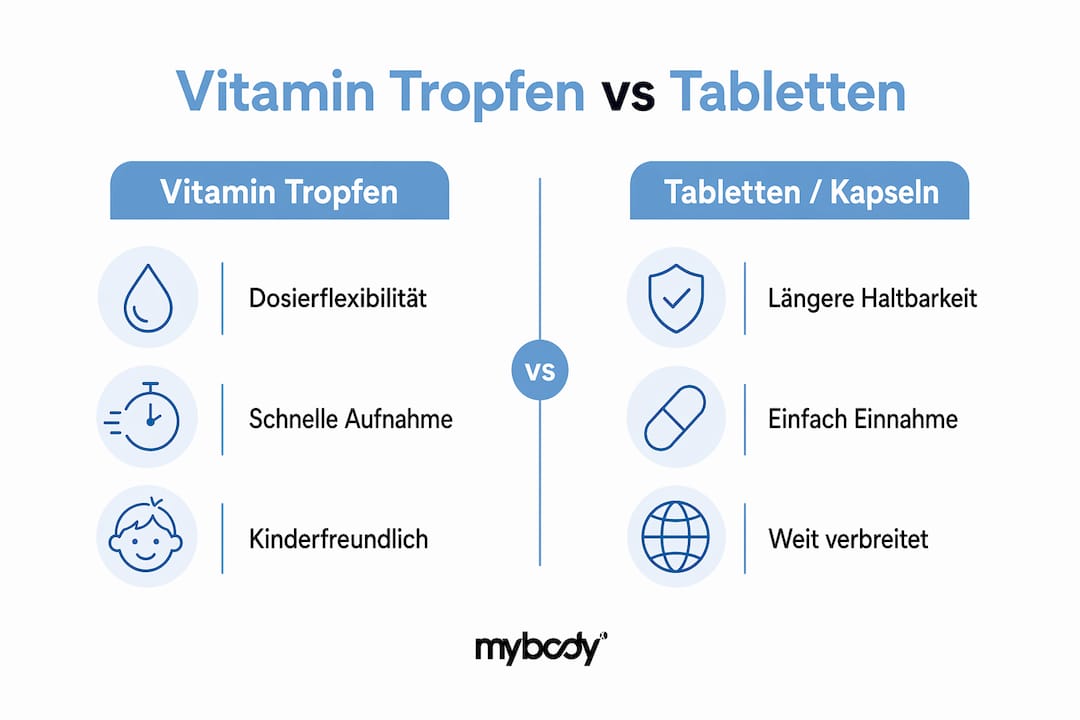
The bioavailability of liquid vitamins is not automatically higher than that of capsules. The carrier is crucial: vitamin D drops based on MCT oil or another fat-containing carrier are absorbed better than aqueous solutions because vitamin D is fat-soluble. An aqueous drop without any fat may even perform worse than a well-formulated softgel capsule.
The following groups of people particularly benefit from the drop form:
- Older people aged 65 and over who have difficulty swallowing or take several medications at the same time
- Children and infants who require precise microdosing
- People who have undergone stomach surgery and whose absorption of solid forms is impaired
- People who do not want gelatin capsules and are looking for vegan alternatives
The most common drawback is dosing error caused by improper pipette use. Anyone who holds the pipette at an angle or squeezes it too quickly will get more or less than intended. This error may sound trivial, but with highly concentrated products containing 2,000 IU per drop, it can lead to significant overdosing over several weeks.
What legal maximum levels will apply to vitamin drops from 2026?
From 2026, the EU will impose binding maximum levels for critical nutrients such as vitamin D in food supplements. This regulation directly affects which products you can still find in stores and the concentrations at which they may be offered. For consumers, this means greater safety, but also a transition period during which high-dose products will disappear from the market or be reformulated.
A key distinction that many people do not know is that food supplements are classified as food products in the EU, not as medicines. This has a direct consequence: their effectiveness is not tested before they are placed on the market. Responsibility for providing accurate dosage information lies with the manufacturer, not with an approval authority such as the BfArM.
What this means for you as a buyer:
- Products tested in laboratories and certified by independent bodies are more reliable than those without verification.
- Daily doses above 1,000 IU should be taken only on a doctor’s recommendation.
- High-dose products containing 4,000 IU per daily dose are at the upper limit under the new EU rules and will become less widely available.
- Combination products with vitamin K2 are not automatically safer in terms of the amount of vitamin D, despite synergy marketing.
Important: The new EU regulation protects against overdosing through products, but not against irresponsibility on the part of consumers. Anyone taking several supplements at the same time must monitor their total intake themselves.
The risk of overdose rarely comes from taking one extra drop; it usually results from taking more than needed over a prolonged period. Symptoms of excessive vitamin D intake, such as nausea, weakness, and kidney damage, appear only after weeks or months, which is why many people do not recognize the connection.
Who can benefit from vitamin drops, and when should they be avoided?
Healthy people derive only limited benefit from vitamin D supplements. The benefits are seen mainly in people with a confirmed deficiency or clear risk factors. This statement by the Tagesschau experts in December 2025 may sound sobering, but it is an important correction to the widespread belief that more vitamin D is always better.
At-risk groups for whom supplementation with vitamin drops is well justified:
- Older people aged 65 and over, as the skin’s natural production decreases with age.
- Pregnant and breastfeeding women, whose needs are higher and whose deficiency can affect the child.
- Infants who have not yet had sufficient sun exposure.
- People with dark skin living in northern latitudes who absorb less UV-B radiation.
- People who spend very little time outdoors or who, for medical reasons, must avoid the sun.
Anyone outside these groups who eats a healthy diet, regularly spends time outdoors, and has no symptoms generally does not need supplementation. Many people take vitamin D supplements without any real need, as Stiftung Warentest and experts consistently point out. This is not only unnecessary but also risky when taken at high doses over a prolonged period.
Pro tip: Before you start taking vitamin drops, have your blood 25-OH vitamin D level measured. A value below 50 nmol/l is considered a deficiency, while 50 to 75 nmol/l is considered suboptimal. Only with this value can you choose an appropriate dose and check the success of supplementation after a few weeks.
A vitamin D home test is a practical way to determine your own status without visiting a doctor. This tells you whether you need to supplement at all and allows you to adjust the dose purposefully instead of guessing.
How do you choose the right vitamin drops and incorporate them into your daily routine?
Choosing the right product does not start with the price, but with the concentration. The potency of vitamin D drops depends on the amount of IU per drop, which is why the number of drops is misleading without knowing the concentration. Two products may both recommend “1 drop daily,” but contain 500 IU and 2,000 IU, respectively.
These are the features you should look for when buying:
- Concentration per drop: Ideally 500 to 1,000 IU for standard supplementation in adults.
- Carrier oil: MCT oil or olive oil as a base improves the absorption of fat-soluble vitamins.
- Combination with K2: Vitamins D3 and K2 together support calcium utilization, but the safety of the D3 amount remains crucial, even in a combination product.
- Laboratory testing: Products with independent quality control are more reliable regarding their actual active ingredient content.
- Vegan formulation: Many D3 sources come from wool fat (lanolin). Vegan alternatives use lichen as the source.
| Criterion | Recommendation |
|---|---|
| Concentration | 500 to 1,000 IU per drop for adults |
| Carrier oil | MCT oil or olive oil for better absorption |
| Certification | Prefer independent laboratory testing |
| Combination | D3 plus K2 makes sense, but pay attention to the total dose |
| Time of intake | In the morning with a fat-containing breakfast |
The easiest way to incorporate it into your daily routine is to establish a fixed routine. Place the drops next to your breakfast dishes so you do not forget them. Mix them into a teaspoon of olive oil or directly into yogurt if you do not like the taste on its own. Recheck your blood level after 8 to 12 weeks to see whether the dose is sufficient or needs to be adjusted.
Anyone who wants to combine vitamin D3 and K2 can find a detailed overview of synergies and safety limits in our article on D3 K2 dosage and effects.
Key findings
Vitamin drops are only useful when the concentration, carrier substance, and individual needs are aligned, since even good products provide no benefit when dosed incorrectly.
| Point | Details |
|---|---|
| Know the concentration | The IU amount per drop varies widely, so always check before taking it. |
| Consider target groups | At-risk groups such as older adults and pregnant women benefit most from supplementation. |
| Observe the maximum amount | The EFSA upper limit is 4,000 IU per day from all sources combined. |
| Measure blood levels | Measure the 25-OH-D level before supplementation to determine your needs and dose. |
| Check quality | Prefer laboratory-tested products with an oil-based formulation and independent certification. |
My assessment of vitamin drops in preventive healthcare
At mybody x, we see every day how many people take vitamin drops without knowing their actual level. That is the real problem, not the drops themselves. Vitamin D drops are a useful tool, but not a cure-all. Anyone who believes that one drop a day will solve all their health problems will be disappointed.
What bothers me about the current debate: The discussion too often revolves around the question “Drops or tablets?” instead of the much more important question “Do I need this at all?” The Tagesschau experts’ recommendation is clear: Without a proven deficiency or risk factor, supplementation offers healthy people few benefits. This applies to drops just as much as to capsules.
What I have learned from our work with thousands of customers: The people who benefit most from vitamin drops are those who know their status beforehand. They know where they stand, choose the right dose, and check the result after a few weeks. This isn’t rocket science, but it requires one more step than simply buying a bottle.
My honest advice: Don’t start with the product, start with the test. Anyone who knows their vitamin D level makes better decisions, saves money, and protects themselves from unnecessary over-supplementation. The new EU maximum levels from 2026 are a step in the right direction, but they do not replace thinking for yourself.
— MYBODY X
High-quality vitamin drops at mybody x

At mybody x, you will find laboratory-tested vitamin drops formulated according to clear quality standards. All products are tested for active ingredient content and purity, so you know what you are actually taking. Whether vitamin D3 on its own or combined with K2 in MCT oil: the range covers the most common needs, with transparent dosage information and vegan options. Use our at-home vitamin D blood test to determine your baseline level before starting supplementation. Shipping is free for orders over 49 euros, and our advice team is available to help with dosage questions.
FAQ
What exactly are vitamin drops?
Vitamin drops are liquid food supplements that deliver vitamins such as vitamin D3 or K2 in a form that can be dosed using a dropper. They are considered food, not medicinal products, and will be subject to binding maximum-level regulations in the EU from 2026.
How many vitamin D drops should I take daily?
The Mayo Clinic recommends adults take 1 drop containing 1,000 IU daily as a standard dose, but the actual amount depends on the product's concentration and the individual's blood level. The EFSA upper limit is 4,000 IU daily from all sources.
Are vitamin drops better than tablets?
Vitamin drops offer greater dosing flexibility and are particularly suitable for children and people with difficulty swallowing, but are not inherently more bioavailable than well-formulated capsules. The carrier substance is crucial: fat-based drops perform better for fat-soluble vitamins than water-based solutions.
Who should take vitamin D drops?
Supplementation is particularly useful for older people aged 65 and over, pregnant women, infants, and people with little sun exposure. According to expert recommendations, healthy adults with sufficient sun exposure benefit little from additional intake.
How can I recognize a high-quality product?
Look for independent laboratory testing, a clear indication of the IU amount per drop, a fat-based carrier substance such as MCT oil, and transparent manufacturer information. You should avoid products without a concentration indication or quality certificate.



Share now:
Vegan Vitamin D3: Your Guide to Optimal Intake
How to recognize a folic acid deficiency: Symptoms, tests &