
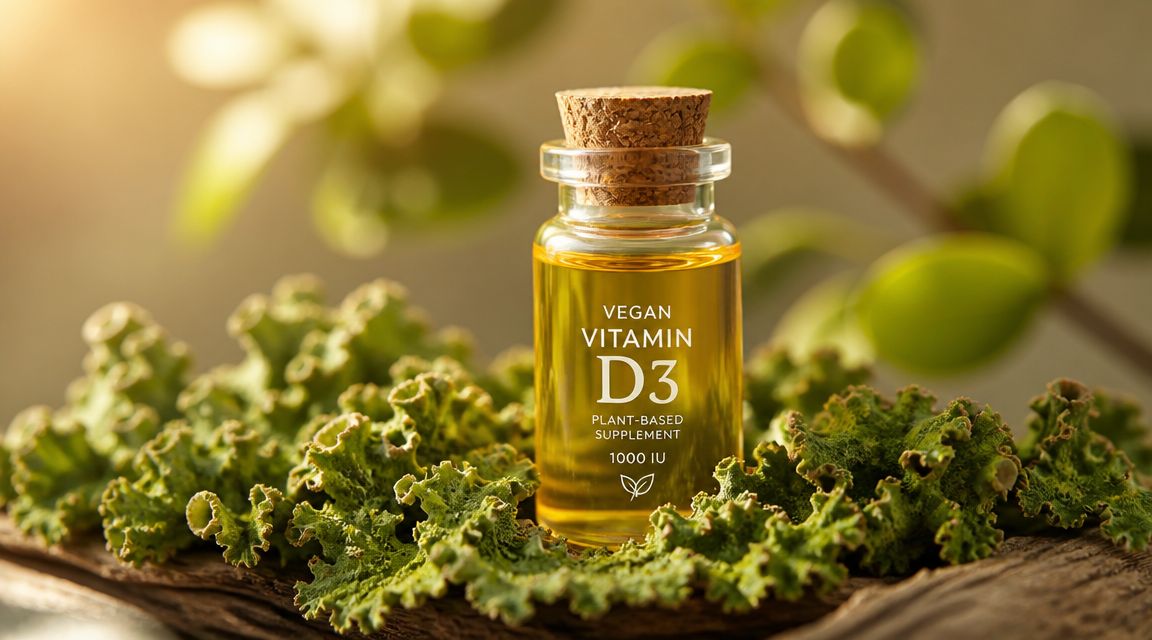
Vegan Vitamin D3: Your Guide to Optimal Intake
If you eat vegan and are still often tired, struggle to recover from winter, or simply want to know whether your intake is really adequate, vitamin D is often the factor many people underestimate. This is where the issue becomes concrete: According to the laboratory data from mybody®, over 70% of vegan customers have an initial test result below 30 ng/ml. This is not a minor detail, but an indication that although a plant-based diet can get many things right, it often reaches a natural limit when it comes to vitamin D3.
The good news is that you do not have to give up your diet or accept animal products. Today, vegan vitamin D3 is available as a genuine plant-based alternative. More importantly, you can test your level instead of simply guessing.
The invisible gap in a vegan diet
Many people start eating vegan with a clear goal. They want to eat more consciously, feel lighter, avoid inflammation, or live healthier in the long term. That makes sense. Nevertheless, there are a few nutrients for which good planning alone is not always enough. Vitamin D3 is one of them.
There is a great deal of confusion, especially with a vegan diet. Some people think a balanced diet will automatically cover everything. Others rely on getting some sunlight in everyday life. In real life, both may be insufficient, especially in Germany and generally at more northern latitudes.

Anyone who wants to explore a well-planned plant-based diet in greater depth will find a useful addition in the article on eating healthily as a vegan. Vitamin D3 nevertheless remains a special case. It is less a classic dietary mistake than a structural problem caused by everyday life, the seasons, and limited sources.
Why this deficiency often remains unnoticed for a long time
Vitamin D is tricky because you may not immediately notice a low level. Some people only notice that they do not feel quite as resilient as usual. Others have no clear signs at all and therefore assume that everything is fine.
Important in everyday life: A healthy lifestyle does not automatically protect you from a vitamin D deficiency. Health-conscious people in particular often overlook this because they otherwise do many things right.
What really helps you
When it comes to vegan vitamin D3, you essentially need three things:
- Understand why a vegan diet reaches its limits in this area
- Recognize what makes a D3 supplement genuinely vegan
- Measure instead of supplementing blindly
That takes the pressure off. You do not have to speculate; you can address the issue in a clear-headed and practical way.
Why vegans need to pay particular attention to the sunshine vitamin
The core issue is simple: vitamin D3 traditionally comes mainly from animal sources, while the body’s own production depends on sunlight. If both are unavailable or inconsistent in everyday life, a gap can quickly arise.
The Vegan Society explains that vegan vitamin D3 can come from lichen, whereas conventional D3 is often obtained from lanolin from sheep’s wool. It also points out that UK health authorities recommend 10 µg per day for people aged 4 and over and that supplementation is particularly advisable from October to March. This is highly relevant for Germany because of the similarly low levels of UVB radiation in winter.
Diet alone is often not enough
Many people look for food sources first. That is understandable, but this strategy only works to a limited extent with vitamin D. If you are wondering what foods contain at all, the overview of vitamin D in foods gives you a good sense of how limited the selection is in practice.
With a vegan diet, the problem is compounded because conventional D3 from animal sources is not an option. That often leaves only sunlight or a suitable supplement.
The sun isn’t always available when you need it
In theory, your body can produce vitamin D itself. In practice, this depends heavily on the season, how long you spend outdoors, and your daily routine. Many people work indoors, exercise in the evening, or see hardly any direct sunlight during winter.
In Germany, this often means that the sun simply isn’t reliable enough during the months when you need support most. This has nothing to do with discipline. It is simply the reality of our climate and daily routines.
Anyone who follows a vegan lifestyle and wants to get through the winter in Germany needs a deliberate vitamin D strategy rather than hoping for the best.
Vitamin D2 vs. D3 and what your body really needs
This is often where the next uncertainty arises. There is vitamin D2 and vitamin D3. Both sound similar, but they are not the same for practical supplementation.
A simple comparison helps: Think of D2 as a key that fits the lock but does not engage quite properly. D3 is the matching original key. Both are forms of vitamin D. But if you want to specifically raise your levels, D3 is usually the form people are actually looking for.
The most important difference
Vitamin D2 is called ergocalciferol.
Vitamin D3 is called cholecalciferol.
For a long time, D2 was the main known option for vegans. Today, however, there is also vegan D3, usually from lichen. This is crucial because it allows you to use the D3 form without relying on animal-derived raw materials.

What the available measurement data show about vegan D3
A controlled study of plant-based VegD3 showed that daily intake of 600 IU over 7 days increased blood vitamin D levels by an average of 33 nmol/L (13.45 ng/mL). This corresponded to 77.3% above the baseline value. In addition, people with a deficiency reached adequate blood levels. The findings are summarized in the VegD3 analysis as a bioavailable source. For interpretation in the EU: 1 µg corresponds to 40 IU, so 600 IU is approximately 15 µg.
This is important in practice because it shows that vegan vitamin D3 is not just a label; it can measurably increase vitamin D status.
Vitamin D2 vs. vitamin D3 at a glance
| Characteristic | Vitamin D2 (ergocalciferol) | Vitamin D3 (cholecalciferol) |
|---|---|---|
| Basic form | Ergocalciferol | Cholecalciferol |
| Typical vegan classification | usually acceptable for vegans | vegan only if the source is plant-based |
| Typical source | Mushrooms or yeasts | often lanolin; vegan options also come from lichen |
| What you should look out for | read the form carefully | check the source as well |
| practical option for many vegans | possible, but often not the first choice | often the targeted choice for supplements |
Key point: If a supplement only says “vitamin D3,” that does not yet clarify whether it is vegan.
The plant-based revolution and vegan vitamin D3 from lichen
A few years ago, this was a genuine trade-off. You wanted D3, but without animal-derived ingredients. Today, there is a clean solution: lichen-derived cholecalciferol.
What makes it special is not that it is a weakened plant-based version. Quite the opposite. Vegan D3 supplements are declared as cholecalciferol from lichen and therefore provide the same bioactive D3 form as conventional products made from lanolin. This is exactly what the product declaration in the US Dietary Supplement Label Database indicates.
How to recognize genuine vegan D3
Many labels make things unnecessarily complicated. “Vitamin D3” is displayed prominently on the front, but the raw material source is missing. It is then unclear whether it comes from lanolin or a vegan source.
So pay attention to these points:
- “Vegan” must be clearly stated. Seeing only D3 is not enough.
- The source should be stated. Wording such as “from lichen” or “lichen” is a good sign.
- Cholecalciferol is the right choice. This is the desired form of D3.
- Leave unclear labels on the shelf. If the source cannot be verified, an unnecessary question mark remains.
Why this inspires confidence
Many vegans wonder whether they have to compromise when taking plant-based D3. With lichen-based cholecalciferol, that is precisely not the case. The difference lies in the source, not in the active vitamin form.
This is probably the most important relief in the whole topic. You do not have to choose between effectiveness and your lifestyle. Both can go together.
Guessing is a thing of the past—here’s how to test your vitamin D level easily
Many people make the same mistake when it comes to vitamin D. They simply take some dose because a friend does the same or because a product sounds good on social media. That may work. But it may also fail to meet your needs.
It makes more sense to determine your status first. In practice, there is a big difference between “I want to maintain my level” and “I need to correct a deficiency.”

Why testing is better than guessing
A blood value turns assumptions into a decision. You then know not only whether you should take supplements, but also how specifically you need to proceed. This is particularly helpful with a vegan diet because you do not want to start from scratch every winter.
Anyone looking for a simple at-home solution can find a helpful overview in the article about the vitamin D test for home use.
How a home test works in everyday life
The typical process is straightforward and easy to fit into a normal day:
-
Order a test
You order a home kit and receive everything you need to collect the sample. -
Collect the sample in the morning while fasting
According to the provider’s information, the blood sample is taken in the morning while fasting. This makes the process more standardized. -
Send in the sample
The sample then goes to the laboratory. -
Receive digital evaluation
The results are returned digitally. -
Move forward with a plan
According to the routine described, an evaluation with a vegan supplement plan and dosage recommendation follows. The entire process takes place without a doctor’s appointment, within 3 to 5 days, as described in the briefing.
A good test answers not only the question “Is my level okay?” but above all “What do I do now, specifically?”
A sober decision is often the best one
If you do not want to rely on gut feeling when it comes to vegan vitamin D3, a test is the most reassuring solution. You then do not need forum opinions, blanket winter routines, or uncertainty about whether your supplement is currently too little or too much.
In this context, an at-home test from MYBODY Lab GmbH can be a practical option if you want to measure your vitamin D status at home and have it evaluated digitally.
Your path to an optimal level with a plan and lifestyle
As soon as you know your level, the topic suddenly becomes simple. It is no longer about general tips, but about your next sensible step. This is exactly where a clear plan is more helpful than yet another guide.
A practical example from the briefing clearly shows what is possible: A vegan female participant, 31 years old, started at 14 ng/ml. After 10 weeks of taking vegan D3 from lichen at a dosage of 3,000 IU per day plus K2 from natto, her level was 38 ng/ml. That corresponds to an increase of 24 ng/ml. She also reported having more energy and sleeping better.

The dosage depends on your situation
Not everyone needs the same product. In practice, it is relevant that vegan D3 products are typically offered in 1,000 IU, 2,000 IU, or 6,000 IU. This range is visible in the product overview of vegan D3 dosages. Lower dosages are more suitable for maintenance, while higher dosages are more suitable for a confirmed deficiency.
If you want to delve deeper into the practical selection, the guide to vitamin D3 drops, dosage, effects, and use can also help.
A simple framework for everyday action
You do not have to make the topic complicated. Usually, a clear process is enough:
-
Interpreting the test result
A low level is more likely to call for targeted replenishment. A stable level is more likely to call for a maintenance strategy. -
Choose the right strength
Not everyone automatically needs high-dose products. The dose should suit your baseline level and your daily routine. -
Pay attention to the source
With vegan D3, what matters is that the label actually states a vegan source such as lichen. -
Establish routines
A supplement only works in everyday life if you take it regularly.
Lifestyle is not a side issue
Supplements are important, but they are not everything. The experiences outlined in the briefing indicate that regular outdoor training can have a measurable positive effect. It describes how outdoor training 3 times a week can additionally increase D3 levels by 5 to 10 ng/ml, especially in combination with vegan supplementation.
This is practical because it does not create an additional health concern; instead, it supports several things at once. You exercise, spend time outdoors, and give your body better conditions.
Everyday rule: A good vitamin D plan rarely consists of just one capsule. It combines testing, the right dosage, and a lifestyle you can actually stick to.
What you can do specifically starting today
If you want to keep it simple, follow this order:
- Do not guess; know your status.
- Choose vegan D3 that is clearly labeled as cholecalciferol from lichen.
- Base the dosage on your level, not on general opinions.
- Make use of sunlight and exercise whenever your daily routine allows.
- Check again later whether your plan is really working for you.
This turns an unclear topic into a manageable project. And that is exactly the point of vegan vitamin D3: You do not have to be perfect. You only need an approach that is measurable, plant-based, and practical for everyday life.
If you no longer want to estimate your vitamin D status, you can find a suitable at-home test at MYBODY Lab GmbH and determine your next step based on data. Especially with a vegan diet, this is often the easiest way to turn uncertainty into a clear plan.


Share now:
Selenium drops: effects, dosage, and tips
Vitamin Drops: Effects, Dosage, and Safety 2026