
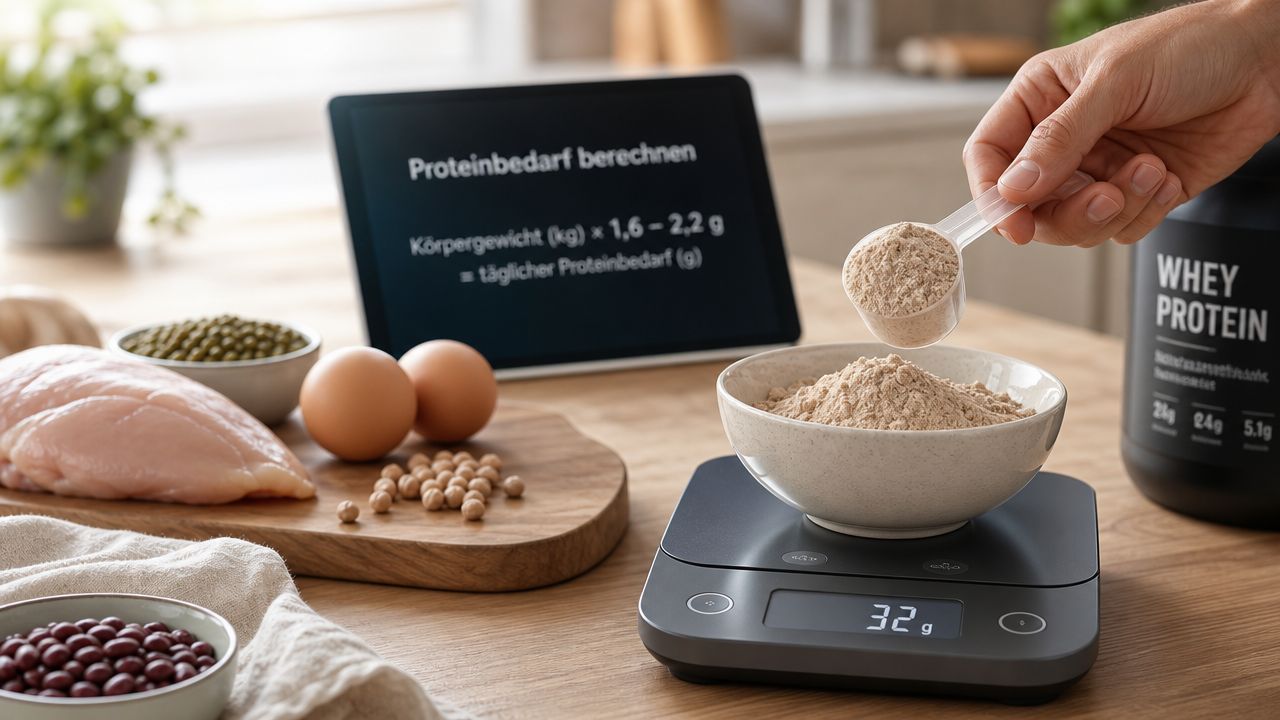
How to calculate your protein needs: Your 2026 Guide
You want to calculate your protein needs, you enter your weight, you get a number, and you still ask yourself: Does this really suit me? That's where the real issue begins in practice. The formula is quickly done. The more difficult question is whether it suits your daily life, your training, your goals, and your body.
Many people swing between two extremes. Either they simply eat "by feel" and end up too low. Or they adopt general fitness values from the internet and are unnecessarily high. I see both regularly in nutritional counseling. A middle ground is sensible: first calculate cleanly, then check in everyday life whether the value works for you.
Why your protein needs are more than just a number
Protein is often only associated with muscle building. That falls short. Your needs also influence how satiated you feel throughout the day, how well you structure meals, and whether your diet even matches your goals.

For example, someone who wants to lose weight usually doesn't need the same strategy as someone who just wants to maintain their weight. And those who train regularly quickly realize: The pure calorie count helps little if the protein intake doesn't follow suit. Conversely, a high protein intake is useless if it is never consistently implemented in everyday life.
The most common misconceptions in everyday life
Often the same patterns occur:
- Roughly estimated. "I actually eat quite a lot of protein" sounds good, but without a rough overview, it's often off.
- Only looked at the daily value. If almost all the protein comes in the evening, it's often harder to implement in practice than a sensible distribution.
- Confusing goals and demands. Walking, two light workouts, and ambitious muscle building are not the same.
Good protein planning is not a bodybuilding trick. It's simply a solid foundation for a diet that suits your life.
That's why calculating protein needs is sensible. But not as a rigid number on a piece of paper, but as a working value. It gives you a direction. You'll recognize whether it fits later by satiety, regeneration, performance feeling, and how easily or difficult it is for you to cover it in everyday life.
How you know the value needs to be practical
A theoretically correct value can still be practically unusable. If you only achieve it with shakes, constantly skip meals, or feel rushed, something is going wrong. Good nutrition also holds up on long working days, with family life, and on weekends.
That's why I never calculate protein in isolation. I always look at eating habits, daily rhythm, and goals. Only then does a number become a strategy.
The basic formula for your daily protein needs
Those who calculate their needs for the first time usually want a clear number. For a start, that makes sense. You just need a clean baseline and the willingness to adjust the value to your everyday life later.
For adults aged 19 to under 65 years, the DGE recommends 0.8 g of protein per kilogram of body weight per day. For adults aged 65 years and older, it states an estimated value of 1.0 g/kg/day. For overweight individuals with a BMI over 25 kg/m², it is more sensible not to calculate with the current weight, but with the normal weight. You can read about this at the German Nutrition Society on protein intake.

How to calculate your starting value
The formula is simple:
Body weight in kg × suitable protein factor
For the basics, this is completely sufficient. It is crucial that you choose the right factor and do not confuse the value with a target value for competitive sports.
| Situation | Practical starting value |
|---|---|
| Not very active or not training | 0.8 to 1.2 g per kg |
| Regularly active in everyday life | rather at the upper end of the basic range |
In counseling, I like to work as follows: First, the official reference value is calculated. Then I check whether this value actually holds up in everyday life. Those who quickly feel hungry again, are not easily satiated, or distribute their meals very unevenly often don't need a completely new approach, but a better practical classification of the starting value.
Two simple calculation examples
- 60 kg body weight × 0.8 g = 48 g protein per day
- 70 kg body weight × 1.0 g = 70 g protein per day
These are not perfect final values. These are clean starting values.
Precisely here lies the difference between calculating and sensibly planning. A mathematically correct value only helps if it fits in with normal foods, your daily rhythm, and your goal. That's why I use the basic formula as a first marker. Afterwards, it is checked whether energy intake, satiety, regeneration, and meal structure fit. If you want to compare this with your calories, a kcal requirement calculator for everyday use can help as a supplement.
The most common calculation error
In cases of overweight, the current body weight is often simply used. On paper, this seems logical. In practice, it quickly leads to target values that are too high, which neither provide a clear additional benefit nor are easy to implement in everyday life.
Therefore, for BMI over 25 kg/m², first calculate with normal weight. This makes the starting value more realistic. You can then check whether it is suitable for you not only by the gram count, but also by results: Do you stay full, do you recover well, can you consistently meet the value, and is your goal developing in the right direction? If these answers don't align, the formula alone is no longer enough. Then a closer look at internal markers such as blood values and, in some cases, genetic differences is worthwhile.
Protein needs for muscle building, weight loss, and maintenance
You train regularly, want to lose body fat, or simply maintain your weight. On paper, the same number can stand for all three goals. In practice, this rarely works. The sensible protein value depends on what your body is currently supposed to achieve and whether you can actually implement the plan in everyday life.

If you want to build muscle
For muscle building, it's not enough to simply eat "more protein." It's crucial that training stimulus, energy intake, and regeneration align. Protein supports building. It doesn't replace good training or sufficient calories.
I usually set a higher range for actively training clients than for maintenance. The reason is simple: those who create more stimuli also need more building blocks and a clean distribution throughout the day. Many fail not because of the formula, but because of the practice. Almost nothing in the morning, little at noon, catching up on everything in the evening. That's unnecessarily difficult for many.
A typical case from counseling: someone trains four times a week, is motivated, but with two sandwiches and a quick dinner, hardly reaches a sensible daily amount. Then it's not discipline that's missing, but structure. Only when breakfast, main meals, and a suitable snack are in place does a theoretical target amount become a value that also supports muscle building.
If you want to lose weight
In a calorie deficit, protein has a dual benefit. It helps many people with satiety and better protects against the typical mistake of unintentionally losing too much lean mass when losing weight.
Here, a value in the upper everyday usable range is often worthwhile. Not maximally high, but so that you can cover it without constant calculation. For example, someone who eats out for lunch, cooks with the family in the evening, and doesn't feel like three shakes a day needs a plan that fits this everyday life. Otherwise, the number will be off the table after a week.
Three points make the difference in practice:
- Protein early in the day relieves the rest. Those who include a good portion at breakfast or their first meal have less to compensate for in the evening.
- Every meal counts more than perfection. Three solid protein-rich meals often work better than an unrealistically high daily value.
- Satiety is a test value. If you are constantly hungry despite planned protein intake, either the amount, the food selection, or the entire calorie planning is not yet right.
If you want to maintain
Maintenance is primarily about consistency. You don't need a bodybuilding approach if you're neither building nor in a deficit and your training is rather moderate. A reasonable, regularly achievable value is almost always better here than an ambitious target value that you only manage on good days.
In this phase, I look less at the highest gram amount and more at the question: Do energy, satiety, digestion, and performance remain stable? If so, the range is usually already well suited.
For orientation:
| Goal | Practical classification |
|---|---|
| Muscle building | rather higher, especially with regular strength training and good overall energy intake |
| Weight loss | rather higher if satiety and muscle preservation are priorities |
| Maintenance | moderate and consistent, without unnecessarily complicated planning |
Precisely here, calculation separates from sensible control. A starting value is quickly found. Whether it's right for you only shows itself over several weeks in training, satiety, body composition, and recovery. If you want to delve deeper into your training goal, you will find a suitable in-depth discussion in the article how much protein is sensible for muscle building.
Special cases that change your protein needs
Not every daily routine can be neatly categorized as "unathletic" or "training." There are phases of life and situations in which you should look more closely.
The practical approach in Germany is usually two-stage: first determine the basic needs, then adjust according to goal and load. In addition, it is crucial to refer to normal weight for BMI over 25 kg/m² to avoid systematic overestimation. This is described by the DGE in the FAQ on protein and amino acids.
Typical special cases in everyday life
- Older age. With increasing age, proper protein intake often becomes more important, not less. The focus then is less on fitness hype and more on maintaining muscle, strength, and everyday safety.
- Pregnancy and breastfeeding. Needs change. Here, conscious planning is worthwhile instead of pure estimation.
- Overweight. Especially here, values are often set too high because calculations are based on current weight.
When caution is more important than ambition
If kidney diseases or other medical issues exist, you should not plan higher protein intake based on internet formulas alone. In such cases, consultation with a doctor is necessary. This is not a trifle, but sound risk management.
Those with pre-existing health conditions should not increase protein based on fitness logic, but should have it medically evaluated.
For women who want to relate the topic more specifically to their everyday lives, the article on protein needs for women can also be helpful. Especially in different phases of life, priorities often change more significantly than pure formulas can reflect.
When the formula isn't enough – an inward look
Sometimes the value is correctly calculated, meals are somewhat adequate, and yet things aren't working out. You're tired, recovering poorly, or feel like your body isn't responding to the plan at all. In such cases, the problem often isn't the formula itself, but factors that the formula cannot account for.

Why estimates have their limits
Calculating protein needs is a good start. But the calculation knows neither your digestion nor your nutrient supply, your stress, or possible individual peculiarities. Two people can eat the same plan and still react differently to it.
Added to this is a point that many underestimate: not only the daily amount counts. Recent sports science overviews emphasize that an even distribution throughout the day with about 20 to 40 g of protein per meal is more practical for muscle protein synthesis than the sole focus on the total daily amount. This is described in the overview on protein distribution throughout the day.
What I check first in practice
If someone is not making progress despite the "correct" number, I usually look at these points:
- Meal structure. Is protein consumed regularly or only in the evening?
- Utilization in everyday life. Are there digestive problems, little appetite, or chaotic eating times?
- Overall context. Sleep, stress, training volume, and daily strain change how well a plan works.
A second step might be to measure more deeply instead of guessing further. Depending on the question, this includes blood values, nutritional status, hormone markers, or genetic indicators of metabolic differences. mybody x Gesundheit offers home tests for blood, DNA, and gut microbiome for those who want to evaluate their diet data-driven and without constant guesswork.
If progress is lacking, more discipline is rarely the first solution. First, it must be clear what is actually hindering the body.
How you know that measuring is more sensible than fine-tuning
A few signals suggest a closer look:
| Observation | What this can practically mean |
|---|---|
| Fatigue despite clean eating | The pure macro distribution doesn't explain everything |
| Poor regeneration | Training, nutrition, and recovery do not interact cleanly |
| Weight stagnation | The bottleneck may not be protein alone |
If you're at this point, the next formula rarely brings the breakthrough. Often, more clarity about your body helps more than even more nutritional content.
Your path to optimal protein needs – a summary
The most sensible way is simple. You start with a realistic calculated value, adapt it to your activity and goals, and then honestly check whether this value really works in your everyday life. This is how you can calculate your protein needs without falling into perfectionism or internet myths.
What's important isn't just what's on paper. What matters is whether you feel full with the value, handle training well, can plan your meals relaxed, and stick with it for weeks. That's what separates a usable strategy from a number that just sounds good.
If progress is stagnant, a change of perspective is worthwhile. Don't just estimate more, but understand better. Because sometimes the answer isn't in a higher or lower protein intake, but in nutrient status, digestion, hormone levels, or an unsuitable distribution throughout the day.
Ultimately: Formulas give you a starting point. Fine-tuning comes through observation, adaptation, and, if necessary, real data from your body.
If you want to do more than just roughly estimate your needs and instead tailor your diet more precisely to your body, you'll find suitable approaches at mybody x Gesundheit, including calculators, guides, and home tests for nutrients, hormones, DNA, and gut microbiome. This is especially useful if, despite good planning, you feel that your body is still missing an important piece of the puzzle.


Share:
Micellar Drops: Effects, Application, and Tips
Pantothenic Acid Benefits: Optimizing Energy & Metabolism