

Personalized Health: Your Path to Greater Well-Being
TL;DR:
- Personalized health is based on individual biomarkers, genetics, and the microbiome to provide tailored recommendations.
- It uses modern analytical methods involving sample collection, laboratory testing, and data integration to develop personalized strategies.
- Quality control, scientific validation, and active implementation are crucial for success.
Imagine following the same dietary recommendations as millions of other people for years, yet still not feeling truly well. This is no coincidence. Most health advice is based on average data from population studies that simply ignore individual differences. At its core, personalized health means basing health and preventive decisions more strongly on individual data such as biomarkers or DNA profiles. This article explains what that means in practice, how such analyses work, and what you should consider when choosing a provider in Switzerland.
Table of contents
- The Basic Idea and Core Aspects of Personalized Health
- How Does Personalized Health Analysis Work?
- Opportunities and limitations: What personalized health can achieve today
- Practical application: What should you consider when getting started?
- Perspective: What Many People Overlook About Personalized Health
- Your Next Step: Personalized Analysis on mybody®x
- Frequently asked questions about personalized health
Key insights
| Point | Details |
|---|---|
| Individual data instead of averages | Personalized health uses your own biological data, not general recommendations. |
| Understand the benefits and limitations | The greatest opportunities lie in prevention and targeted self-optimization, but not every test is truly reliable. |
| Data quality as a key factor | Be sure to look for validated methods and transparent provider standards. |
| A gradual implementation is advisable | Individual recommendations have the greatest impact when they are tailored and integrated realistically. |
| Remain critical of promises | Not every innovation delivers what it promises—always scrutinize results and methods carefully. |
The Basic Idea and Core Aspects of Personalized Health
Once you understand why blanket recommendations often fail to achieve the desired results, we clarify the key terms and approaches of personalized health.
The term “personalized health” initially sounds like a marketing promise. However, it is based on a concrete concept: Instead of general guidelines for the population at large, recommendations are developed based on your own biological data. This applies equally to nutrition, exercise, sleep, and stress management.
It is important to distinguish this from related terms. Personalized medicine primarily focuses on treating diseases, for example through targeted cancer therapies. Precision medicine is an even narrower term used in the clinical context. Personalized health, by contrast, starts much earlier: with prevention, preventive care, and optimizing everyday life. Personalized health begins with prevention and preventive care and uses individual data such as the genetic profile.
The benefits of personalized nutrition become particularly clear when you understand which elements are incorporated into such an analysis:
- Individual biomarkers: blood values, inflammatory markers, hormone levels
- Genetic profile: DNA variants that influence metabolism and nutrient utilization
- Microbiome: the composition of gut bacteria, which influences digestion and the immune system
- Lifestyle data: sleep quality, stress levels, physical activity
- Medical history: personal medical history and family predispositions
“Personalized health does not mean that every person has completely different biology. It means that small individual differences in genetics, the microbiome, and metabolism can have major effects on the optimal diet and lifestyle.”
What makes this approach so interesting is that two people can react completely differently to the same diet. A high-carbohydrate diet may stabilize blood sugar in person A but cause major fluctuations in person B. This is due to genetic variants in enzymes such as amylase, the composition of the microbiome, and individual insulin responses. Generalized recommendations simply cannot account for these differences.
How Does Personalized Health Analysis Work?
Once the basic idea is clear, let’s look at how personalized analysis methods actually work and how they differ from conventional approaches.
Modern personalized health analyses combine multiple data sources. Personalized nutrition is based on a multidimensional mix of data from genotype, microbiome, and blood and metabolic profiles, and aims to predict individual responses. This may sound complex, but it is well structured in practice.
A typical analysis process proceeds as follows:
- At-home sample collection: You collect a saliva sample yourself for DNA analysis, a stool sample for microbiome analysis, or a finger-prick blood sample for nutrient and hormone testing.
- Shipping to the laboratory: The sample is sent to a certified laboratory in a prepared kit. ISO-certified laboratories analyze the sample according to standardized protocols.
- Data analysis: Algorithms and scientists link the raw data with validated reference databases. This creates individual profiles.
- Report preparation: You receive a personalized report with specific recommendations for nutrition, supplements, and lifestyle.
- Follow-up support: Reputable providers offer consultations to explain the results and prioritize measures.
Precision Nutrition uses individual risk assessments, systematic data analysis, and a dynamic process to guide recommendations. This means that the recommendations are not static but can evolve as new data becomes available.
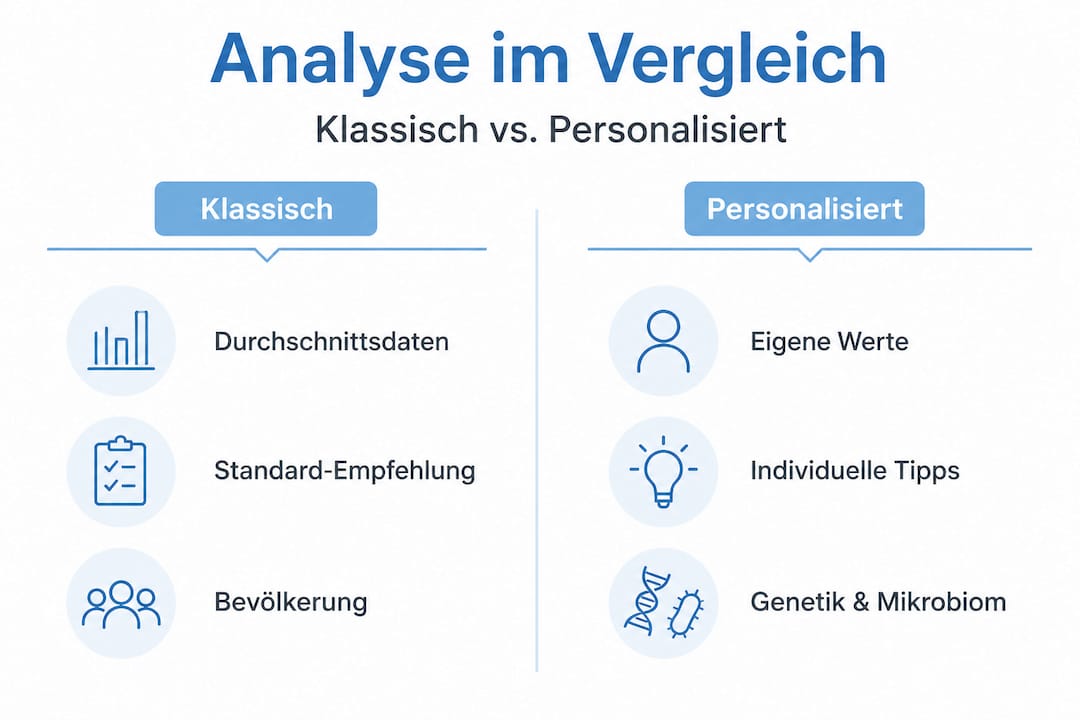
A concrete example illustrates the difference. Suppose you want to manage your weight. A traditional dietary consultation might recommend a calorie-reduced mixed diet with little fat. However, a personalized analysis could show that your genotype responds better to a Mediterranean diet, your microbiome processes high-fiber foods particularly well, and you simultaneously have a vitamin D deficiency that is slowing your metabolism. This combination of insights enables a more precise strategy.

The oral microbiome also plays an increasingly important role, as it is linked to systemic diseases and overall immune status. Many analyses have so far focused solely on the gut, but research shows that the oral microbiome also provides valuable insights.
| Characteristic | Classical analysis | Personalized analysis |
|---|---|---|
| Data basis | Population average | Individual biomarkers |
| Dietary recommendation | General guidelines | Genotype- and microbiome-based |
| Nutrient check | Standard blood test | Targeted micronutrient profiles |
| Adaptability | Static | Dynamic and updatable |
| Focus on prevention | Reactive | Proactive and forward-looking |
Read more about how a DNA analysis for nutrition and health is used in practice and which variants are particularly relevant.
Expert tip: Before choosing a provider, ask this one question: “Which scientific studies demonstrate the validity of your recommendations?” A reputable provider can answer this question with specific publications and certifications. Providers who evade the question or only refer to customer reviews should be viewed critically.
Also learn more about what personalized nutrition means in detail and how different analytical approaches differ from one another.
Opportunities and limitations: What personalized health can achieve today
Once you understand the processes and data sources, you should realistically assess the opportunities, as well as the uncertainties, of current offerings.
Personalized health analyses have genuine potential. At the same time, it would be dishonest to conceal their existing limitations. A critical assessment can help you make informed decisions.
Let us begin with a sobering finding: At-home microbiome tests show substantial differences between providers, and their quality and reproducibility are often questionable. This does not mean that all tests are useless. It means that the choice of provider and quality assurance are crucial.
Important finding: Studies show that the same stool sample can lead to sometimes contradictory recommendations from different microbiome testing providers. This underscores the importance of standardized laboratory methods and validated evaluation algorithms.
The general evidence for personalized nutrition is also limited: When study quality is high, there are often no significant advantages over standard approaches. This may sound sobering, but it is not an argument against personalized approaches. It is an argument for more research, better standardization, and more critical consumer choices.
Here is a structured overview of the opportunities, risks, and open questions:
| Area | Opportunities | Risks and open questions |
|---|---|---|
| DNA analysis | Early detection of genetic risks | Not all variants are clinically relevant |
| Microbiome analysis | Insights into gut health and the immune system | Significant variation between providers |
| Nutrient profiles | Targeted supplementation is possible | Blood values fluctuate depending on the time of day and diet |
| Dietary recommendations | Individually tailored and more precise | The evidence base is still developing |
| Prevention | A proactive approach before disease onset | Long-term studies are still largely lacking |
What can personalized analyses really achieve today? The following is well established:
- Identifying nutrient deficiencies: Targeted blood tests for vitamin D, B12, iron, and magnesium are clinically valid and actionable.
- Assess genetic risk factors: Certain DNA variants, such as those associated with lactose intolerance or folate metabolism, are well documented scientifically.
- Identify individual intolerances: Tests for food intolerances can provide important insights into chronic symptoms.
- Increase motivation: Personalized results have been shown to increase willingness to follow recommendations.
Where should you remain skeptical? Whenever providers make very far-reaching promises without citing clear scientific evidence. And whenever no quality certifications are available.
Find out about the differences between microbiome tests and the limitations of at-home tests you should know before making a decision.
Practical application: What should you consider when getting started?
Building on the opportunities and limitations, we will now show you how to evaluate offers in practice and avoid common mistakes.
The market for personalized health analyses is growing rapidly. This is positive because greater competition often leads to better quality. However, it also means that you as a consumer need to take a critical look. Data quality, standardization, and clinical validation are the key factors determining the actual benefits of personalized health services.
Here are the most important criteria when choosing a provider:
- Laboratory accreditation: Look for ISO certifications such as ISO 15189 for medical laboratories. These demonstrate standardized analytical methods.
- Scientific validation: Reputable providers publish studies or refer to peer-reviewed research. Ask about this specifically.
- Data protection: Your health data is highly sensitive. Check whether the provider complies with the GDPR and how long samples are stored.
- Transparency of methods: Good providers explain how recommendations are calculated. Black-box algorithms without explanation are a warning sign.
- Follow-up support: A report alone is often not enough. Providers offering personal consultations help you interpret the results correctly.
- Return policies and warranties: Reputable providers stand behind their products and offer clear warranty terms.
Which data is actually useful? That depends on your goals. Those who want to regulate their weight can benefit from DNA metabolism analyses and nutrient profiles. Those with digestive problems should have their microbiome analyzed. Those who want to take preventive measures can start with a broad health profile.
Pro tip: Do not start with the most comprehensive test, but with the one that answers your most urgent question. If you are chronically tired, a targeted nutrient check is more useful than a complete DNA analysis. Build your knowledge gradually.
How can you approach results critically and take ownership of your health? Here are some practical recommendations:
- View results as indications, not diagnoses. No at-home test replaces a medical examination.
- Set priorities: Not every finding requires immediate action. Focus on the two or three most important insights.
- Compare recommendations with established dietary guidelines. If a test advises you to eliminate all carbohydrates without a genetic basis, skepticism is warranted.
- Use personalized relaxation techniques as a complement, because stress management has been shown to influence the microbiome and metabolism.
- Find the right test type for your health based on your specific goals and symptoms.
A common mistake is that people buy a comprehensive test, receive a lengthy report, and then do not know where to start. This leads to overwhelm and inaction. That is why structured follow-up support is so important. Good providers help you derive concrete everyday actions from data.
Perspective: What Many People Overlook About Personalized Health
Now that you know how to get started, we share our perspective on the most underestimated success factors and pitfalls.
There is one expectation we observe again and again: Many people buy a personalized health test and then expect a clear, definitive answer to all their health questions. That is understandable, but it does not reflect reality. Data is not an oracle. It is a starting point.
The true value of personalized health analyses lies not in the test itself, but in what you do with it afterward. A microbiome report that ends up in a drawer is of no use to anyone. Real value emerges only when insights are translated into concrete everyday decisions. This sounds obvious, but it is systematically underestimated.
Another blind spot: Many consumers evaluate providers based on the amount of information delivered. The logic is that the more pages in the report, the better. That is wrong. What matters is the quality of the data and the clarity of the recommendations. A well-structured report with three actionable measures is more valuable than an 80-page document full of technical terms.
We also observe a certain faith in technology. Algorithms sound precise and objective. But an algorithm is only as good as the data it was trained on and the validation work behind it. If a provider does not transparently explain how its recommendations are calculated, you should be skeptical, no matter how modern the technology sounds.
What really makes the difference is the interplay of three factors: first, valid, reproducible data from certified laboratories; second, competent interpretation that takes individual goals and living circumstances into account; and third, consistent implementation in everyday life. If any one of these three factors is missing, the added value remains limited.
Read more about how DNA tests and prevention are connected and which genetic insights are actually relevant for action.
Our honest assessment: Personalized health is not a cure-all, but it is a real advance over blanket recommendations. Those who start with realistic expectations, choose a quality-assured provider, and are prepared to actively implement the results will benefit. Those who expect quick miracles will be disappointed. Health remains a process, not a one-time measurement.
Your Next Step: Personalized Analysis on mybody®x
Those who want to test the next steps themselves will find tailored solutions at mybody®x. As a Swiss provider with ISO-certified laboratory analyses, more than 11,300 satisfied customers, and an average rating of 4.77 stars, mybody®x offers scientifically validated tests for DNA, the microbiome, nutrients, hormones, and intolerances. All samples are pseudonymized, destroyed after analysis, and processed in compliance with the GDPR. You receive not only results, but also specific recommendations and personal advice. With free shipping on orders over 49 euros, a money-back guarantee, and the CareClub for returning customers, mybody®x is a reliable partner for anyone who wants to manage their health proactively and based on evidence.
Frequently asked questions about personalized health
What distinguishes personalized health from conventional medicine?
Personalized health begins with prevention and preventive care and uses individual data such as the genetic profile, while conventional medicine often intervenes only when symptoms or diagnoses already exist. The focus shifts from treatment to prevention.
Are home tests reliable for gaining personalized health insights?
Many home tests, especially those for the microbiome, show highly variable results between different providers, which is why ISO-certified laboratories and transparent methods are essential. Quality assurance is the most important selection criterion.
Which data is particularly relevant for personalized health?
The most informative analyses cover DNA, individual blood values, and the gut microbiome, because personalized nutrition is based on a multidimensional mix of data from the genotype, microbiome, and blood and metabolic profiles. Combining these sources provides the most precise recommendations.
Do I need to completely change my diet immediately?
No, gradual adjustments based on individualized recommendations are more sensible and sustainable than radical changes. Small, consistent steps lead to better long-term results than short-term extreme measures.
What role do algorithms play in individualized recommendations?
Algorithms link various health data and calculate individualized recommendations, but their reliability depends directly on the quality and validation of the input data. Precision Nutrition uses individual risk assessments, systematic data analysis, and a dynamic process that can continuously refine recommendations.
Recommendation
- Personalized nutrition: Everything important for your health – mybody®x
- Health optimization: 70% do not benefit from standard approaches – mybody®x
- Yo-yo effect – How to maintain your weight with DNA nutrition – mybody®x
- Your personalized nutrition: Why a diet doesn’t work – mybody®x
- Personalized health plans: natural therapies for pain relief
- Personalized Relaxation: Tailoring Stress Relief to You – Lunix



Share now:
Perform self-tests safely: step-by-step workflow
Understanding electrolytes: Function, effects, and nutrition tips