

The role of health analyses in your everyday life
More than 60 percent of people in Germany now use precise health analyses to better understand their physical condition. While laboratory values often seemed confusing in the past, modern methods now enable individual recommendations and targeted prevention. Anyone who wants to take an active role in managing their health can learn here how various types of analyses reveal hidden risks and open up new ways to live a healthier life.
Table of contents
- What health analyses can do
- Different types of analysis and applications
- Process and scientific validation of the tests
- Personal insights and examples of applications
- Costs, risks, and data protection at a glance
Key findings
| Point | Details |
|---|---|
| Individualized health analyses | Modern analyses provide customized insights into your health, enabling personalized strategies. |
| Various types of analyses | Genetic, metabolic, nutrient, and microbiome analyses provide comprehensive health information. |
| Ongoing process | Regular analyses are important for continuously adjusting health strategies and tracking changes. |
| Data protection and security | Choose ISO-certified providers and review their privacy policies to ensure the security of your data. |
What health analyses can do
Health analyses are more than just medical tests—they are your personal key to a deeper understanding of your body. Using state-of-the-art scientific methods, these analyses can provide important insights into your individual health situation. They deliver precise information about metabolism, genetics, nutrient status, and potential health risks.
The benefits are diverse: A metabolic analysis helps you optimize your health in a targeted way. It enables you to understand exactly how your body processes nutrients, produces energy, and regulates metabolic processes. In concrete terms, this means you can develop customized nutrition strategies, improve your fitness, and identify risks at an early stage.
Modern health analyses cover several key areas:
- Genetic analysis: Examination of individual gene variants
- Metabolic screening: Assessment of metabolic processes
- Nutrient status: Identification of deficiencies or excesses
- Microbiome analysis: Analysis of the intestinal flora
Pro tip for health-conscious individuals: Don't view health analyses as a one-time test, but as an ongoing process. Repeat analyses at regular intervals to document changes and continuously adjust your health strategy.
Different types of analysis and applications
Health analyses encompass a wide range of examination methods, each highlighting specific aspects of your health. Health analyses can cover various areas, such as needs and efficacy analyses, to provide a comprehensive picture of your individual health situation.
The most important types of analysis include:
- Genetic analyses: Examine your individual gene variants and potential health risks
- Metabolic analyses: Assess how your body processes nutrients and produces energy
- Nutrient analyses: Identify deficiencies or excesses of essential vitamins and minerals
- Microbiome analyses: Examine the composition of your gut flora
- Hormone analyses: Check the balance of your hormonal systems
The complexity of these analyses enables precise diagnoses and personalized health recommendations. They provide detailed insights into your metabolic processes, genetic predispositions, and individual metabolic functions.
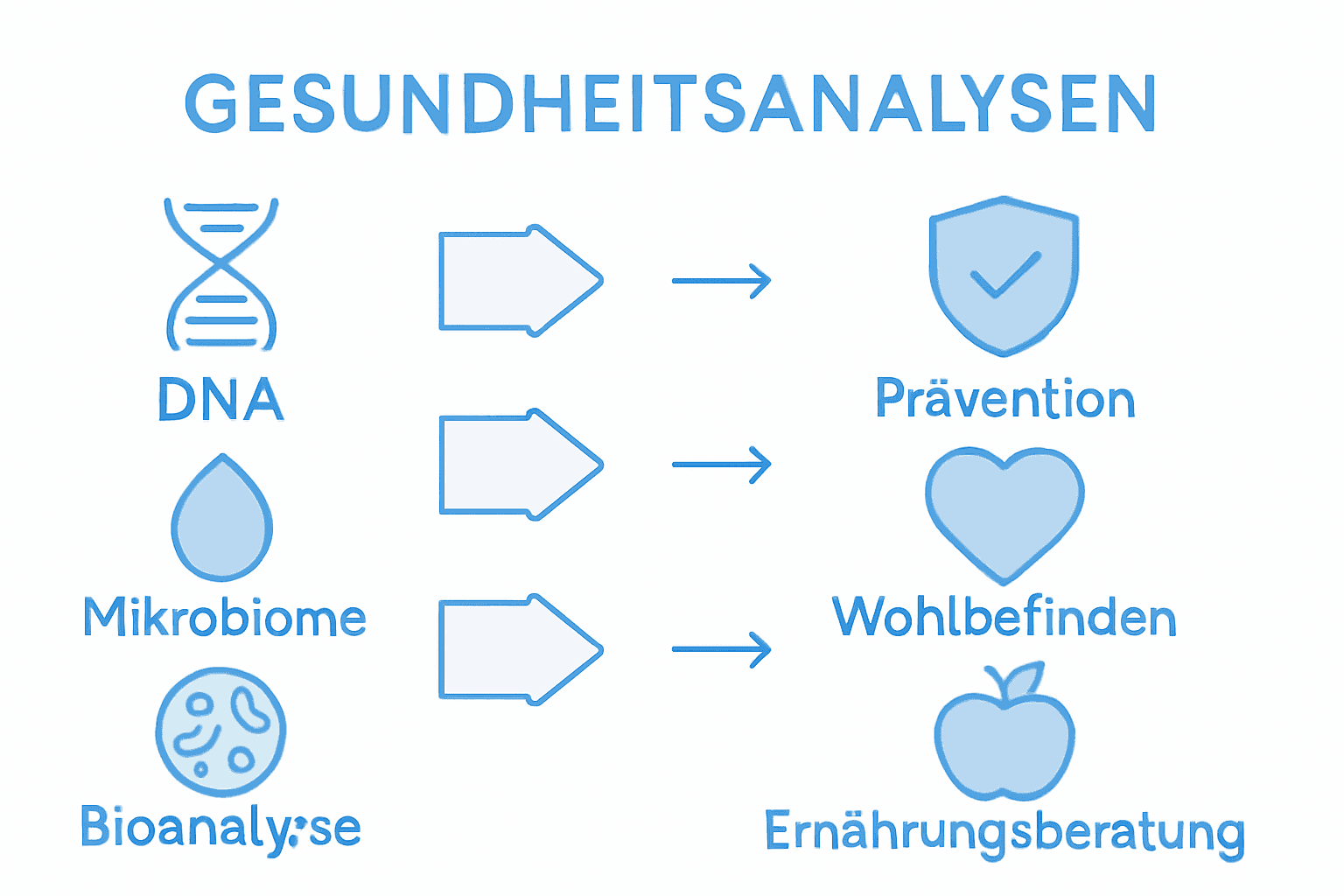
Here is an overview of the most important types of analysis and their applications:
| Type of analysis | Typical applications | Health benefit |
|---|---|---|
| Genetic analysis | Predisposition, risk assessment | Early prevention possible |
| Metabolic analysis | Nutrition optimization, training | Customized nutrition and fitness |
| Nutrient analysis | Deficiency and excess assessment | Early correction of deficiencies |
| Microbiome analysis | Gut health, immune defense | Better digestive system |
| Hormone analysis | Hormonal balance | Personalized therapy options |
Pro tip for analysis beginners: Start with a comprehensive baseline analysis and gradually expand your examinations. Always consult a healthcare professional who can help you interpret the results.
Process and scientific validation of the tests
Health analyses follow a precise, scientifically grounded process. The European Investment Bank's health overview illustrates the systematic planning and implementation of health analyses, which comprises several crucial steps.
The typical process of a health analysis is divided into the following phases:
- Sample collection: Targeted collection of test material
- Laboratory analysis: Highly precise examination of the sample
- Data analysis: Scientific interpretation of the results
- Results report: Personalized evaluation and recommendations
Scientific validation is crucial to the reliability of the tests. It is based on strict quality criteria such as reproducibility, precision, and independent expert evaluation. For example, microbiome analysis provides detailed insights into your gut health by using state-of-the-art genetic sequencing technologies.

Pro tip for health-conscious individuals: When choosing your health test, look for ISO-certified laboratories and international quality standards. This guarantees scientifically sound and trustworthy analyses.
Personal insights and examples of applications
Health analyses provide more than just numbers and data—they offer a deep understanding of your individual health situation. Genetic analysis can serve as a personal compass for your health by revealing genetic predispositions and individual health risks.
Concrete examples of applications highlight the added value:
- Nutritional optimization: Identifying nutritional needs and genetic metabolic characteristics
- Fitness and training: Adapting training strategies to your genetic predisposition
- Disease prevention: Early detection of potential health risks
- Lifestyle adjustment: Targeted measures based on individual health data
These personal insights enable a proactive approach to your own health. They help you develop tailored strategies aligned with your specific genetic and metabolic needs. In concrete terms: less guesswork and more knowledge.
Pro tip for health explorers: View your health analysis as a dynamic process. Document your results, track changes, and continuously adapt your lifestyle based on the insights gained.
Costs, risks, and data protection at a glance
Health analyses provide valuable insights but also raise questions about costs, potential risks, and data protection. The cost of genetic tests varies depending on the scope and level of detail of the analysis, with prices between 100 and 500 euros being quite common.
The key aspects at a glance:
- Costs: Depending on the scope and level of detail of the test
- Data protection: Highest security standards and GDPR compliance
- Sample analysis: Pseudonymization and secure destruction after evaluation
- Health risks: Minimal physical risks with non-invasive tests
When it comes to data protection, reputable providers focus on maximum transparency and security. Sensitive health data is processed in strict confidentiality, and your personal information is used exclusively for the analysis. Once the examination is complete, the samples are reliably destroyed.
The cost and data protection aspects are summarized below in a structured manner:
| Aspect | Significance for users | Practical recommendation |
|---|---|---|
| Costs | 100–500 euros per analysis | Compare prices and check the scope |
| Data protection | Strict GDPR compliance | Check provider certifications and processes |
| Sample handling | Pseudonymization, subsequent destruction | Provide as little personal data as possible |
| Physical risks | Minimal burden, usually non-invasive | Take advantage of preliminary information and consultation |
Pro tip for privacy-conscious people: Before the test, review the provider’s privacy policy and make sure your data is fully anonymized and deleted after the analysis.
Use health analyses tailored to your everyday life
Many people face the challenge of understanding their health holistically and optimizing it over the long term. In everyday life, there is often a lack of clear information about how genetic factors, metabolic processes, and nutrient supply interact. Health analyses can provide clarity here and show you how nutrition, fitness, and lifestyle can be tailored precisely to your individual needs. Terms such as genetic predisposition, metabolic analysis, and nutrient deficiency are no longer unfamiliar concepts but rather the key to greater well-being and vitality.
At mybody®x, we offer modern, scientifically validated at-home tests, including DNA metabolic tests for your optimal nutrition and detecting and preventing nutrient deficiencies. Our ISO-certified laboratories guarantee the highest precision and data protection in accordance with the GDPR. Get started now with simple sample collection from the comfort of your home. This allows you to benefit from personalized recommendations that help you actively manage and sustainably improve your health. Discover your personal health profile and make decisions based on sound facts. You can find more information and suitable tests at any time on mybody-x.com.
Frequently asked questions
What are the benefits of health analyses?
Health analyses provide precise information about metabolism, genetics, nutrient supply, and potential health risks, helping you optimize your health in a targeted way.
How often should health analyses be carried out?
It is recommended not to view health analyses as a one-time test, but to carry them out at regular intervals to document changes and adjust your health strategy.
What types of health analyses are available?
The most important types of analysis include genetic analyses, metabolic analyses, nutrient analyses, microbiome analyses, and hormone analyses.
How are the results of health analyses interpreted?
The results should always be interpreted in collaboration with a healthcare professional to receive tailored health recommendations and derive the greatest possible benefit from the analyses.
Recommendation
- Understanding genetic analysis: Your personal compass for health – mybody®x
- DNA analysis for weight loss: Find your path to a comfortable weight – mybody®x
- Your personalized nutrition: Why a diet doesn't work – mybody®x
- Understand and sustainably improve your eating habits – mybody®x
- Changing household batteries: Step-by-step guide - accu.blog



Share now:
8 sustainable tips to reduce bloating for a flat stomach
How much does a metabolic analysis really cost? Your guide to the prices