


Fitness | VITALITY DNA Test
Your DNA test for training and recovery based on your genetic predisposition
-
 Training and nutrition tailored to your predisposition
-
 Which training stimuli suit your strengths
-
 Bonus: DNA-based nutrition and weight loss tips


Auf Lager · Lieferung in approx. 2–4 working days

- ISO-certified laboratory analysis
- Privacy & Secure Shopping
What does the test include?
- At-home saliva test kit with instructions and a prepaid return envelope
- Analysis by a specialist laboratory in Germany
- Over 100 gene variations from a saliva sample
- 32 analysis reports in 6 chapters across 160 pages, covering fitness, nutrition, and weight loss
- Assessment of over 1,000 foods based on your genetic predisposition
- Your report on the mybody x platform, 15 to 25 business days after your sample arrives, plus the app for free
Product description
Two people train the same way and achieve different results. One reason may lie in their genetic makeup. The Fitness DNA Test shows whether strength or endurance comes more naturally to you, how your body is genetically predisposed to burn fat, and how quickly you recover after training.
To do this, the lab analyzes more than 100 genetic variations from your saliva sample. These are SNPs, or single inherited sections of your DNA that differ from person to person. The analysis also covers your nutrient needs during exercise and evaluates more than 1,000 foods.
You’ll get insights into which training stimuli suit your genetic makeup. What you do with that information is up to you. The results are not a diagnosis, and because your DNA doesn’t change, one test is enough for a lifetime.
The DNA test is perfect for you if you …
- you give it your all in training, but still see no progress.
- want to know whether strength or endurance training works better for you.
- want to find out which training stimuli suit your predispositions.
- want to better assess your recovery after training.
- want to tailor your training and nutrition to your genetic predisposition.

The thought
Which workout suits your body?
Two people train the same way and achieve different results. Muscle fiber type, recovery ability, and nutritional needs are genetically determined. The fitness DNA test uses a saliva sample to show you how your body is predisposed to respond to exertion, and the results apply for life.
What’s inside
What does the fitness DNA test analyze?
Everything related to your training: which stimuli work for you, how your body recovers, and what your nutritional needs are. This also includes ratings of over 1,000 foods and your metabolism.
The source
1
Saliva sample, collected at home by yourself
-
Fitness
Whether strength or endurance training works better for you, how your body burns fat according to your genetic makeup, and how quickly you recover after a workout.
-
Nutrition
Where your need for vitamins and minerals is above average, along with the evaluation of over 1,000 foods.
-
Lose weight
How your body responds to fats and carbohydrates, and which diet type suits your predisposition.
-
Everything together
Over 100 gene variations, evaluated in 32 analysis reports across 160 pages.
6 chapters

The sample
A saliva sample. Once in a lifetime.
The report
What does the fitness DNA test report say?
Your report shows your result and a sentence about what it means for you. Each result describes your genetic predisposition, not a measured value. Below, you can see this in a sample report, chapter by chapter.

Physical activity
6 Reports
Whether your body responds to endurance or strength training - and how quickly it recovers.
-
01 Muscle structureExample
- Your result
- High endurance
- What this means for you
- Your muscles have good endurance. Long-distance running, cycling, swimming, and hiking suit you.
-
02 Fat-burning geneExample
- Your result
- No favorable variant
- What this means for you
- Your genes give you no advantage when burning fat through endurance exercise. It’s possible—it just takes more effort.
-
03 VO2 maxExample
- Your result
- Average aerobic potential
- What this means for you
- Your VO2 max, or how much oxygen your body takes in during maximum exertion, is moderate. You need to put in a little more effort to get the same results.
-
04 Recovery after trainingExample
- Your result
- Fast recovery
- What this means for you
- You don’t carry any variants that slow your recovery.
-
05 Heart capacityExample
- Your result
- Lower heart capacity
- What this means for you
- Regular endurance training suits this predisposition.
-
06 Lean body massExample
- Your result
- Higher
- What this means for you
- Get enough protein: eggs, low-fat dairy products, lean meat, poultry, and fish.
Lifestyle
2 Reports
What your genetic makeup says about sleep, aging, and how you handle recreational substances.
-
01 Biological agingExample
- Your result
- Favorable predisposition
- What this means for you
- Your predisposition is favorable here. Smoking, alcohol, and overeating negate this advantage.
-
02 Inflammation sensitivityExample
- Your result
- Lower sensitivity
- What this means for you
- Dark green vegetables, dark chocolate, garlic, walnuts, ginger, and salmon suit this predisposition.
Nutrient requirements
9 Reports
Which nutrients your genetic needs are higher for - and which they aren't.
-
01 Vitamin B6Example
- Your result
- Low level
- What this means for you
- Your need is higher. Figs, apricots, and chicken are rich in it.
-
02 Vitamin B9Example
- Your result
- Low level
- What this means for you
- Your need is slightly higher. Apples, dried apricots, leeks, beans, and broccoli are rich in it.
-
03 Vitamin B12Example
- Your result
- Low level
- What this means for you
- Your need is higher. It is found mainly in animal products.
-
04 Vitamin DExample
- Your result
- Low level
- What this means for you
- Your need is higher, and regular sun exposure is also important. Perch, trout, and tuna are rich in it.
-
05 IronExample
- Your result
- Low level
- What this means for you
- Your need is slightly higher. Pumpkin and sesame seeds, pistachios, cashews, and rice bran are rich in it.
-
06 Sodium (salt)Example
- Your result
- Average sensitivity
- What this means for you
- Less salt suits your constitution. Lemon, garlic, celery, and mint add flavor instead.
-
07 PotassiumExample
- Your result
- Low level
- What this means for you
- Your need is slightly higher. Apricots, blueberries, leeks, wheat germ, and pistachios are good sources.
-
08 Bone densityExample
- Your result
- Average bone density
- What this means for you
- Strength training and vitamin-rich foods such as broccoli, cabbage, and blackcurrants.
-
09 ZincExample
- Your result
- Average level
- What this means for you
- Your level is average. Soaking vegetables beforehand improves absorption.
Metabolic factors
5 Reports
Cholesterol, blood sugar, and inflammation markers – what your genes contribute.
-
01 HDL cholesterol (the good cholesterol)Example
- Your result
- Average level
- What this means for you
- Genetically average. Daily exercise suits this predisposition.
-
02 LDL cholesterol (the bad cholesterol)Example
- Your result
- Higher level
- What this means for you
- Slightly above average. More fiber from legumes and grains suits this predisposition.
-
03 TriglyceridesExample
- Your result
- Average level
- What this means for you
- Average. The recommendations on saturated fats and sugar apply here.
-
04 Blood sugar regulationExample
- Your result
- Average level
- What this means for you
- Less simple sugar from pastries and cookies suits this predisposition.
-
05 C-reactive protein (CRP)Example
- Your result
- Low CRP level
- What this means for you
- CRP is a protein the body produces during inflammation. Your predisposition is favorable here, and daily relaxation suits it.
Influence of diet on body weight
7 Reports
How your body responds to fats and carbohydrates - and which diet type follows from that.
-
01 Regaining lost weightExample
- Your result
- High likelihood of weight gain
- What this means for you
- Starving yourself won't get you anywhere. Habits you can maintain long term are a better fit.
-
02 Predisposition to overweightExample
- Your result
- Higher predisposition
- What this means for you
- Your predisposition is above average. Daily exercise has a greater impact on you than on others.
-
03 Response to saturated fatsExample
- Your result
- Normal
- What this means for you
- Saturated fats are not especially unfavorable for you. A moderate amount is still advisable.
-
04 Response to monounsaturated fatsExample
- Your result
- Normal
- What this means for you
- A regular place in your diet is a good fit. Olive oil is the easiest source.
-
05 Response to polyunsaturated fatsExample
- Your result
- Normal
- What this means for you
- Hazelnuts, almonds, and mackerel meet your needs.
-
06 Response to carbohydratesExample
- Your result
- Favorable
- What this means for you
- You can have a high proportion of carbohydrates: vegetables, grains, fresh and dried fruit.
-
07 Diet typeExample
- Your result
- Balanced diet
- What this means for you
- A range of food groups, with an emphasis on carbohydrates. This summarizes the six results above.
Metabolic properties
4 Reports
How your body handles alcohol, caffeine, lactose, and gluten.
-
01 Alcohol metabolismExample
- Your result
- Efficient metabolism
- What this means for you
- Your body breaks it down well.
-
02 Caffeine metabolismExample
- Your result
- Fast metabolism
- What this means for you
- Caffeine has a shorter-lasting effect on you.
-
03 Lactose metabolismExample
- Your result
- Efficient metabolism
- What this means for you
- Your genetic makeup suggests that you digest lactose well.
-
04 Gluten toleranceExample
- Your result
- No particular sensitivity
- What this means for you
- Your genetic makeup does not indicate a particular sensitivity to gluten. You can continue to enjoy a varied diet.
Food table
over 1,000 food products
Find out how your body genetically responds to more than 1,000 foods.
-
01 Genetic predispositions related to food (Part 1 of 2)
Bread and pastries, grain products, confectionery, egg products, baked goods, dairy products, fruit products, vegetable products, potato products
-
02 Genetic predispositions related to food (Part 2 of 2)
Red meat products, white meat products, seafood, animal-based meals, vegetarian meals, deli meats, legumes, spices, oils & fats, non-alcoholic beverages, alcoholic beverages

The food table
Which foods does the fitness DNA test evaluate?
Over 1,000, each individually classified according to your genetic makeup. This isn’t a list of forbidden foods, but rather an overview of what suits your predisposition and what doesn’t as well.
What you eat also influences how your body responds to a training stimulus. Take the list with you when you go shopping.
- Over 1,000 food products
- classified according to your system
- Sorted by groups
- from bread and grains to beverages

What arrives
How do I get the results of the Fitness DNA test?
As a 160-page report on the mybody x platform, accessible anytime on any device with a browser. Each result comes with a sentence explaining what it means for you, instead of a table of values you have to decipher on your own.
If you’d rather flip pages than scroll, you can also order the report as a printed Analysis Booklet.
- On the platform
- accessible anytime, on any device
- Printed if you want it
- as an analysis booklet, available to order separately
- Consultation included
- with our expert staff, free of charge
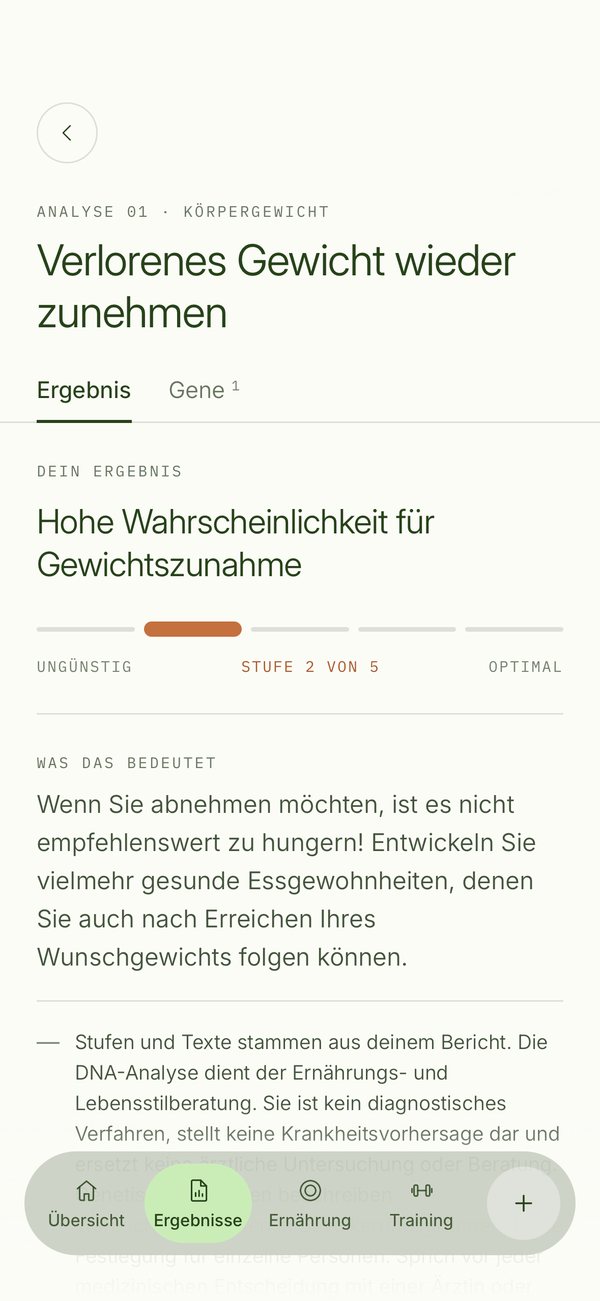
In the app
What does the app show you about your DNA test?
Your report, chapter by chapter. The app is free with every DNA test.
- Results by chapter, with level and note from your report
- The most important information from your report on the app’s home page
- With a sports chapter in the report, your plan shows you suggestions from it
Your training
What does the Fitness DNA test reveal about your training?
Three things that make a difference in training: which stimuli work for you, how much endurance you’re naturally equipped with, and how you recover.

Strength or endurance
How your muscle structure is configured and whether strength or endurance stimuli are more likely to work for you.

Endurance and heart
How much aerobic potential and heart capacity your system has.

Relaxation
How quickly your body recovers after training and why your breaks can differ from what’s in the plan.


Here's how it works
How does the fitness DNA test work?
From home in three steps. You don’t need to make an appointment in advance.
-
Collect a saliva sample
You spit into the tube from your test kit through a small funnel. The instructions are included with your test kit.
-
Activate and return the test kit
You activate your test on the mybody x platform and send the sample back. You can also track the status of your sample there.
-
Report received
Your report will be available on the platform 15 to 25 business days after we receive your sample, with recommendations for training, recovery, and nutrition.

Then
Can I get help reading my DNA report?
Yes. If anything is unclear, talk to one of our specialists. The consultation is free, and they won’t try to sell you anything.
- Consultation with a specialist
- free, no sales
- Read anytime
- The report remains in your account.
- Valid for a lifetime
- Your DNA does not change.

The boundaries
What can’t the Fitness DNA test do?
It is not a medical examination and does not provide a diagnosis.
- It won’t make you faster or build muscle. You have to train yourself.
- It doesn’t measure performance metrics. How fit you are today becomes clear during your workout.
- It does not provide information about illnesses and does not replace a visit to the doctor.
- Genetic variants describe probabilities in population groups. They do not define you.
- He doesn’t write you a training plan. What you do with it is up to you.

Experts for you
Who developed the fitness DNA test?
Experts in nutrition and sports science and laboratory technology, working together with us. mybody x has been around since 2016. The result is not a lab report full of columns of numbers, but an analysis you can understand without any prior knowledge.
Your sample is analyzed in a laboratory in Germany certified to ISO 9001 and ISO 13485. Your data is processed in accordance with ISO 27001 and the GDPR.
- ISO 9001 · ISO 13485
- Laboratory quality management
- ISO 27001
- Information security
- GDPR
- How your data is handled
- Germany
- Evaluation location
The comparison
What distinguishes the Fitness DNA test from standard DNA tests?
Especially how much he reads and how he explains it.
| What is being compared | Common tests | |
|---|---|---|
| Analyzed gene variations | over 100 | under 18 |
| Developed with experts in nutrition, sports science, and laboratory technology | Yes | Partial |
| Laboratory accredited to ISO 9001 and ISO 13485, data compliant with ISO 27001 and GDPR | Yes | Partial |
| Easy-to-understand results and recommendations | Yes | — |
| Gene-based nutrition plan (available as an add-on) | Yes | — |
| No appointment needed in advance | Yes | — |

You can't change your DNA. You stop working against it.
Experiences
What experiences do customers have with our DNA tests?
11,314 customers have ordered from mybody x (our own count, as of September 2026). Every body responds differently; your experience may be different.
-
Team · Longevity DNA Test
Read Tim's experience -
Marina · INFINITY DNA Test
Read Marina's experience -
Chris · INFINITY DNA Test
Reviews
How do customers rate mybody x?
Literally, as they appear on the platform.
4,77 out of 5 stars
540+ reviews
-
Incredible insights, fast delivery, and a super professional team behind mybody-x. I honestly never thought I’d learn so much about my own body in my 30s....
Yuri by Able & Baker G.ProvenExpert
-
Fast processing, comprehensive analysis results, highly recommended
AnonymousProvenExpert
-
I was really impressed by the DNA test - very insightful! I’d also especially like to praise this company’s customer service. The Help page already answers almost every possible question in detail. In my case, however, I had a specific follow-up question and received extremely competent support. I can wholeheartedly recommend mybody’s tests. Thank you!
Gerlinde E.ProvenExpert
-
I was pleasantly surprised by the test results and the detailed analysis. This kind of analysis was completely new to me, but it offers valuable insights into my body. I’m curious to explore the results further to understand their significance even better. I can highly recommend MYBODY to anyone who wants to learn more about their body!
S.ProvenExpert
-
The test was easy to carry out, and everything went wonderfully. The results are very interesting and presented in detail. The recommendations made me rethink my diet, and I was able to apply them very easily in everyday life! I’d happily do it again!
N. H.ProvenExpert
-
I’m delighted to know what my body really needs, and MybodyDNA has been very helpful with that.
Thank you 🙏🏻Marinela-Simona I.ProvenExpert

Fitness | VITALITY DNA Test
Your DNA test for training and recovery based on your genetic predisposition
In stock · Delivery in approx. 2–4 working days
- Results 15–25 business days after sample receipt
- Analyzed in Germany
- A test for life
Questions
Frequently asked questions about the Fitness DNA test
What is a fitness DNA test?
An analysis of your genetic predispositions related to training and recovery. More than 100 genetic variations are analyzed from a saliva sample—that is, individual points in the genetic code that differ from person to person. This produces 32 analysis reports in 6 chapters across 160 pages.
You train regularly, but your progress doesn't match the effort you put in. Muscle fiber type, recovery capacity, and nutrient requirements are genetically determined and vary from person to person, which is why two people following the same plan can achieve different results. A saliva sample that you collect yourself at home is analyzed. Your DNA doesn't change, so one test is enough for a lifetime.
What does the fitness DNA test reveal about my training?
It determines whether strength or endurance stimuli are more effective for you and how much time your body needs to recover. It also covers your nutrient requirements and evaluates over 1,000 foods. It does not create a training plan for you.
Genes such as ACTN3 and PPAR-alpha underpin muscle structure, while ADRB2, PPARGC1A, and ACE, among others, are associated with aerobic potential. The CAT, NQO1, GPX1, and SOD2 genes are analyzed for post-workout recovery, and LPL for fat burning. The report does not specify repetitions or weights, but rather the direction your training can take.
Strength or endurance: can a DNA test answer that?
It can assess which stimuli are more likely to work for you. The report describes your predispositions for exertion and recovery. This is not a definitive determination, but rather the starting point from which you move into the next training phase.
Does a genetic test help with building muscle?
It doesn’t build muscle; you have to do the training yourself. What it provides is a starting point: which training stimuli suit your predispositions. It gives you a basis for trying out training stimuli more purposefully.
Who is the Fitness DNA Test suitable for?
For you, if you train regularly and your progress is lagging behind your effort. It’s aimed at people who want to stop copying other people’s training plans. It’s not for you if you expect a ready-made plan, because the report doesn’t provide one.
How much does the fitness DNA test cost, and what is included?
You pay once because the results are valid for life. The package includes the test kit and a complete analysis with 32 reports across 160 pages, along with an assessment of over 1,000 foods. More than 100 genetic variations are analyzed from a single saliva sample.
How long does the analysis take?
15 to 25 business days from receipt of your sample; analysis is carried out in Germany. Your report will then be available as a PDF in your customer account. Shipping time for the kit and return shipment is additional.
What can’t the Fitness DNA test do?
It does not measure performance metrics. How fit you are today is not shown in your records, but becomes clear during training. It does not diagnose or say anything about illnesses.
The fitness DNA test is not a medical or sports medicine examination. It won’t make you faster or build muscle. Genetic variants describe probabilities in population groups and do not determine your personal outcome. Your doctor remains responsible for medical questions.
Fitness VITALITY DNA Test: What traits it categorizes for your training and where it stops short
Buy the Fitness VITALITY DNA Test: over 100 genetic variations for training and nutrition
VITALITY analyzes over 100 genetic variations from a saliva sample in 32 analysis reports spanning 160 pages across 6 chapters.
Genetic variations are specific points in the genome where people differ. The Fitness VITALITY DNA test reads the variations associated with endurance, strength, fat metabolism and recovery, and supplements them with an assessment of over 1,000 foods. You pay the postage for returning the sample. 15 to 25 business days after your sample is received, your report will be available in the app and as a PDF in the customer portal. It is designed for people who train regularly and want to know which stimuli suit their genetic makeup. If your main goal is to lose weight, the smaller starting point is the WeightLoss | SLIM DNA test.
What training analyses are included in the Fitness VITALITY DNA test?
Six analyses from the “Physical Activity” chapter: fat-burning gene, VO2max, heart capacity, muscle structure, post-workout recovery, and lean body mass.
VO2max represents your aerobic potential. The report indicates whether your predisposition leans more toward strength or endurance stimuli and how your recovery is predisposed. None of these tells you how much muscle you will build. That depends on training, nutrition, sleep, and how many years you’ve been at it. A predisposition describes how common a trait is in population groups; it does not determine what will happen for you.
Recovery after training: What does the Fitness VITALITY DNA test assess?
The “Recovery after Training” analysis describes what your genetic predisposition for recovery is like, not how recovered you are today.
Two people do the same workout and need different amounts of time afterward before they’re fully ready to perform again. Part of that comes down to how you’re feeling that day, sleep, and nutrition. Part of it is innate. The report puts that innate part into context and describes what it may mean for your rest periods. It does not replace listening to your body or measuring your performance. It can’t tell you what your protein intake is like right now based on your genetic predisposition. That requires current values, such as the 22 values from protein metabolism in the PerformanceCheck | Amino Acid Test. Your genetic predisposition shows what you’re predisposed to; the blood test shows your current status. VITALITY does not write you a training plan.
Fitness VITALITY DNA test or blood test for athletes: genetic predisposition or current status?
VITALITY reads your predisposition once, while a blood test measures your current levels. The DNA test answers the question of which stimuli are right for you; blood tests answer questions about electrolytes or amino acids.
Your predisposition from the saliva sample stays the same, while your training volume and diet change. That’s why one test is enough, and the report becomes a reference guide for every new season. Blood values, on the other hand, fluctuate with training, food, and time of day, so repeated measurements are worthwhile. If you sweat a lot and want to know your current sodium, potassium, and magnesium levels, measure them with the BalanceCheck | Electrolytes & Minerals Test. If you want to understand your protein metabolism, choose the PerformanceCheck. VITALITY doesn’t answer either of these questions, but it does answer one that no blood test can: what predispositions shape your training. Neither type of test provides a diagnosis. They complement each other rather than replace each other.
Is the Fitness VITALITY DNA test worth it if you’ve been following a training plan for a long time?
Especially if you’ve been training for a long time and want to know what you’re predisposed to. It explains your predispositions. You won’t get a new program.
Almost any training leads to progress at first, and it’s difficult to distinguish your predispositions from the beginner effect at that stage. Things get interesting later, when the same plan produces less progress for you than for others. That’s when it helps to know whether you’re more predisposed to strength or endurance, and what your aerobic potential and recovery are like. This is an explanation, not a training guide. You decide what to change in your training, ideally with someone who can watch you train. The report also rates over 1,000 foods based on your predispositions. If you’re just starting to train, you’ll learn more from the training itself in the first few months than from the report. The test makes more sense later. Find more tests related to performance and recovery in the Sports & Recovery category.
Fitness VITALITY or Longevity ALL IN ONE: When is the more comprehensive DNA test worth it?
If you’re interested in skin and overall nutrition in addition to training. Longevity analyzes over 170 gene variations in 74 analysis reports, while VITALITY analyzes over 100 in 32.
VITALITY is tailored to training and includes food ratings as a secondary focus. Longevity ALL IN ONE combines four topics, weight loss, nutrition, fitness, and skin, in one 240-page report. Both rate over 1,000 foods, and the lab analyzes both from a single saliva sample. The difference lies in their scope. If you’re mainly interested in your potential for training and recovery, VITALITY is the more streamlined choice. If you want to test once and then be able to look up all the topics, the more comprehensive test is the better option, as it too remains valid indefinitely. Neither is a medical examination, and neither provides a diagnosis. For details on the scope, see the Longevity | ALL IN ONE DNA test.