

Understand and sustainably improve your eating behavior
Your eating behavior is much more than just the sum of your meals. Think of it as a personal fingerprint—a unique blend of habits, emotions, and, yes, even your biology. It includes everything from the conscious decision to choose an apple to the unconscious reach for chocolate on a stressful day.
What your eating behavior really reveals about you

Your eating behavior is like a complex puzzle. Each individual piece represents a different influencing factor, and only when you put them all together can you see the complete picture of your eating habits. It is not just about what you eat, but above all about why and how you do it.
Many decisions you make at the table each day happen on autopilot. You reach for the same coffee cup in the morning, often eat lunch at the same time, and may have a set ritual for an evening snack. These patterns are deeply embedded in your daily life and directly influence your energy, mood, and overall well-being.
The pillars of your eating behavior
To truly understand your eating behavior, it helps to look at the different forces working behind the scenes. They can be broadly divided into four core areas that are constantly interacting with one another.
This table gives you a quick overview of the core areas that shape your daily eating behavior.
| The four dimensions of your eating behavior | ||
|---|---|---|
| Dimension | What lies behind it | An example from your everyday life |
| Biological | Your feelings of hunger and fullness, your metabolism, and even your genes. Your body is constantly sending signals. | After exercising, you crave something savory because your body needs salt and energy. |
| Psychological | Emotions such as stress, boredom, or joy. Eating often serves as a reward, a way to calm yourself, or simply a habit. | After a stressful day at work, you reach for chocolate to “reward” yourself and relax. |
| Social | Your environment. Shared meals with family, eating culture among friends, or social occasions. | At a birthday party, you eat a piece of cake even though you are not hungry at all—simply because it is part of the occasion. |
| Cognitive | Your thoughts, beliefs, and knowledge about nutrition. Beliefs such as “Carbohydrates make you fat” guide your choices. | You avoid fruit in the evening because you read somewhere that fructose is bad at night. |
Each of these areas plays a role and shows how complex the topic really is.
Your eating habits are not simply a matter of willpower or discipline. They are the result of a complex interplay of internal signals, learned habits, and external influences.
This interplay also makes it clear why there can be no one-size-fits-all solution for a “perfect” diet. Your body and your life are unique. While your genes provide a kind of basic framework, your daily choices determine how your health develops. If you would like to delve deeper into the fascinating world of your genetic makeup, our article explains how easy it can be to understand genetics.
Becoming aware of these factors is the first and most important step. It is about recognizing your own patterns without judging yourself for them. Because only when you understand why you do what you do can you truly initiate lasting changes and regain control over your well-being.
The invisible forces that control your decisions
Have you ever wondered why you almost automatically reach for chocolate after a tiring day? Or why things that were not even on your list suddenly end up in your shopping cart at the supermarket? These are not coincidences. They are invisible forces that steer your eating habits every day.
Your body and mind are constantly engaged in a dialogue. Sometimes this dialogue is loud and clear, like a growling stomach demanding energy. Often, however, it is quiet whispers—feelings, habits, or hormonal signals—that guide your decisions without you even noticing.
When feelings control hunger
One of the most powerful, invisible drivers is emotional eating. You do not eat because your body needs nutrients, but because your soul is craving something. Boredom, stress, sadness, or even joy can be powerful triggers that make you reach for very specific foods.
Imagine you had a frustrating day at the office. As soon as you get home, you open a bag of chips. At that moment, you are not seeking nutritional value, but comfort, distraction, or a quick reward. Eating becomes a strategy for dealing with unpleasant feelings.
Typical triggers for emotional eating include:
- Stress: The hormone cortisol often increases the desire for foods high in fat and sugar.
- Boredom: Eating can be a simple and quick way to fill an inner emptiness.
- Habit: Reaching for a cookie in the afternoon is often less about hunger than a deeply ingrained ritual.
This behavior is completely human. But if it becomes a regular occurrence, it can sabotage your well-being. The first step is to recognize and question these patterns in yourself: “Am I really hungry, or am I feeling something completely different right now?”
The hormonal orchestra in your body
In addition to your feelings, an entire orchestra of biological messengers directs your eating behavior. Two of the most important players in this ensemble are the hormones ghrelin and leptin.
Ghrelin is known as the “hunger hormone.” It is produced mainly in the stomach and signals to your brain: “It’s time to eat!” Its counterpart is leptin, the “satiety hormone,” which is released by fat cells and sends the message: “I’m full, you can stop.”
A balanced interaction between ghrelin and leptin is essential for healthy eating habits. When this delicate system gets out of sync, the signals for hunger and fullness become unreliable.
An often-underestimated disruptor of this hormonal balance is sleep deprivation. Just one night of too little sleep can increase ghrelin levels while reducing leptin production. The result: You wake up hungrier and with a weaker feeling of fullness—a perfect recipe for cravings.
Genes and the environment working together
However, your hormones and emotions are not the only invisible forces. Your genetic predisposition and epigenetics also have a say. Epigenetics describes how your lifestyle and environmental influences can control the activity of your genes without changing the DNA itself. So your eating habits today can influence how your genes work tomorrow.
This insight is quite encouraging because it shows that you are not simply at the mercy of your genes. Through your daily choices, you have the power to positively influence your body. If you would like to learn more about how your lifestyle affects your gene activity, you can find fascinating insights in our article about what epigenetics is and the role it plays in your health.
By understanding these invisible psychological and biological drivers, you regain control. You learn to recognize the true causes of your cravings and can make conscious choices that benefit your body—instead of letting old patterns or hormonal chaos guide you.
Typical eating patterns in Germany put to the reality check
After looking at the invisible psychological and biological forces that guide your eating behavior, let’s zoom out. Let’s take an honest look at the big picture: What does Germany really eat? You often feel quite alone in your everyday struggles—whether it’s craving something sweet or reaching for a frozen pizza because of stress. But reality looks very different.
Most of us want to eat healthily. Of course. But everyday life is all too happy to get in the way. This gap between what we intend to do and what actually ends up on our plates is a widespread phenomenon. Let’s take a closer look at the figures and find out where we really stand as a society.
Expectations and reality on the plate
A cornerstone of a healthy diet is eating fruit and vegetables every day. But how consistent are we about that in Germany? The data paints a fairly clear picture, strongly influenced by age and gender.
According to the 2023 TK study “Eat What, Germany?!”, only 59 percent of people in Germany eat fresh fruit and vegetables every day on average. Things get interesting when you take a closer look: There is a clear gap between generations and genders. While 70 percent of those over 60 eat them every day, the figure is just 49 percent among 18- to 39-year-olds. At 69 percent, women are doing somewhat better, while the figure for men is again just 49 percent. You can find more fascinating details directly in the full TK study.
These figures make it clear that there is still plenty of room for improvement, especially among younger people and men.
The following infographic illustrates which invisible forces guide our eating behavior in the background—from emotions and hormones to deeply ingrained habits.
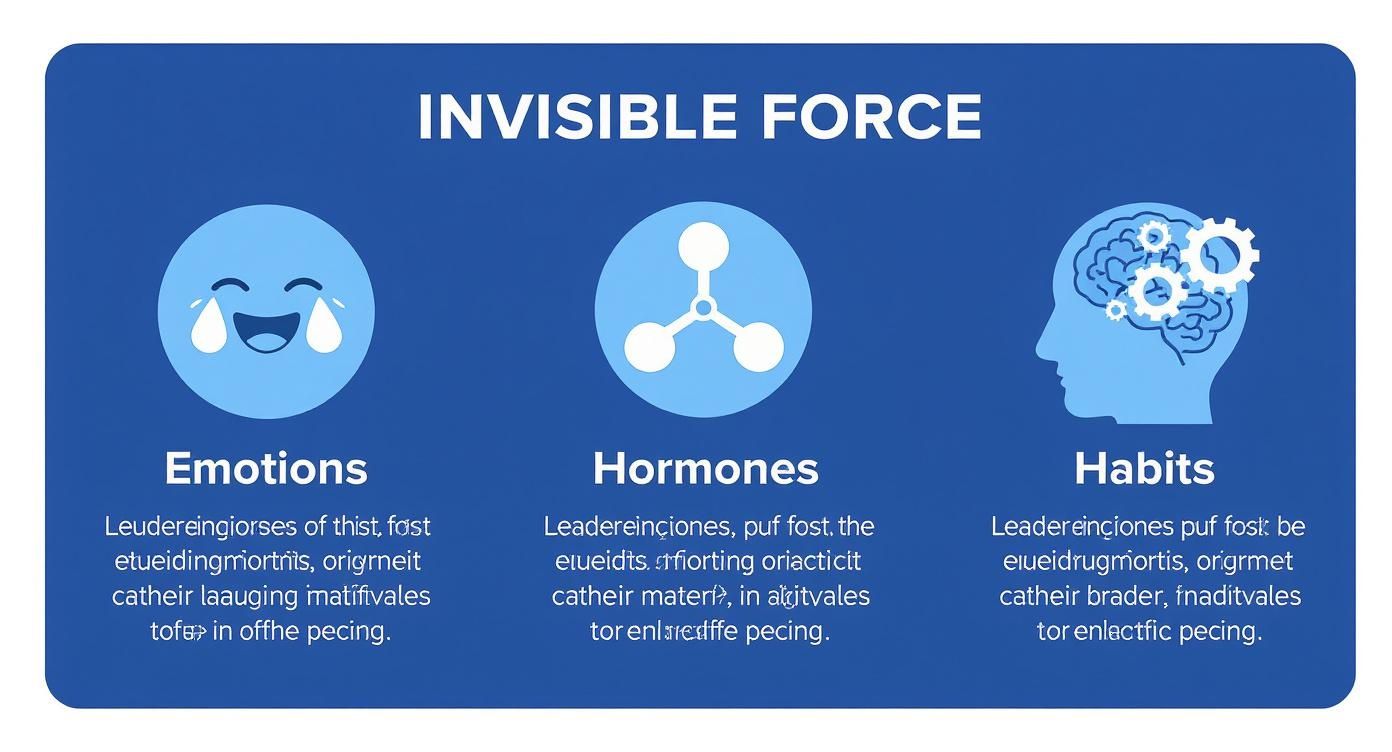
You can see it right away: Our decisions at the dinner table are rarely purely rational. A complex interplay of internal drivers is at work.
The popularity of meat and growing flexibility
Meat and sausage are still a staple of the diet for many people in Germany. But a lot is changing here too. There is a growing awareness of health, animal welfare, and the environment.
Although most Germans eat meat regularly, the group of flexitarians—that is, people who consciously reduce their meat consumption—is steadily growing.
This shift reflects an important trend: It's no longer just about rigid categories such as “meat eater” or “vegetarian.” Instead, a much more flexible and mindful approach to food is emerging. Many people are looking for a middle ground that fits into their everyday lives and allows them to live more healthily without having to give up everything.
What do these insights mean for you?
- You are not alone: Extremely many people are familiar with the challenge of eating healthily in everyday life.
- There is no “normal”: Eating habits are individual and change over the course of life.
- Every step counts: Even small, conscious adjustments can make a huge difference to your well-being.
The statistics reveal clear patterns and potential. Perhaps they will motivate you to reflect on your own behavior and find your own personal path—without pressure or perfectionism. The next logical step is to take a closer look at your own patterns.
Analyze your eating habits—without pressure or stress

Real change rarely begins with strict rules; much more often, it starts with honest curiosity. Analyzing your eating habits may sound like complicated work, but it doesn't have to be. Forget calorie charts and lists of forbidden foods for a moment—it's about developing a sense of your own personal patterns.
The key is to switch from autopilot to observer mode. In a sense, you become a detective investigating yourself to find out what really drives you. This process is meant to bring you clarity, not create additional stress.
The food diary as your personal compass
A food diary is one of the most effective tools on this journey. But don't worry—this isn't about weighing every gram. Think of it more like a logbook that helps you recognize the connections between food, feelings, and situations.
For a few days or a week, record what you eat and drink without judgment. The circumstances surrounding it are much more important than the exact quantities.
Ask yourself the following questions at every meal or snack:
- When did I eat? (e.g., 3:00 p.m.)
- What did I eat? (e.g., a handful of nuts and a piece of chocolate)
- Where was I? (e.g., at my desk at work)
- How did I feel before I ate? (e.g., stressed, bored, tired)
- Was I really physically hungry? (e.g., on a scale of 1–10, where 1 means no hunger and 10 means extreme hunger)
After just a few days, you will probably begin to recognize initial patterns. Perhaps you’ll notice that you always reach for something sweet in the afternoon, when work stress is at its highest. Or you eat in front of the TV in the evening out of sheer habit, even though you are no longer hungry.
These insights are incredibly valuable because they show you exactly where you can make changes. Such a journal can also provide clues about possible deficiencies. Do you often feel tired and reach for certain foods as a result? Then it’s worth taking a closer look. In our article, you’ll learn how to test for nutrient deficiencies and take targeted action.
The Art of Mindful Eating
Alongside observing your patterns, mindful eating is the second important pillar for greater self-awareness. In our hectic world, we often eat on the go: at our desks, in front of a screen, or while traveling. In doing so, we lose touch with our most important guides—our hunger and fullness cues.
Mindful eating means giving your meal your full, undivided attention. It is an invitation to consciously notice your body’s signals again and enjoy your food with all your senses.
It’s about switching off autopilot and bringing enjoyment back to the forefront.
Try incorporating these simple principles into your next meal:
- Create a calm atmosphere: Sit at a table and consciously put your smartphone aside.
- Take your time: Eat slowly and chew each bite thoroughly. This not only supports your digestion but also gives your brain enough time to receive the fullness signal (which takes about 15–20 minutes).
- Use your senses: What does your food smell like? What colors do you see? What textures do you feel in your mouth?
- Listen to your body: Eat until you feel comfortably full—not until you are stuffed.
These two methods—keeping a journal and practicing mindfulness—are not quick fixes but sustainable tools. They help you relearn your body’s language and build a healthy, intuitive relationship with food. Without any pressure, but with plenty of self-understanding.
Practical Strategies for a Healthier Everyday Life

Knowledge is the first step, of course. But the real art lies in putting that knowledge into practice in a hectic everyday life. Fortunately, building healthy eating habits does not mean you have to turn your life upside down overnight.
It is more about small but consistent adjustments that fit easily into your existing routines. Forget rigid prohibitions and radical diets—they usually lead only to frustration. Instead, let’s focus on practical, proven strategies that sustainably improve your well-being. Step by step, at your own pace.
Small Goals, Big Impact
Trying to change everything at once is almost always doomed to fail. It is much smarter to focus on small, realistic goals that you can actually achieve. Every small success motivates you and gives you the confidence to take the next steps.
So instead of resolving to “eat only healthy food from now on,” why not try one of these micro-goals:
- One Extra Serving: Simply add an extra handful of vegetables to one of your main meals. This could be a small side salad, a few tomatoes, or some cucumber.
- The Glass Beforehand: Drink a large glass of water before every meal. This not only keeps you hydrated but also helps you feel full.
- The Conscious Swap: Replace just one unhealthy snack a day with a smart alternative—for example, an apple instead of a chocolate bar.
These small steps may seem insignificant, but together they lay the foundation for permanently healthier eating habits.
The Power of Preparation: Meal Prepping
One of the biggest enemies of good eating intentions? Lack of time. When hunger strikes and there is nothing healthy on hand, we quickly reach for ready-made meals or fast food. That is exactly where meal prepping comes in—the art of cooking in advance.
Meal prepping is not a complicated system for fitness professionals, but a simple way to reduce stress in everyday life and stay in control of your diet.
Even one or two hours on the weekend are enough to set yourself up for the whole week. Cook a larger quantity of basic ingredients such as quinoa, rice, or lentils in advance. Chop vegetables so they are ready to use, or prepare complete meals in storage containers right away. That way, you always have a healthy option on hand when hunger strikes.
Understanding cravings and countering them cleverly
Cravings often feel overwhelming, but you are not powerless against them. They are usually a signal from your body that something has gotten out of balance—whether it's a nutrient deficiency, stress, or simply an old habit.
A key factor here is often sugar consumption. Although in 2021, a notable 111 kilos of vegetables and 69 kilos of fruit were eaten per person, this was accompanied by 9.6 kilos of chocolate and 5.7 kilos of sweets. Total sugar consumption is particularly striking: On average, each German consumed around 32.2 kilograms of sugar in 2022/23, equivalent to about 91 grams per day. That is almost twice as much as the maximum of 50 grams recommended by the German Diabetes Association. If you'd like to take a deeper look at these figures, you can discover more insights into nutrition in Germany on zdfheute.de.
To prevent cravings, regular, balanced meals are worth their weight in gold. A plate assembled according to the building-block principle—with a good source of protein, complex carbohydrates, and plenty of vegetables—keeps your blood sugar levels stable and prevents attacks.
Smart snack alternatives for in between meals
Snacks aren't inherently bad; it simply depends on what you choose. Instead of reaching for chips or cookies that only provide empty calories, why not try nutrient-rich alternatives:
- A handful of unsalted nuts
- Greek yogurt with fresh berries
- Vegetable sticks with hummus
- A hard-boiled egg
These strategies are, of course, just the beginning of your journey. Find out what works best for you, and be patient with yourself. If you're looking for more ideas, why not check out our 10 Tips for a Healthy Lifestyle for even more inspiration for your everyday life?
The most frequently asked questions about eating behavior
Finally, we want to answer a few questions that come up again and again in our practice. From emotional hunger to dealing with setbacks, here you'll find honest answers to help you confidently overcome common stumbling blocks.
What is actually the difference between eating behavior and an eating disorder?
This question is incredibly important because the terms are often confused. Imagine your eating behavior as a vast landscape with gentle hills and valleys. It describes all your daily habits, preferences, and patterns around food—including those that are not quite perfect, such as occasionally reaching for chocolate when stressed. That is human and entirely normal.
An eating disorder, by contrast, is like a deep, dangerous ravine in this landscape. Here, we are talking about a serious mental illness. The relationship with food, one’s own body, and weight is severely disrupted. The behavior becomes compulsive, the level of distress is extremely high, and health is often in acute danger. If you feel that your eating behavior is dominating your life and becoming compulsive, seeking professional help from a doctor or therapist is the only right course of action.
Why do I eat even though I am not hungry at all?
An incredible number of people experience this, and it is usually a clear sign of emotional eating. In these moments, you are not eating because your body is asking for energy, but because your soul is longing for something else.
Common reasons include:
- Pure habit: The cookie at 3 p.m. is simply part of your routine because you have always done it that way.
- Social occasion: At a party, you join in and eat a piece of cake to fit in and avoid dampening the mood.
- Emotional regulation: Food serves as comfort when you are sad, as a reward for an achievement, or as a simple distraction when you are bored.
The first step toward change is to pause briefly in moments like these. Ask yourself: “What do I really need right now?” Often the answer is a short break, a conversation, or a walk in the fresh air—not the food itself.
How do I deal with setbacks?
Setbacks are not failures. They are an inherent and entirely normal part of any change. What matters is not that they happen, but how you deal with them. Instead of sinking into self-criticism, be kind to yourself. One “slip-up” does not undo all your progress.
A setback is no reason to give up. It is an opportunity to learn. Ask yourself what triggered it and consider how you could respond differently next time.
Analyze the situation objectively: Were you particularly stressed? Had you not slept enough? Was there simply no healthy alternative within reach? Each of these insights will only make you stronger for the future and help you refine your strategies.
Does my eating behavior change with age?
Yes, absolutely! Your eating habits are not static; they continually adapt throughout your life. There are many different reasons for this:
- Biological changes: Your metabolism slows down over time, your hormonal balance changes (including during menopause), and even your sense of taste can change.
- New circumstances in life: A different job, starting a family, or retiring brings entirely new daily routines and social habits that shape your eating behavior.
- Growing health awareness: As you get older, long-term health and disease prevention become more important. This often naturally leads to more conscious choices on your plate.
So it is perfectly normal for you to have different needs and preferences at 45 than you did at 25.
What role does meat consumption play in Germany today?
Meat consumption is a great example of how eating habits change in society. A 2023 survey by Techniker Krankenkasse shows that 78 percent of respondents still eat meat regularly. At the same time, however, awareness of the consequences—for animal welfare and the environment—is growing.
For example, 71 percent of those who eat less meat or no meat at all cite animal welfare and ethical reasons as their motivation. Almost as many (69 percent) mention environmental concerns. The trend toward flexitarianism is particularly strong: According to the BMEL Nutrition Report 2024, 41 percent of Germans already follow a flexitarian diet, consciously eating meat less often and choosing higher-quality meat when they do. These figures show a clear shift toward a more conscious and flexible approach to animal products. You can find more information in the TK Nutrition Study 2023.
Your eating habits are as unique as your fingerprint. If you want to understand the deeper connections within your body and put your diet on a scientifically sound foundation, MYBODY Lab is exactly the right place for you. Our at-home analyses help you decipher your body's language—from your metabolism to your nutrient supply.
Discover now at https://mybody-x.comwhich test suits you best and begin your journey toward greater well-being and personalized health.



Share now:
Nutrition in old age: How to stay fit and full of energy
Metabolic disorder: Everything you need to know