

DNA analysis for weight loss: Finally find your personal path to a comfortable weight
A DNA analysis for weight loss shows you how your body really works and how it responds to fats or carbohydrates. This allows you to finally adapt your diet to your very own genetic predisposition. Instead of another generic diet, you get a personalized roadmap that prevents frustration and makes lasting results achievable.
Why most diets are destined to fail

Does this sound familiar? You’ve already tried countless diets, from low-carb to low-fat, but lasting success simply never seems to materialize. You’re definitely not alone. Many people feel burned out after a short time, struggle with the yo-yo effect, and feel like nothing works for them.
The reason is often simpler than you think: Standard diets are purely “one-size-fits-all” approaches. They ignore the most important factor in the entire equation—you and your unique biology. Everyone processes nutrients differently, and what works great for one person may be ineffective or even counterproductive for you.
Your genetic blueprint has a say
Imagine trying to charge a brand-new smartphone with an ancient charging cable. It may fit somehow, but it will never work optimally. The same is true of your body and generic diet plans. Your DNA is your body’s individual blueprint and determines how your metabolism works.
Scientific studies show that 40 to 70 percent of differences in weight between people can be attributed to genes. Your genetic predisposition directly affects how you lose weight:
- How your metabolism works: Your genes determine whether your body gets energy more efficiently from carbohydrates or fats.
- How you process fat: Certain gene variants, such as the well-known FTO gene, can significantly increase the tendency to store fat.
- How your sense of fullness works: How quickly you feel full and how strong your hunger is are also controlled by your DNA.
These genetic differences explain why your friend loses weight while eating pasta and bread, whereas the number on your scale shoots up. It has nothing to do with a lack of discipline—it simply comes down to your genetic makeup.
Starting a diet without knowing your genetic predispositions is like taking a journey without a map. You may make some progress, but the road is unnecessarily difficult and the destination often unreachable.
The path to a diet that truly suits you
This is exactly where DNA analysis for weight loss comes in. Instead of continuing to guess which diet might be right for you, it provides clear, scientifically grounded answers. It deciphers the language of your body and shows you which nutrients it prefers and which it may have more difficulty processing.
This personalized approach makes the difference between short-term dieting attempts and a long-term, successful change in eating habits. When you understand how your body works, you can support it in a targeted way instead of constantly working against it. Learn more about how personalized nutrition based on your DNA can be the key to reaching your feel-good weight. By basing your plan on facts rather than assumptions, you create the foundation for sustainable success—without constant restrictions and frustration.
What a genetic test reveals about your metabolism

Now that we’ve clarified why standard diets often fail, let’s delve deeper into the fascinating science behind DNA analysis for weight loss. Think of your DNA as a vast, personal cookbook containing countless recipes for your body. Each of these recipes—that is, each gene—is a precise instruction for how your body should function.
These instructions control everything from your hair color to the way you process nutrients. Tiny variations in these “recipes,” known as SNPs (Single Nucleotide Polymorphisms), make you completely unique. And these small differences are precisely why your metabolism works differently from that of your friends or partner.
The main players in your genetic code
A DNA analysis is essentially a targeted look into this personal cookbook. It focuses specifically on the genes that play the leading role in weight management. Instead of reading the entire code from A to Z, experts look specifically for the key markers that speed up your metabolism—or slow it down.
Some of the most important of these “main players” include genes that directly control:
- Fat metabolism: There are genes such as APOA5 and PPARG that regulate how efficiently your body absorbs, transports, and burns fats from food as energy—or stores them directly in fat deposits. An unfavorable variant can mean that your body gains weight more quickly even after a single high-fat meal.
- Carbohydrate metabolism: Other genes determine your insulin sensitivity and how your body responds to sugar and starch. A particular predisposition can cause your blood sugar level to fluctuate more after a serving of pasta, which in turn promotes cravings.
- Hunger and satiety: The famous FTO gene, often referred to as the “obesity gene,” plays a major role here. Certain variants of this gene can noticeably reduce your sense of satiety while increasing your preference for high-calorie foods.
These genetic differences are by no means rare. They are a major reason why around 54% of adults in Germany struggle with overweight. Lifestyle is of course crucial, but genetics explains why some people are simply more prone to weight gain than others.
What this means for your everyday life
Now let's get practical: What does all of this mean for you specifically? Imagine that your DNA analysis shows that your body is genetically less able to process fats.
A DNA analysis is like a personal instruction manual for your body. It doesn't tell you that you have to do something, but rather what works best for you.
Of course, this doesn't mean you'll never be allowed to eat avocado or nuts again. However, it does mean that a low-carb, high-fat diet will probably be less successful for you than for someone with a different genetic makeup. Instead, you could achieve much better and faster results with a balanced diet that focuses on high-quality carbohydrates and proteins.
Here's another example: If your genes indicate a lower sense of satiety, you'll finally understand why you often still feel hungry after eating. With this knowledge, you can take targeted action by choosing fiber- and protein-rich meals that have been shown to keep you full for longer. Our health portal provides deeper insights into how your metabolism is embedded in your genes and how you can use this knowledge to your advantage.
This type of analysis gives you the confidence that your nutrition plan isn't based on guesswork, but on solid scientific data about you.
How at-home DNA analysis works

You may imagine the path to your personal genetic analysis as complicated and time-consuming—almost like something out of a science-fiction film. The good news is that the entire process is surprisingly simple, safe, and convenient to complete from home today. You don't need to make a doctor's appointment or undergo complicated procedures.
The idea of decoding your own DNA to make losing weight easier is gaining increasing momentum in Germany. At their core, these tests examine specific genetic markers that control how your body processes fats and carbohydrates. The most common method is a simple saliva sample, which is then analyzed in specialized laboratories.
Your path to analysis in just three steps
We designed the entire process to be as simple as possible for you. At mybody-x.com, everything is geared toward helping you get your results quickly and securely.
-
Order and receive your test kit The first step is the easiest: You order your DNA test kit directly online. Within a few days, a small, discreet package arrives in your mailbox. Inside, you'll find everything you need for the sample, with clear and easy-to-understand instructions.
-
Collect a saliva sample at home Now it's your turn. But don't worry, it's very easy. Using the enclosed cotton swab, you collect a sample from the inside of your cheek yourself. It takes just one minute, is completely painless, and requires no prior knowledge.
-
Send in your sample and wait for the analysis Next, you securely package the sample in the prepaid return envelope and take it to the post office. From there, it goes directly to our certified partner laboratory in Germany. This is where the actual analysis of your genes begins.
Would you like to know more? We have summarized the entire process of the DNA metabolism tests at mybody-x.com for you, so you know exactly what to expect.
What happens in the laboratory, and how secure is your data?
As soon as your sample arrives at the laboratory, it is immediately pseudonymized. This means that your name is replaced with a unique code. No one in the laboratory knows whom the sample belongs to. This step is crucial for protecting your privacy.
The experts in the laboratory then isolate your DNA and analyze the genetic markers relevant to metabolism. They use state-of-the-art technologies to guarantee accurate and reliable results.
Protecting your sensitive data is our top priority. We strictly comply with the General Data Protection Regulation (GDPR). Your genetic data is used exclusively to create your personal report and is never shared with third parties.
After the analysis is complete, which usually takes a few weeks, you will receive a notification. Your comprehensive results report will then be available securely and encrypted in your personal customer account.
So, as you can see, the path to the hidden insights in your DNA is designed to be straightforward and completely safe, allowing you to look forward fully to the exciting results.
Understanding your genetic report correctly
It’s finally here: your personal DNA report. You’re holding it in your hands, but what now? This moment can feel almost a little overwhelming. But don’t worry—simply think of this section as your personal translator. It helps you not only read the valuable information, but truly understand it and integrate it into your everyday life.
Think of the report as a personalized treasure map for your body. This is not a dry collection of data, but a detailed guide showing you the way to your optimal diet and fitness routine. With this knowledge, you finally take control yourself.
From results to concrete action
The core of your analysis is the insight into your genetic metabolic types. These show you how your body responds to the three main nutrients—carbohydrates, fats, and proteins. The DNA analysis for weight loss provides clear and precise answers to these questions.
Instead of continuing to grope in the dark, you learn, for example, whether you are genetically more of a “carbohydrate type” or a “fat type.” This is a fundamental insight because it explains why certain diets may never have worked for you. It wasn’t due to a lack of discipline, but simply your biology.
This graphic shows you at a glance which key areas a DNA analysis examines to give you a comprehensive picture of your metabolism.
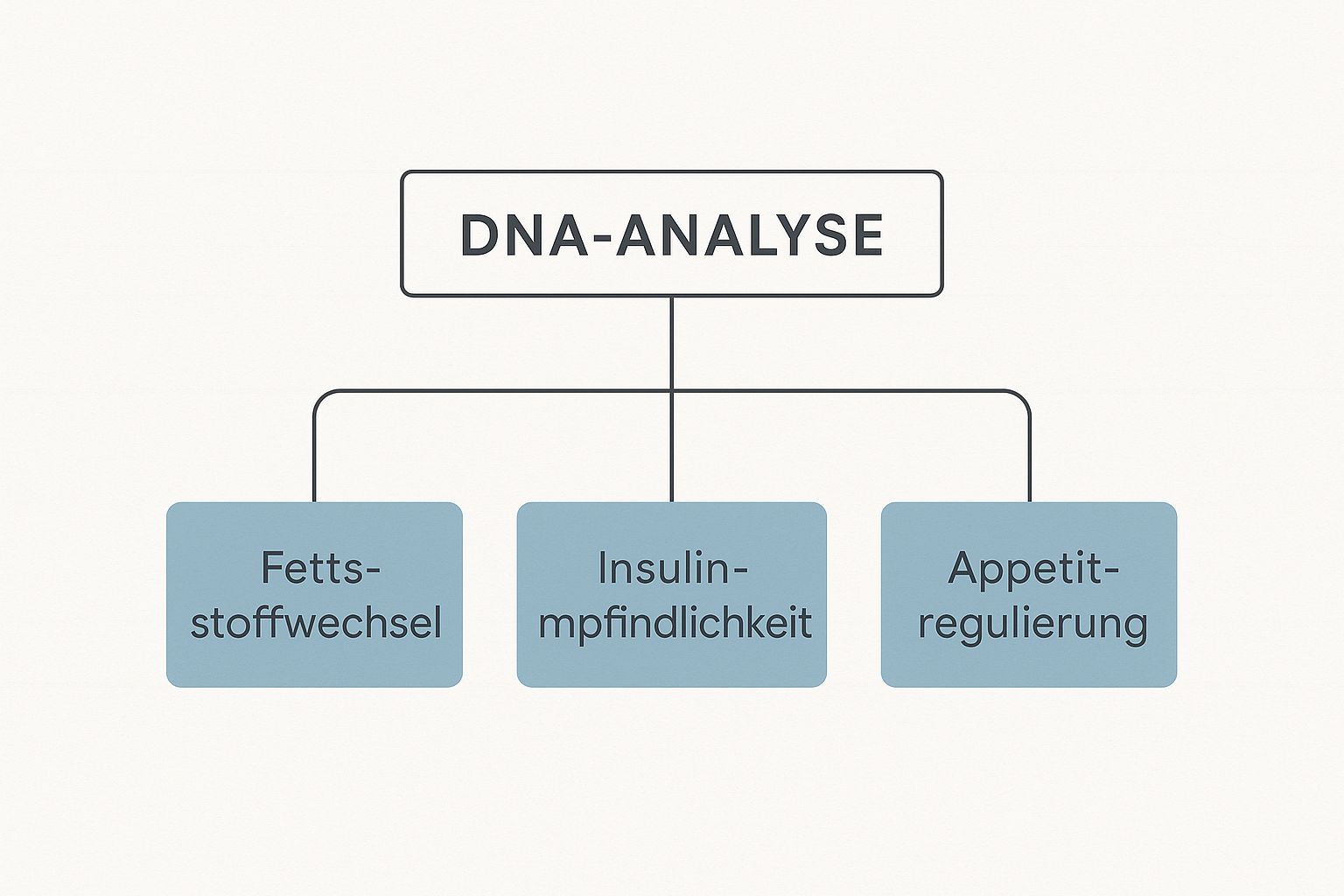
So the analysis doesn’t just look at one aspect; it examines the complex interplay of various genetic factors that influence your weight and health.
A typical “aha moment” deciphered
Many users report a genuine “aha moment” when they go through their report for the first time. The analyses are often 60–70 pages long and packed with details about fat and carbohydrate metabolism or potential intolerances. For many, it is the first time after years of frustrating dieting attempts that they truly understand the connections between their diet and their body’s reactions.
Let’s play this out using a specific example:
- Scenario: Your report shows a genetic tendency toward slower fat metabolism. This means your body processes fats less efficiently and tends to store them more quickly as energy reserves in fat deposits.
- What this changes for you: A ketogenic diet with an extremely high fat content would probably not be the fastest path to success for you. Instead, you are more likely to benefit from a balanced diet with a moderate fat content based on high-quality, unsaturated fats—think avocados, nuts, and olive oil.
- Your new shopping list: Instead of butter and full-fat cheese, your cart might now contain salmon, flaxseeds, and lean poultry.
Your genetic report is not a rulebook full of prohibitions. Think of it as a compass that points you toward the foods and habits that are in harmony with your body.
The following table provides a simplified illustration of how different genetic predispositions can lead to specific dietary recommendations.
| Metabolic type (genetic tendency) | Description | Optimal macronutrient distribution | Example foods |
|---|---|---|---|
| Protein type | Uses protein very efficiently for energy production and muscle maintenance. | Slightly higher protein content (approx. 25–35%) | Lean meat, fish, eggs, lentils, quinoa |
| Carbohydrate type | Can metabolize carbohydrates well without quickly storing them as fat. | Moderate to higher carbohydrate content (approx. 45–55%) | Whole-grain products, oatmeal, potatoes, fruit |
| Fat type | Uses fat efficiently as an energy source. A low-fat diet is often less effective. | Moderate fat content (approx. 30–40%) from healthy sources | Avocado, nuts, seeds, olive oil, fatty fish |
| Mixed type | Balanced metabolism without a strong tendency toward any particular macronutrient. | Balanced distribution of all three macronutrients | A varied mix of all food groups |
These examples make one thing clear: there is no single perfect diet, only the one that perfectly suits your genetics.
More than just nutrition: your exercise match
But your DNA reveals even more. It also provides insight into what type of athlete you are. Some people are genetically predisposed to endurance sports, while others see results much faster from short, intense strength workouts.
- The endurance type: Your muscle fibers are designed for prolonged, steady exertion. Jogging, cycling, or swimming are ideal sports for you to get your metabolism going.
- The strength type: Your muscles respond particularly well to intense, short bursts of exertion. Strength training, HIIT (High-Intensity Interval Training), or sprints are the most effective ways for you to build muscle and increase your basal metabolic rate.
This knowledge is worth its weight in gold. Instead of forcing yourself through a workout that doesn’t suit you, you can deliberately choose a form of exercise that not only you enjoy but also delivers the best results. If you’d like to explore the subject in greater depth, our article explains how you can understand your genes and use them for nutrition and health.
Adapting Your Daily Routine to Your Genes
Okay, you have the knowledge now—but real success only comes with implementation. You understand what treasures are hidden in your genetic report. Now comes the exciting part: translating this knowledge into your everyday life. A DNA analysis for weight loss only becomes your most powerful tool when you turn the recommendations into concrete, achievable habits.
Don’t worry, you don’t have to turn your whole life upside down. It’s more about making smart, informed decisions that feel good and fit easily into your daily routine. You’ll quickly notice that when you work with your body instead of against it, healthy choices suddenly feel effortless and right.
From Report to Personalized Nutrition Plan
The most important step? A nutrition plan tailored not only to your genes but also to your personal preferences. Forget rigid prohibitions and complicated rules. Your plan should be flexible, taste good, and fit into your everyday life.
Think of your genetic report as the ingredient list for your very own recipe for success. It reveals which amounts of carbohydrates, fats, and proteins are optimal for you. Your task now is to create dishes from them that taste good and do you good.
Let’s start with a simple structure for your day:
- Breakfast: What really gives you energy to start the day? If your body metabolizes carbohydrates well, porridge with fruit could be ideal. As a “fat type,” you might benefit more from scrambled eggs with avocado.
- Lunch: Plan a balanced meal that fills you up without sending you into an afternoon slump. A large salad with chicken breast for the protein type or a quinoa and vegetable bowl for the carbohydrate type are great options.
- Dinner: Choose something lighter that won’t unnecessarily burden your digestion overnight. Steamed fish with vegetables is almost always a good choice. Depending on your metabolic type, you can complement it with a little olive oil or a small portion of sweet potatoes.
This simple framework helps you keep track and make targeted decisions day after day.
Your genetic shopping list
The change begins in the supermarket. Instead of wandering aimlessly through the aisles, you now shop with a clear mission. Your knowledge of your genes becomes your personal shopping adviser.
Imagine your shopping cart is a reflection of your DNA. Every food you put in it is a conscious decision for your health and your healthy weight.
Here are a few practical tips for your next shopping trip, based on possible genetic tendencies:
- If you are sensitive to saturated fats: Leave fatty sausages and ready-made meals on the shelf. Choose lean poultry, fish, and plant-based protein sources such as lentils or chickpeas instead.
- If your body processes carbohydrates well: Focus on complex varieties that keep you full for a long time. Whole-grain bread, oats, quinoa, and legumes are your friends. Avoid white-flour products and sugary snacks instead.
- If you get hungry again more quickly: Fill your cart with fiber-rich vegetables and protein-rich foods. Salads, broccoli, bell peppers, as well as eggs, low-fat quark, and nuts can help curb cravings.
This conscious selection makes a huge difference. It is the first and most important step toward sustainably changing your diet.
Strategies for everyday life and special occasions
A healthy lifestyle also has to work outside your own four walls. Whether at a restaurant, with friends, or at family gatherings, with the right knowledge you can make the right choice here too—without any stress.
It's not about perfection, but about finding a good balance. Don't forbid yourself anything; instead, learn to find smart compromises.
- At the restaurant: Read the menu carefully. Choose grilled or steamed dishes instead of fried food. Ask for sauces to be served on the side—this way, you control the amount.
- At parties: Eat a small, protein-rich snack before the party. That way, you won't arrive famished and can better resist the temptations at the buffet. Focus on salads, lean meat, and vegetables.
- Snacks for on the go: Prepare healthy snacks that suit your metabolic type. These could be vegetable sticks with hummus, a handful of nuts, or an apple. This way, you won't be tempted to make unhealthy impulse purchases in the first place.
With these tools, the DNA analysis from mybody-x.com becomes your personal compass. It guides you not only toward your desired weight, but toward a healthier and lighter life overall—perfectly tailored to you.
What you should know about DNA analysis: the most frequently asked questions
The idea of getting a glimpse into your own genetic blueprint is fascinating. But of course, it also raises questions. You are curious, but perhaps also a little skeptical about what to expect and how it all works. No problem! Here we clarify the most important points so you know exactly where you stand.
Does a DNA analysis guarantee that I will lose weight?
This is probably the most important question of all, and the most honest answer is: yes and no. A DNA analysis for weight loss is not a magic pill that makes the pounds melt away overnight. But it is an incredibly powerful tool—essentially your personal, scientifically grounded roadmap to your goal.
Imagine receiving the exact blueprint for your dream house. That alone will not build the house. You still have to put the bricks together yourself. But with this blueprint, you know exactly where each brick belongs and save yourself the tedious and expensive process of trial and error.
The DNA analysis is your scientific compass. It does not relieve you of responsibility, but it shows you the most direct and intelligent path—without the usual “trial-and-error” cycles.
Your success still depends on you and your commitment. Your lifestyle, how you deal with stress, the quality of your sleep, and of course exercise remain crucial pieces of the puzzle. The huge advantage is that the analysis shows you which of these areas you need to focus on to achieve the greatest impact.
How secure is my genetic data, really?
A completely legitimate question! When it comes to such personal information as your DNA, you want to be sure. Protecting your data is not just a promise for reputable providers like mybody-x.com—it is their top priority.
We strictly comply with the European General Data Protection Regulation (GDPR) and work exclusively with ISO-certified laboratories in Europe. The entire process is designed for maximum security:
- Pseudonymization: As soon as your sample arrives at the laboratory, it is separated from your name. It is assigned a unique barcode, and only this code is used for processing.
- Encrypted transmission: All data exchanged between you, us, and the laboratory takes place via secure, encrypted connections.
- Clear purpose limitation: Your genetic data is used for one purpose only: creating your personal report. It will never end up with third parties such as insurance companies, employers, or other businesses.
- You are in control: You remain in control of your data at all times and can request its deletion whenever you wish.
So you can be absolutely sure: Your privacy is protected at all times.
Who can benefit most from a DNA analysis?
Essentially, the analysis is exciting for anyone who wants to better understand their body and take their health into their own hands. However, there are a few groups that benefit from it especially:
- The “diet veterans”: Have you already tried countless diets, but nothing has worked in the long term? If you are frustrated, the analysis can finally give you the answers you are looking for.
- The “why askers”: Do you often feel that your body works differently? That certain foods affect you differently than they affect others? The analysis provides those “aha moments” and explains connections you have previously only suspected.
- The health optimizers: You already live consciously but want to do everything right from the start? Instead of chasing general trends, you build your nutrition and training on a solid, individual foundation.
Ultimately, the analysis is designed for anyone who is ready to take responsibility for themselves and make decisions based on facts rather than assumptions.
Does the DNA test replace medical advice?
No, and this is a very important point. A DNA test for nutrition and lifestyle purposes is not a medical diagnostic tool. It never replaces a visit to the doctor.
If you have health issues, chronic conditions, or suspect food allergies or severe intolerances, your first point of contact should always be a doctor or qualified therapist.
What the DNA analysis can be, however, is an excellent basis for a conversation with an expert. You can discuss your genetic predispositions with your doctor or nutritionist to fine-tune and personalize your health plan even further. This creates a bridge between lifestyle optimization and medical care.
Are you ready to crack the mystery of your metabolism and find your very own path to greater well-being? With a mybody-x test, you get scientifically grounded analyses that provide clear, actionable insights into your body. Start your journey toward nutrition that truly suits you now.



Share now:
Lose belly fat: Why your metabolism is the key
What is a Slim DNA analysis? Understand the basics