

Understanding Fiber: Effects, Benefits, and Tips
TL;DR:
- Fiber consists of indigestible plant components that do more than simply promote bowel function. It affects the microbiome, blood sugar, and inflammation in the body, with soluble and insoluble types serving different functions. A varied diet containing at least 30 grams daily supports gut health and can be individually adjusted to prevent discomfort.
Anyone who first associates the word “fiber” with constipation or whole-grain bread is not wrong, but is thinking far too narrowly. Fiber is an indigestible carbohydrate component found in plant-based foods that does far more than occasionally stimulate the bowels. It affects the microbiome, inflammatory responses in the body, blood sugar, and even well-being. This article explains what fiber really is, how different types work, how much the body needs, and why individual tolerance is so often underestimated.
Table of Contents
- What Fiber Really Is: Definition and Classification
- How Fiber Works in the Body: More Than Just Bulk
- How Much Fiber Does Switzerland Need? Recommendations and Everyday Tips
- Individual tolerance: Is Fiber Different for Everyone?
- Why simplicity with dietary fiber actually has the greatest impact
- Fiber and Gut Health: Your Path to Greater Well-Being
- Frequently Asked Questions About Fiber
Key Takeaways
| Point | Details |
|---|---|
| Fiber Explained | Fiber consists of indigestible plant components that perform important functions in digestion. |
| Soluble vs. Insoluble Types | Soluble and insoluble fiber work differently and complement each other to support healthy digestion. |
| Swiss Recommendations | According to the SGE and DGVS, adults are recommended to consume at least 30 grams of fiber per day. |
| Individual Tolerance | Not everyone tolerates fiber equally well, so a cautious, individualized start is advisable. |
| Practical Implementation | Small, lasting changes to your diet have the most sustainable impact on well-being. |
What Fiber Really Is: Definition and Classification
Fiber is a type of carbohydrate, but it is not—or is barely—broken down by the human digestive system. This may initially sound unimpressive. Yet this very property is what makes fiber so valuable. Because it passes undigested through the stomach and small intestine, it exerts its effects where they matter most: in the large intestine.
Fiber can be broadly divided into soluble and insoluble fiber. This is not merely an academic distinction. The two categories behave fundamentally differently in the body and consequently offer different benefits.
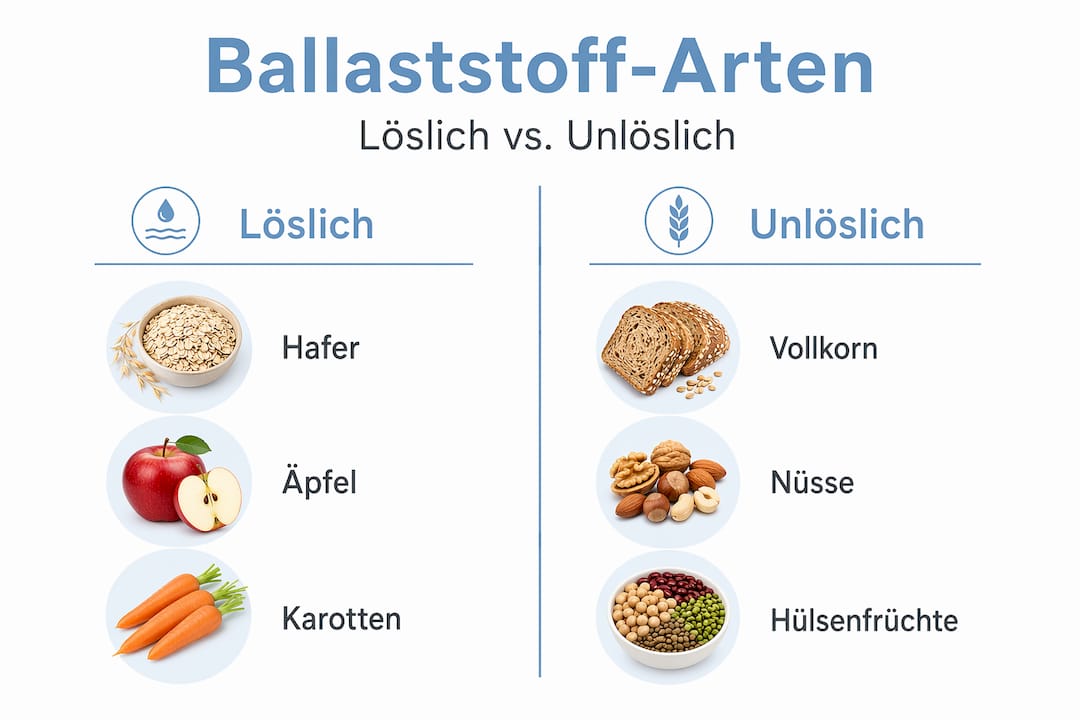
Soluble fiber swells when it comes into contact with water and forms a gel-like mass. It is found primarily in oats, legumes, apples, citrus fruits, and psyllium husks. In the large intestine, it is fermented by gut bacteria, meaning they use it as food, producing beneficial metabolic byproducts. One particularly well-known example is beta-glucan from oats, which has been shown to lower cholesterol levels.
Insoluble fiber does not dissolve in water; instead, it binds liquid, increasing the volume of the intestinal contents. It accelerates intestinal transit and thereby promotes regular digestion. It is abundant in whole-grain products, nuts, seeds, wheat bran, and many types of vegetables. The fiber in bananas in particular shows how a single food can contain both types.
Comparison: Soluble vs. Insoluble Fiber
| Property | Soluble fiber | Insoluble fiber |
|---|---|---|
| Behavior in water | Swell, become gel-like | Bind water, remain structured |
| Main sources | Oats, legumes, fruit | Whole grains, nuts, vegetables, bran |
| Fermentation in the intestine | Yes, fully or partially | Little to no fermentation |
| Effect on digestion | Slows gastric emptying | Accelerates intestinal transit |
| Cholesterol and blood sugar | Known positive influence | Little direct influence |
| Effect on the microbiome | Highly prebiotic | Less prebiotic |
The following list summarizes where each type is particularly common:
- Oats and oat bran: Particularly rich in beta-glucan, a soluble fiber
- Flaxseeds and psyllium husks: Contain both soluble and insoluble fiber
- Kidney beans and lentils: High in soluble fiber
- Wheat bran: A classic source of insoluble fiber
- Carrots and broccoli: Good sources of mixed fiber profiles
- Whole-grain bread and whole-grain pasta: Primarily provide insoluble fiber
This variety makes it clear: Those who eat a varied diet cover both types without having to pore over nutrition tables.
How Fiber Works in the Body: More Than Just Bulk
Now that you know what fiber is, the question is how it actually works in the body. The answer surprises many people because the mechanisms are so different.
Fiber supports digestion primarily by adding bulk to the contents of the intestines and influencing bowel movements and intestinal transit. This is the mechanical effect that most people are familiar with. But in addition, there is the biochemical effect, which is even more far-reaching.
The journey of fiber through the body
- Stomach: Soluble fiber forms a gel that slows gastric emptying. The feeling of fullness lasts longer, and post-meal blood sugar spikes are buffered.
- Small intestine: Fiber is barely digested but binds bile acids. This forces the liver to produce new bile acids from cholesterol, which lowers blood cholesterol levels.
- Large intestine: This is where the most interesting processes take place. Gut bacteria ferment soluble fiber and produce short-chain fatty acids, also known in English as “short-chain fatty acids."
- Short-chain fatty acids: These molecules, especially butyrate, propionate, and acetate, nourish the intestinal lining, inhibit inflammatory processes, and even communicate with the immune system.
- Excretion: Insoluble fiber leaves the body almost unchanged, but takes bound toxins and bile acids with it.
“Short-chain fatty acids produced during the bacterial fermentation of fiber are considered one of the most important mechanisms through which diet directly influences gut health."
This point deserves special attention: The gut flora, or microbiome, depends on fiber. Without sufficient dietary fiber, certain bacterial strains literally starve. A depleted microbiome has been linked to an increased risk of inflammation, weight gain, and even psychological problems.
Fiber therefore functions as natural prebiotics, serving as food for beneficial bacteria. This fundamentally distinguishes it from probiotics, which introduce live bacteria. Anyone who wants to improve their digestion in the long term can hardly avoid a high-fiber diet.

The effect on the immune system is also interesting. Around 70 percent of immune cells are located in intestinal tissue. A well-nourished intestinal lining that benefits from butyrate acts as a more stable barrier against invaders. Anyone who regularly gets sick or suffers from low-grade inflammation will find a practical starting point in a high-fiber diet. Further practical tips for better digestion can help put this approach into practice in everyday life.
How Much Fiber Does Switzerland Need? Recommendations and Everyday Tips
After understanding the mechanisms of action, it is helpful to look at specific recommendations and how to implement them in everyday life in Switzerland.
The SGE reference values for nutrients recommend at least 30 grams of fiber per day for adults in Switzerland. In reality, a large proportion of the population does not reach this amount. Studies show that many adults in German-speaking countries consume only 18 to 22 grams per day on average. That is a significant gap.
The DGVS states in its guideline that a high-fiber diet providing 30 g/day is even recommended to help prevent diverticular disease. Diverticula are small pouches in the intestinal wall that can form when intestinal contents remain under increased pressure. More fiber, more bulk, less pressure.
Fiber content of common foods
| Food | Serving | Fiber (approx.) |
|---|---|---|
| Cooked lentils | 150 g | 7,5 g |
| Oatmeal (dry) | 50 g | 4,5 g |
| Whole-grain bread | 2 slices (80 g) | 5,5 g |
| Carrots (raw) | 150 g | 4,0 g |
| Apple with skin | 1 piece (150 g) | 3,5 g |
| Broccoli (cooked) | 150 g | 4,5 g |
| Flaxseeds (ground) | 1 tbsp (10 g) | 3,5 g |
| Kidney beans (canned) | 100 g | 6,5 g |
This table makes it easy to calculate: A breakfast with oatmeal and an apple already provides 8 grams. A lunch with lentil salad and whole-grain bread adds another 13 grams. For dinner, broccoli with carrots can add another 8.5 grams. The 30 grams are achievable without resorting to dietary supplements.
Anyone familiar with the fiber content of bananas also knows that a medium-sized banana provides about 2.5 to 3 grams and makes a good snack for any eating routine.
Practical everyday tips:
- Consistently replace white bread with whole-grain alternatives
- Include legumes in meals at least three times a week
- Do not peel vegetables unless necessary, as the peel often contains a lot of fiber
- Stir flaxseeds or chia seeds into yogurt, muesli, or smoothies
- Choose snacks made from nuts or raw vegetables
Pro tip: Always combine fiber with sufficient fluids. For every 5 grams of additional fiber, you should drink about 200 ml more water. Without sufficient fluid, insoluble fiber can actually block the intestines instead of relieving them.
For anyone who wants to improve their gut health gradually, gradually increasing the daily amount of fiber is much more sensible than making an abrupt change. More on this in the next section.
Individual tolerance: Is Fiber Different for Everyone?
Following the basic recommendations, we now turn to individual differences and challenges. Because what sounds good in theory does not work equally well for everyone.
A very high fiber intake can cause bloating and, for some people, genuine discomfort. This is because fermentation in the large intestine produces gas. When the microbiome is not yet accustomed to certain types of fiber, more gas than usual is produced. This is not a sign of an unhealthy gut, but often an adaptation response.
In irritable bowel syndrome (medically: irritable bowel syndrome), the situation is more complex. Some people benefit from soluble fiber such as psyllium husks. Others are sensitive to certain fermentable carbohydrates known by the acronym FODMAP. FODMAP stands for fermentable oligosaccharides, disaccharides, monosaccharides, and polyols. These are sugar molecules in foods such as onions, garlic, apples, and legumes that can trigger symptoms in people with sensitive digestion.
There is no one-size-fits-all recommendation for people with irritable bowel syndrome. A structured approach is helpful. More about fiber for IBS explains how individualized adjustment can work.
Pro tip: Anyone new to a high-fiber diet or familiar with symptoms such as bloating after eating should gradually increase their intake over three to four weeks. The gut needs time to adjust its microbiome.
A gentle transition in five steps
- Establish a baseline: For one week, record how much fiber you consume each day. This creates an honest starting point.
- First week: Consume 5 grams more each day than before, for example through a serving of legumes or whole-grain bread.
- Adjust fluid intake: Increase your water intake at the same time, aiming for at least 1.5 to 2 liters per day.
- Monitor reactions: Bloating or a feeling of fullness during the first few days is normal. If the symptoms do not subside after two weeks, reduce the amount slightly again.
- Prefer soluble fiber: Psyllium husks, oats, and well-cooked legumes are especially well tolerated. People who are very sensitive often do better with these than with raw wheat bran.
For people with irritable bowel syndrome, there are also alternative approaches such as qigong that target the gut-brain connection and may be worth considering alongside dietary changes.
The key message for individual tolerance is this: Dietary fiber is not a universal miracle cure. Anyone who understands their own gut—that is, knows which dietary fibers are well tolerated and which cause problems—can take targeted action. This is precisely where the value of a personal microbiome analysis becomes clear.
Why simplicity with dietary fiber actually has the greatest impact
A well-intentioned misconception persists in the world of nutritional optimization: Anyone who seriously wants to do something for their gut health needs special supplements, fermented superfoods from faraway countries, or sophisticated fiber combinations in capsule form. That simply is not true.
In our experience with thousands of customers, the same pattern emerges again and again. Those who make the greatest progress do not replace complicated systems with new ones. They add oatmeal to their daily breakfast, replace white rice with whole-grain varieties, or eat more lentils once a week. Over time, these small, boring steps achieve more than any expensive supplement.
This is also because the gut thrives on consistency. A microbiome that reliably receives dietary fiber every day stabilizes. It develops a more resilient community of bacterial strains. By contrast, a sporadic high-dose burst of fiber often overwhelms the system and creates precisely the bloating and feeling of fullness that keep people from sticking with it.
We also observe that focusing on unusual products often distracts from the actual task: honestly assessing your own diet and adjusting it step by step. Anyone who uses simple home remedies for bowel movements and tried-and-tested food combinations every day gains more in the long term than someone searching for the next trendy supplement.
Another blind spot: Many people think of dietary fiber exclusively in terms of regulating digestion. In reality, its effects go deeper. Better blood sugar stability, more favorable cholesterol levels, a supported immune system, and a well-nourished intestinal lining. These are not side effects; they are core benefits that can be achieved with simple foods.
Dietary fiber is a tool for improving quality of life. It is not a magic bullet, and it does not replace taking a targeted look at your own microbiome or individual nutrient intake. But as the foundation of a healthy diet, it has a firm place, and that place can be filled with foods found in every Swiss supermarket.
Fiber and Gut Health: Your Path to Greater Well-Being
Once the overview of fiber is complete, we show what else can be done in practice. Knowledge alone does not change habits.
At mybody-x, you will find extensive resources on the connection between nutrition, gut health, and individual well-being. Anyone who wants to understand their own microbiome and determine which types of fiber work best for them can benefit from a scientifically grounded microbiome analysis. The health portal also offers practical guides, such as guidance on nutrition for irritable bowel syndrome, based on current research findings. With more than 11,300 satisfied customers and a personalized consulting service, mybody® is the companion for anyone who wants to manage their health independently and based on evidence.
Frequently Asked Questions About Fiber
What Happens If You Consume Too Much Fiber?
A very high fiber intake often causes bloating and a feeling of fullness and can, in rare cases, impair the absorption of certain minerals such as iron or zinc. Increasing intake gradually and drinking enough fluids significantly minimizes this risk.
Are There Foods That Contain Particularly High Amounts of Fiber?
Yes: Legumes, whole-grain products, flaxseeds, and many types of vegetables are high in fiber, as is confirmed by the fiber content of plant-based foods such as whole grains and vegetables. Kidney beans, oats, and broccoli are among the most efficient sources.
How Can I Tell Whether I’m Eating Enough Fiber?
Typical signs of a deficiency include sluggish digestion, irregular bowel movements, and frequent hunger shortly after eating. Keeping a food diary for a week quickly provides clarity about your actual intake.
Is Fiber Beneficial for Irritable Bowel Syndrome?
This depends largely on the individual symptoms: Some people benefit from soluble fiber, while others are sensitive to FODMAP-rich foods, as Kantonsspital Baden also describes in its dietary recommendations for irritable bowel syndrome. Introducing fiber slowly and choosing the right type are crucial.



Share now:
Melatonin effects: facts and use explained scientifically
How many bananas a day are healthy? The honest answer