

Losing weight after 60: what really matters now
The essentials at a glance
After 60, the crucial question is no longer how quickly your weight drops, but what is lost in the process. Over the years, muscle mass declines anyway, and losing weight without countermeasures accelerates exactly that.
This article explains what shifts in the body during this stage of life, why protein now plays a different role than it did at forty, what amount the professional societies recommend, and how to recognize whether losing weight actually benefits you.
First, you will read why the question is different after 60, followed by the physical background, the protein lever with documented figures, three approaches compared, the role of strength in everyday life, and the limits of every recommendation.
What to expect in this article
1. Why the question is different after 60
2. What shifts in the body
3. The protein lever and the number behind it
4. Three approaches compared
5. Strength in everyday life: the underestimated part
6. When your own values are helpful
7. The limits of every recommendation
8. What you will take away from this article
Frequently asked questions
Sources
Why the question is different after 60
Most weight-loss guides are written for people around forty. There, the focus is on kilograms, speed, and discipline. After 60, that calculation falls short, for a reason that is rarely stated: It is no longer just how much you lose that matters, but what the loss consists of.
Every weight loss consists of fat and fat-free mass, and muscle is part of fat-free mass. In younger years, the body can easily compensate for this. As the years pass, that compensation becomes more difficult, while muscle mass is already gradually declining. Anyone who loses weight quickly after 60 without doing anything to preserve muscle therefore loses it in precisely the area where it hurts.
Those seeking advice during this stage of life nevertheless usually encounter the same recommendations as people in their thirties: eat less, move more, count calories. The first part of that advice can even be risky after 60 if it is not accompanied by the second. A strict calorie deficit without protein and without a stimulus from exercise breaks down exactly the tissue that matters here.
This does not mean that losing weight during this stage of life is wrong. If weight puts strain on the joints, raises blood pressure, or limits mobility, there is much to be said for it. Only the order changes: Preserve muscle first, then lose kilograms. One kilogram less at the cost of strength is not a gain.
The focus also shifts. At thirty, the goal was usually appearance; at sixty, it is mobility, resilience, and managing everyday life without outside help. This is not a lesser goal—it is a more concrete one, and it can be assessed more effectively than any clothing size.
A warning sign belongs at the beginning here as well: Unintentional weight loss in later life is not a success but a reason to make a doctor's appointment. Anyone who loses weight without intending to, loses their appetite, or becomes noticeably lighter within a short period should have it checked before changing anything about their diet.
For clarity: The hormonal changes of menopause, meaning roughly the years between 45 and 55, are covered in the article Losing Weight During Menopause. This article focuses on the period afterward, when hormone levels have settled and another factor comes to the fore.
What changes in the body
The German Nutrition Society describes the change in body composition with age in objective terms: Because lean body mass decreases, especially skeletal muscle, energy expenditure also declines (DGE, 2023). That is the entire mechanism in one sentence, and it explains both observations that many people experience during this stage of life.
The first: Weight increases slowly even though eating habits have not changed. The reason is lower energy expenditure, not a lack of self-control. The second: Everyday activities become more strenuous—climbing stairs, carrying a shopping bag, getting up from a deep armchair. This, too, is due to diminishing muscle mass, and it is the factor that helps determine whether someone can remain independent in old age.
That is precisely why professional societies place protein at the center of discussions about nutrition in old age:
Documented source
“Experts from several European specialist groups and societies consider a protein intake of 1.0–1.2 g per kg of body weight to be optimal.”
German Nutrition Society (DGE)
Body composition and critical nutrients in old age, DGEwissen 9.2023
Key message
From age 60 onward, the number on the scale matters less than whether muscle mass is preserved. Protein and exercise are the two tools for this, and both only work together.
Why the scale is now the poorer guide
This mechanism leads to a conclusion that contradicts most weight-loss guides: After 60, body weight alone says little. Two people with the same weight may be in completely different condition, depending on how much of that weight is muscle. And the same person can weigh the same over a year and still have become significantly weaker.
What the body can do is therefore more meaningful. How often can you stand up from a chair without using your hands? How far can you walk briskly before you need a break? How does carrying the groceries up to the third floor feel? These three observations are better for tracking progress than any number on the scale in the morning, and they cost nothing.
Anyone who still wants to measure progress can also measure their waist circumference. It responds to changes in fat distribution without being distorted as much by muscle mass and fluid retention as total body weight is. Once a month, always at the same spot, in the morning before breakfast—that is sufficient.
There is also a third shift that goes largely unnoticed in everyday life but still matters: The sensation of thirst decreases with age. Those who drink little are more likely to mistake thirst for hunger, and kidney function is placed under additional strain. Adequate hydration is therefore part of every nutrition plan at this stage of life, even if it appears unrelated to weight loss at first glance.
The protein lever—and the number behind it
The most important figure in this article can be stated in one sentence: For adults between 19 and 64, the DGE reference values specify 0.8 grams of protein per kilogram of body weight per day, compared with 1.0 grams from age 65 onward (DGE, derivation 2017). So protein requirements increase while energy requirements decrease.
A brief calculation shows what this means in practice: At a body weight of 70 kilograms, that amounts to around 70 grams of protein per day instead of the 56 grams that used to be sufficient. And because less energy is needed at the same time, this protein has to come from a smaller overall intake. The plate does not get bigger; its composition changes.
Honesty includes being clear about how reliable these figures are. The DGE itself states regarding the values for older adults that they are estimates and that protein requirements cannot be determined with the desired precision (DGE, 2017). The overall direction is therefore well established, but not the second decimal place. Anyone reaching 1.0 rather than 1.2 grams has done nothing wrong.
In practical terms, every main meal should include a recognizable source of protein. In the morning, quark, skyr, or an egg; at lunch, legumes, fish, or poultry; in the evening, cheese, eggs, or a lentil soup. If you eat a plant-based diet, use lentils, beans, tofu, and nuts, and combine them a little more deliberately. The articles Protein requirements for women and Daily protein requirements explain how to meet your individual needs in concrete terms.
What a day can look like in practice
Numbers remain abstract until they are on the table. An example day providing around 70 grams of protein: in the morning, 250 grams of low-fat quark with berries, providing about 30 grams. At lunch, a portion of lentils or a piece of fish, providing another 25 grams or so. In the evening, two eggs or a piece of cheese with whole-grain bread, providing the remaining 15 to 20 grams. None of this is expensive, complicated, or unfamiliar.
If you have little appetite—which is more common at this stage of life—reverse the order: Eat the protein first, then the rest. If you only manage half the plate, at least you will have eaten the part that matters most. Soups, casseroles, and quark dishes also help because they are easier to eat than a large portion of meat.
A second building block alongside protein is fiber from vegetables, legumes, and whole grains. It fills the plate without adding much to the overall balance, and it supports digestion, which becomes more sluggish over the years. Together with sufficient fluids, this is the least glamorous yet most effective part of the entire plan.
One point that is often overlooked: Distribution throughout the day matters too. Many people eat almost no protein in the morning and a great deal in the evening. A more even distribution across three meals is the better choice in old age because the body can make less use of one very large portion at once than of three medium-sized portions.
Chapter at a glance
From age 65, protein requirements rise to 1.0 grams per kilogram of body weight, compared with 0.8 grams in the preceding decades (DGE, 2017 derivation); European professional organizations consider 1.0 to 1.2 grams optimal (DGE, 2023). At the same time, energy requirements decrease. So the plate does not get bigger—it becomes richer in protein, and distributing it across three meals is better than having one large portion in the evening.
Three approaches compared
These shifts result in three starting points. The table places them side by side according to the same criteria, with particular attention to what is at stake at this stage of life.
| Criterion | Increase protein | Build strength | Know your own values |
|---|---|---|---|
| What it addresses | the increased need resulting from lower energy expenditure | the stimulus that maintains the muscles in the first place | whether a deficiency is getting in the way |
| What it can do | provides good satiety and supports muscle maintenance | strength in everyday life, stability, greater energy expenditure at rest | replaces guesswork with numbers, including for discussions with your doctor |
| Effort | daily decisions, no new appointments | two sessions per week, also possible at home | measure once and repeat after a few months if needed |
| What it does not do | without a movement stimulus, its effect on the muscles remains limited | does not replace an individualized diet; works slowly | not a diagnosis or treatment decision |
What stands out is what is missing from the table: a diet with a name. That is intentional. Keto, intermittent fasting, and low-carb diets are not inherently wrong at this stage of life, but they answer the wrong question. An approach that does not ensure sufficient protein and provide a movement stimulus will not help after 60, no matter what it is called or how well it has worked for younger people.
The honest interpretation: The first two columns belong together and only work in combination. Protein without a movement stimulus does not build muscle, and training without enough protein has no building material. The third column is not an intervention but an assessment of where you stand, and it is especially worthwhile when nothing improves despite your efforts.
Strength in everyday life: the underestimated part
When many people hear the term strength training, they picture a gym full of equipment and young people. It means something else: muscles working against resistance twice a week; twenty minutes is enough to start. The resistance can be a band, a water bottle, a stair step, or your own body weight as you stand up from a chair.
After 60, strength is not about appearance but about independence.
The reason strength matters above everything else at this stage of life has nothing to do with the number on the scale. Anyone who can get up using their own strength, carry groceries, and walk safely remains independent. Muscle is the prerequisite for this, and it responds to training at any age, even at eighty. That may be the most encouraging message of this topic.
Four exercises that require no equipment
To turn your intention into action, here are the four movements that cover most of the strength needed in everyday life. Standing up from a chair without using your hands, ten times in a row, trains your legs and core at the same time. Standing on your toes at the kitchen counter, also ten times, supports your calves and balance. Lifting light weights overhead—two water bottles are enough—keeps your shoulders flexible. And standing on one leg for twenty seconds at a time trains exactly what prevents falls.
Twice a week, two to three sets, with one day of rest in between. If you want to do more, increase the repetitions first and only then the weight. And if you feel unsteady, do the exercises within reach of a table edge or with another person in the room. This is not patronizing; it is the difference between a program you can stick with and a fall.
What you can expect: Strength comes before appearance. After about six to eight weeks, stairs and shopping bags feel easier, long before anything shows in the mirror. Anyone who waits only for visible change will stop before the real benefit arrives.
Everyday movement also matters more than its reputation might suggest: walking, gardening, taking the stairs instead of the elevator, and shopping without a car. It does not replace strength training, but it keeps daily energy expenditure at a level that noticeably eases the changed balance, and it requires no effort to show up for a scheduled appointment.
The article Losing Weight Without Exercise calculates, using documented figures, how much exercise contributes mathematically to weight loss and what is possible even without training. For this stage of life, its conclusion needs one added qualification: Without exercise, weight loss comes more at the expense of muscle, and that is precisely the loss to avoid here.
One qualification is important: Anyone with joint problems, cardiovascular disease, or balance issues should consult a doctor before starting a training program. This is not a mere formality, but the difference between a program that holds up and one that ends in a setback after two weeks.
When your own values can help
There is a situation in which diet and exercise alone do not get you any further: when a nutrient deficiency is underlying the problem. A low vitamin B12 level, iron deficiency, or an underactive thyroid can make you tired and lethargic, and fatigue is the most reliable enemy of any plan. Especially in older age, the body also absorbs some nutrients less effectively than it used to.
Three values are particularly often abnormal: vitamin B12, because absorption through the stomach declines over the years and because people who eat less meat take in less of it. Vitamin D, because the skin produces less of it with age and many people spend less time outdoors. And iron status, which can gradually shift without anyone noticing. All three first show up as fatigue, and at this stage of life, fatigue is often attributed to age rather than to a treatable cause.
A measurement answers one limited but useful question: Where do your levels currently stand? It does not replace a diagnosis or treatment; both belong in a doctor's office. It replaces something else: guesswork, and it makes the next conversation there more specific. At mybody®x (MYBODY Lab GmbH), the VitalCheck provides this, with ISO-certified analysis in Germany. You can read how others experienced their measurement on the customer reviews page.
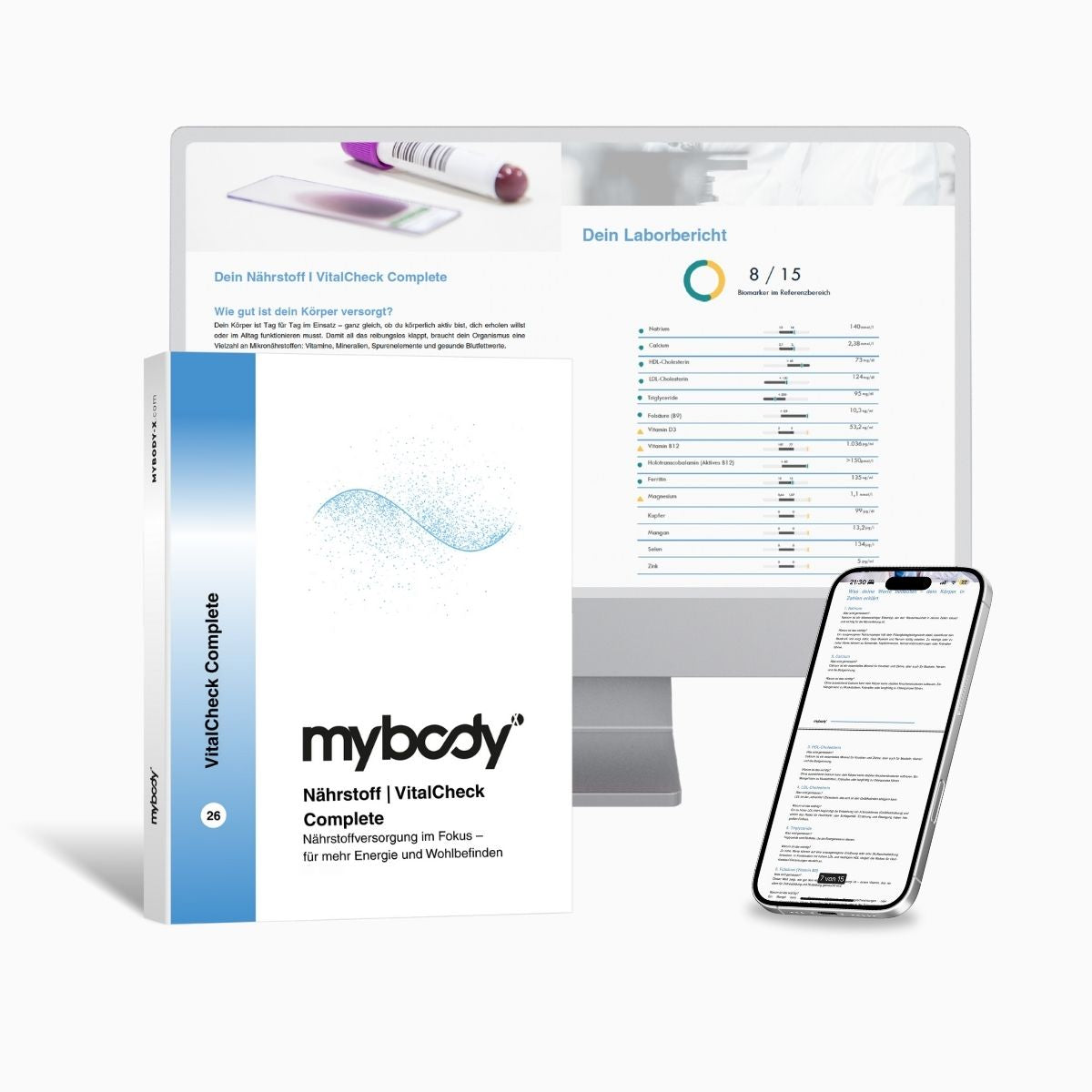
Blood test from capillary blood
VitalCheck | Complete Nutrient & Mineral Test
18 biomarkers from capillary blood, including vitamin B12, vitamin D, iron status, and a thyroid value, providing a snapshot at the time of sampling. What the test does not do: It does not diagnose, replace a medical consultation, or make the changes to your daily routine for you.
Laboratory evaluation 3–5 business days after sample receipt
Product page information, accessed 26 August 2026
You can read what the individual values mean before and after the measurement in the Biomarker Lexicon with 67 explained blood values. The honest comparison answers whether a measurement is worthwhile for you in either direction:
Useful for you if …
you feel persistently tired and weak and want to know whether a nutrient deficiency could be behind it before changing your diet.
you want to make a change anyway and are looking for a starting point instead of a guess.
you want to bring numbers to your next doctor's appointment that you can discuss specifically.
Probably not if …
you expect the test itself to make you lose weight. A measurement doesn't move weight; plates and exercise do.
you are already receiving medical treatment and having blood drawn regularly there. In that case, the results are already available.
if you are unintentionally losing weight or have acute symptoms. This belongs directly in a medical practice, not in a self-test.
The limits of every recommendation
The first boundary concerns the numbers themselves. The DGE explicitly points out that the protein values for older adults are estimates. They provide guidance, not a target that must be hit exactly. Following them as a guide is sensible; turning them into daily bookkeeping only places unnecessary pressure on you without any benefit.
The second boundary concerns medical conditions. With impaired kidney function, different rules apply to protein intake, and medications can also affect appetite, weight, and nutrient absorption. Anyone who regularly takes medication or has a chronic condition should discuss dietary changes with their healthcare provider before starting them. In this context, that is not a mere platitude.
Another boundary concerns the pace. For younger adults, losing 5 to 10 percent of their initial body weight over 6 to 12 months is considered a sensible range. From age 60 onward, that is more of an upper limit than a goal: The slower the weight loss, the greater the proportion that comes from fat rather than muscle. Half a kilogram per month, accompanied by protein and training, is a better result at this stage of life than two kilograms without either.
The third boundary is the most important, which is why it appears here once again: Unintentional weight loss, declining appetite, or loss of strength over a short period are not weight-loss issues. They need to be investigated, and that comes first. A guide can provide context, but it cannot examine you.
What you will take away from this article
If you take away one thing, let it be the changed order: Preserve muscle first, then focus on weight. In concrete terms, that means more protein with lower energy needs, spread across three meals, plus a muscle-strengthening stimulus twice a week that can even take place in your living room.
The second thought is reassuring: Much of what is experienced as personal failure at this stage of life is simply lower energy expenditure with the same habits. This is not a question of character, nor a reason to be stricter with yourself. It is a calculation problem with a known solution.
And measure your progress by more than the scale. Whether you get up more easily, walk more confidently, and carry the shopping bag without taking a break says more about your condition at this stage of life than two kilograms in either direction.
It began with the observation that the usual weight-loss guides no longer work after 60. They do not work because they optimize a number, whereas something else is at stake here. If you first want to see where you stand: the consultation costs nothing, and it will not sell you anything.
Frequently asked questions
Is losing weight after 60 still worthwhile?
It depends on what the weight loss consists of. If weight is putting strain on your joints or affecting health markers, there is a strong case for it. The key is to preserve muscle in the process, because it provides strength and independence. Weight loss without protein and without a movement stimulus disproportionately affects muscle and can ultimately do more harm than the lost kilogram does good.
How much protein do I need per day after 60?
The DGE reference values specify 1.0 grams of protein per kilogram of body weight per day from age 65, compared with 0.8 grams between ages 19 and 64 (DGE, derivation 2017). European professional groups consider 1.0 to 1.2 grams optimal (DGE, 2023). At 70 kilograms, that amounts to around 70 to 84 grams per day. The DGE points out that these are estimates, so the direction is supported by evidence, not the second decimal place.
Why am I gaining weight even though I am not eating more than I used to?
Because your energy expenditure has decreased, not because you have become more careless. Over the years, fat-free body mass decreases, especially skeletal muscle, and energy expenditure falls with it (DGE, 2023). The same portion therefore creates a small surplus over the years. The key is less about cutting things out and more about the composition of your plate and preserving muscle.
Is strength training still worthwhile at this age?
Yes, muscles respond to training at any age. This does not mean using gym equipment, but doing two sessions per week against resistance, which could be a resistance band, a water bottle, or standing up from a chair. If you have joint problems, cardiovascular disease, or balance issues, consult a doctor before getting started.
When should I bring this issue to a medical practice?
In three cases, go straight to a medical practice rather than relying on guides and tests: if you have unintentional weight loss, a persistent decline in appetite, or noticeable loss of strength over a short period. Any change in protein intake should also be discussed beforehand if you have impaired kidney function. A measurement at home can help prepare for the conversation, but it cannot replace it.
Next step
If you first want to see where you stand
VitalCheck Complete measures 18 biomarkers from capillary blood, including vitamin B12, vitamin D, and iron status. As a basis for your next steps and for your conversation with your doctor. The Biomarker Encyclopedia explains what the results mean.
Go to VitalCheck Complete Go to the Biomarker EncyclopediaRead more
You might also be interested in
The broader context surrounding this article’s protein question.
The phase before that, with hormonal changes at the center.
Sources
- German Nutrition Society (DGE): Body Composition and Critical Nutrients in Older Age (DGEwissen 9.2023) – dge.de
- German Nutrition Society (DGE): Reference Values for Protein (Derived 2017) – dge.de
The verbatim quote on the optimal protein intake of 1.0 to 1.2 grams and the information on changes in body composition with age are taken from [1]; the statement about declining fat-free mass is paraphrased. The reference values of 0.8 grams for ages 19 to 64 and 1.0 grams from age 65 onward, as well as the note that these are estimates, are taken from [2]. Information on price, sample type, biomarkers, and laboratory comes from the mybody®x product page, accessed on 26 August 2026; processing times follow the central specification for each test type. All sources were accessed and checked on 26 August 2026.

mybody®x Editorial & Expert Team
Blood analysis interpretation Nutritional science Laboratory diagnostics
This article was created by the mybody®x editorial and expert team. The team combines expertise in blood analysis interpretation, nutritional science, and laboratory diagnostics. Contributors can be found on the authors page.
Published on 26 August 2026 · Last updated on 26 August 2026
The content is for general information only and does not replace medical advice, diagnosis, or treatment. Reference ranges depend on the laboratory, method, and age—always refer to the information on your test report.

Share now:
Which genes does a DNA test examine? The scope explained honestly
Fasting for a blood test: what is and isn’t allowed