

Which genes does a DNA test examine? The scope explained honestly
The essentials at a glance
A lifestyle DNA test examines genetic variants with an established connection to nutrition, metabolism, nutrient requirements, exercise, and recovery. More than 700,000 predefined positions in the genome are read for this purpose; depending on the package, more than 80 to more than 170 genetic variants are analyzed. Disease diagnostics are explicitly not included.
This article explains what a gene and a genetic variant actually are, the principle used to select the positions examined, which subject areas are covered, and where the boundary to medical genetic diagnostics lies.
You will first read the short answer and the basics, followed by the reading method, the subject areas, what is deliberately not examined, and where you can look up every individual entry before buying.
What to expect in this article
1. The short answer to the question in the title
2. What exactly are genes and genetic variants?
3. How a test reads your genes
4. Which subject areas are examined
5. What a lifestyle test deliberately does not examine
6. Where to look up every entry before buying
7. Three methods compared
8. One package as an example
9. The limits of what is examined
10. What to check before buying
Frequently asked questions
Sources
The short answer to the question in the title
The question of which genes are examined is one of the smartest questions to ask before taking a DNA test, because it determines your expectations. The short answer: A lifestyle DNA test examines genetic variants whose connection with nutrition, metabolism, nutrient utilization, exercise, and recovery has been scientifically described.
Specifically, according to the product pages dated 24 August 2026: The smallest package analyzes more than 80 genetic variants, while the largest analyzes more than 170. In between are packages with more than 100 and more than 140, plus a skin specialist with 33. Which package includes which variants can be viewed before purchase; more on that later.
The opposite direction of the answer is just as important: genes associated with a high risk of disease are not part of the analysis. A lifestyle test answers everyday questions, not medical ones, and a reputable provider makes this boundary clear rather than quietly glossing over it.
The fact that this question is so rarely answered clearly is due to a linguistic imprecision. The question asks about genes, but what is examined is genetic variation, and that is more than mere semantics: a gene is the blueprint, while a variation is the individual expression at a specific point in that blueprint. A test does not assess “your caffeine gene,” but rather the variant you carry at a described position.
Once you know this distinction, you read product pages differently. The statement “more than 140 genetic variations” is precise, verifiable information about the scope of the analysis. A vague formulation such as “we analyze your genes” is not, and that is exactly how providers can be distinguished.
The question behind the question
The question in the title usually reflects one of two concerns. One is: Am I getting enough substance for my money, or just generalities in attractive packaging? The other is: Will the test discover things about me that I do not want to know? Both concerns are valid, and this article addresses them separately.
The question of substance is clarified by the scope and method described in Chapters 3 and 4. The question of concern is clarified by what is deliberately not examined in Chapter 5, and its short answer is: A lifestyle test is designed so that it does not put disease findings in front of you.
Key point
Depending on its scope, a lifestyle DNA test examines more than 80 to more than 170 genetic variations with documented relevance to everyday life, read from more than 700,000 positions in the genome, and is not a diagnostic test for diseases.
What exactly are genes and genetic variations?
For the question in the title, a short basics section is sufficient, and it begins with how genetic material is packaged. The Institute for Quality and Efficiency in Health Care describes it as follows:
Documented source
“People generally have 46 chromosomes—23 chromosomes from each parent.”
Institute for Quality and Efficiency in Health Care (IQWiG)
How does inheritance work?, as of July 22, 2026
DNA is located on these chromosomes, and the same IQWiG guide defines a gene, in essence, as the section of genetic material that contains specific information, such as the blueprint for a protein. The cell uses DNA’s letter code primarily to produce proteins, which the body uses to build its tools.
The 23-plus-23 division also contains the answer to a question that concerns many people when it comes to genetic predisposition: why siblings can turn out so differently. Each inheritance reshuffles which variants from which parent are combined. That is why your combination is uniquely yours, even within your family.
A genetic variation is a position where this code differs between people. Most of these differences have no consequences. Some measurably affect how the body functions: how quickly it breaks down caffeine, how it responds to saturated fats, or how pronounced the feeling of fullness is.
This second group in particular is the subject of a lifestyle test. It is not the gene as a whole that is assessed, but the specific variant at a described location, together with what has been published about its effects.
From blueprint to everyday trait: the example of caffeine
The chain behind this can be traced through an example. A gene contains the blueprint for an enzyme that breaks down caffeine. If you carry a variant at the relevant site that causes this enzyme to work more slowly, caffeine remains active in your body for longer.
The report translates this chain into practical everyday information: slower caffeine metabolism, with the practical consequence that a late espresso affects you differently than it does others. This is how every analyzed genetic variation works, always following the same path from DNA through the protein to the noticeable trait.
An important point for setting expectations: Almost never does a single variation alone determine a trait. Weight, energy levels, or recovery result from the interplay of many sites with lifestyle. The report shows components of this interplay, not its final outcome.
How a test reads your genes
The method behind this is called SNP genotyping. DNA is extracted from your saliva sample, and at more than 700,000 predefined individual positions, we read which variant you carry. These positions are precisely the sites where people have been shown to differ.
Many people are surprised that saliva is sufficient for this. The reason is that your genetic material is fully contained in the cells of your body, including those from the lining of your mouth found in saliva. Reading your predispositions therefore requires neither blood nor a visit to a practice, just a clean sample collected according to the instructions.
This is not whole-genome sequencing. Your entire genetic material is not decoded letter by letter; instead, a dense grid of relevant points is analyzed. For nutrition and lifestyle questions, this is the appropriate scope, and accurately naming the method is a quality feature, not a flaw.
Why these particular sites are read
The positions are selected according to a simple principle: We read where differences between people have been documented. Such sites are described in the scientific literature, many of them for years, and a standardized framework applied across them makes the results of different people comparable.
The second selection stage follows the same principle: Only information with a documented connection to nutrition, metabolism, or recovery makes it into the reports. A read position without proven relevance to everyday life remains raw data and is not inflated into a recommendation. This restraint distinguishes an analysis from a claim.
The framework is as follows: the analysis is carried out in Germany as an ISO-certified laboratory analysis, using pseudonymized samples and GDPR-compliant data transfer. The saliva sample and DNA sequence are completely destroyed two months after the analysis is completed; what remains is the report.
Standardizing the framework has a practical side effect: it keeps the analysis compatible with future developments over the years. Because the same positions are read for everyone, new knowledge about a position can later be applied to existing data without anyone having to submit a new sample.
The real work lies between the positions read and the reports: interpretation. Only some of the more than 700,000 positions feed into the genetic variations analyzed—namely, those with a documented, described relevance to everyday life. A great deal is read; only what has been substantiated is interpreted.
A great deal is read; only what has been substantiated is interpreted.
This principle also explains why the number of genetic variations analyzed differs between packages even though the reading process is identical: the difference lies in the scope of interpretation, not in the laboratory. It also explains why a result becomes more valuable as research advances. Your result remains the same. Only the knowledge about it grows.
Which subject areas are analyzed
The genetic variations analyzed are grouped into subject areas that recur across all packages and are fully included in the largest one. Here is an overview of the most important ones, along with what the analysis answers in each area.
A rule of thumb helps when reading the sections: each section answers an everyday question you could ask even without a test—just without an answer. What can I tolerate, what do I need more of than others, how do I recover, what suits my skin? The test turns these questions into evidence-based information about you.
Nutrition and macronutrients
This section focuses on how you respond to the major building blocks of nutrition: saturated, monounsaturated, and polyunsaturated fats, as well as carbohydrates. The analysis shows which composition suits your predisposition, providing the basis for a nutrition strategy rather than a one-size-fits-all diet.
For the larger packages, this also includes the assessment of more than 1,000 foods, turning the characteristics into concrete guidance for shopping. It is the part of the analysis that translates most directly into everyday life because it brings the theory into the kitchen.
Metabolic Function and Tolerance Traits
This field includes four specifically documented reports, among others: alcohol metabolism, caffeine metabolism, lactose metabolism, and gluten intolerance. Important for context: these are predisposition reports, not allergy diagnostics. If a genuine allergy is suspected, an IgE test is the recognized diagnostic method.
The difference is crucial in everyday life. A lactose predisposition report explains recurring stomach rumbling after a latte and provides an approach to try. Suspected genuine intolerance or allergy with pronounced symptoms, however, belongs in medical evaluation—for lactose, for example, using an H2 breath test as the medical standard.
Weight and Satiety
For the goal of losing weight, two groups are particularly relevant: the response to fats and carbohydrates, and traits related to satiety. If you know that your genetic predisposition for satiety is weaker, you understand why portion control requires more effort from you than from others and can choose strategies that target precisely that issue. None of these analyses predicts weight-loss success.
Nutrient and Micronutrient Needs
Some genetic variants influence how well the body absorbs and utilizes individual nutrients. The analysis identifies predisposed increased needs and thus provides candidates for a later blood test, which shows the actual status.
This field is also the best example of how the different test types complement each other: the DNA side shows where measuring is worthwhile, while the blood side does the measuring. Combining both insights means supplementing based on evidence rather than guesswork and, after a few months, seeing from the result whether the adjustment is working.
Sport, Recovery, and Sleep
This section covers traits related to performance type, recovery needs, and sleep. For people who train, it answers why the same plan affects two people differently and where their own stimulus and recovery rhythm can begin.
Training success still depends on stimulus, recovery, and consistency. Genetic variants explain differences between people; they do not replace a training plan, let alone the training itself.
Skin
The skin field covers predispositions related to skin aging and skincare needs. It exists as a chapter in the comprehensive version and as a standalone specialist test with 33 genetic variants that analyzes this single topic in depth.
For beauty enthusiasts, this field offers a way out of the most expensive guessing game on the bathroom shelf: Instead of trying product lines one after another, skincare begins with what your own skin is predisposed to have.
Chapter at a glance
The genetic variations examined cover nutrition and macronutrients, metabolism and tolerance traits, nutrient requirements, exercise including recovery and sleep, and skin. Specifically documented are four tolerance reports covering alcohol metabolism, caffeine metabolism, lactose metabolism, and gluten intolerance. All fields describe predispositions relevant to everyday life, not diagnoses.
What a lifestyle test deliberately does not examine
The list of what is tested is just as important as the list of what is omitted—and the latter is not accidental but intentional. High-risk genes associated with diseases, such as those examined in medical genetic diagnostics, are not part of the analysis.
The reason is twofold. Professionally: Such findings require counseling that explains their implications, and a self-test cannot provide that. Legally: Predictive genetic tests for diseases are subject to Germany’s Genetic Diagnostics Act, which requires medical information and counseling. The IQWiG guide to genetic testing explicitly describes this framework, including written consent before any such examination.
Ancestry and family relationships are not covered either: A lifestyle test is neither a genealogy test nor a paternity test. Anyone with one of these questions needs a different test category, while anyone with a medical question needs genetic counseling.
This also applies in both directions of expectation. Anyone ordering a lifestyle test does not need to worry about being confronted with ancestry or disease findings without asking for them. And anyone specifically seeking such information should not order this test in the first place, because they will not receive it in this reporting format.
For you, this omission is protective in both directions. It prevents a general-audience report from causing fears it can neither put into context nor address, and it prevents the opposite misinterpretation: taking an unremarkable lifestyle result as medical reassurance.
The practical case: If a family history of a disease concerns you, the right approach is to talk to your general practitioner, who can refer you for genetic counseling if necessary. A lifestyle test can serve its own purpose alongside this, but it does not answer that question—and a report that pretends otherwise would be a warning sign against the provider.
Where you read up on every entry before buying
The question in the title has one feature that distinguishes it from most purchasing questions: It can be answered completely before purchase. The DNA lexicon explains more than 170 genetic variations from the analysis topics, searchable and filterable, each with what it means for everyday life.
This article and the lexicon divide the work: Here, you learn the principle used for the analysis and where its limits lie. There, you can look up whether your specific topic is included, entry by entry. Anyone who uses both does not buy a scope they are unaware of.
The objection is understandable: Why doesn’t the report simply explain all the entries itself? Because a report is a selection for you, while a lexicon is a reference work for everyone. One tells the story of your results; the other keeps the entire body of knowledge available, including variants you do not carry. Combining both in one document would make it unreadable.
Here is how to use the lexicon: Enter your topic in the search field, such as caffeine or satiety, or filter by subject area. Each result shows the genetic variation, an explanation in everyday language, and what it means for nutrition or training. Ten minutes there replace most preliminary questions for customer service.
For the technical terms alongside it, there is the glossary with 75 terms from allele to cellular respiration, provided by Allel bis Zellatmung. Together, the two pages answer the two most common objections before a DNA test: whether the recommendations really come from your own results and whether your particular topic is included at all.
This disclosure is the practical test for every provider, including this one: A test whose scope can be viewed before purchase must be measured against it afterward. One that keeps it hidden usually has a reason.
Three methods compared
To put what you have read into context, it helps to look at the neighboring methods. The table compares the lifestyle test’s SNP genotyping with whole-genome sequencing and medical genetic diagnostics.
The comparison is also worthwhile as protection against a common sales pitch. Anyone advertising that they read “everything” initially sounds superior. For everyday questions, however, it is not the amount read that matters, but the quality of the interpretation—and that depends on the evidence for each finding, regardless of how many additional findings are included in the dataset.
| Criterion | SNP genotyping (lifestyle test) | Whole-genome sequencing | Medical genetic diagnostics |
|---|---|---|---|
| What is read | More than 700,000 predefined individual positions | The entire genome | Specifically, the genes relevant to the medical question |
| Purpose | Nutrition and lifestyle counseling | Research and special medical cases | Diagnosis and disease prediction |
| Possible at home | Yes, via a saliva sample | No, not a standard consumer offering | No, performed by a physician with information and counseling |
| Legal framework | Lifestyle counseling, not diagnostics | Depending on the purpose, research or medicine | Genetic Diagnostics Act with written consent |
The table removes the most common pitfall in the title question: the term DNA test refers to three very different things. Anyone who knows which column they are dealing with can set the right expectation for each method—and only then can one fulfill it.
The columns also explain why the question of which genes are examined feels different depending on the method. In the left column, it is a transparency question with an answer that can be reviewed. In the right column, it is part of a medical consultation in which the selection of genes follows from the question being investigated. Both are valid; they are simply not the same.
An example of the scope
What the subject areas look like in a specific test is illustrated by mybody®x’s (MYBODY Lab GmbH) nutrition-focused offering, analyzed in Germany under ISO certification. You can read how others work with their reports on the customer reviews page.
This example reveals the article’s logic in full: more than 140 analyzed gene variants from the data read, grouped into 54 reports across eight chapters, with four specifically substantiated tolerance reports and a clearly identified gap regarding protein requirements. This is what a transparent scope of testing looks like.
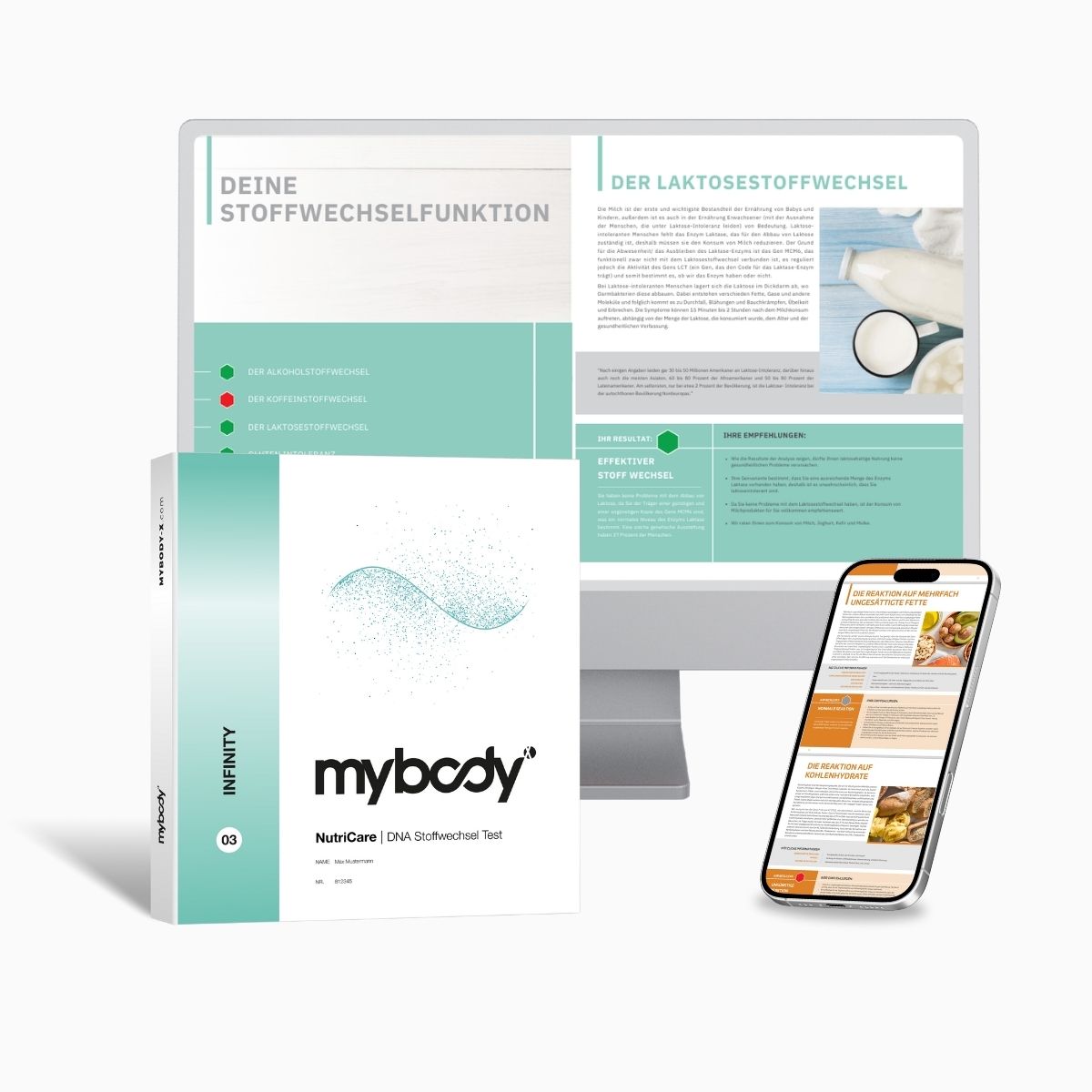
DNA test from saliva
NutriCare | INFINITY DNA Test
More than 140 gene variants presented in 54 reports across eight chapters, focusing on nutrition and nutrient utilization, including four tolerance reports on alcohol, caffeine, lactose metabolism, and gluten intolerance. What the test does not provide: it contains no report on protein requirements, does not provide a diagnosis, and is not allergy testing.
Laboratory analysis available 15–25 business days after receipt of the sample
Product page information, accessed 24 August 2026
Which overall scope best suits which goal is explained in the neighboring article Which DNA Test Is Right for Me?
The Limits of What Is Analyzed
The first boundary is set by the significance of each individual gene variation. It describes a probability observed in population groups, not a predetermined outcome for you. How a predisposition manifests itself depends on its interaction with diet, exercise, and everyday life. A predisposition is not a predetermined outcome.
This boundary is also reassuring: In a lifestyle report, there is no bad news—only traits that require more or less action. Once you know your characteristics, you stop comparing yourself with the average and start planning around yourself.
Purpose establishes the second boundary: DNA analysis is used for nutrition and lifestyle counseling. It is not a diagnostic procedure, does not predict disease, and does not replace a medical examination or consultation. Anything that sounds like diagnosis belongs in a medical practice, not in the report.
Research establishes the third boundary. What is analyzed is what has been described and substantiated, and this body of knowledge continues to grow. An honest test therefore treats its interpretation as the state of scientific knowledge as of a given date, not as eternal truth. For you, that means only good things: The data that was read remains the same, while its interpretation becomes richer over the years.
And the fourth boundary concerns measurement: An analyzed gene variation says nothing about your current condition. Only a blood test can show whether a predisposition to increased needs has actually resulted in a low level. Anyone who asks the title question should therefore also know the follow-up question, which is: What should I measure afterward?
What to check before buying
Turn the title question into a three-step checklist. First: Check the DNA glossary to see whether your topic is among the more than 170 gene variations explained there. Second: Check whether the provider names its method, including what it is not. Third: Read where the test draws the line between itself and medicine, and whether it mentions that line at all.
Anyone who follows these three steps can answer the question “Which genes are analyzed?” for any test in the world—and, along the way, recognize providers whose answers are difficult to find.
The review routine takes a quarter of an hour, and it changes the balance of roles: Instead of someone who has to trust a test, you become someone who has checked it. For a product whose result applies for a lifetime, that is the best-invested quarter of an hour in the entire purchase.
It started with a question about genes. In the end, it is a question of transparency—and one that can be clarified before purchase rather than afterward. If you would like support with this, the consultation is free and does not try to sell you anything.
Frequently asked questions
Which genes does a lifestyle DNA test specifically analyze?
Depending on the panel, more than 80 to more than 170 gene variations with documented links to nutrition, metabolism, nutrient requirements, sports, recovery, and skin are analyzed, read from more than 700,000 positions in the genome. The complete list can be viewed in the DNA Lexicon before purchase, with an explanation and everyday relevance for each gene variation. High-risk genes associated with diseases are not included.
Does the test also examine disease-related genes?
No. Predictive genetic testing for diseases is subject to Germany’s Genetic Diagnostics Act, which requires medical information, counseling, and written consent (IQWiG, 2026), and belongs in the field of human genetics. A lifestyle test deliberately excludes these genes so that an everyday report neither causes unaccompanied anxiety nor is mistakenly interpreted as medical reassurance.
Does the test decode my entire genome?
No. The method is SNP genotyping: More than 700,000 predefined individual positions are read—exactly the places where people have been demonstrably shown to differ—not whole-genome sequencing. For nutrition and lifestyle questions, this panel is the right fit, and honestly naming the method is a good sign for a provider.
Can I see exactly what is being analyzed before I buy?
Yes, completely: The freely accessible DNA Lexicon explains more than 170 gene variations from the analysis topics. It is searchable and can be filtered by topic, while the glossary translates 75 technical terms from allele to cellular respiration. If someone cannot find their topic there, they can avoid ordering the wrong test; if they do find it, they know before ordering what the report will answer.
What happens to my genetic data after the analysis?
The saliva sample and DNA sequence are completely destroyed two months after the analysis is completed. The samples pass through the ISO-certified laboratory in Germany in pseudonymized form; transmission is SSL-encrypted and GDPR-compliant. What remains permanently is your analysis report—not the biological material and not the raw sequence.
Next step
If you want to know whether your topic is covered
The DNA Lexicon lists all over 170 explained genetic variations for reference before purchase. The NutriCare | INFINITY shows how this becomes a nutrition report.
To the DNA Lexicon To the NutriCare | INFINITY DNA TestRead more
You might also be interested in
The terms behind the title question, clearly distinguished.
The introductory article for a deeper dive.
Sources
- Institute for Quality and Efficiency in Health Care (IQWiG): How does inheritance work? (as of 07/22/2026) – gesundheitsinformation.de
- Institute for Quality and Efficiency in Health Care (IQWiG): What happens during a genetic test? (as of 08/05/2026) – gesundheitsinformation.de
The direct quotation about the 46 chromosomes and the paraphrased definition of a gene are taken from [1]. The information about the scope of the Genetic Diagnostics Act and written consent is taken from [2]. All information about genetic variations, reports, compatibility reports, the laboratory, data protection, and pricing comes from mybody®x product and knowledge pages, accessed on 08/24/2026; processing times follow the central specification for each test type. All sources were accessed and reviewed on 08/24/2026.

mybody®x Editorial & Expert Team
Nutrigenetics Nutritional science Laboratory diagnostics
This article was created by the mybody®x editorial and expert team. The team combines nutrigenetics, nutritional science, and laboratory diagnostics. The contributors are listed on the authors page.
Published on 08/24/2026 · Last updated on 08/24/2026
The content is intended for general information and does not replace medical advice, diagnosis, or treatment. The DNA analysis is intended for nutritional and lifestyle counseling; it is not a diagnostic procedure, does not predict diseases, and does not replace a medical examination or consultation.




Share now:
Which DNA test is right for me? Five analyses, one way to choose
Losing weight after 60: what really matters now