
Nutrigenetics test experiences: what the field does and does not establish
The essentials at a glance
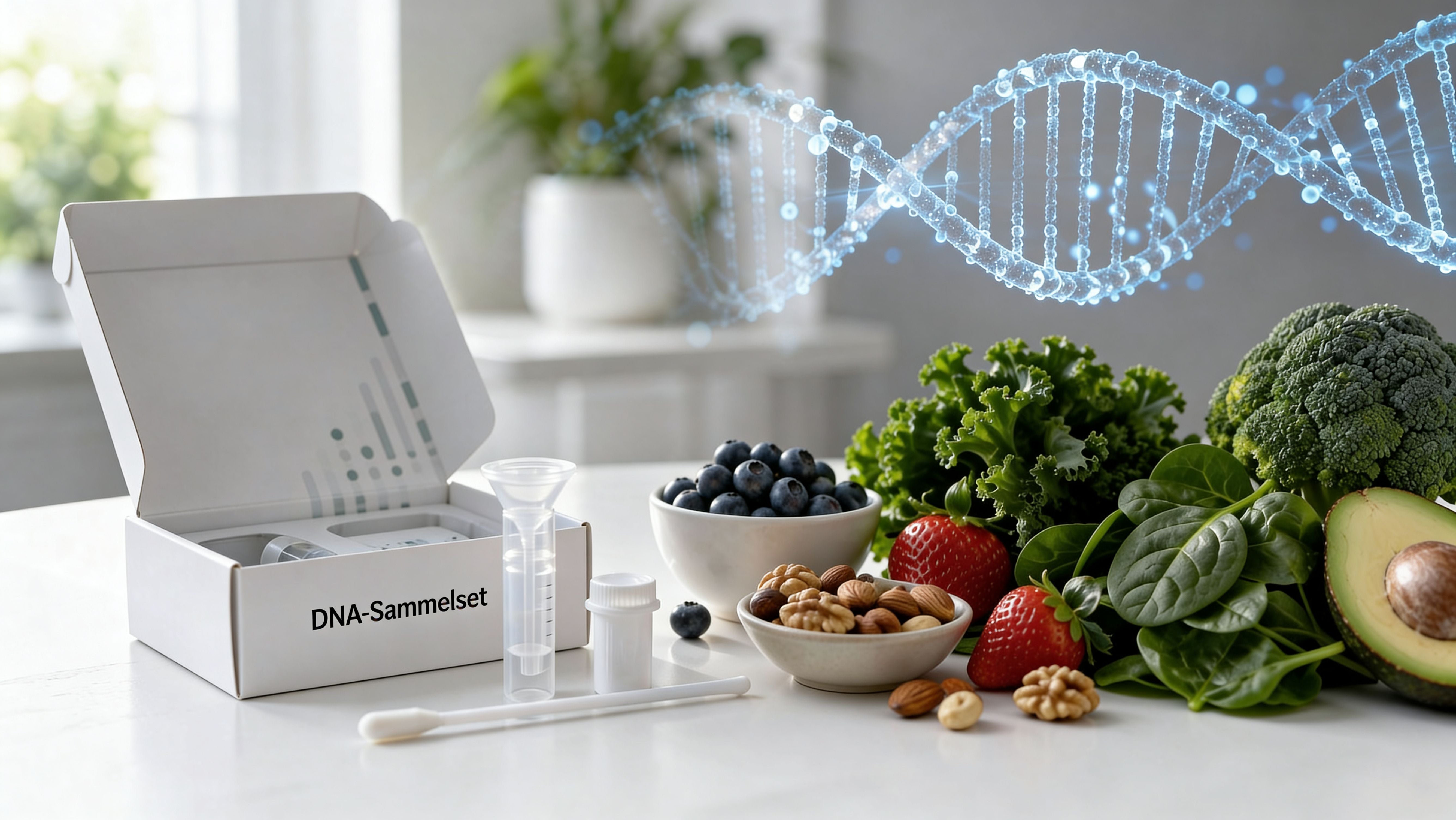
Nutrigenetics is the branch of nutrition research that investigates how inherited gene variants affect what a body does with a food. This relationship is well established for individual, narrowly defined traits. However, evidence that broad dietary recommendations derived from it are effective remains largely lacking.
Anyone looking for experiences with a nutrigenetics test will find mostly personal reports. This article takes a step back and organizes the field itself: what is studied, how to recognize supporting evidence, which four traits are comparatively well established, and where the evidence becomes thin.
You will first read the definition and the position of the German Nutrition Society. This is followed by the distinction between nutrigenomics and epigenetics, the steps used to verify evidence, four documented examples, the special case of gluten, and the difficult case of body weight. Finally, it covers common misconceptions, report contents, what experiences can tell you, and the limitations.
What to expect in this article
1. What nutrigenetics studies as a field
2. What the German Nutrition Society has established on this subject
3. Nutrigenetics, nutrigenomics, epigenetics: what each field describes
4. How to recognize that an interaction is truly supported by evidence
5. Four traits for which the evidence is comparatively strong
6. Why genetic testing for gluten primarily rules things out
7. Why body weight is the most difficult case in this field
8. Three statements about nutrigenetics that persist
9. What a nutrigenetic report actually contains
10. What experiences with such a test can tell you
11. Where the research stands today
12. Limitations: what a nutrigenetic test cannot determine
13. Who may benefit from this topic and who may not
14. What matters about this term
Frequently asked questions
Sources
What nutrigenetics studies as a field
Nutrigenetics is the study of how inherited differences in genetic material influence what the body does with a nutrient. The technical term combines nutrition and genetics, and it refers precisely to this one direction of analysis: from the gene to the response.
These are usually individual-letter variants in the genetic material, known as SNPs in technical terminology. An SNP is a position in the genome where people routinely differ in a single building block. Such positions are distributed throughout the genome, and some lie in or near genes whose products are involved in digestion.
The field’s question is therefore not whether nutrition works. It is whether the same diet affects two people differently because they differ at a particular position in their genetic makeup. Experts call this a gene–nutrient interaction.
Key takeaway
Nutrigenetics investigates whether an inherited gene variant changes how a person responds to a food. It does not investigate whether a dietary recommendation derived from that variant is effective. These are two different questions, and they have two different bodies of evidence.
Why the term is used more broadly in advertising than in research
In research, nutrigenetics refers to a narrowly defined field of study with a clear research question. In test marketing, the same word often stands for a promise: that the analysis will produce a personalized nutrition plan that works better than any other.
The entire discussion about these tests lies between these two meanings. People looking for experiences are usually looking for the second meaning. The first is what is predominantly supported by evidence.
That is why this article starts with the technical term rather than the report. Knowing what the field investigates is a prerequisite for making sense of an experience.
What the German Nutrition Society has recorded on this subject
In Germany, there is a published position from a professional society on the evidence for gene-based dietary recommendations. It comes from a position paper by the “Personalized Nutrition” working group of the German Nutrition Society, which was peer-reviewed and published in a specialist journal. The German Nutrition Society lists it on its website under “Statements and position papers” in the “Positions” section.
Documented source
“evidence for the success of gene-based dietary recommendations is still generally lacking”
Holzapfel C, Waldenberger M, Lorkowski S, Daniel H and the “Personalized Nutrition” working group of the German Nutrition Society (DGE)
Genetics and Epigenetics in Personalized Nutrition: Evidence, Expectations, and Experiences, Molecular Nutrition and Food Research, 2022, DOI 10.1002/mnfr.202200077
In substance, in German and in a translation by our editorial team: Evidence for the success of gene-based dietary recommendations is still largely lacking. The German version is a rendering, not a second quotation; the English wording from the cited source remains authoritative because the paper was published in English.
What this position disputes and what it accepts
The entire remainder depends on this distinction. The position does not deny that gene variants related to nutrition exist, nor does it deny that these variants can be reliably determined in the laboratory.
What is disputed is a narrower claim: that dietary recommendations based on such variants demonstrably lead to better outcomes than recommendations without this basis. The dispute concerns the derived recommendation, not the finding described.
The working group does not reject the field either. It calls for concepts that go beyond genes and incorporate additional characteristics as well as digital tools. This is a call for more research, not for discontinuation.
Our position: a basis, not a promise
The question naturally arises how a provider of such tests deals with this. At mybody®x (MYBODY Lab GmbH), the answer appears not in a statement but in the wording on its own product page for the DNA nutrition test, accessed on 27 August 2026.
It states verbatim that the analysis provides “a personal view of your genetic basis” and shows “how your body processes, stores, and utilizes nutrients.” On the same page, the result is described as a “basis” for optimizing nutrition and how you feel in your body “at your very own pace.” No outcome is promised anywhere.
This leads to our position in one sentence: We do not sell gene-based dietary recommendations, but rather an interpretation. The test describes predispositions, and it does not predict success. In doing so, we make precisely the claim that the position paper describes as unsubstantiated.
Nutrigenetics, nutrigenomics, epigenetics: what each field describes
Three terms in this field are closely related and regularly confused. They describe different perspectives, different measurements, and different time horizons. The following comparison distinguishes them according to the same five criteria.
| Criterion | Nutrigenetics | Nutrigenomics | Epigenetics |
|---|---|---|---|
| Perspective | From gene to response: How does an inherited variant affect what the body does with a nutrient? | From nutrient to gene: How does a food change gene activity? | Focus on the switches above the gene: How are genes switched on and off without changing the sequence? |
| What is measured | Single-letter variants (SNPs) at defined positions in the genetic material | Gene activity, messenger molecules, and protein levels in cells or tissue | Chemical markers on the genetic material and its packaging proteins |
| Changes over the course of life | No. The sequence remains the same throughout life | Yes, sometimes within hours after a meal | Yes, over weeks to years, depending on life circumstances |
| Sample and testing interval | Saliva; once in a lifetime is sufficient | Blood or tissue; each provides a snapshot | Blood or tissue; repeated measurement required |
| Availability as a consumer test | Widely available; the basis of most DNA nutrition tests | Predominantly research; rarely offered as a consumer test | Predominantly research; the significance of individual markers is disputed |
The practical implication of this table appears in the third row. A nutrigenetic result does not become outdated because the sequence studied does not change. What grows is knowledge of how to interpret a variant.
Conversely, this means that a nutrigenetic finding says nothing about your current status. Anyone who wants to know the current state of a nutrient needs a blood measurement, not a saliva test.
How to recognize that an interaction is truly supported by evidence
There are several verification steps between “there is a genetic variant” and “this leads to a recommendation.” They are why some nutrigenetic claims are robust and others are not. The four levels build on one another.
Four levels of validation
Association found
In one group, a variant is found to occur alongside a characteristic. This is an initial suspicion, not evidence.
Interaction tested
An analysis specifically tests whether the effect of a food differs depending on the variant. Only this constitutes a genuine gene–nutrient interaction.
Confirmed in other groups
The same finding appears again in independent population groups. Without this replication, a result remains a single observation.
Recommendation tested in a trial
People are randomly assigned to a gene-based recommendation or an ordinary recommendation, and then the outcomes are compared. This is exactly where the evidence is thin.
The first three levels have been reached for a number of characteristics. The fourth level determines whether a recommendation works, and it is precisely this level that the sentence from the position paper of the German Nutrition Society refers to.
Five questions for every nutrigenetic claim
Which characteristic exactly is being described?
The narrower the characteristic, the more robust the claim. “Tolerates lactose” is narrower than “gains weight more easily.”
How many variants are behind it?
A single variant with a major effect is different from hundreds of variants, each with a tiny contribution.
In which population was this studied?
Variant frequencies differ considerably between population groups of different ancestry. A number without a reference group is worthless.
Does the sentence describe a predisposition or an outcome?
“You process caffeine more slowly” is a predisposition. “This makes you lose weight” would be an outcome, and that requires Level 4.
What would be needed to disprove the claim?
A claim that nothing could disprove is not a scientific claim but an advertising slogan.
Four characteristics for which the evidence is comparatively strong
There are traits for which a single position in the genome explains a large part of the difference. They are the robust cases in this field, and they have one thing in common: each involves either an enzyme that breaks down a particular substance or a protein that recognizes it.
Lactose: a variant upstream of the lactase gene
Whether an adult continues to produce enough lactase, the enzyme that breaks down lactose, depends on a position outside the lactase gene itself. In Nature Genetics (2002), Enattah and colleagues described the C/T-13910 variant, located around 14 kilobases upstream of the lactase gene.
The association was complete in this study: among 236 people from four different populations, the variant matched the biochemically confirmed lactase activity. In an additional 1,047 samples, the frequency of the variant corresponded to the known prevalence of lactose intolerance.
This is the ideal case in this field: one trait, one enzyme, one position. Nevertheless, the genetic finding does not replace medical evaluation, because symptoms after consuming dairy products can also have other causes.
Caffeine: the most well-known interaction of all
One of the most frequently cited gene–nutrient interactions involves caffeine. In the Journal of the American Medical Association (2006), Cornelis and colleagues studied 2,014 people after a first heart attack and an equal number of control subjects, grouping them according to their variant in the CYP1A2 enzyme gene.
Among slow metabolizers, the calculated ratio rose to 1.64 from four cups of coffee per day onward, with a confidence interval of 1.14 to 2.34. Among fast metabolizers, the same value was 0.99, and the authors reported a p-value of 0.04 for the interaction between the gene and coffee consumption.
The same amount of coffee, two different groups, two different findings. That is exactly what is meant by a gene–nutrient interaction. The study is an observational study of a population in Costa Rica, not guidance for one’s own coffee consumption.
Alcohol: why some people turn red after one drink
When alcohol is broken down, acetaldehyde is produced as an intermediate, which a second enzyme further breaks down. If a variant impairs this enzyme’s function, the intermediate accumulates and the skin turns red.
Cho and colleagues reported in BMC Genomics (2023) that around 36 percent of people of East Asian ancestry experience this flushing reaction. In that study, the two variants rs671 in the ALDH2 gene and rs1229984 in the ADH1B gene together explained about half of the genetic variation in this trait.
This too is a narrowly defined marker with clear biochemistry. And it shows why the reference population matters: the same variant is rare in Central Europe, and a percentage from East Asia cannot be applied to Germany.
Gluten: a recognition marker of the immune system
With gluten, the genetic connection is not an enzyme involved in breakdown but the immune system. The HLA-DQ2 and HLA-DQ8 markers help determine whether certain fragments of the gluten protein can be presented to the immune system at all.
This case differs from the three previous ones and therefore deserves its own chapter. It is the best example of how a genetic finding can say a great deal about ruling something out and little about establishing it.
Why genetic testing for gluten mainly rules things out
Nearly all people with celiac disease carry one of the two markers mentioned. This observation leads to an asymmetry that is instructive for the entire field: a negative result says a great deal, while a positive result says little.
HLA-DQ2 and HLA-DQ8 in figures
90 %
of people with celiac disease carry the HLA-DQ2 marker; nearly all the rest carry HLA-DQ8
30–35 %
of the general population carry one of these two markers without any symptoms
2 %
of these carriers actually develop celiac disease during their lifetime
Source: German Celiac Disease Society, “Genetics” page, accessed in 2026. The page does not indicate its own date; the access date is 27 August 2026.
These three figures fully explain the asymmetry. People who carry the markers make up one third of the population, and the vast majority of these people remain healthy. Those who do not carry them, by contrast, belong to a group in which celiac disease is virtually absent.
The professional society draws a practical conclusion from this. The updated S2k guideline on celiac disease issued by the German Society for Gastroenterology, Digestive and Metabolic Diseases (AWMF registry number 021-021, 2022) states that if the HLA-DQ2 and HLA-DQ8 markers are absent, further testing for tTG-IgA is not necessary.
This establishes a clear limit for a dietary test at home. A genetic finding related to gluten is not a diagnosis. It can indicate a direction, but the evaluation itself belongs in a medical practice because blood tests and, if necessary, a tissue sample are required.
The order is crucial. Anyone who eliminates gluten as a precaution and is then tested makes the serological evaluation unusable. The elimination comes after the test, not before.
Why body weight is the most difficult case in this field
Body weight is where the fundamental misunderstanding in this field lies. That genes are involved is undisputed and well established. That an effective personal recommendation can be derived from this is something entirely different.
Elks and colleagues analyzed 88 heritability estimates from twin studies, involving a total of 140,525 twins, in Frontiers in Endocrinology (2012). The values for body mass index ranged from 0.47 to 0.90, with the mean of the distribution at 0.75.
This figure is often misinterpreted. It does not mean that 75 percent of your weight is determined by your genes. It means that, in the groups studied, a large proportion of the differences between people was associated with genetic differences.
Key takeaway
High heritability indicates how strongly people differ from one another for genetic reasons. It says nothing about how much an individual person can influence their weight through their behavior.
Many variants, each with a tiny contribution
For lactose, one position accounts for practically the entire trait. For body weight, the genetic contribution is distributed across very many positions, each of which makes only a minuscule contribution. Specialists call this a polygenic trait.
This fundamentally changes what the result can tell us. A single variant in a body-weight report describes a fraction of a fraction. It indicates a tendency in a population, but it says nothing about what will happen to you.
The surrounding context also matters. Sleep, physical activity, meal timing, medications, and food availability all affect the same trait, and none of these factors is encoded in the genome.
That is precisely why the sentence in the position paper is worded so carefully. It does not dispute the genetics of weight. It disputes the evidence that recommendations derived from it are effective.
Three persistent claims about nutrigenetics
Claims about this specialist term circulate widely and repeatedly appear in search results and forums. Three of them can be clearly assessed using the evidence already mentioned.
Common claims versus established evidence
Widespread
“Science considers nutrigenetics nonsense.”
Substantiated
The position paper of the Personalized Nutrition working group of the German Nutrition Society (Molecular Nutrition and Food Research, 2022) does not reject the field. It states that evidence of the effectiveness of gene-based recommendations is largely lacking and calls for concepts that incorporate additional characteristics and digital tools.
Widespread
“A single gene determines whether I gain weight.”
Substantiated
Body mass index is a polygenic trait. An analysis of 88 heritability estimates from twin studies involving 140,525 twins found values between 0.47 and 0.90 (Elks et al., Frontiers in Endocrinology, 2012). This is a statement about differences between groups, not about a single position in the genome.
Widespread
“A positive genetic test proves an intolerance.”
Substantiated
Thirty to 35 percent of the total population carry HLA-DQ2 or HLA-DQ8, and only around 2 percent of them develop celiac disease (German Celiac Disease Society, accessed 2026). The genetic finding is useful for ruling it out, not for diagnosing it.
All three misconceptions arise at the same point. They confuse a description of predispositions with a prediction for an individual.
What a nutrigenetic report actually contains
A report from such a test consists of a series of chapters, each covering one characteristic. For each characteristic, it states the variant found in your case, a brief explanation of the background, and an interpretation for everyday life.
According to the product page, accessed on 27 August 2026, mybody®x's DNA test for nutrition evaluates more than 140 genetic variants. The underlying method is genotyping defined positions, not complete genome sequencing.
Within this scope, the four reports on alcohol, caffeine, and lactose metabolism, as well as gluten tolerance, are the best supported in terms of content. They correspond exactly to the characteristics from Chapter 5 for which a single position explains a large part of the difference.
How to read a sentence in the report
If it says that you process caffeine more slowly, that sentence describes a predisposition. It does not say that coffee is harmful to you, nor does it specify an amount that is permitted. What it does is explain why a late espresso keeps you awake more than it does your companion.
This shift is the real benefit. Once people know that their body processes a substance differently, they stop blaming themselves for a reaction they did not choose. Self-blame becomes observation.
The converse is equally true. If the report identifies a trait you have never noticed in everyday life, that does not change your daily life. A trait is not a determination.
What personal experiences can tell you about such a test
Seeking out personal experiences is understandable, because a test costs money, and no one wants to take it for nothing. But a personal account answers a different question from the one behind it.
A testimonial can reliably show what a process was like: how understandable the kit was, how long the analysis took, and how readable the report was. These are verifiable observations, and experiences are the appropriate source for them.
What a testimonial cannot provide is proof of an effect. It lacks a comparison group: No one knows how the same person would have made it through those same months without the test. This comparison group is precisely the fourth level from Chapter 4.
For this reason, this article contains no fabricated customer testimonials. A testimonial that names a person, a name, and a number without that person actually existing would be an advertising claim disguised as evidence.
This article covers the technical term and its evidentiary basis. If you are instead interested in the process and people’s experiences with nutrition, the article DNA-Test Ernährung Erfahrungen will take you there; if your focus is on losing weight, Gentest abnehmen Erfahrungen is the right text, while DNA-Test zum Abnehmen Erfahrungen explains what testimonials about losing weight can actually prove.
Chapter at a glance
Testimonials about nutrigenetic tests are informative about the process, but not about their effects. They describe how a purchase, a saliva sample, and a report were experienced, but they cannot show what would have happened without the test. Anyone seeking evidence of an effect needs a comparison between two randomly formed groups. To this day, precisely this comparison is largely missing for gene-based dietary recommendations.
Where the research stands today
The field has changed direction. In the first years after the human genome was decoded, the expectation was that it would be enough to find a sufficient number of variants. That expectation was not fulfilled.
The reason lies in the structure of the traits studied. For narrow, enzyme-linked traits such as the breakdown of lactose, caffeine, or alcohol, the genetic approach works well. For broad traits such as weight, satiety, or eating behavior, it makes a small contribution to a larger picture.
The “Personalized Nutrition” working group of the German Nutrition Society concludes in its 2022 position paper that genetic data alone are insufficient and must be supplemented with additional characteristics and digital tools. This places behavior at the center—something previously regarded as secondary.
What this means for the coming years
For a saliva sample that has already been collected, this development has one reassuring feature. Your sequence does not change, so one test is sufficient for a lifetime. What grows is the interpretation that can be derived from the same data.
The objection is justified: new studies are constantly being published, and some interpretations accepted today may be read differently tomorrow. More precisely, it is not your result that changes, but the knowledge surrounding it.
Anyone who takes such a test today is therefore not buying a definitive answer. They are buying a data foundation whose interpretation will continue to evolve.
Limitations: what a nutrigenetic test does not clarify
A nutrigenetic test describes predispositions and does not measure levels. It says nothing about your current iron, vitamin D, or blood sugar levels. Current levels require a blood test.
It also does not provide a diagnosis. Celiac disease, lactose intolerance, and allergies are not determined through genetic variants, but through the appropriate tests in a medical practice.
A nutrigenetic test describes predispositions and does not measure levels.
It also does not predict success. Whether changing your diet will lead to a particular result for you is not stated in any genetic report, and a provider who claims otherwise goes beyond the available evidence.
It also does not cover every topic that arises in nutritional counseling. Questions about protein requirements, portion sizes, or meal distribution cannot be answered using genetic variants because there are no robust gene–nutrient interactions for these matters.
Finally, there is the legal classification. An analysis of nutrition and lifestyle is not a diagnostic procedure or a disease prediction. Genetic variants describe probabilities in population groups, not fixed outcomes for individuals.
Who the topic is worthwhile for—and who it is not
Whether exploring this field is worthwhile for you depends on your initial question. Two groups can be clearly distinguished.
It speaks in your favor if you have been observing a recurring reaction in yourself for some time and are looking for an explanation. If you regularly experience the same thing after consuming dairy products, having coffee in the afternoon, or drinking a glass of wine, a specific enzyme-related trait may provide a possible clue.
It also argues in favor if you want a one-time foundation that does not age, and if you are prepared to treat it as a starting point rather than an instruction. Describing a predisposition is information you can work with.
It argues against this approach if you expect an answer to the question of your weight. For this question, the evidence is thin precisely where the recommendation begins, and a report will not resolve it.
It also argues against it if you have acute symptoms. Persistent abdominal pain, unintentional weight loss, blood in the stool, or recurring diarrhea belong in a doctor’s office—and before any self-test. A genetic report does not replace this evaluation and, in the worst case, delays it.
And it argues against it if you want to know how you are doing today. Blood is the right sample for that. A mnemonic helps with sorting things out: DNA explains the why; blood shows the now.
What matters about this word
If you take away a single checking routine from this article, make it this: Read every statement about nutrigenetics to determine whether it describes a predisposition or promises an outcome. The difference is usually in the verb.
“Processes more slowly,” “produces less,” and “recognizes differently” describe a predisposition, and depending on the characteristic, there is solid evidence for this. “Leads to,” “helps with,” and “ensures” promise an outcome, and evidence for this is still largely lacking for gene-based dietary recommendations.
This check takes five seconds per sentence, and it works with every provider, every guide, and this text too. It is independent of how much a test costs and how many variants it analyzes.
It all started with the question of what experiences with a nutrigenetics test are worth. The most honest answer is: a lot for the process, nothing for the effect. If you want to know whether the field delivers what the advertising copy promises, you cannot avoid looking at the evidence. And if you are not sure whether a test is right for your question: the consultation is free, and it does not sell you anything.
Frequently asked questions
What is nutrigenetics in one sentence?
Nutrigenetics is the branch of nutrition research that examines how inherited genetic variants influence what the body does with a nutrient. It usually focuses on single-letter variants at specific positions in the genome. The perspective runs from the gene to the response, whereas nutrigenomics asks the reverse question: how does a food change gene activity?
Is a nutrigenetics test scientifically recognized?
The answer depends on what is being asked. It has been established that genetic variants can be determined reliably and play a role in individual characteristics such as the breakdown of lactose, caffeine, or alcohol. For the dietary recommendations derived from this, the position paper of the “Personalized Nutrition” working group of the German Nutrition Society (Molecular Nutrition and Food Research, 2022) states that evidence of success is still largely lacking.
Which experiences with a nutrigenetic test are actually meaningful?
Experiences with the process are meaningful: the clarity of sample collection, the time until the result, and the readability of the report. Experiences regarding effects are not meaningful because there is no comparison group. No one can say how the same person would have gone through the same months without the test.
Can a genetic test detect gluten intolerance?
No. The HLA-DQ2 and HLA-DQ8 characteristics are carried by 30 to 35 percent of the total population, and only around 2 percent of them develop celiac disease during their lifetime (German Celiac Disease Society, accessed 2026). A positive finding therefore does not establish anything. Conversely, a negative result is meaningful: According to the S2k guideline on celiac disease from the German Society for Gastroenterology, Digestive and Metabolic Diseases (AWMF 021-021, 2022), if both characteristics are ruled out, further testing for tTG-IgA is not necessary.
Do I need to repeat a nutrigenetic test later?
No. The sequence analyzed does not change over the course of your life, so one saliva sample is sufficient. What continues to develop is the interpretation: New studies may make it possible to learn more from the same data. Your result remains the same; only the knowledge about it grows. Current values such as iron or vitamin D, on the other hand, change continuously and are measured in blood.
Next step
A foundation, not a promise
If, after reading everything, you want a description of your genetic predispositions as a starting point, NutriCare | The INFINITY DNA Test leads there. It costs €269.00 (as of 27 August 2026; subject to change), uses a saliva sample, and is performed once. Kit shipping takes 1 to 3 business days, and laboratory analysis takes 15 to 25 business days after the sample is received. It does not predict a better nutrition outcome.
NutriCare | INFINITY DNA Test Question for the expert teamRead more
You might also be interested in
If you are less interested in the technical term and more in the process and report content related to nutrition.
The context for the case where your initial question concerns body weight rather than the subject area.
Sources
- Holzapfel C, Waldenberger M, Lorkowski S, Daniel H, and the “Personalized Nutrition” working group of the German Nutrition Society (DGE): Genetics and Epigenetics in Personalized Nutrition: Evidence, Expectations, and Experiences, Molecular Nutrition and Food Research (2022), DOI 10.1002/mnfr.202200077 – onlinelibrary.wiley.com
- German Society for Gastroenterology, Digestive and Metabolic Diseases (DGVS): Updated S2k Guideline on Celiac Disease, AWMF Registry Number 021-021 (as of 2022) – register.awmf.org
- German Celiac Disease Society: Genetics (accessed in 2026, with no date specified on the page) – dzg-online.de
The verbatim quotation concerning the evidence for gene-based nutritional recommendations, the statement about the need for additional characteristics and digital tools, and the discussion in Chapter 11 are taken from source [1]. The statement about foregoing further examinations when HLA characteristics have been ruled out comes from [2], while the three percentages concerning HLA-DQ2 and HLA-DQ8 come from [3]. Four additional papers are attributed in the main text by authorship, journal, and year and therefore do not require a separate line: Enattah et al., Nature Genetics (2002), on the C/T-13910 variant; Cornelis et al., Journal of the American Medical Association (2006), on CYP1A2 and coffee; Cho et al., BMC Genomics (2023), on ALDH2 and ADH1B; Elks et al., Frontiers in Endocrinology (2012), on the heritability of body mass index. Information on price, scope, sample type, and procedure comes from the mybody®x product page, accessed on 27 August 2026; processing times follow the central specification for DNA tests. All sources were accessed and reviewed on 27 August 2026.

mybody®x Editorial & Specialist Team
Nutrigenetics Nutritional science Laboratory diagnostics Blood analysis interpretation
This article was created by the mybody®x editorial and specialist team. The team combines nutrigenetics, nutritional science, laboratory diagnostics, and the interpretation of blood analyses. Contributors are listed on the authors page.
Published on 24 May 2026 · Last updated on 27 August 2026
DNA analysis is intended for nutritional and lifestyle counseling. It is not a diagnostic procedure, does not predict disease, and does not replace a medical examination or consultation. Genetic variants describe probabilities in population groups, not determinations for individuals.




Share now:
Weight Loss DNA: Your Path to Your Desired Weight?
Slow Down the Aging Process: Your Strategy for 2026