

How individual tests measurably improve your own health
TL;DR:
- Lifestyle analyses combine genetic data, laboratory values, and habits to create individualized health strategies.
- They increase the success rate of weight management, disease prevention, and a long life expectancy.
- Reliable tests require certified laboratories, scientific validation, and professional interpretation.
What good is the best general health tip if it does not fit your individual life? Most people know the problem: You follow a popular diet, exercise regularly, and get enough sleep, yet the desired result still fails to appear. The reason is rarely a lack of discipline, but rather a lack of personalization. A healthy lifestyle measurably extends life, but only when the measures truly fit your own biological requirements. Lifestyle analyses use precisely this insight to turn general recommendations into precise, personal strategies. In this article, you will learn how such analyses work, what the science says about them, and how you can benefit from them in everyday life.
Table of contents
- Foundations and benefits of lifestyle analyses
- methods and measurements compared
- Impact of lifestyle analyses: live longer and healthier
- Limitations, criticism, and practical recommendations
- Our perspective: what you should know about lifestyle analyses
- Learn more or get started now?
- Frequently asked questions
Key findings
| Point | Details |
|---|---|
| Personalization matters | Individual analyses offer greater certainty and better results than standard recommendations. |
| Measurable benefits | Empirical studies show that a personalized lifestyle prevents disease and significantly extends life expectancy. |
| Critical application | Use analyses as a guide, not as a substitute for medical advice, and remain cautious about promises. |
| Practical implementation | With modern methods such as DNA and score analyses, everyone can actively promote their health. |
Foundations and benefits of lifestyle analyses
Once it is clear why standard advice is often insufficient, we take a closer look at the foundations and practical benefits of lifestyle analyses. A lifestyle analysis is not a simple questionnaire that can be completed in five minutes. It is a structured process that combines various data sources to create as complete a picture as possible of an individual's health situation.
The foundation is usually made up of three pillars: genetic data, laboratory values from blood or saliva, and information about habits such as diet, exercise, and sleep. DNA analysis and lifestyle assessment enable personalized recommendations that go far beyond what a general nutrition plan can achieve. The more data points that are included, the more precise the result becomes.
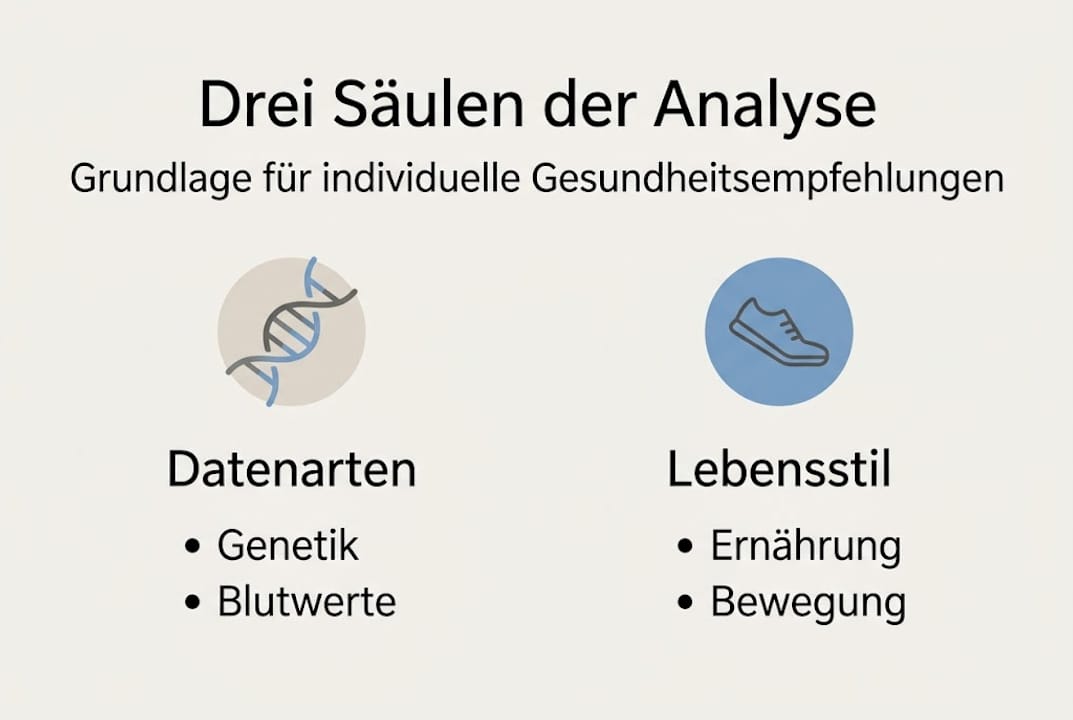
The core benefit lies in tailored recommendations. A person with a genetic predisposition to a slower fat metabolism needs a different nutritional strategy than someone whose body processes carbohydrates particularly efficiently. These differences are real, measurable, and crucial to the success of prevention and weight management measures. The benefits of personalized nutrition are evident not only on the scales, but also in energy levels, digestion, and long-term health.
Typical aspects considered in a lifestyle analysis:
- eating behavior and individual nutrient requirements
- metabolic type and genetic predispositions
- exercise habits and athletic performance
- sleep quality and ability to recover
- stress levels and psychological well-being
- risk factors for chronic diseases such as diabetes or cardiovascular disease
“The combination of measurable biological data and personal habits makes lifestyle analyses one of the most effective tools in modern prevention.”
The reasons for personalized analyses are diverse. They range from the early detection of nutrient deficiencies to the targeted optimization of weight management. Further examples of DNA analyses show how broad the field of application has become. What was once only possible in specialized clinics can now be conveniently done at home.
methods and measurements compared
With this basic knowledge, we now turn to the question of how different methods and metrics perform in practice. There is no single lifestyle analysis. Depending on the objective and starting point, some approaches are more suitable than others.
| method | what is analyzed | who is it suitable for | strengths | weaknesses |
|---|---|---|---|---|
| genetic test | DNA variants, metabolic genes | everyone, especially those with a family history | long-term guidance | genetics is not destiny |
| metabolism analysis | blood values, hormone levels, inflammatory markers | for specific complaints | precise, up to date | more time-consuming, more expensive |
| lifestyle questionnaire | habits, nutrition, exercise, sleep | an entry point for a broad target audience | easily accessible | less precise |
| combined score | genetics plus lifestyle | optimal results | highest predictive power | requires multiple data sources |
The combined approach is particularly interesting. Lifestyle score prediction shows that combining genetic analysis with a lifestyle questionnaire provides the most reliable score for chronic diseases. This means that anyone who takes only a genetic test gets an incomplete picture. Anyone who fills out only a questionnaire misses important biological information.
In practice, this means:
- Genetic testing alone: useful for orientation, but of limited significance without lifestyle context
- Metabolic analysis: ideal for specific health goals such as weight reduction or performance optimization
- Questionnaire-based scores: an accessible starting point that identifies initial areas for action
- Combination: provides the most precise recommendations and the greatest predictive power
DNA-based nutrition is a good example of how genetic data can be directly translated into nutritional recommendations. Combined with a detailed lifestyle questionnaire, it produces recommendations that truly fit. Gene diets and personalized approaches show that this field extends far beyond passing trends.

Pro tip: When considering commercial tests, look for ISO certification of the laboratory and scientifically validated evaluation methods. Tests based solely on questionnaires that do not analyze biological samples deliver significantly less precise results than combined methods involving laboratory analysis.
Impact of lifestyle analyses: live longer and healthier
The way these methods work and why the effort is worthwhile is demonstrated by the following impressive figures and comparative values. The data is clear: a healthy lifestyle tailored to individual circumstances measurably extends life. According to studies, living up to 24 years longer is possible when several health factors are optimized simultaneously. This is not a marketing claim but an empirically proven fact.
Statistics: More than 70 percent of diets fail without personalization. Those who know their metabolism have significantly better chances of success.
| Health area | Effect of personalized analysis | Time period |
|---|---|---|
| Weight management | Up to 3 times higher long-term success | 12 months |
| Diabetes prevention | Risk reduction of up to 58% | 3 years |
| Cardiovascular health | Significantly fewer events | 5 years |
| Life expectancy | Up to 24 additional years | Lifelong |
Measurable effects for common diseases:
- Type 2 diabetes: personalized dietary interventions have been shown to reduce the risk of developing the disease. The key lies in early detection of insulin resistance through individual blood value analyses.
- Cardiovascular disease: knowing your genetic risk factors allows you to take targeted countermeasures. This concerns cholesterol levels, blood pressure, and inflammatory markers.
- Cancer prevention: certain lifestyle factors, such as diet and exercise, significantly influence cancer risk. Epigenetics and genes shows how diet can even influence gene expression.
- Overweight and obesity: without knowledge of an individual’s metabolism, many measures remain ineffective. Sustainable weight loss is only possible when the measures truly suit the body.
These figures make one thing clear: it is not about living perfectly. It is about knowing your own biological levers and using them strategically. That is the difference between general recommendations and a truly individual health strategy.
Limitations, criticism, and practical recommendations
The impressive results call for a critical look: what is really behind them, and where are the limits of these analyses? It would be dishonest to present lifestyle analyses as a cure-all. They are a valuable tool, but not a substitute for medical expertise.
A common misconception is overestimating genetics. Genes are not destiny. They describe predispositions, not certainties. Experts emphasize that analyses serve as guidance but are not a substitute for sound, individual advice from a doctor. This is particularly true in the presence of existing conditions or specific symptoms.
“A genetic test tells me that I have an increased risk of vitamin D deficiency. It does not tell me whether I already have this deficiency. Only a blood test can show that.”
This is how you can recognize reputable offers:
- ISO-certified laboratory: sample analysis should take place in an accredited laboratory, not merely be evaluated algorithmically.
- Scientifically validated methods: ask about the evidence base for the recommendations. Reputable providers cite specific sources.
- No exaggerated promises: offers that promise guaranteed cures or drastic weight loss should be viewed with caution.
- Data protection: genetic data is highly sensitive. Look for pseudonymization and deletion after the analysis.
- Professional interpretation: a good provider delivers not only raw data, but also understandable, actionable recommendations.
Genetic analysis and its effects shows how reputable providers work and what constitutes a high-quality analysis. Expert advice on DNA analysis can help you find the approach that suits you.
Pro tip: a lifestyle analysis is especially useful if you have specific health goals, are not making progress with general recommendations, or are aware of familial risk factors. In the case of acute symptoms or illnesses, the first step is always to see a doctor.
Our perspective: what you should know about lifestyle analyses
Theory becomes everyday life. What does this mean for you personally? In our assessment, the strength of lifestyle analyses lies not in genetics alone, but in the combination of evidence-based scores and consistent personal adaptation. A genetic test without behavioral change achieves little. Behavioral change without knowledge of your own biology is often inefficient.
In practice, we see that many people place too much weight on genetic test results. Genetics may explain 20 to 30 percent of health risk. The rest is determined by lifestyle, environment, and behavior. That is actually good news: you have more control than a genetic test suggests.
Personalization is helpful, but it is not a miracle cure. The practical benefits of personalized nutrition are most apparent when analyses are used as a starting point, not an endpoint. The biggest mistake is taking a test and then changing nothing. The second-biggest mistake is treating every finding as an absolute rule. Use analyses as guidance and combine them with common sense and professional support.
Learn more or get started now?
Anyone motivated by an honest assessment can take concrete action: the first step toward a truly personalized health strategy begins with your own data. At mybody-x, you will find ISO-certified analyses for DNA, metabolism, the microbiome, and nutrient status that can conveniently be performed at home. The evaluations provide not raw data, but clear, actionable recommendations that you can integrate directly into your daily life. With more than 11,300 satisfied customers and a rating of 4.77 stars, mybody® stands for scientifically grounded, privacy-compliant health analyses. Start with the test that matches your goals and discover what your body really needs.
Frequently asked questions
Who are lifestyle analyses particularly useful for?
People who benefit most include those with an increased risk of disease, existing overweight, or a desire for targeted prevention. DNA analysis and counseling show that high-risk groups in particular benefit from personalized recommendations.
How accurate are the results, and what is behind them?
The scores are based on thousands of study findings and factors such as genetics, lifestyle habits, and biochemical analyses. Lifestyle score prediction shows that combined methods provide the greatest predictive accuracy.
Is an at-home genetic test enough for precise recommendations?
It provides valuable insights, but genetics and lifestyle must be combined and professionally interpreted to obtain truly precise recommendations.
Can a lifestyle analysis cure diseases?
No. It is intended for prevention and guidance, but does not replace therapy or a well-founded diagnosis by a doctor.
Recommendation
- At-home lab test: Your guide to better health and well-being – mybody®x
- Self-test process 2026: How to use personalized analyses – mybody®x
- Optimize your nutrition based on your test results: Step-by-step guide – mybody®x
- At-home genetic testing: Personalized health explained simply – mybody®x
- Why test your blood? Unlock wellness and longevity at any age | Healthspan Holistic



Share now:
Finally eat right with DNA analysis in 2026
Leaky Gut Nutrition Plan: Heal the Gut & Boost Vitality