
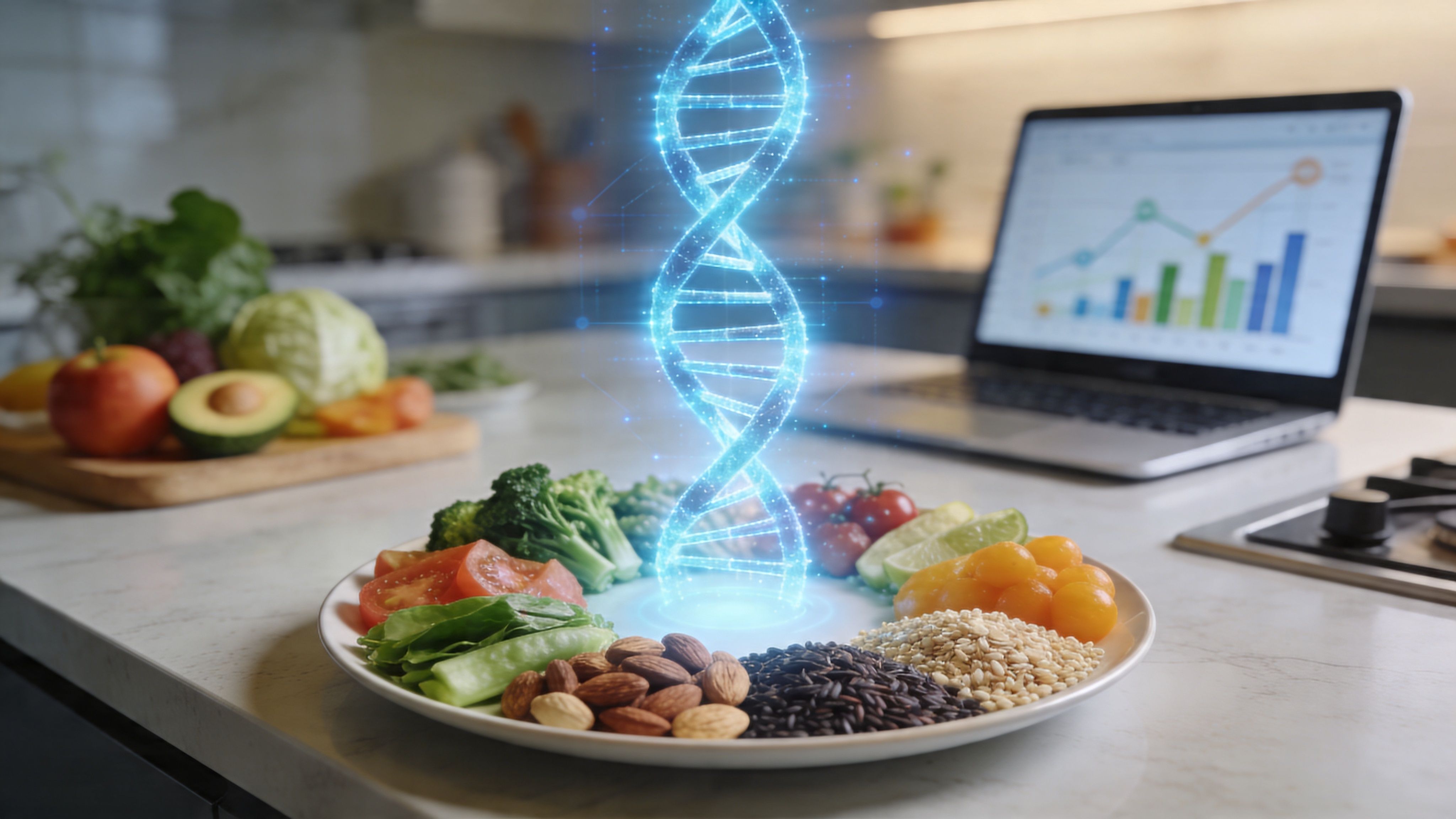
Finally, Eat Right with DNA Analysis in 2026
You want to eat better. So you read more, listen to podcasts, save recipes, and perhaps try Low Carb, then more protein, then less fat. And yet you often feel not clearer, but more confused.
That is understandable. Many people don’t fail because they lack discipline, but because they face contradictory rules. One person tolerates bread wonderfully in the morning, while another feels ravenous afterward. One person feels full for a long time with plenty of fat, while another feels heavy and sluggish. If you wonder why general advice doesn’t quite work for you, you’re not complicated. You’re simply individual.
That is exactly what makes the topic of nutrition so interesting. Not as a list of prohibitions, but as a question: What does your body really need to function well, stay satisfied, maintain its performance, and remain healthy in the long term?
Why general nutrition rules often fail
Most nutrition rules sound simple. Eat less sugar. More vegetables. Fewer calories. Don’t eat too late. More protein. Fewer carbohydrates.
The problem isn’t that this advice is always wrong. The problem is that it is so general that it barely takes your body into account. It acts as though everyone responds to food in the same way. In practice, that is often not true at all.

When good advice doesn’t work in everyday life
Maybe this sounds familiar. You start a new phase of eating with motivation. At first, things go well. Then everyday life gets hectic, hunger grows stronger, your cravings for sweets increase, or your energy levels crash. You quickly start to feel as though you didn’t follow through.
The flaw in thinking often lies in the system. A plan that works for your friend may be impractical, unsatisfying, or simply not right for you. Different preferences are only part of the picture. Metabolism, satiety, digestion, and your eating environment also play a role.
You don’t have to feel guilty if a standard diet isn’t right for you. Often, the diet is the problem—not you.
Our diet has changed. So has our daily life
On top of that, our diet has changed significantly throughout history. According to data on per-capita food consumption in Germany, per-capita bread consumption fell from 183 kg in 1900 to 51 kg in 2021. Potatoes declined from 197 kg to 52 kg. At the same time, meat, oils, fats, and citrus fruits increased significantly.
This shows two things. First, we eat differently today than previous generations did. Second, more choice does not automatically mean more clarity. Many people today have access to countless foods but little sense of what is personally good for them.
In short: General dietary rules often fail not because of a lack of information, but because they are not a good fit.
- A plan ignores your everyday life: Shift work, family meals, training, or stress change what is practical.
- A plan ignores your response: Some people stay full for a long time after eating oatmeal, while others quickly get hungry again.
- A plan ignores your biology: The way you process nutrients is not the same for everyone.
This idea is often called bio-individuality. It is not just a buzzword, but a helpful perspective. If you want to eat healthily, you do not need even more rigid rules. You need a better understanding of yourself.
Understanding the building blocks of your body
If you want to eat sensibly, a simple image can help. Imagine your body as an engine. To run smoothly, it needs fuel, lubricants, and small but essential operating aids.
The major nutrient groups are called macronutrients. They include carbohydrates, protein, and fats. The smaller helpers are micronutrients, namely vitamins, minerals, and trace elements. If you want to learn more about the basics, the article what is a nutrient is a good place to start.
Macronutrients are your main fuel
Carbohydrates provide readily available energy. This is especially useful when you are physically or mentally demanding. Your body needs protein, among other things, for muscles, tissue, and many repair processes. Fats are important for cell structures, hormones, and a long-lasting feeling of satiety.
None of these building blocks is inherently good or bad. What matters is how much you need and how your body responds to it.
| Nutrient | Put simply | Typical function |
|---|---|---|
| Carbohydrates | Quick fuel | Energy for everyday life, the brain, and movement |
| Protein | Building material | Muscles, recovery, satiety |
| Fats | Long-lasting energy and protection | Hormones, cell membranes, absorption of fat-soluble vitamins |
Many misunderstandings arise right here. People then hear statements such as “fat makes you fat” or “carbohydrates are the problem.” In reality, it depends on context, quantity, and tolerance.
Micronutrients keep the engine running smoothly
Vitamins and minerals provide hardly any energy, but they are necessary for countless processes. Without them, the body does not function properly. You can eat enough calories and still not have an optimal diet if you do not get enough important micronutrients.
A simple example: You feel sluggish even though you eat regularly. The problem is not necessarily that you are eating too little. It may also be that the composition of your diet does not match your needs.
Everyday rule: Feeling full and being well nourished are not the same thing.
This way of thinking is therefore helpful:
- First ask what a food is for: Does it satisfy you, provide protein, supply fiber, or mainly deliver quick energy?
- Then look at the combination: A meal often has a more stabilizing effect when fuel, building blocks, and micronutrients come together.
- Finally, observe your own response: Do you feel calm, clear-headed, and satisfied afterward, or tired, bloated, and hungry again soon?
Eating well does not mean eating perfectly. It means nourishing your body better. And that is easier when you look not only at calories or individual restrictions, but at how the different components work together.
Standard diet versus personalized nutrition
A standard diet works with averages. Personalized nutrition works with differences. This may sound like a small detail, but it changes almost everything.
Many traditional diets set rigid rules. Don’t eat this food. Halve that portion. Avoid this time of day. For some people, this works in the short term. In the long term, it often becomes difficult because the rules are not tailored to the person expected to follow them.

Two ways of thinking compared directly
| Standard diet | Personalized nutrition |
|---|---|
| works with rules for everyone | is guided by your body |
| is often restrictive | is adaptable and practical for everyday life |
| evaluates foods across the board | assesses how you respond individually |
That is exactly why standard diets often feel like a struggle. They require you to adapt to a system. Personalized nutrition turns the process around. It asks: What does the system need to look like to suit you?
If you want to explore the topic in more depth, the article personalized nutrition provides a good overview of this approach.
Why the one-size-fits-all solution so often falls short
Let’s take a simple recommendation like “eat fewer carbohydrates.” For some people, that’s relieving. They stay full longer and snack less. Others become irritable, experience dips in performance, or compensate later with intense cravings.
The same applies to high protein intake, intermittent fasting, or a high-fat diet. A method can be useful. It is simply not automatically useful for everyone.
The difference becomes especially clear here:
- A standard diet thinks in terms of rules: What is generally allowed or forbidden?
- Personalized nutrition thinks in terms of responses: What supports your hunger, energy, and digestion?
- A standard diet treats deviation as a failure: If you cannot stick to it, the fault is supposedly yours.
- Personalized nutrition looks for the right strategy: If something does not work, the plan is adjusted.
A good diet is not the strictest one. It is the one that your body and daily life can sustain together.
Sustainability does not come from harshness
Many people try to manage their diet through discipline. That rarely lasts long. What works in the long term is a strategy that suits your appetite, lifestyle, and biology.
That is why personalized nutrition is not more complicated, but more realistic. It recognizes that people eat, digest, feel full, and respond to foods differently. That is often where the first real relief begins.
The science behind your metabolism
When two people eat the same way but still feel or develop differently, that is not a coincidence. Part of the answer lies in the genes. Another part lies in the gut.
Metabolism is not a single switch. It is a network of signaling pathways, enzymes, hormones, bacteria, and habits. That is why simple statements such as “you just need to eat less” often fall short.

What genes help determine when it comes to nutrition
Certain genetic variants influence how your body regulates hunger and processes energy. According to the article on Cerascreen’s metabolic analysis, variants such as the FTO gene can increase the risk of obesity by up to 30% because they affect feelings of fullness. It also explains that genetic factors can account for 40 to 70% of the differences in weight between people.
That does not mean that genes determine your fate. But it does mean that they help determine your starting point. Someone who gets hungry again more quickly often needs a different meal structure than someone who naturally stays full for a long time.
The article what is nutrigenetics and how does it shape our lives explains this connection between genetics and nutrition in an accessible way.
Why your gut has a say
In addition to your genes, the microbiome also influences your metabolism. This refers to the entire community of microorganisms in your gut. Among other things, these tiny inhabitants help determine how food is processed and how your stomach feels after eating.
This is one of the reasons why two people can react so differently to the same meal. One person feels stable, while the other feels bloated or tired. Not all of this is in your head. Much of it is biology.
A simplified overview helps:
- Genes influence how strongly hunger, satiety, and nutrient processing may be affected.
- The microbiome influences how your digestive system responds to certain foods.
- Everyday life influences both, because stress, sleep, exercise, and eating patterns change your regulation.
Key takeaway: Your metabolism is not just a matter of willpower. It is an interplay of genetics, the gut, and behavior.
What this means for your everyday life
If you want to eat as though you were an average person, you may overlook important signals from your body. Perhaps a protein-rich start to the day suits you better. Perhaps you need a different distribution of carbohydrates. Perhaps intolerances or satiety signals also play a greater role than you previously thought.
Personalization sounds scientific. In practice, it is often highly relevant to everyday life. It helps you finally understand why your body reacts to food the way it does.
Common nutrition mistakes and how to avoid them
Many nutrition mistakes do not stem from convenience, but from oversimplified messages. “Just eat less.” “Avoid fat.” “Counting calories is enough.” This sounds clear, but in everyday life it often leads you astray.
What makes these rules particularly tricky is that they sound reasonable. Only when you observe their consequences do you realize that they are too narrow in their thinking.
Three misconceptions that often cause problems
- Reducing everything to calories: Calories matter, but they do not alone explain how full you feel, how stable your energy remains, or how easily you can stick to a diet.
- Do not automatically suspect fats: Those who eat everything low-fat out of fear of fat often end up with meals that seem “light” but are not very filling.
- Do not forget micronutrients: Many people focus heavily on macros and hardly at all on the quality of their food. This can mean that the plate is full, yet the body still does not feel properly nourished.
The overlooked influence of your environment
Another point is often underestimated. People do not eat in a vacuum. In its article on obesogenic food environments, the Scientific Advisory Board on Agricultural Policy emphasizes that it is not just willpower that matters; constant access to and advertising for unhealthy foods also shape behavior.
That explains why good intentions can falter so quickly. When snacks are constantly visible, eating happens on the go, and advertising continually triggers your appetite, eating becomes a stimulus-response reaction rather than a conscious decision.
You do not have to resist perfectly. You can shape your environment so that good decisions become easier.
What works better instead
Instead of constantly monitoring yourself, work with clear, simple guardrails:
- Build meals around satiety. Protein, fiber, and suitable fats often help more than calorie control alone.
- Make triggers visible. Food is not the only thing that triggers you. Fatigue, stress, and fixed habits do too.
- Observe patterns instead of slip-ups. A single meal is rarely the problem. Repeated mismatches are.
- Adapt the strategy to your body. If you know what you are more sensitive to genetically or in terms of digestion, you can recognize many common mistakes earlier.
The most important shift in perspective is this: Not every bad decision is a character flaw. Often, you simply lack the right information about your metabolism and your everyday life.
Find your personal nutrition strategy
Many people spend years trying to eat better, changing rules above all. What is often missing is a clear look inward—not just a gut feeling, but a combination of observation and analysis.
A personal nutrition strategy begins with three questions. How do you respond to certain meals? Which patterns run through your everyday life? And which biological clues lie beneath the surface?
From assumptions to useful insights
You can already learn a great deal by looking honestly at your habits. Does a breakfast really keep you full for a long time, or does it merely keep you occupied? Do you feel calm and clear after certain foods, or rather tired and bloated? Observations like these are valuable.
The picture becomes even clearer when laboratory analyses are added. They can help identify blind spots that are easy to overlook in everyday life. That is exactly why more and more people are interested in at-home DNA and other health analyses.
Studies such as the EFFORT study in the Claraspital PDF show that personalized nutrition therapy can significantly reduce mortality among patients. At the same time, this preventive approach is still often missing from standard care. This is an important indication: personalization is not a gimmick, but a serious approach to health.
What a good strategy consists of
A sustainable nutrition strategy is rarely spectacular. It is precise. It often consists of these building blocks:
- Your goal: Do you want to lose weight, stabilize your energy, recover better athletically, or understand digestive issues?
- Your response to food: It is not just what you eat that matters, but how you respond to it.
- Your biological data: Genetics, gut health, nutrient status, or intolerances can provide important insights.
- Your everyday life: The best strategy is of little use if it cannot be integrated into your life alongside work, family, and routines.
Personalization does not mean you have to eat in a more complicated way. It means you can finally stop guessing.
Why at-home tests can make sense here
At-home tests do not provide a magical shortcut. But they can bring clarity to vague questions. Instead of repeatedly trying out new eating styles, you get a more sound basis for making decisions. This is especially helpful if you have already tried a lot but still cannot seem to make real progress.
A good analysis does not replace your own awareness. It complements it. This often results in a plan that does not feel like a diet, but rather like guidance.
Your mybody® DNA Test Roadmap
If you want to understand how your body responds to nutrition, a DNA test is a logical next step. It does not answer every health question. But it can show very specifically where standard recommendations are too general for you.
The mybody® DNA test guide explains the basic idea in an easy-to-understand way. In everyday life, the process is usually straightforward: collect a sample at home, send it in, receive your results, and use them to derive concrete nutrition steps.

Turning genetics into everyday life
A DNA nutrition test analyzes genetic indicators related to metabolism, nutrient utilization, and eating behavior. In the end, what matters to you is not the laboratory terminology, but how it translates into everyday life.
A test like this only becomes worthwhile when the results lead to real options for action, for example:
- which meal structure better suits your sense of satiety
- whether a particular focus on carbohydrates, fats, or protein may be appropriate
- what you should pay particular attention to when choosing your food
- how you can cook more easily and consistently without constantly having to plan from scratch
Why a recipe book makes the difference
This is exactly where the DNA Nutrition Test with Individual Cookbook and Recipe Book becomes practical. Knowledge alone does not change your kitchen. Many people receive good health information, but no clear way to put it into practice.
A personalized cookbook and recipe book bridges this gap. It translates abstract results into dishes, food choices, and routines. Instead of merely knowing what might theoretically suit you, you get a practical version for everyday life.
This is particularly helpful if you do not just want to eat “healthier,” but finally want to eat reliably well. In other words, in a way that suits your body and your daily routine.
How to put it into practice
A good start often looks like this:
- Read the results and simplify. Do not implement everything at once. First identify the most important patterns.
- Choose three suitable meals. Breakfast, lunch, or dinner. The important thing is to be specific.
- Repeat recipes instead of constantly optimizing. Consistency beats perfection.
- Observe your response. Greater satiety, better energy, and less mealtime chaos are often the first noticeable signals.
The real benefit is not just a report. It is the end of constantly guessing. You learn to base your diet not on trends, but on the signals from your own body.
If you no longer want to base your diet on general rules, but on your own metabolism, a data-driven starting point may be worthwhile. MYBODY Lab GmbH offers a DNA nutrition test with an individual cookbook and recipe book that translates genetic insights into concrete, practical recommendations for everyday life.



Share now:
The 7 Most Popular Types of Diets and Trends in 2026 at a Glance
This is how personalized tests measurably improve your own health