
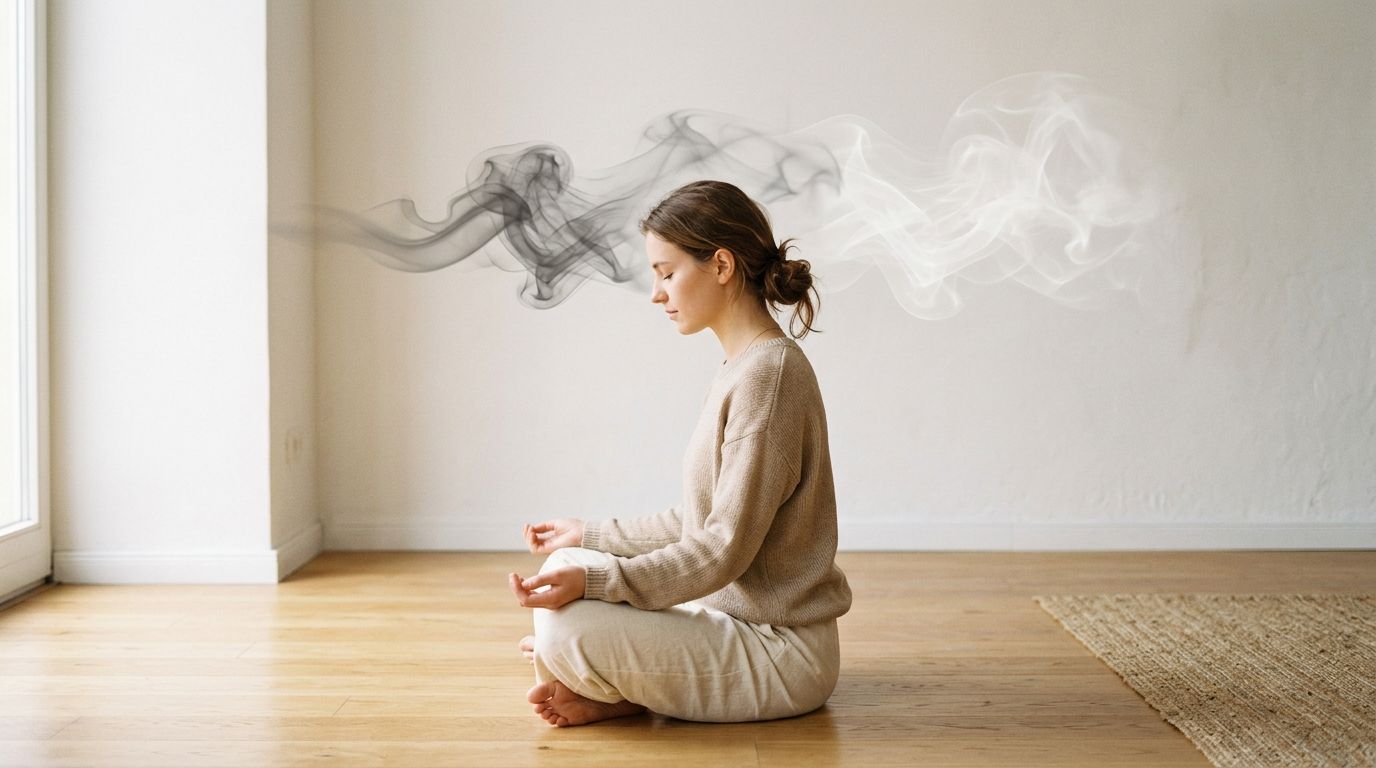
Inner Restlessness: Causes & Balance 2026
You finally sit down on the sofa in the evening. The day is actually over. And yet it feels as if your body is still running. Your shoulders are tense, your chest feels tight, and your mind jumps from one thought to the next. You want to relax, but inside, everything remains on high alert.
Many people describe inner restlessness exactly this way. Not as clear fear of something specific, but as a constant feeling of being driven. As if a switch somewhere in the system were stuck. From the outside, everything may look normal. Inside, there is constant tension.
The tricky thing is that you quickly start doubting yourself. Am I too sensitive? Am I overreacting? Pull yourself together. But that is not how the body works. Inner restlessness is not a character flaw. It is a signal. And that signal can come from the mind, the metabolism, hormones, nutrient deficiencies, or the gut-brain system.
That is exactly where it is worth taking a closer look. Not just with general relaxation tips, but by asking yourself an honest question: What is actually keeping my nervous system permanently on high alert?
You are not alone with your inner restlessness
Some people notice the restlessness first thing in the morning, immediately after waking up. Others only notice it around midday, when the coffee kicks in and the to-do list gets longer. Still others experience this state mainly in the evening, when things should finally be quiet, but their body still does not wind down.
Typically, the feeling is difficult to pin down. You are not necessarily panicking. Not necessarily sad. And yet something is not right. You are more irritable, less focused, tire more quickly, and at the same time feel as if you are constantly wound up. This confuses many people.
When the body cannot enter rest mode
Feeling restless inside often means that your system is not switching smoothly between tension and relaxation. A healthy daily routine needs both: focus, performance, and responsiveness, but also switching off, recovery, and a sense of safety.
When this switch no longer works, even a free evening doesn’t really feel free. You sit still, but your nervous system does not.
Inner restlessness is often not a sign of weakness, but an indication that your body or mind is currently carrying more strain than you realize.
Why many people look in the wrong place
Many people initially look only to their minds for an explanation. That’s understandable. Worries, pressure at work, conflicts, fears about the future, or emotional strain often play a role. But the problem does not always begin there.
An everyday example: You feel nervous, restless, and quickly overwhelmed. At the same time, you sleep worse, experience palpitations more often, and sometimes have trembling hands. The cause may be psychological. But it may also be physical. This distinction is missing from many guides.
A more helpful approach is to take an objective look at both levels:
- Mind: chronic stress, rumination, anxiety, emotional overload
- Body: hormones, blood sugar, nutrients, thyroid, gut
- Everyday life: caffeine, lack of sleep, sensory overload, irregular meals
The good news
You do not have to simply put up with this feeling. The better you understand which part is psychological and which is physical, the more specifically you can make changes. Sometimes a small adjustment is enough. Sometimes you need greater clarity through tests or medical guidance.
Both are okay. The important thing is simply to take your symptom seriously.
What is behind it: the most common causes
You feel your heart pounding, become irritable quickly, cannot wind down in the evening, and wonder: Is it stress? Or is something physically wrong? This is often where things become confusing, because psychological and physical causes can feel very similar.

Inner restlessness is therefore not a single problem, but rather an alarm signal. Your nervous system is telling you: I am under pressure. This pressure can come from thoughts and feelings. But it can just as easily originate in the body itself, for example through hormones, blood sugar fluctuations, lack of sleep, stimulants, or undetected deficiencies.
Psychological triggers
Psychological causes often begin gradually. Not everyone immediately notices that rumination, inner tension, or underlying anxiety are keeping the body in a constant state of alert. The system then runs like an engine that never fully returns to idle.
Common emotional triggers include:
- ongoing stress at work or in the family
- constant rumination and worry
- periods of anxiety or underlying nervousness
- depressive moods accompanied by inner tension rather than just sadness
- distressing experiences after which the body switches to alarm mode more quickly
People who are particularly performance-oriented often misinterpret these signals. They think they simply need to pull themselves together. In reality, their nervous system has often been responding to too much pressure for weeks or months.
Physical causes
Physical triggers are often overlooked, even though they can be measured. This is especially true when the restlessness has suddenly become more intense without any clear emotional trigger.
Typical examples include an overactive thyroid, hormonal changes, major blood sugar fluctuations, reactions to caffeine or alcohol, and medication side effects. Infections, sleep deprivation, or a highly sensitive autonomic nervous system can also contribute.
The distinction is important: Psychological strain can trigger inner restlessness. But a physical stimulus can produce exactly the same feeling. At first, this makes no difference to how you experience it. It does make a difference to the solution.
Everyday life as an amplifier
Everyday life often acts like a volume control. Two coffees on an empty stomach, long gaps between meals, little sleep, lots of screen time, and hardly any recovery time. Before you know it, mild tension has turned into pronounced restlessness.
A simple example: When your blood sugar drops, the body releases stress hormones to counteract it. This can feel like anxiety, even though the initial trigger is physical. The same applies to consuming a lot of caffeine. Some people tolerate it well, while others react with trembling, palpitations, and a mind that can no longer settle down.
Why making a clear distinction is so helpful
Many guides stop at stress management. That does not go far enough. If the cause lies in nutrient deficiencies, hormones, or the gut–brain system, simply thinking positively only helps to a limited extent.
That is why it is worth starting with a careful assessment:
- More likely psychological, when the restlessness is closely connected to worries, conflicts, feeling overwhelmed, or specific situations
- More likely physical, when symptoms occur without a clear thought-related trigger, together with palpitations, trembling, digestive problems, changes in the menstrual cycle, sleep disturbances, or a drop in performance
- A combination of both, when stress makes the body more susceptible and the body further intensifies the psychological tension
The gut is particularly fascinating. When digestion, inflammatory processes, or the composition of bacteria become imbalanced, this can affect mood, the stress response, and inner tension through the gut–brain axis. A good introduction can be found in the article about a healthy gut flora and its role in the nervous system.
People who travel frequently or find themselves in unfamiliar living conditions often experience this combination of psychological strain and physical overstimulation particularly intensely. The article Work and Travel Guide to the challenges provides a relevant example.
If a confirmed deficiency shows up in your blood test results, targeted supplementation may be beneficial. One example is the Vitamin D3 K2 Complex | Shield. According to the product description, it combines vitamins D3 and K2 and is intended for situations in which a deficiency has been identified through a blood test or other diagnostic method.
The body as the source of nutrient deficiencies and your microbiome
You may feel driven from within even though nothing particularly dramatic is happening in your mind. In that case, it is worth seeing the body not merely as a side effect, but as a possible trigger.

Nutrients as a calming system
Your nervous system works like a finely tuned orchestra. To keep signals flowing calmly and in an orderly way, it needs sufficient minerals and vitamins. When these building blocks are lacking, the body often reacts more quickly with irritability, tension, or fatigue, even when the actual trigger is unclear.
Magnesium, vitamin B12, iron, and other B vitamins are particularly often overlooked in cases of inner restlessness. The problem is simple: When there is a deficiency, the body can no longer respond to stress as steadily. Then even a little can be enough to make you feel jittery, highly sensitive, or on edge.
Ferritin also plays a role here. When iron stores are too low, many people report not only fatigue but also heart palpitations, nervousness, or an inner tension that is difficult to explain. The same applies to B12. A deficiency does not always initially cause classic symptoms such as tingling or severe fatigue. Sometimes it first shows up through mood, concentration, and a nervous baseline feeling.
Why the gut can have a say
The gut and brain are in constant communication. You can think of it as a busy two-way connection. What happens in the mind affects the gut. What happens in the gut can, in turn, affect mood, the stress response, and tension.
That is precisely why the microbiome is so fascinating in relation to inner restlessness. When the bacteria in the gut become imbalanced, the intestinal lining is irritated, or digestion repeatedly causes problems, the effects often extend beyond the abdomen. The body then constantly sends small alarm signals. You may not experience this as clear pain, but rather as diffuse tension, fatigue, irritability, or the feeling that you can never fully unwind.
This is a gap that many guides leave open. They explain the psyche, but not the gut-brain system. If you experience restlessness together with bloating, alternating bowel movements, food intolerances, or exhaustion, it is worth taking a closer look at the role of a healthy gut flora in the nervous system.
Inner restlessness without any clear external cause is often not a sign of weakness, but an indication that your body is calling for attention.
What you can practically take away from this
A helpful question is: What occurs together? Individual symptoms are often vague. In combination, they frequently point in a particular direction.
| Observation | Possible physical clue |
|---|---|
| You feel scattered and become irritable quickly | Magnesium or B vitamins could be involved |
| You feel nervous and empty at the same time | Also check ferritin or vitamin B12 |
| Digestive problems accompany the restlessness | Take a closer look at the gut-brain system |
| You react strongly to stress | Consider nutrient status and the body's stress response together |
If a blood test actually shows a B-vitamin deficiency, the Vitamin B Complex | Energize may be an appropriate option. According to the product description, it contains all 8 B vitamins and is intended for situations in which a deficiency has already been identified through a blood or DNA test.
Investigating your own body: when are which tests useful?
Not every instance of inner restlessness immediately requires extensive diagnostic testing. But if symptoms keep recurring, measuring is often more useful than guessing. A test does not replace a medical diagnosis. However, it can help you identify patterns.

Which clues point to which test
Sometimes the accompanying symptoms already reveal quite a lot:
-
Restlessness plus fatigue
A nutrient test is often useful then. Ferritin, vitamin B12, magnesium, and other blood values in particular can provide clues. -
Restlessness plus hot flashes, menstrual cycle changes, or mood swings
Then a hormone test may be worthwhile. This applies especially if menopause or other hormonal shifts are suspected. -
Restlessness plus digestive problems
If bloating, irregular digestion, or food-related problems occur as well, a microbiome analysis may be useful.
Which laboratory values are important for metabolism and stress
Certain values are especially important if the restlessness comes in waves or worsens after long intervals between meals. Fasting glucose, HbA1c, and electrolytes, particularly magnesium and potassium, are essential for identifying metabolic disorders, as significant blood sugar fluctuations can mimic or intensify autonomic anxiety symptoms and inner restlessness, as explained in the overview of laboratory diagnostics for anxiety disorders.
If you also suspect that your stress axis is permanently overactive, it can also help to look at the connection in the article Measuring cortisol at home.
A simple decision framework
You do not have to test everything at once. This sequence makes more sense:
-
Check the frequency
Does the restlessness occur only during stressful periods or almost without any apparent reason? -
Note accompanying symptoms
Fatigue, dizziness, palpitations, digestion, sleep, menstrual cycle, hot flashes. -
Measure relevant physical markers
Especially when the symptoms recur. -
Take the psychological level seriously
If the tests show no abnormalities but worry, tension, or rumination dominate, psychological support is not a last resort but a logical next step.
One objective way to do this is through the self-tests from mybody x Gesundheit, for example in the areas of blood, hormones, or the gut microbiome. They are designed to check for measurable physical triggers when you are seeking more clarity about recurring symptoms.
Immediate relief: 5 evidence-based tips for acute restlessness
You may be sitting at your desk; nothing dramatic has actually happened, yet your body feels as though it has to run off immediately. Your heart is beating faster, your muscles are tense, and your mind is frantically searching for a reason. In a moment like this, it helps to lower the alarm in your nervous system first. Investigating the causes can come later.

Five mini tools for acute situations
-
Exhale longer than you inhale
A prolonged exhalation often slows the inner alarm faster than prolonged thinking. For example, inhale for four seconds and exhale for six to eight seconds. You do not have to count perfectly. What matters is the signal to your body: The danger is over. -
Progressive muscle relaxation
During acute restlessness, your body is often already tense before you consciously notice it. A simple alternation between tensing and releasing can help. Tense your hands, shoulders, or legs for a few seconds, then relax them again. This works like a reset for your muscles and nervous system because your body can once again perceive the difference between tension and relaxation more clearly. -
Walk calmly instead of staying seated
Restlessness is often trapped activation energy. If you remain sitting still, it continues to circle in your head. A short, steady walk through your home, along the hallway, or around the block helps channel this tension into movement. Ideally, do it without your phone and without additional input.
Reminder for acute situations: Calm the body first, then sort out the problems. An overstimulated nervous system rarely thinks clearly.
-
Interrupting the alarm with cold
Cold water on your face, holding your cold hands under running water, or slowly drinking a cool glass of water can interrupt the moment. The sensation brings your attention back from the thought carousel to your body. This is often the first step toward feeling grounded again. -
Orienting instead of ruminating
When your mind is racing, no perfect meditation will help. A simple orientation exercise in the room often works better: Name five things you see, four things you feel, and three things you hear. This exercise shifts your focus from internal alarm to external reality.
When your body is especially strongly involved
Some people mainly experience inner restlessness as trembling, muscle tension, heart palpitations, or a nervous vibration throughout the body. In that case, it makes sense to ask whether not only stressful thoughts but also physical factors may be involved. One example is nerve and muscle function. If you want to understand more precisely what role mineral balance may play, read the article Magnesium for nerves and inner tension.
Herbal support with moderation
Herbal remedies may provide additional support for some people, for example when the restlessness occurs mainly in the evening or it is difficult to switch off. But they do not replace a proper assessment of the cause. Especially if your restlessness keeps returning, is strongly noticeable physically, or occurs together with digestive problems, cycle changes, sleep disturbances, or a drop in performance, it is worth considering the underlying cause first: nutrients, hormones, blood sugar, or the gut-brain system.
Acute calming can be helpful. But it does not automatically resolve the trigger. That is precisely why it is so important to distinguish between emotional stress and measurable physical factors, rather than hastily lumping them together.
Long-term strategies for greater calm in everyday life
Acute relief is helpful. Lasting change, however, comes from habits that do not overburden your nervous system anew every day. Especially with inner restlessness, the small, unspectacular things are often the most effective.
Stabilize your blood sugar instead of riding a roller coaster
If you skip meals, only grab quick snacks, or go without food for a long time, your body can fluctuate more. You may notice this not only as hunger, but often also as nervousness, irritability, or inner tension.
The foundation is simple:
- Eat regularly instead of eating nothing for hours and then eating a lot
- Include protein and fiber to get through the day more steadily
- Don't just drink coffee when your body actually needs energy
Excessive consumption of caffeine, nicotine, or alcohol directly irritates the nervous system and promotes nervous restlessness. Reducing these substances and stabilizing blood sugar through regular meals are considered evidence-based measures for alleviating symptoms, as described in the article on nervous restlessness caused by caffeine, nicotine, or alcohol.
Movement, but not as another stressor
Many people try to compensate for restlessness with intense exercise. That can work. But if you are already running on empty, it can also stimulate the nervous system even further.
Often more suitable are:
| Everyday situation | More helpful |
|---|---|
| You feel tense and exhausted at the same time | Walking, easy cycling, yoga |
| You tend to overthink | Rhythmic movement without performance pressure |
| You spend a lot of time sitting and are overstimulated | Short movement breaks throughout the day |
Sleep as an anchor for calm
Poor sleep is not a side issue. If your sleep is shallow or interrupted, your system often starts the morning already irritable.
Simple rules can help:
- A consistent evening routine instead of a different schedule every day
- Offline periods, so your mind is not flooded with more input before bed
- Fewer stimulants late in the day, especially if you are sensitive to them
- A brief escape from the carousel of thoughts, for example by using a worry note for tomorrow
In the evening, do not write down how you should feel better. Write down what your body probably needed today but did not receive.
Mental relief in everyday life
Not all inner restlessness disappears simply by optimizing your nutrient intake or sleeping better. Sometimes your mind remains the loudest part. Then structures help, not harshness.
A few simple examples:
- A set time window for open to-dos instead of constantly keeping them in mind
- Clear boundaries around messages, social media, and availability
- A brief daily log to help you recognize triggers
- Conversations when stress is no longer just part of everyday life, but a constant state
Long-term calm rarely comes from one major breakthrough. It grows when your body experiences more often: I am nourished. I am safe. I do not have to remain in alarm mode all the time.
Conclusion: Your path to inner balance
Inner restlessness is unpleasant. But it is also a serious signal that should not be ignored. Your body is showing you that something is out of balance. It may be psychological. It may be hormonal, related to metabolism, or connected to nutrient levels. And sometimes your gut also plays a bigger role than you previously thought.
The important thing is not to rush into choosing just one explanation. If you constantly feel driven, it is worth looking at both sides: what is weighing on you internally and what can be measured in your body.
Start small. Observe patterns. Reduce obvious aggravating factors. Use immediate support when the pressure becomes acute. And if the symptoms persist, seek clarity through tests or medical evaluation.
If the restlessness is accompanied by severe symptoms such as persistent rapid heartbeat, significant weight loss, dizziness, panic, depressive episodes, or suicidal thoughts, you need professional help and should not bear this alone.
If you want to better understand recurring inner restlessness, taking a structured look at nutrients, hormones, or gut health can be a sensible first step. mybody x Gesundheit offers at-home self-tests for this purpose, allowing you to check measurable physical triggers and plan your next steps with a better-informed approach.



Share now:
Significant Weight Gain Around the Abdomen: Causes & What Helps
Recognizing alcohol intolerance: ALDH2, symptoms, and when a genetic test is truly helpful