

Losing weight with a genetic test: Your genetic blueprint as the key to success
Have you tried countless diets, meticulously counted calories, and worked yourself to exhaustion at the gym, yet the number on the scale simply does not change? You are absolutely not alone. The real reason why most diet plans fail lies in a fact that is often overlooked: Your body is unique and follows its own biological blueprint.
Your personal blueprint determines your success
Have you ever wondered why your friend loses weight so successfully with low-carb, while the same method does absolutely nothing for you? Or why your colleague becomes slimmer effortlessly through intermittent fasting, while you are left struggling with a growling stomach and frustration? The answer lies not in a lack of discipline, but in your genetics.
Everyone metabolizes nutrients differently. Your genes determine how efficiently your body converts carbohydrates, fats, and proteins into energy—or stores them as fat reserves. A “one-size-fits-all” approach to weight loss is therefore doomed to fail from the outset because it completely ignores your individual biological predisposition.
Think of it this way: You are trying to fill a car with the wrong fuel. Even the best model will not go a single mile. Your body works the same way. If you do not give it the nutrients it is genetically predisposed to process most effectively, even the strictest diet simply will not work. The feeling of failure is therefore often just the result of a strategy that does not suit you at all.
Genetic obstacles on the way to your desired weight
In recent years, science has made enormous progress and identified a whole range of genes that are directly linked to our weight and metabolism. These genes control many different aspects of your body and even your behavior.
Here are some of the most important factors controlled by your DNA:
- Your feeling of fullness: How quickly do you really feel full after a meal? Genes such as the MC4R gene play a decisive role in regulating your appetite.
- Your predisposition to the yo-yo effect: Some people are genetically more prone to quickly regaining weight after a diet. In a sense, your body fights against weight loss.
- Your fat and carbohydrate sensitivity: Is your body particularly sensitive to dietary fats? Or are carbohydrates more likely to immediately show up on your hips?
- The effectiveness of exercise: Certain gene variants determine whether you benefit more from endurance exercise or intensive strength training to burn fat effectively.
These genetic differences are the key to understanding why general dietary advice so often falls short. A personalized diet tailored to your genetic predispositions can make the crucial difference here and finally pave the way to an approach that works for you.
The following table gives you a quick overview of how differently your genetic predispositions may be set.
Genetic factors that influence your weight-loss results
This table shows how different genetic predispositions can influence whether you lose weight more effectively through exercise or dietary changes, and how your body responds to fats and carbohydrates.
| Genetic factor | Possible impact on weight loss | Personalized approach |
|---|---|---|
| FTO gene variant | Increased tendency toward obesity; stronger feelings of hunger. | A protein-rich diet for greater satiety; strength training may be more effective than with other genotypes. |
| PPARG gene variant | Increased sensitivity to saturated fats; tendency to store fat more quickly. | Reduce saturated fats (e.g., from sausage and butter); focus on unsaturated fats (e.g., from avocados and nuts). |
| ADRB2 gene variant | Lower calorie expenditure through exercise; losing weight through physical activity is more difficult. | Focus on high-intensity interval training (HIIT) to boost metabolism more strongly; diet plays an even greater role. |
| TCF7L2 gene variant | More difficult processing of carbohydrates; higher risk of unstable blood sugar levels. | Low-carb approach with moderate amounts of complex carbohydrates (e.g., whole-grain products, legumes); optimize meal timing. |
As you can see, there is no single right way. What works for one person may be exactly the wrong thing for another.
When science explains failure
The frustration so many people experience when trying to diet can even be demonstrated statistically. One survey shows that only eight percent of Germans manage to maintain their weight-loss and increased-exercise goals over the long term.
An impressive study at the University Medical Center Hamburg-Eppendorf makes the power of genes particularly clear: With exactly the same diet, participants with a defect in the APOA5 gene lost a mere 0.3 kilograms. In contrast, participants with an intact variant of this gene lost almost 13 kilos. The shocking part: Around 96 percent of people carry at least one defect in this important gene. This explains why standard diets simply cannot work for the overwhelming majority. Anyone who wants to explore this topic in greater depth will find more fascinating background information in the article Genetics Instead of Exercise.
So it is not your fault or a lack of willpower. Your body follows its own rules—and a genetic test helps you finally understand and use those rules to your advantage.
A genetic test provides you with the missing pieces of the puzzle, so to speak. It deciphers your personal metabolic code and gives you clear guidance on which dietary and lifestyle adjustments can genuinely make a difference for you. Instead of continuing to feel your way in the dark and trying one frustrating diet after another, you can follow a scientifically grounded approach tailored to you.
How a DNA metabolism test really works
Perhaps you associate genetic testing with a complicated doctor's visit involving needles and a lot of effort. Let me reassure you: the opposite is true. The entire process is designed so that you can complete it conveniently and easily at home.
All we need is a simple saliva sample. Instead of a blood draw, which many people find unpleasant, a quick swab of your cheek is enough. We will send the test kit directly to your home. Collecting the sample itself takes just a few minutes, is completely painless, and requires no prior knowledge.
As soon as you have collected the sample, simply place it in the enclosed return envelope and send it to our certified partner laboratory in Germany. From there, the experts take over.
What happens to your sample in the laboratory
Once your sample arrives at the laboratory, it is prepared for analysis. The first and most important step is DNA isolation. Your cells are gently broken open to access the most valuable thing inside them: your genetic material, DNA. This purified DNA is the basis for everything that follows.
Next, modern laboratory technology comes into play, specifically searching for the sections of your DNA that play a role in your metabolism. Specific genetic markers are analyzed—markers that scientific research has shown can influence things such as fat burning, appetite, and the way your body processes carbohydrates and fats. Your entire genome is not decoded; only the key areas relevant to weight loss are analyzed.
Data protection is our top priority: Your sample is processed in the laboratory exclusively under a pseudonymized code. This means the laboratory does not know your name and cannot directly link the data to you. The entire process is, of course, GDPR-compliant and guarantees the highest level of data security.
From analysis to your personal roadmap
The laboratory analysis provides a huge amount of raw data about your genetic predispositions. But numbers alone do not help you. Only through interpretation by our scientists and algorithms are these data transformed into a plan you can understand and implement in your everyday life.
The following graphic shows how genetic analysis can break the typical vicious cycle of dieting attempts and frustration.
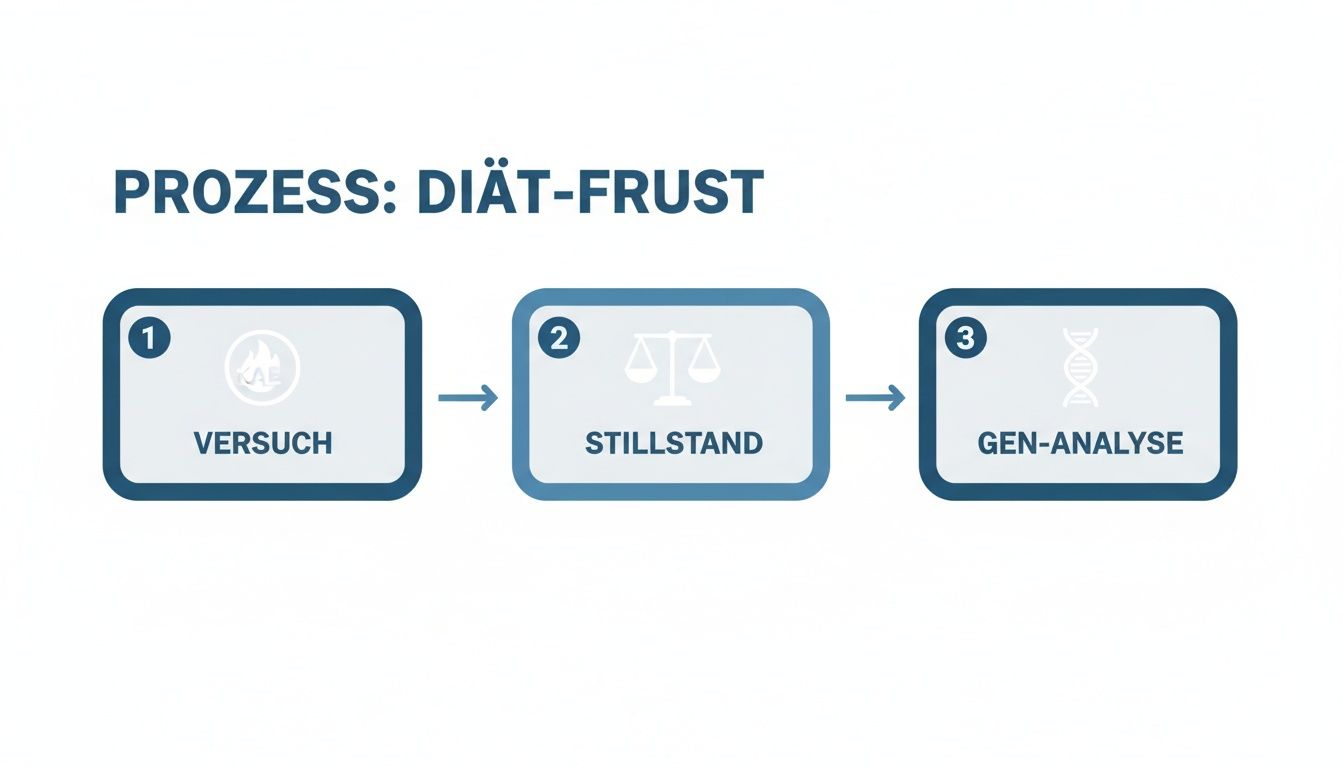
It is clear: Where conventional methods often lead to stagnation and disappointment, genetic analysis offers a personalized way forward.
Based on your results, we create a comprehensive report that translates complex science into clear, easy-to-understand language. For example, you will learn:
- Your metabolic type: Does your body belong to those that process carbohydrates, fats, or proteins particularly efficiently?
- Your tendency toward the yo-yo effect: How strong is your genetic predisposition to quickly regain weight after a diet?
- Your optimal type of exercise: Do you benefit more from long endurance sessions or short, high-intensity strength training?
This is how a small, painless saliva sample becomes a detailed and highly personal roadmap for your health. If you are curious, you can read how a saliva test works in detail in our guide. In the end, you hold a scientifically based report that not only tells you what you should do, but also explains why it works best for you.
What your genetic results report reveals
As soon as your sample has been processed in the lab, you receive the centerpiece of the whole process: your personal results report. But what exactly does it contain, and how does it help you lose weight? Think of this report as a detailed kind of user manual for your body. It translates the complex science behind your DNA into clear, actionable advice for your everyday life.
So instead of simply telling you that you should change something, it explains the why behind the recommendations. This turns abstract data into a real plan you can follow.

Key genes that control your weight
Your report focuses on very specific genes that have been proven to have a major influence on metabolism, appetite, and weight. Each of us carries variants of these genes, and these variants determine how our body responds to certain foods and forms of exercise.
Two of the best-known “weight genes” that we examine closely are:
- The FTO gene: It is often referred to as the “obesity gene.” Certain variants are associated with a higher BMI and a stronger feeling of hunger. People with such a variant tend to eat more and store fat particularly efficiently.
- The MC4R gene: This gene is, so to speak, the main regulator of your feelings of hunger and satiety. If it does not function optimally, your brain sends weaker “I’m full” signals. The result: You quickly eat more than you actually need.
The prevalence of obesity in Germany has increased from 12.2 percent in 2003 to 19.7 percent in 2023. Many diets fail precisely because of genetic obstacles such as mutations in the MC4R gene, which increase appetite while simultaneously slowing energy expenditure. Interestingly, there are also protective variants: A specific variant in the MC4R gene (I103) reduces the risk of being overweight by 30 to 40 percent and leads to an average body weight that is 1.6 kg lower. With its DNA tests, MYBODY® provides precise insights into these genes to create personalized weight-loss plans that are truly tailored to your genetic predisposition.
Your personal metabolism type, decoded
One of the most important findings in your report is the determination of your genetic metabolism type, also known as your metabolism type. This tells you which of the three main nutrients—carbohydrates, fats, or proteins—your body metabolizes most efficiently.
Imagine that your result says:
“Your genetic metabolism type is a protein type. This means your body can convert proteins into energy particularly well and use them to promote satiety. A protein-rich diet provides optimal support for weight loss and keeps you feeling full for longer.”
This one piece of information alone can change everything. While you may have relied on low-fat products for years, your DNA shows that increasing your intake of lean meat, fish, legumes, and dairy products is a much more effective way for you to reach your goal.
There are various metabolism types, for example:
- The carbohydrate type: Your body handles complex carbohydrates well and can use them efficiently as a source of energy.
- The fat type: You benefit from a diet rich in healthy fats and should avoid saturated fats where possible.
- The mixed type: Your metabolism is balanced and processes all three macronutrients relatively equally well.
From insight to concrete action
However, the report does not stop at pure theory. Every genetic insight is translated into concrete recommendations for your everyday life. So you learn not only what type of metabolism you have, but also what that means in practical terms for your meals.
Another crucial factor is the genetic predisposition to the yo-yo effect. If your genes indicate a strong tendency toward it, your body will try even harder to regain the lost weight after a diet. Knowing that this tendency is rooted in your DNA is not a reason to give up, but rather extremely important information.
The recommendation might then be to pay particular attention to a slow and controlled increase in calories after the weight-loss phase and to incorporate strength training in order to maintain muscle mass. This way, you consciously work with your body instead of fighting against your genetic predisposition. A detailed DNA analysis provides precisely these kinds of personalized strategies that go beyond mere weight loss and aim for sustainable success. This turns your genetic report into a tool that helps you stop seeing your body as an opponent and finally start seeing it as a partner.
Implementing Your Personal Nutrition Plan
So, now you’re holding your genetic results report in your hands—a kind of personal map for your metabolism. That’s already a huge step. But honestly? The best insights are worthless if they remain only on paper. Now it’s time to get down to business: put the theory into practice and implement your personalized plan in concrete terms.

This is often the step that determines success or failure. It’s not about completely turning your life upside down overnight. What matters much more are smart, sustainable adjustments that are tailored precisely to your body.
From Report to Plate
The core of your report is the recommendation for your optimal macronutrient distribution. That may sound technical at first, but it simply means: In what proportions should you eat carbohydrates, fats, and protein to optimally support your metabolism? Think of your plate as a canvas that you can now paint according to your genetic blueprint.
For example, if your genetic test identifies you as a protein type, your ideal plate will look quite different from that of a carbohydrate type.
- Your goal: Every main meal should contain a high-quality source of protein. This not only keeps you feeling full for longer, but also revs up your metabolism.
- In plain English: Instead of a jam-filled bread roll for breakfast, you could try scrambled eggs with vegetables or Greek yogurt with berries. For lunch, a large salad with chicken breast or lentils would be perfect—instead of the usual pasta.
If you are more of a carbohydrate type, the focus is on choosing the right carbohydrates.
- Your goal: Choose complex carbohydrates that keep your blood sugar levels stable and provide you with long-lasting energy.
- In plain English: Swap white bread for whole-grain bread, regular pasta for whole-grain or lentil varieties, and add sweet potatoes, quinoa, and oats to your meal plan more often.
A genetic test is like a compass that points you in the right direction. It shows you the most efficient route to your destination, but you have to walk it yourself. The trick is to view the recommendations as a guide, not a rigid set of rules.
Putting it into practice at the supermarket and in the kitchen
It all starts when you're shopping. Create your shopping list based on the recommendations in your report. If you know that you benefit from healthy fats, avocados, nuts, and high-quality olive oil go in your cart. If protein is your key, plan meals specifically with fish, lean meat, or plant-based alternatives such as tofu and chickpeas.
Here are a few simple kitchen tricks:
- Meal prep is your best friend: Cook ahead for several days. When you have a healthy lunch tailored to you in the fridge, you won't even be tempted to grab something unsuitable at lunchtime.
- Simple recipe swaps: You don't have to give up your favorite dishes. Just adapt them. Replace half the ground meat in your Bolognese with lentils, or make lasagna with zucchini slices instead of pasta sheets.
- Know your go-to foods: Find 5–10 foods that are a perfect fit for your metabolic type and that you always keep at home. This way, you can quickly whip up something suitable at any time.
You can also find a detailed step-by-step guide in our article, how to create your individual nutrition plan.
Example implementation for different metabolic types
The following table shows how nutritional and training recommendations can vary depending on genetic profile. This makes it clear why a one-size-fits-all recommendation simply cannot work for everyone.
| Metabolic type (example) | Optimal macronutrient distribution | Recommended foods | Most effective sport |
|---|---|---|---|
| Protein type | 40% protein, 30% fat, 30% carbs | Lean meat, fish, eggs, Greek yogurt, lentils, quinoa, green vegetables | Strength training, HIIT |
| Carbohydrate type | 20% protein, 20% fat, 60% carbs | Whole-grain products, oats, sweet potatoes, legumes, plenty of fruit and vegetables | Endurance sports (running, cycling) |
| Mixed type (fat-protein) | 35% protein, 45% fat, 20% carbs | Avocado, nuts, seeds, olive oil, fatty fish (salmon), eggs, leafy greens | Combination of strength & moderate endurance |
As you can see, the “perfect” plate is different for everyone. It’s about finding your personal formula and putting it into practice in everyday life.
Your genetically optimized training
Just as with nutrition, there is no one-size-fits-all solution when it comes to exercise. Your genes reveal whether you tend to be more of an endurance or strength type and what your body responds to best.
- Are you an endurance type? Then your body responds especially well to longer, moderate sessions such as jogging, cycling, or swimming. This allows you to burn calories effectively and strengthen your cardiovascular system.
- Are you a strength type? Then you benefit especially from intense weight training or high-intensity interval training (HIIT). This type of exercise builds muscle, which in turn increases your basal metabolic rate—so you burn more calories even at rest.
Of course, that doesn’t mean you should avoid the other option completely. A good mix is always sensible. But when you know where your sweet spot lies, you can set your focus correctly and simply achieve better results with the same effort.
Understanding the limitations and staying realistic
One thing must be clear: losing weight with a genetic test is not a magic pill. Your genetic report is an incredibly powerful tool that shows you a personalized path, but it does not replace healthy lifestyle habits. Sufficient sleep, good stress management, and a positive attitude remain essential building blocks for your success.
The results take the guesswork out of it. You no longer have to try every new fad diet, but can focus on the strategy that works for you. This not only saves time and frustration, but above all creates one thing: the foundation for sustainable success based on understanding your own body.
The science behind the gene diet
The idea that your genes could control your weight-loss success sounds almost too simple to be true, doesn’t it? Many people wonder: Is losing weight with a genetic test just a clever marketing trick, or is there solid science behind it? Let’s take a closer look so you can make an informed decision for yourself.
Research over the past few years paints a fairly clear picture: Our DNA is indeed a decisive factor when it comes to our body weight. Scientists have identified a whole range of genes that directly influence our metabolism, sense of hunger, and even our tendency to store fat. So the question is no longer whether genetics plays a role, but how we can use this knowledge to our advantage.
More and more studies indicate that personalized nutrition plans based on genetic analyses produce noticeably better and, above all, more sustainable results than the typical run-of-the-mill diet. When your plan is tailored to you, you work with your body—not constantly against it.
Epigenetics: You are more than just your genes
But it is not only about the genes you inherited from your parents. An even more fascinating field is epigenetics. Think of it as a kind of software layered over your DNA that determines which genes are “switched on” or “switched off.” Your lifestyle—your diet, stress level, and how much you exercise—can actively influence these switches.
The good news is this: You are not helplessly at the mercy of your genetics. Through targeted measures, you can positively change the activity of your genes. And this is exactly where a genetic test becomes an extremely useful tool, because it shows you the key starting points.
A striking example is the POMC gene, which plays a central role in your feeling of satiety. A groundbreaking study by Berlin’s Charité hospital involving more than 1,100 participants showed that a specific epigenetic change in this gene can increase the risk of obesity in women by a substantial 44 percent. Specifically, the researchers found more so-called methyl groups on this gene in women with a BMI above 35; these groups effectively “silence” it. This proves that it is not only the genes themselves but also their activity that matters. Genetic tests such as those offered by mybody-x can uncover such variants and provide you with targeted strategies. If this discovery interests you, you can find the details in Charité’s press release.
Science shows that a personalized strategy is not a luxury, but the logical consequence of our understanding of human biology. It is about knowing your body’s unique rules and using them to your advantage.
Why personalized nutrition is superior
Research shows time and again that people who follow a diet tailored to their genes lose significantly more weight compared with control groups following standard diets. The reason is simple: Your body gets exactly the nutrients it can process most effectively.
- Higher efficiency: Your metabolism runs at full speed because it is getting the right “fuel.”
- Better satiety: When you eat the macronutrients that suit you, you stay full for longer and those agonizing cravings decrease.
- Greater sustainability: A diet that suits you does not feel like a hardship. You can integrate it into your daily routine much more easily and stick with it in the long term.
Losing weight through genetic testing is therefore much more than just a passing trend. It is the smart application of modern scientific findings to pave the way to your ideal weight in an individual—and therefore significantly more effective—way. It gives you the confidence of choosing a method based on facts.
Everything you want to know about the DNA metabolism test
A genetic test for metabolism? That sounds complicated at first and naturally raises questions. Completely understandable—after all, this is about your body and your very personal goals. So that you know exactly what to expect, we have compiled the answers to the most frequently asked questions here—clearly, honestly, and without technical jargon.
Who can benefit from such a test?
In principle, everyone can benefit from insights into their own genetics. However, the test is particularly valuable for you if you feel that you have already tried everything. Countless diets, plenty of discipline, but no success—or only short-lived results? A DNA analysis finally provides the missing pieces of the puzzle.
A genetic test is perfect for anyone who wants to stop guessing and instead find a science-based, personalized path to their ideal weight. However, it is not for you if you expect a magic pill that will change everything overnight without any effort on your part.
A genetic test is not a magic wand, but rather an extremely detailed map. It shows you the best route for your body—but you have to take it yourself.
How quickly will I see the first results?
This naturally varies from person to person, because every body works differently. However, many of our customers notice a change within the first few weeks—whether through having more energy in everyday life or because those annoying cravings suddenly disappear.
Visible results on the scale usually appear after four to eight weeks when you consistently incorporate the recommendations into your daily routine. However, sustainability is far more important than speed. Because the plan is based on your unique DNA, you are working toward a long-term solution for your well-being—not a short-term crash diet.
What actually happens to my genetic data?
Your data belongs to you—and protecting your privacy is our top priority. The entire process is designed to ensure that you retain full control and that your sensitive information is always secure.
- Pseudonymization: Your test kit receives a unique, anonymous code. The laboratory therefore never sees your name or other personal details, only this code.
- Strict data protection under the GDPR: All your data is processed and stored securely in accordance with the strict requirements of the European General Data Protection Regulation (GDPR).
- Destruction of your sample: Once the analysis is complete, your biological sample will be properly and completely destroyed in the laboratory.
So you can be absolutely certain that we handle your data with the utmost responsibility. It is used solely to create your personal report.
And what if I don't follow everything 100% of the time?
Life happens! Weight loss with a genetic test does not mean that you can never eat pizza with friends or enjoy a glass of wine again. Perfection is not the goal. It is about creating a healthy foundation that works for you, not about rigid prohibitions.
Just think of the 80/20 rule: If you 80 % If you stick to your genetically suitable recommendations most of the time, you will still see fantastic results. The rest 20 % are for the wonderful exceptions that make life worth living.
The great advantage is that you always have a clear guide to return to. Even if you get off track, you know exactly how to find your way back on course.
Does the genetic test replace a visit to the doctor?
A clear no. A DNA metabolism test is a fantastic tool for your lifestyle and preventive healthcare. However, it can never replace a medical diagnosis or advice from a doctor. Think of the results as well-founded recommendations to help optimize your diet and exercise.
If you have chronic illnesses or health concerns, you should always discuss the results and any planned changes with your doctor. By the way: Many doctors and nutritionists already use our analyses as a valuable foundation to provide their patients with even more targeted, personalized advice.
Are you ready to put an end to guesswork and embark on a path based on your unique DNA? Discover with mybody-x how your body really works, and start your journey toward lasting well-being. Find the right test for you now at https://mybody-x.com.



Share now:
DNA test for dieting: Can your genetics unlock your weight-loss secret?
Discover the DNA test: Your personal key to health, nutrition & fitness