

Vitamin D3 Deficiency in Women: Recognizing Symptoms & Taking Action
TL;DR:
- Many women in Switzerland suffer from an often-overlooked vitamin D3 deficiency, causing fatigue and mood swings. This deficiency is common in the colder months and can be addressed through blood tests and targeted supplementation. A conscious approach to vitamin D3 is crucial for women's health and well-being.
Many women in Switzerland know the feeling: they are constantly tired, feel unmotivated, and their mood fluctuates for no apparent reason. Most attribute the cause to stress, poor sleep, or simply the hectic everyday life. In doing so, they overlook one of the most common and at the same time most easily treatable causes: a vitamin D3 deficiency. This article shows you which symptoms truly indicate a deficiency, who is particularly at risk, and how you can gain clarity and take action with concrete steps.
Table of Contents
- What is Vitamin D3 and what function does it have in the female body?
- Typical Symptoms of Vitamin D3 Deficiency in Women
- Risk Factors and Specific Challenges for Swiss Women
- Medical Consequences of Severe Vitamin D3 Deficiency
- Diagnosis and Countermeasures: How to Proceed Step by Step
- Our Standpoint: Vitamin D3 Deserves More Attention Than It Receives
- Test Your Vitamin D3 Status Easily at Home Now
- Frequently Asked Questions about Vitamin D3 Deficiency in Women
Key Takeaways
| Point | Details |
|---|---|
| Recognizing Symptoms Specifically | Fatigue, low mood, and muscle pain often indicate a deficiency in women. |
| Considering Risk Factors | Swiss women, especially, should be particularly vigilant in winter and with low sun exposure. |
| Testing Before Supplementing | A blood test is advisable before taking vitamin D3 to avoid overdosing. |
| Avoiding Consequences | Untreated deficiency can have serious effects on bones and muscles. |
| Individual Solution | Treatment is optimally based on testing, consultation, and controlled dosage. |
What is Vitamin D3 and what function does it have in the female body?
Vitamin D3 is strictly speaking not a classic vitamin, but a hormone precursor. The body mainly produces it through the skin when exposed to sunlight. It is hardly absorbed in sufficient quantities through food. In the body, vitamin D3 is converted into its active form and then acts in almost every tissue.
Vitamin D regulates calcium absorption, immune function, and hormone balance, making it important for women at every stage of life. Without sufficient vitamin D3, the intestines cannot efficiently absorb calcium from food, bones become weaker, and the immune system works less reliably. What many underestimate: Vitamin D3 also directly influences the production of serotonin, the so-called happiness hormone, in the brain.
For women, there are particularly critical life phases:
- During pregnancy, the need increases significantly because vitamin D3 helps determine the development of the child's skeletal system and immune system.
- During lactation, the mother passes vitamin D3 through breast milk, which can further deplete her own reserves.
- During menopause, estrogen levels drop, accelerating bone loss. Vitamin D3 and calcium are then particularly crucial to prevent osteoporosis.
- Even younger women with office jobs who spend little time outdoors are often affected.
The typical signs of vitamin D3 deficiency are often subtle and therefore unfortunately often ignored for years or attributed to the wrong trigger. This is a problem, because the longer a deficiency persists, the more far-reaching the consequences.
Pro Tip: Vitamin D3 works in the body together with Vitamin K2. K2 ensures that the calcium absorbed by Vitamin D3 actually reaches the bones and does not end up in blood vessels. Those who supplement with Vitamin D3 should therefore also keep K2 in mind.
Typical Symptoms of Vitamin D3 Deficiency in Women
Now that the biological basics are clear, the question arises: How does a woman specifically recognize a vitamin D3 deficiency? The answer is not always easy, because the symptoms are so general that they could fit dozens of other ailments.
Common symptoms include fatigue, muscle weakness, muscle and joint pain, susceptibility to infection, bone pain, hair loss, low mood, and headaches. Particularly insidious: all these complaints can also be caused by lack of sleep, stress, or other nutrient deficiencies. Therefore, they are rarely immediately associated with vitamin D3.

However, there is a pattern that is alarming: the symptoms typically worsen in autumn and winter when sunlight hours decrease, and slightly improve in summer. If you notice this in yourself, you should definitely have your vitamin D3 status checked.
Mild versus Pronounced Deficiency Symptoms in Comparison
| Symptom | Mild Deficiency | Pronounced Deficiency |
|---|---|---|
| Fatigue | Occasionally, in the afternoon | Persistent, even after sleep |
| Muscle Pain | Mild tension | Diffuse pain, weakness |
| Mood | Slight low in winter | Depressive mood |
| Immune System | Slightly more colds | Frequent, prolonged infections |
| Bones | No noticeable discomfort | Pain, increased fracture risk |
| Hair | Increased loss possible | Significant, diffuse hair loss |
| Headaches | Rare | Regular, without clear trigger |
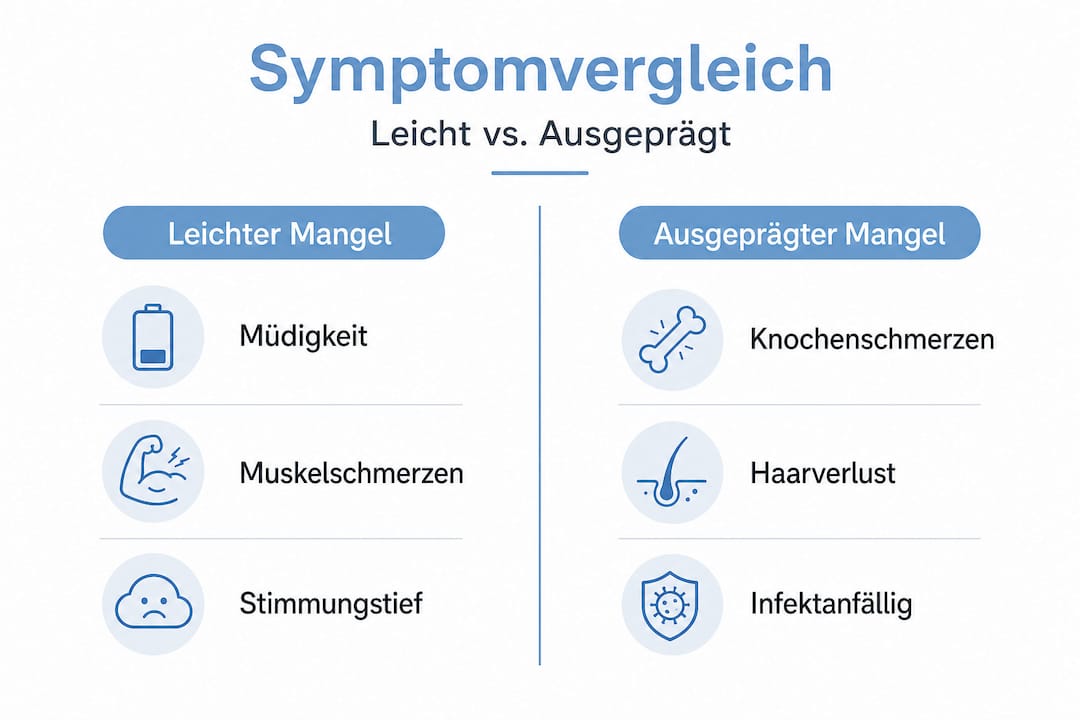
This image shows: A mild deficiency often simply feels like "not 100 percent fit". Many women live in this state for years because the symptoms never become so severe that they trigger a doctor's visit.
📊 Statistic: 60% of the Swiss population is undersupplied in winter. Women are a risk group due to less sun exposure. This means: If you feel run down in January or February, statistically speaking, you are very likely to be deficient in vitamin D3.
What you should specifically observe:
- Do you feel particularly exhausted from October to March?
- Do you have more colds or infections in winter than in summer?
- Do you complain of diffuse muscle pain that no doctor can clearly explain?
- Do you feel a depressed mood or rumination without a clear trigger?
- Do you notice that your hair falls out more in autumn than usual?
If you answer "Yes" to two or more of these points, it's worth taking a look at other vitamin deficiency symptoms and getting a specific test. You can find out more about the symptoms and causes of vitamin D deficiency in our guide.
Risk Factors and Specific Challenges for Swiss Women
Now that the general symptoms are known, it turns out that not all women are equally at risk. The geographical location of Switzerland plays a greater role than many assume.
Switzerland is located between the 46th and 48th parallel. From October to April, the sun is so low in the sky that UVB radiation is insufficient to stimulate significant vitamin D3 production in the body. This is not an assumption, it is physics. Even if you walk outside for an hour every day during this time, your skin will hardly produce any vitamin D3.
Women are a risk group due to less sun exposure, darker skin, pregnancy, or menopause. In addition, there are societal factors: women more often work part-time or from home, often wear covering clothing in summer for sun protection, and use sunscreen that absorbs UVB radiation.
Who in Switzerland should be particularly attentive:
- Women over 50 (menopause, lower skin production)
- Pregnant and breastfeeding mothers
- Women with darker skin tones (higher melanin content slows down vitamin D3 production)
- Women who cover a lot of skin due to religious or cultural reasons
- Women who primarily work indoors
- Overweight women (vitamin D3 is stored in fat tissue and is less available to the body)
- Women with intestinal diseases such as celiac disease or Crohn's disease (impaired absorption)
"In Switzerland, about 60% of the population is undersupplied with Vitamin D in winter." Federal Food Safety and Veterinary Office (FSVO)
This figure is remarkable, considering that Switzerland is considered a prosperous country with good healthcare. The problem is structural: it is not due to poor nutrition or negligence, but simply to the lack of sunlight in the cold season.
Furthermore: Many women are familiar with the other typical deficiency symptoms of other nutrients, whose symptoms can overlap with those of a vitamin D3 deficiency. A targeted test provides clarity here and saves a long search.
Medical Consequences of Severe Vitamin D3 Deficiency
It is important to classify the significance of the symptoms by clearly stating the potential consequences of a long-standing deficiency. A mild deficiency feels unpleasant. A severe deficiency over months or years can have serious consequences.
In severe deficiency, osteomalacia, increased risk of osteoporosis, and proximal muscle weakness occur, especially during menopause. Osteomalacia is the softening of bones in adults because too little calcium is incorporated. This sounds drastic, but it develops insidiously and is often only discovered after a bone fracture from a harmless fall.
The most important consequences of severe and prolonged vitamin D3 deficiency:
- Osteomalacia (bone softening): Bones lose density and stability. Affected individuals report diffuse bone pain, especially in the spine, hips, and legs.
- Osteoporosis (bone loss): The risk is particularly increased after menopause. Lower estrogen levels plus low vitamin D3 is a dangerous combination for bone substance.
- Proximal muscle weakness: These are the large muscle groups in the thighs and shoulders. Affected individuals have difficulty climbing stairs or carrying heavy shopping bags.
- Increased risk of falls: Weak muscles and less stable balance increase the risk of falls, which, in combination with weak bones, can lead to serious injuries.
- Weakened immune system: Chronically increased susceptibility to infection, possibly also an increased risk of autoimmune diseases.
Symptoms, Risks, and Recommendations at a Glance
| Symptom | Medical Risk | Recommendation |
|---|---|---|
| Persistent bone pain | Osteomalacia, fracture risk | Consult doctor immediately, measure level |
| Pronounced muscle weakness | Risk of falls and injuries | Test and targeted therapy |
| Frequent infections | Immunodeficiency | Check level, supplement if necessary |
| Depressed mood in winter | Seasonal affective disorder | Test, therapy, consider light therapy |
| Severe hair loss | Nutrient deficiency | Create comprehensive nutrient profile |
Pro Tip: When diagnosing, always have your parathyroid hormone level measured as well. This increases when vitamin D3 is too low because the body tries to stabilize calcium levels through bone breakdown. An elevated parathyroid hormone level confirms a clinically relevant vitamin D3 deficiency even if the vitamin D level itself is still at the lower end of the normal range.
How to recognize and treat a deficiency and what ways there are to compensate for a vitamin D deficiency, we describe in more detail in other articles.
Diagnosis and Countermeasures: How to Proceed Step by Step
Knowing what's missing is the first step, but how do you proceed concretely and safely? Here's the good news: a vitamin D3 deficiency can be reliably measured and, in most cases, well-addressed. The key is to take the right steps in the right order.
The standard procedure is the measurement of the so-called 25-hydroxyvitamin D level (25(OH)D) in the blood. This is the storage form of vitamin D, which provides the most accurate information about the supply status. Winter supplementation is recommended; if symptoms are present, measurement should be done using the 25(OH)D method, treatment is individually dosed, and a check-up takes place after 3 months.
Here's how to proceed specifically:
- Document symptoms: For two to three weeks, note when you experience fatigue, muscle pain, or low mood. Is there a seasonal pattern? Do the symptoms worsen in winter?
- Perform a test: Have your 25(OH)D level measured in your blood. This can be done by your family doctor or conveniently with a vitamin D deficiency test at home, where you take the blood sample yourself and send it in. For those who want it particularly uncomplicated, there are practical solutions with the vitamin D test for home.
- Classify the value: A value below 30 nmol/l is considered a severe deficiency. Between 30 and 50 nmol/l, there is a mild to moderate deficiency. Above 75 nmol/l is considered optimal supply. Your doctor or the laboratory report will help you classify.
- Take targeted action: If a deficiency is confirmed, individual supplementation is recommended. It is important not to simply buy the highest available dose. Supplementation has been shown to help only with a true deficiency below 30 nmol/l. For normal values, preparations offer no benefits, and the risk of overdose is in the harmful range at over 100 µg per day.
- Monitor progress: Re-measure after three months of supplementation. This way, you can see if the dose is appropriate and adjust it if necessary.
Pro-Tip: In winter, preventive supplementation with 1,000 to 2,000 IU daily is beneficial for most women in Switzerland, but only after a test. Knowing your baseline allows for more targeted dosing, preventing both under- and overdosing. Blind supplementation without knowing your own levels is like navigating without a map.
Our View: Vitamin D3 Deserves More Attention Than It Gets
In the public discussion about healthy eating, almost everything revolves around proteins, omega-3 fatty acids, or probiotics. Vitamin D3 is often neglected, although its breadth of action is almost unparalleled. Our experience from thousands of analyses shows: nutrient deficiencies are rarely spectacular. They are quiet, insidious, and therefore underestimated.
The real problem is not that women don't pay attention to their health. The problem is that non-specific symptoms like fatigue or mood swings have been normalized in society. "Everyone knows that" is not a diagnosis; it's a trivialization. Anyone who is constantly exhausted deserves an explanation, not a suggestion to simply go to bed earlier.
Another point that is important to us: Many women supplement vitamin D3 on suspicion, without ever having measured their levels. That's better than nothing, but it's not optimal. Anyone who knows their exact baseline, who knows whether they are at 20 or 80 nmol/l, can act much more targeted and efficiently. And anyone who re-tests after three months of supplementation will see in black and white whether the measure has worked.
Self-determined health does not mean deciding everything yourself. It means making informed decisions. A simple blood test gives you a basis that no general guide in the world can replace, because your body is your body and not the average of a population study.
Test Your Vitamin D3 Status Easily at Home Now
If you recognize yourself in the described symptoms or simply want clarity about your nutrient supply, mybody® offers an uncomplicated solution. With our ISO-certified blood tests, you can have your vitamin D3 level determined conveniently from home, without a doctor's appointment, without waiting time. You will receive a scientifically validated report with your personal values, a clear classification, and concrete recommendations for action tailored to your situation. More than 11,300 satisfied customers already trust mybody®. Start now with a targeted nutrient check and stop guessing how you really are.
Frequently Asked Questions about Vitamin D3 Deficiency in Women
How long does it take for a vitamin D3 level to normalize after supplementation?
With consistent intake, the value can significantly improve within 3 months. A follow-up measurement after this period will show whether the dosage is correct.
Can symptoms improve after a short time?
Many women report noticeable improvements in energy and mood within just a few weeks, although this strongly depends on the individual baseline.
Is there a risk of overdose from vitamin D supplements?
Yes, consistently exceeding 100 µg daily can lead to hypercalcemia and organ damage. That's why a test before supplementation is so important.
Are extra supplements useful in summer?
Generally not necessary, provided you expose your skin to midday sun for 15 to 30 minutes daily. However, women with less sun exposure should also monitor their levels in summer.
Does vitamin D protect against colds?
Vitamin D demonstrably supports the immune system, regulates immune function and hormone balance, but does not guarantee complete protection against infections. It is an important prerequisite, not a panacea.



Share:
Online Gut Microbiome Analysis: Your Path to Better Health
Microbiome Analysis: Your Guide to Gut Health