
Leaky Gut Syndrome: Your test for clarity regarding intestinal problems
Do you often feel tired, bloated, or struggle with vague symptoms that seem inexplicable? Leaky gut syndrome – increased permeability of your intestinal wall – could be the culprit. A targeted leaky gut syndrome test can finally clarify whether your intestinal barrier is weakened and allowing unwanted substances to enter your bloodstream.
What Leaky Gut Syndrome Really Means
Imagine your intestinal wall as a highly intelligent and rather strict bouncer. Its job is to allow only desired guests – that is, vital nutrients like vitamins and minerals – into the exclusive club of your bloodstream.
All unwanted visitors, such as toxins, pathogens, or undigested food particles, are consistently repelled. This protective mechanism is the silent foundation of your overall health.
In leaky gut syndrome, however, this gatekeeper becomes negligent. The tiny but extremely important connections between the cells of your intestinal wall, the so-called tight junctions , loosen. Suddenly, the barrier is no longer tight, but permeable – hence, "leaky" or "holey".
When the intestinal barrier becomes leaky
This weakened barrier has far-reaching consequences. Particles that should never enter your bloodstream now cross the intestinal wall. Your immune system, about 70% of which resides in the gut , immediately recognizes these invaders as a threat and sounds the alarm. It initiates a defense response that can lead to silent inflammation throughout the body.
These persistent inflammatory foci are often the true cause of a whole range of symptoms that at first glance seem to have nothing to do with the intestines.
Before we continue, here's an overview of typical signs associated with leaky gut. Perhaps you'll recognize yourself in some of them?
| Symptom category | Concrete examples | Connection with Leaky Gut |
|---|---|---|
| Digestive problems | Chronic bloating, abdominal pain, diarrhea, constipation, irritable bowel syndrome | The most direct consequence of impaired bowel function and altered intestinal flora. |
| skin problems | Acne, eczema, rosacea, psoriasis, skin rashes | Inflammatory substances from the intestines enter the bloodstream and can trigger skin reactions. |
| Tiredness & Exhaustion | Chronic fatigue, "brain fog", concentration problems | The body uses a lot of energy to constantly fight inflammation. |
| Food intolerances | Sudden reactions to foods that were previously tolerated | Undigested food components enter the bloodstream and trigger an immune response. |
| Mood swings | Anxiety, depression, irritability | The gut-brain axis transmits inflammatory signals, which affects mental health. |
| Joint pain | Nonspecific joint pain, muscle pain, arthritis | Systemic inflammation triggered by the immune response in the gut. |
| Autoimmune diseases | Hashimoto's thyroiditis, celiac disease, rheumatoid arthritis | A leaky intestinal wall is discussed as a key trigger for autoimmune reactions. |
This table shows how far-reaching the consequences can be. Leaky gut is not an isolated intestinal problem, but a condition that can throw your entire health off balance.
Restoring an intact intestinal barrier is therefore a crucial step towards greater well-being and vitality.
The connection to irritable bowel syndrome
The symptoms of leaky gut syndrome closely overlap with those of irritable bowel syndrome (IBS), and this is no coincidence. An estimated 11 million people in Germany suffer from IBS, and a compromised intestinal barrier has been detected in approximately 70 percent of these patients.
Leading gastroenterologists repeatedly emphasize how factors such as chronic stress, an unbalanced diet, or the use of antibiotics can weaken the tight junctions. This paves the way for bacteria and toxins to enter the bloodstream. If you would like to read more about these connections, you can find fascinating insights into gut health at Presseportal.de .
A leaky gut syndrome test is therefore not just a way to confirm suspicions. It is an important tool to get to the bottom of your symptoms and finally be able to take targeted action.
If you would like to delve deeper into the subject now, also read our comprehensive article on Leaky Gut Syndrome and its mechanisms .
The most informative tests for leaky gut
Do you suspect that a leaky gut might be the cause of your symptoms? Then the next logical step is to get to the bottom of it. Instead of continuing to guess and rely on assumptions, you can now use scientifically sound methods to specifically assess the health of your intestinal barrier.
Testing for leaky gut syndrome doesn't have to be complicated. Modern analytical methods are designed to give you precise insights into how well your gut is functioning. It's not just about a simple "yes" or "no," but about understanding exactly where the problem might lie.
This infographic clearly illustrates how a healthy gut can gradually develop into a leaky gut and what symptoms can result throughout the body.
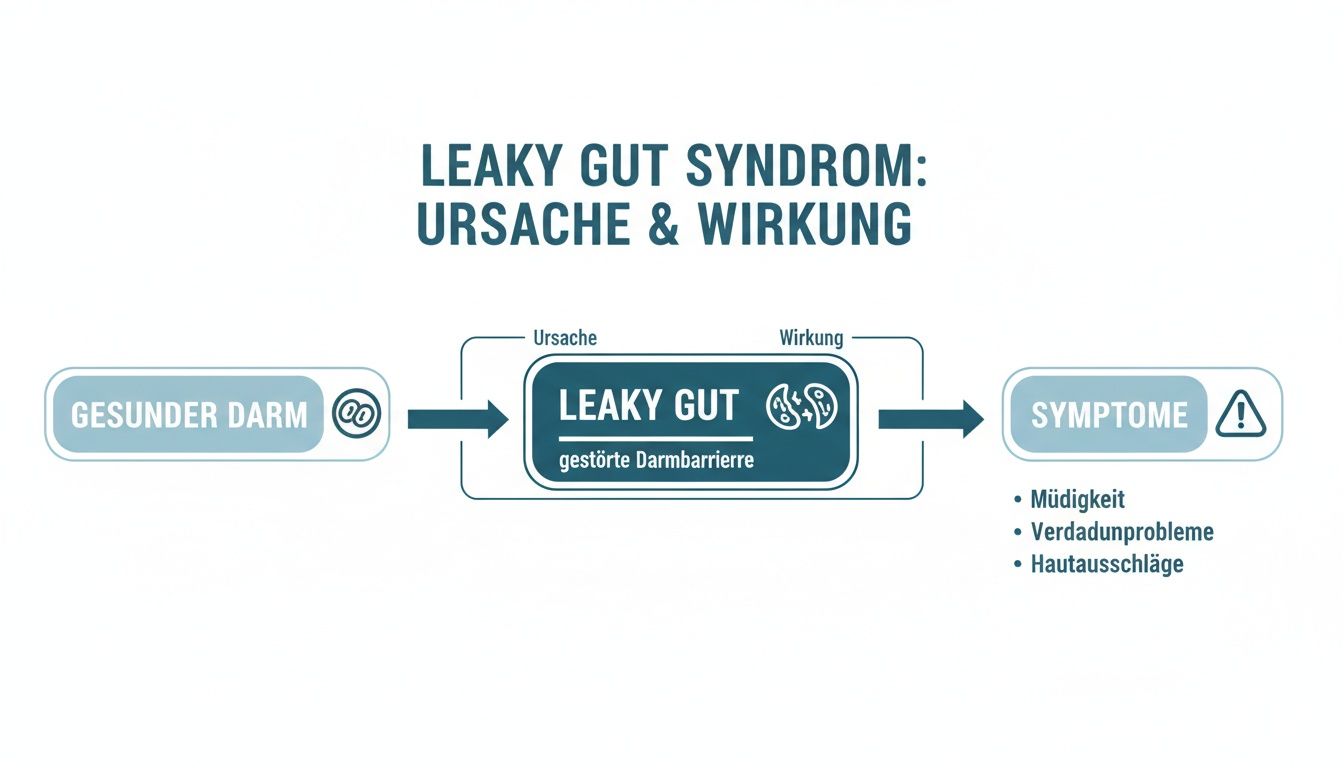
It is easy to see how a disrupted intestinal barrier can trigger a whole cascade of reactions in the organism.
The zonulin test as the gold standard
Perhaps the best-known and most important test when it comes to leaky gut is the measurement of zonulin . You can think of zonulin as a kind of "keymaster" for your intestinal wall. This protein controls how permeable the so-called tight junctions are – the tiny gateways between your intestinal cells.
Elevated zonulin levels in stool or blood strongly suggest that these "doors" are open too often and for too long. Therefore, this value is a direct marker for increased intestinal permeability.
The lactulose-mannitol test: A true functional test
Another very informative method is the lactulose-mannitol test . This test doesn't just check a single value, but the actual function of your intestinal barrier. For this, you drink a special solution containing two different sugar molecules: mannitol (a small molecule) and lactulose (a large molecule).
- Mannitol: This small molecule should easily pass through a healthy intestinal wall and enter the bloodstream.
- Lactulose: The significantly larger molecule, however, should hardly get through.
The urine is then tested to determine how much of each sugar is excreted. A sudden high level of lactulose is a clear indication that the intestinal barrier is leaky and allows larger molecules to pass through that don't belong there.
Other important markers that complete the picture
Besides tests that directly measure permeability, there are other important markers. They often provide crucial pieces of the puzzle to get a complete picture of your gut health and to substantiate a suspicion of leaky gut syndrome.
A single value rarely tells the whole story. Only the combination of different markers provides a clear picture and helps to take truly targeted measures.
These supplementary indicators include, among others:
- Alpha-1 antitrypsin: This protein is normally produced in the liver. If it is found in larger quantities in the stool, this strongly indicates a leaky intestinal lining and often also inflammatory processes.
- Calprotectin: An established inflammatory marker in stool. Elevated levels indicate active inflammation in the intestine, which very often goes hand in hand with impaired barrier function.
- LPS antibodies: Lipopolysaccharides (LPS) are components of the outer cell wall of certain intestinal bacteria. When they pass through a leaky intestinal wall into the bloodstream, the immune system reacts and produces antibodies against them. The detection of these antibodies is a clear indication that the intestinal barrier is no longer properly fulfilling its protective function.
Each of these tests provides valuable but different information. While zonulin measures the control of the "doors," the lactulose-mannitol test shows what actually gets through. Finally, inflammatory markers and LPS antibodies reveal the consequences of a disrupted barrier.
Which test is right for you depends on your individual symptoms and situation. To delve deeper into the different options, you'll find more detailed information in our guide to leaky gut tests to help you decide.
What the zonulin test reveals about your gut health
When we talk about leaky gut syndrome , one name almost always comes up: zonulin . This protein can best be thought of as the gatekeeper of the intestinal barrier. It is the only endogenous regulator that we currently know of that has the task of selectively and only briefly opening the tight junctions between intestinal cells.
This mechanism is fundamentally ingenious and absolutely vital. It allows the body to exchange fluids, nutrients, and even immune cells between the intestines and the bloodstream in a very controlled manner. The whole thing only becomes a problem when this gatekeeper essentially sends a permanent signal to keep the doors open.

A persistently elevated zonulin level is therefore a fairly clear warning signal. It indicates that the intestinal barrier is no longer properly fulfilling its important filtering function and that potentially harmful substances can enter the body.
What causes zonulin levels to rise?
The release of zonulin doesn't just happen randomly. There are very specific triggers that cause the body to open its floodgates. Knowing these factors is the first important step in understanding the causes behind symptoms and finally taking targeted countermeasures.
Some of the most well-known triggers include:
- Gliadin (a building block of gluten): Studies suggest that gliadin can stimulate zonulin release in many people – not just those with celiac disease. This also explains why a low-gluten diet often brings noticeable relief from intestinal problems.
- Certain gut bacteria: An imbalance in the gut flora (dysbiosis) can also drive up zonulin levels. Some strains of bacteria produce substances that directly stimulate intestinal cells to release zonulin.
- Chronic stress: Persistent stress, whether psychological or physical, directly affects the function of the intestinal barrier via the so-called gut-brain axis. Stress hormones can weaken the stability of the tight junctions.
However, other factors such as environmental toxins or a diet rich in highly processed foods and sugar can also contribute to chronically activating this system.
How a zonulin test works and what it tells you
Fortunately, a zonulin test is straightforward. It can be performed on both blood (serum) and stool samples. However, stool measurements have proven particularly informative for assessing the situation directly at the site of zonulin levels, i.e., at the intestinal mucosa.
An elevated zonulin level is more than just an abstract lab result. It's a concrete indication that your intestinal barrier is neglecting its protective function, potentially putting your immune system under constant stress.
The interpretation of the results is quite clear. The lab report provides clear reference ranges that show you whether your value is in the normal, slightly elevated, or significantly elevated range.
- Normal value: Everything is fine. Your intestinal barrier seems stable and the tight junctions are functioning well.
- A slightly elevated value can indicate an emerging or even just temporary disorder. Often, targeted adjustments to diet and lifestyle can make a significant difference.
- A significantly elevated value is a clear indication of considerably increased intestinal permeability. It is important to investigate the underlying causes and develop a more comprehensive strategy to regenerate the intestinal lining.
A test for leaky gut syndrome that measures zonulin provides you with a valuable tool. It not only identifies a problem but also offers a crucial starting point for taking control of your gut health. You gain a better understanding of what's happening in your body and can use your results to plan the next sensible steps for your well-being.
Home tests or laboratory analysis at the doctor's office
Do you want clarity about your gut health but are unsure which method is right for a leaky gut test? Choosing between a modern home test and a traditional lab analysis at the doctor's office can initially seem confusing. Both methods are perfectly valid, but they differ in important aspects such as accessibility, effort, and the type of aftercare provided.
Modern home tests, like those offered by mybody®, are a great way to get a first, scientifically sound insight – all from the comfort of your own home. You take a small sample, send it to a certified laboratory, and receive a detailed, yet easy-to-understand results report with personalized recommendations.
The home test as a straightforward first step
The biggest advantage of a home test? Clearly, its ease of use and the clear presentation of the data. Instead of waiting weeks for a specialist appointment, you can take action yourself and make the first step. This gives you back control over your health and quickly provides you with important information without you having to leave the house.
Another crucial advantage is the clarity. The reports are usually written in such a way that even as a layperson, you immediately understand what the values mean and what the next sensible steps might be. This sharpens your awareness of your own body and empowers you to make well-informed decisions.
The possibility of discreetly and easily performing a test for leaky gut syndrome from home lowers the barrier to entry and makes diagnostics accessible to anyone who wants to take responsibility for their health.
Medical laboratory analysis for a comprehensive overview
In contrast, laboratory analysis performed by a doctor is usually part of a broader diagnostic workup. Here, the results are directly interpreted by a physician within the context of your entire medical history and any pre-existing conditions. This approach is particularly appropriate if you are already experiencing severe or complex symptoms and require comprehensive medical care.
Based on the lab results, the doctor can directly order further tests or initiate targeted therapy. However, the disadvantage can be the increased time commitment involved in scheduling appointments, waiting times, and often multiple visits to the doctor's office.
To make your decision easier, we have directly compared the two approaches.
Home tests compared to medical laboratory analysis
A direct comparison of the most important criteria to help you decide on the right testing approach.
| feature | mybody® Home Test | Medical laboratory analysis |
|---|---|---|
| implementation | Convenient and discreet from home | In a doctor's office or a laboratory |
| Expense | Minimal, no waiting times for appointments | Higher prices require appointments. |
| Results report | Easy to understand, with concrete recommendations for action. | Professional laboratory findings, interpretation by the physician |
| speed | Results often available within a few days | Depending on the practice and laboratory, it may take longer. |
| Cost | Mostly transparent and fixed costs (self-payers) | Depending on the health insurance company and the scope of the examination |
| Advice | Personalized recommendations, often with optional expert support | Direct medical consultation and inclusion in the medical history |
Ultimately, the choice depends entirely on your personal situation. For a solid initial overview and concrete, actionable tips, a home test is an excellent, straightforward option. If you'd like to learn more about exactly how a home stool test works and what advantages it offers, you'll find all the important information in our comprehensive guide.
However, it is also clear that in the case of severe or unclear symptoms, a visit to the doctor remains essential in order to fully clarify the causes.
Interpret your test result correctly and take action.
The moment has arrived: You're holding your test results in your hands. Perhaps the leaky gut syndrome test shows an elevated zonulin level or other abnormalities. This might feel alarming at first, but it's actually a crucial turning point. Don't see it as the end, but as the beginning of your very personal journey to greater well-being.
This result is not a judgment, but a valuable tool. It's like a personal map that finally shows you exactly where you can start to specifically strengthen your gut health. Now you can stop guessing and start taking targeted action.
A positive test result simply means that you now have the opportunity to actively support your body's regeneration. You're no longer in the dark, but have a concrete starting point for positive changes.
The first steps after the diagnosis
An elevated level, for example of zonulin, confirms that your intestinal barrier is more permeable than it should be. The good news is that the cells of the intestinal lining regenerate remarkably quickly. With the right measures, you can actively promote this process and restore the stability of your intestinal wall.
The focus is on two central pillars that go hand in hand: nutrition and lifestyle.
Your test result is the starting point. From now on, it's no longer about finding a problem, but about creating solutions. Every small step in the right direction supports your gut in its regeneration.
These two areas offer you the most effective levers to fundamentally improve your gut health. It's not about achieving perfection overnight, but about consistent, positive changes in your daily routine.
Nutrition as the key to regeneration
Your diet is arguably the most powerful tool you have for healing your intestinal barrier. The basic idea is quite simple: give your gut the building blocks it needs to repair itself, while simultaneously removing the things that further irritate it.
- Reduce inflammatory foods: Highly processed products, sugar, excessive gluten, and unhealthy fats can unnecessarily irritate the intestinal lining. Try to consciously avoid these.
- Integrate healing nutrients: Certain nutrients are true superheroes for your intestinal cells. These include the amino acid L-glutamine , which serves as the main energy source for intestinal cells, as well as zinc and omega-3 fatty acids , which inhibit inflammation and support the repair of cell connections.
- Incorporate pre- and probiotic foods: Fermented foods like kefir or sauerkraut provide beneficial bacteria (probiotics). Fiber-rich foods like leeks, onions, or asparagus serve as food for these good gut inhabitants (prebiotics).
If you would like to delve deeper into this topic, you will find many practical tips and scientifically sound recommendations in our comprehensive guide to leaky gut nutritional therapy .
Make your lifestyle gut-friendly
Besides diet, your lifestyle plays an equally important role. Chronic stress is one of the biggest enemies of a healthy intestinal barrier, as it can directly influence the release of zonulin and promote inflammation in the body.
Target these steps specifically to give your body the necessary rest to regenerate:
- Establish stress management: Find a method that truly suits you. Whether it's meditation, yoga, walks in nature, or simple breathing exercises – just 10–15 minutes a day can make a huge difference.
- Make sleep a priority: While you sleep, your body carries out its most important repair processes. Aim for 7-8 hours of restful sleep per night, ideally in a dark and cool environment.
- Incorporate movement: Regular, moderate exercise such as brisk walking or cycling promotes bowel activity and has an anti-inflammatory effect. But don't overdo it – overly intense training can stress the body.
Sometimes it's absolutely essential to discuss the results and next steps with an expert. A doctor, naturopath, or specialized nutritionist can help you develop a holistic strategy perfectly tailored to your individual needs.
Why your microbiome is the key
A test for leaky gut syndrome , which measures zonulin levels, for example, gives you an important indication of the state of your intestinal barrier. But this value is often just a symptom of a much deeper underlying cause. To truly address your gut health at its root, we need to go a step further and look at the complex ecosystem in your gut: your microbiome.
Imagine your microbiome as a colorful, diverse garden. Trillions of microorganisms – mainly bacteria – live in this garden, working together in a delicate balance. These aren't passive inhabitants, but diligent helpers that make a crucial contribution to your well-being.

If your gut bacteria community is diverse and healthy, they perform vital tasks for you. They actively strengthen your intestinal barrier, produce important nutrients such as vitamin K and some B vitamins, and even train your immune system so that it reacts appropriately to threats.
When the garden becomes unbalanced
However, if this finely tuned system becomes unbalanced, it is called dysbiosis . It's like weeds suddenly growing rampant in your garden and crowding out the beneficial plants. Harmful bacteria can then proliferate and gain the upper hand.
These unwanted microbes often produce metabolic byproducts that directly damage your intestinal lining. They can release substances that weaken the tight junctions and thus boost zonulin production – a direct path to leaky gut.
Leaky gut is therefore rarely an isolated problem of the intestinal wall. Rather, it is the logical consequence of a disrupted microbiome. A simple leaky gut test will show you that the door is open, but only a microbiome analysis will reveal why .
Therefore, a single leaky gut test often only tells half the story. While it reveals increased permeability, it doesn't uncover the underlying cause. And this is precisely where a comprehensive microbiome analysis plays a crucial role.
Understanding the overall picture through a microbiome analysis
A detailed analysis of your gut microbiome, such as the one offered by mybody®, provides you with the missing piece of the puzzle. It looks deeper than a single marker and paints a complete picture of the health of your "gut garden".
Such an analysis can show you exactly:
- How diverse your bacterial flora is: High diversity is considered a sign of a robust and healthy microbiome.
- Whether dysbiosis is present: The ratio of beneficial to potentially harmful bacteria becomes visible.
- Which important strains of bacteria you are missing: For example, it detects whether you are lacking important producers of butyrate – a short-chain fatty acid that serves as the main energy source for your intestinal cells.
With this knowledge, you finally have clear and actionable guidance. You can counteract problems by giving your beneficial gut bacteria exactly the food they need. This can be achieved, for example, through prebiotic fiber from foods like chicory, artichokes, or leeks.
Analyzing your microbiome is therefore the key to a long-term, cause-oriented strategy for your gut health. It allows you not only to combat symptoms, but also to strengthen the foundation of your well-being from the ground up.
Still have questions about the leaky gut test? Here are the answers.
Do you still have questions about the leaky gut syndrome test ? That's perfectly understandable, as the topic is complex. Here we've summarized the most important points for you – concisely, clearly, and without technical jargon.
How long does it take for leaky gut to improve?
Patience is key here. The regeneration time of your intestinal lining is as individual as you are and depends heavily on the severity of the disorder and how consistently you adjust your diet and lifestyle.
The cells of your intestinal wall regenerate incredibly quickly, often within just a few days. However, the real work – namely restoring the protective barrier and a healthy microbiome – is a marathon, not a sprint.
Many people notice initial positive changes after about four to six weeks when they change their habits. However, for truly profound and lasting healing, you should think in terms of months rather than weeks.
Is it possible for a test to produce a false negative result?
Yes, that's absolutely possible. A single value like zonulin is just a snapshot in time. Factors such as your diet the previous day or your current stress level can influence the result. Therefore, a normal result doesn't completely rule out impaired bowel function, especially if your symptoms persist.
A test provides valuable data, but it should always be considered in the context of your symptoms and your overall well-being. Your body's signals are and remain an important guide on your path to health.
Therefore, a more comprehensive view, which may also include inflammatory markers or a microbiome analysis, is often much more informative than a single measurement.
What role does gluten play in a leaky gut test?
Gluten, or more precisely its component gliadin, is one of the best-known triggers that stimulates the release of zonulin. This can temporarily open the "gates" between your intestinal cells (the tight junctions) and thus increase intestinal permeability – even in people who do not have celiac disease.
So if you completely abstain from gluten for weeks before taking a test, the result could be unremarkable, even though your gut is actually sensitive.
To get an honest picture of your gut's reaction to your daily routine, you should eat normally before the test. Unless, of course, your doctor or therapist has specifically recommended otherwise.
mybody® is your partner for scientifically sound health analyses. We help you better understand your body's signals and take targeted steps toward greater well-being. Discover how a detailed analysis of your gut health can lay the foundation for renewed vitality.



Share:
Building up gut flora: How long does it really take?
Constantly tired despite getting enough sleep – what's really behind it?