

Symptoms of menopause you should know about
Sudden hot flashes in the middle of the night, unexplained sweating, or a leaden fatigue that simply refuses to go away—these are often the first symptoms of menopause experienced by many women over 40. We often attribute them to everyday stress, but in reality they are important signals from your body as it adjusts to a new, natural phase of life.
Your body is sending signals: What menopause really means
Perhaps you know the feeling: You're in your mid-40s and actually feel fit as a fiddle, but suddenly a hot flash jolts you awake or your mood swings wildly for no apparent reason. Don't worry, you're far from alone. In Germany, around 9 million women between the ages of 40 and 55 are in exactly this phase of life.
Statistics show that around 80 percent of them suffer from typical symptoms—from hot flashes and sleep disturbances to emotional fluctuations. You can find out more in the findings on the situation of women going through menopause published by the Federal Anti-Discrimination Agency.
This phase is not an abrupt stop but a gradual transition that is often unsettling. Many women wonder: Are my exhaustion, unexplained weight gain, or thinning skin really already the first signs? This uncertainty is exactly what prevents many from actively doing something for their well-being.
An overview of the most common early symptoms of menopause
This table summarizes the typical early signs to give you a quick overview and help you recognize what your body is trying to tell you.
| Symptom category | Typical signs | Possible cause |
|---|---|---|
| Vasomotor symptoms | Hot flashes, night sweats | Fluctuating hormone levels affect temperature regulation in the brain. |
| Psychological changes | Mood swings, irritability, anxiety, difficulty concentrating | Hormonal changes directly affect neurotransmitters such as serotonin and dopamine. |
| Sleep disturbances | Difficulty falling asleep and staying asleep, often exacerbated by night sweats | A declining progesterone level and nighttime hot flashes disrupt sleep patterns. |
| Physical changes | Irregular cycles, weight gain (especially around the abdomen), joint pain, dry skin & mucous membranes | The drop in estrogen affects metabolism, collagen production, and joint health. |
| Lack of energy | Persistent tiredness, exhaustion, reduced performance | Hormonal imbalances and poor sleep deprive the body of valuable energy. |
Remember: Not every woman experiences all symptoms with the same intensity. Your body is unique, and the same is true of your menopause.
Why Interpreting Symptoms Is So Important
Your body is a finely tuned system in which hormones such as estrogen play a central role. As their production gradually declines, it affects almost every area—from your skin and bones to your mental well-being.
The first symptoms are therefore much more than merely bothersome side effects. They are valuable indications that your body is seeking a new balance. If you ignore these signals, you risk allowing symptoms to become entrenched or missing important opportunities to safeguard your long-term well-being. For example, declining estrogen levels can increase the risk of osteoporosis or affect cardiovascular health. Read more about the specific signs in our article on Estrogen Deficiency Symptoms.
Do not view menopause as an ending, but as your body's invitation to give it targeted support. It is the perfect time to take charge of your health and lay the foundation for a vibrant future.
The key lies in understanding exactly what is happening in your body. An imbalance in your hormones or a deficiency in important nutrients can intensify existing symptoms. Taking a targeted look at your blood values, as enabled by the hormone and nutrient tests from mybody-x.com, can give you the clarity you need to regain control and shape this new phase of life on your own terms and with energy.
The Hormonal Journey Through Menopause
Menopause is not a switch that flips overnight. Think of it more like a long journey—a kind of hormonal roller coaster with different stages that gently but steadily guides your body into a new phase of life.
This process can be divided into three major phases: perimenopause, menopause, and postmenopause. Each phase has its own distinctive characteristics and typical menopause symptoms, triggered by hormonal fluctuations.
Perimenopause: The Beginning of Change
Perimenopause is the real starting point. It can often begin as early as the beginning of your 40s—and for some women, even earlier. This phase lasts an average of four to five years, but it can also extend over an entire decade. During this time, the ovaries begin producing hormones less regularly.
Usually, the level of the hormone progesterone, which ensures a stable cycle, drops first. Shortly afterward, the estrogen level also begins to fluctuate—at times shooting up, then dropping sharply again. This hormonal roller coaster is exactly what causes the first noticeable signs:
- Cycle fluctuations: Your period becomes unpredictable—sometimes shorter, sometimes longer, and the amount of bleeding may also change.
- Sleep disturbances: You wake up more often during the night or have trouble falling asleep, often for no apparent reason.
- Mood swings: Suddenly, you are more irritable, anxious, or simply more prone to tears. This is typical.
- First hot flashes: They may occur occasionally even now, but they are usually still milder.
Many women do not associate these first symptoms with menopause at all because their periods are still coming. Yet this is exactly where the major hormonal changes begin.
This graphic beautifully illustrates where menopause fits into a woman’s life journey.
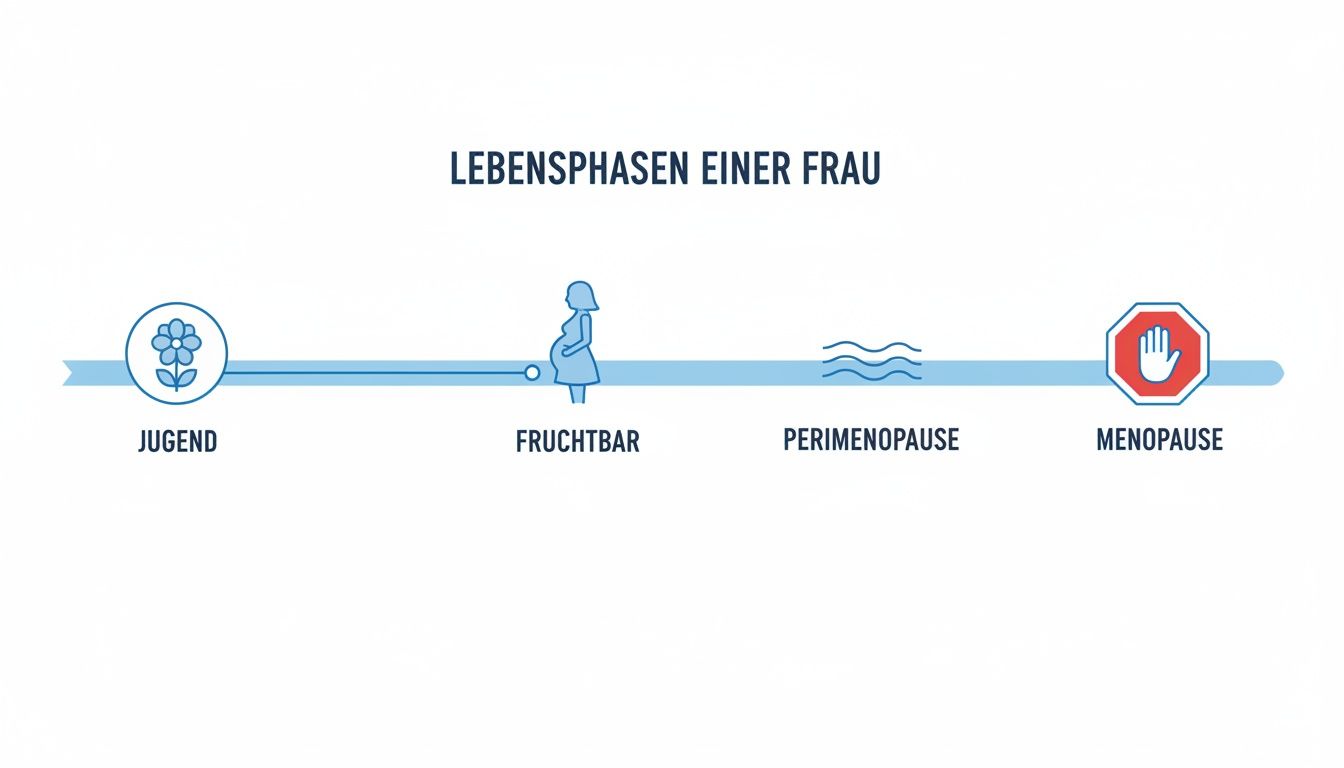
It is clear that perimenopause is a gradual transition from the fertile phase to menopause, not an abrupt event.
Menopause: The Turning Point
Medically speaking, the term “menopause” refers to just one day: the date of your last menstrual bleeding, followed by twelve months in a row without any further bleeding. The average age for this moment in Germany is around 51.
At this point, the ovaries have reduced their production of estrogen and progesterone to a permanently low level. Hormone levels have now fallen so far that ovulation no longer occurs, and therefore neither does bleeding.
Postmenopause: The Phase of Reorientation
Directly after menopause begins, postmenopause starts and accompanies you for the rest of your life. During the first few years of this phase, your hormones stabilize at a consistently low level. Your body slowly adjusts to the new state, and many typical symptoms, such as hot flashes or mood swings, subside or even disappear completely.
However, persistently low estrogen levels bring new issues. Estrogen has many protective functions in the body, which is why its deficiency can have long-term effects, for example on bone density (osteoporosis risk) or the health of the skin and mucous membranes.
If you would like to know more precisely where you currently are on this journey, taking a look at your levels can be very revealing. In our article about how to get your hormone levels tested, you can learn more. A blood test, such as the hormone test from mybody-x.com, gives you a valuable snapshot and helps you better interpret your body’s signals.
Typical physical and emotional symptoms in detail
Suddenly, heat rushes to your face, your joints ache in the morning, or your mood goes on a roller coaster and you barely recognize yourself anymore—the list of possible menopause symptoms is long and, above all, very personal. Let’s explore together which symptoms are typical and what is actually happening in your body.
Above all, it is important to understand that every woman experiences this phase very differently. While one woman barely notices anything, another feels overwhelmed by a whole wave of symptoms. The severity of the symptoms and the combination in which they occur are unique to each woman—almost like a personal fingerprint of hormonal change.

The physical roller coaster of hormonal changes
The physical signs are often the first that women notice and the ones that affect everyday life most clearly. The main culprit is almost always the declining estrogen level. You can think of estrogen as a conductor who controls countless processes in the body.
When this important hormone gradually declines, the perfectly coordinated orchestra of your body falls out of sync. The result is the classic symptoms that many women know all too well.
And this is not uncommon: About 75 percent of all women experience noticeable symptoms during menopause, with between one-third and one-half of them feeling severely affected. One serious, often invisible consequence is accelerated bone loss. While we lose about 0.3 to 0.5 percent of our bone mass each year from the age of 35 onward, this figure rises dramatically to 3 to 5 percent per year at the beginning of menopause. This naturally increases the risk of osteoporosis.
Here is an overview of the best-known physical symptoms:
- Hot flashes and night sweats: Sudden, intense waves of heat that rise from the chest to the head, often accompanied by flushed skin and bouts of sweating. At night, many women wake up drenched in sweat, which severely disrupts their sleep.
- Joint and muscle pain: Many women complain of stiff, painful joints, especially right after getting up. Estrogen has anti-inflammatory effects and keeps the joints supple—when it is lacking, pain can result.
- Dry skin and mucous membranes: Estrogen is a real boost to collagen production and skin hydration. A deficiency leads to thinner skin, brittle nails, and hair loss. The mucous membranes in the vagina and bladder are also affected, which can cause dryness, itching, or more frequent urinary tract infections.
- Weight gain: Your metabolism slows down, and your body tends to store fat, especially around the abdomen. Many women find that they gain weight even though they have not changed their diet or physical activity.
- Palpitations and dizziness: Hormonal fluctuations can also disrupt the autonomic nervous system. This can sometimes manifest as skipped beats, a racing heart, or dizziness.
When emotions turn upside down
Menopause is not just a physical challenge, but also a profound emotional journey. The hormones that regulated your cycle for decades also affect the neurotransmitters in your brain responsible for your mood—above all serotonin and dopamine.
This biochemical imbalance can really test your emotional resilience and trigger feelings you may not even recognize as your own.
Most importantly: You are not being oversensitive or imagining this. Hormonal changes have a real, measurable impact on your mental health. This is a biological process, not a personal failure.
Typical emotional and psychological symptoms include:
- Mood swings and irritability: You may quickly feel overwhelmed, become easily irritable, or suddenly burst into tears for no apparent reason.
- Feelings of anxiety and panic attacks: Constant inner restlessness or sudden fears may be new and deeply unsettling.
- Concentration problems and “brain fog”: Many women know the feeling: difficulty finding words, forgetfulness, and the impression that they can no longer think as clearly as they used to.
- Lack of motivation and exhaustion: A heavy fatigue that simply cannot be shaken off, even with plenty of sleep.
- Sleep problems: In addition to night sweats, hormonal changes often cause problems falling asleep and staying asleep. If you’d like to learn more, take a look at our article about sleep problems during menopause.
Knowing and understanding these diverse symptoms is the first important step toward regaining control. A hormone or nutrient test from mybody-x.com can provide clarity on whether your symptoms are really related to menopause or whether other causes, such as a nutrient deficiency, might be behind them.
Check your hormone and nutrient status specifically
Are you wondering whether your symptoms are really due to menopause or whether something entirely different might be behind them? That’s a completely valid question. An undetected nutrient deficiency can massively intensify typical symptoms such as fatigue or low moods. This is exactly where we bridge the gap between uncertainty and clarity.
A simple blood test, like the one offered by mybody-x.com, can provide you with valuable answers. It’s like getting a behind-the-scenes look at your body and seeing in black and white what’s currently going on. This means you no longer have to make decisions based on guesswork, but can rely on solid data.
Why looking at hormones and nutrients is so crucial
During menopause, your hormone balance gets disrupted. This is completely normal. At the same time, your body’s need for certain vitamins and minerals also changes. A deficiency can unnecessarily worsen the symptoms of menopause.
Imagine your body as an orchestra. Hormones set the rhythm, but nutrients are the musicians. If important musicians are missing, even the finest symphony sounds off-key and unbalanced. That’s exactly what happens when, for example, vitamin D or magnesium is lacking—the fatigue turns into exhaustion, and mood swings feel uncontrollable.
A blood test is your personal roadmap through menopause. It shows you where you are and which adjustments you need to make to specifically support your well-being.
Some levels are particularly informative during this stage of life because they give you a clear picture of your hormonal and physical condition.
Important blood levels during menopause and what they mean
Before you start groping in the dark, it is helpful to know which levels really matter. A targeted look at specific markers in your blood can reveal exactly where the causes of your symptoms may lie.
The following table provides an overview of which blood levels are relevant, what they reveal about your body, and which symptoms may be associated with an imbalance.
| Blood level | Function in the body | Typical change during menopause | Symptoms of an imbalance |
|---|---|---|---|
| FSH (follicle-stimulating hormone) | Stimulates the ovaries to produce estrogen. | Rises sharply because the ovaries no longer respond. | A high FSH level is a clear indication of menopause. |
| Estradiol (a form of estrogen) | Important for the menstrual cycle, skin, bones, and mood. | Drops significantly. | Hot flashes, dry skin, mood swings, bone loss. |
| Vitamin D | Essential for calcium absorption and bone health. | Deficiency is common because the skin produces less of it. | Fatigue, bone pain, increased risk of osteoporosis, susceptibility to infections. |
| Magnesium | Important for muscle relaxation, the nervous system, and sleep. | Requirements increase, and stress can worsen a deficiency. | Muscle cramps, inner restlessness, sleep disorders, nervousness. |
| TSH (thyroid-stimulating hormone) | Regulates thyroid function and metabolism. | An underactive thyroid has similar symptoms. | Fatigue, weight gain, hair loss, sensitivity to cold. |
Knowing these levels gives you back control. Instead of groping in the dark, you can recognize connections and take targeted action. If you would like to learn more about the significance of individual nutrients, you will find further information in our article on nutrient analysis from blood.
Your path to clarity with the mybody-x.com self-tests
That’s exactly where we come in. We know that the thought of doctor’s visits and long waiting times can be off-putting. That’s why we developed the mybody-x.com hormone and nutrient self-tests—a straightforward and reliable way to gain precise insights into your body from the comfort of your home.
The process is remarkably simple: You order the test kit, take a small blood sample from your fingertip, and send it to our certified partner laboratory in Germany. There, your levels are analyzed precisely.
The result is not an incomprehensible collection of data. You receive a clear, easy-to-understand report that shows you exactly where you stand and what steps you can take next. This data-based foundation enables you to adjust your diet and lifestyle in a targeted way or enter a conversation with your doctor well prepared. This way, you actively take control of your health.
Strategies for greater everyday well-being
Okay, you now know what is happening in your body. That is the first and most important step. Now it is about not only understanding but also taking action and facing the symptoms of menopause. With the right strategies, you can noticeably improve your daily well-being and reclaim your quality of life.
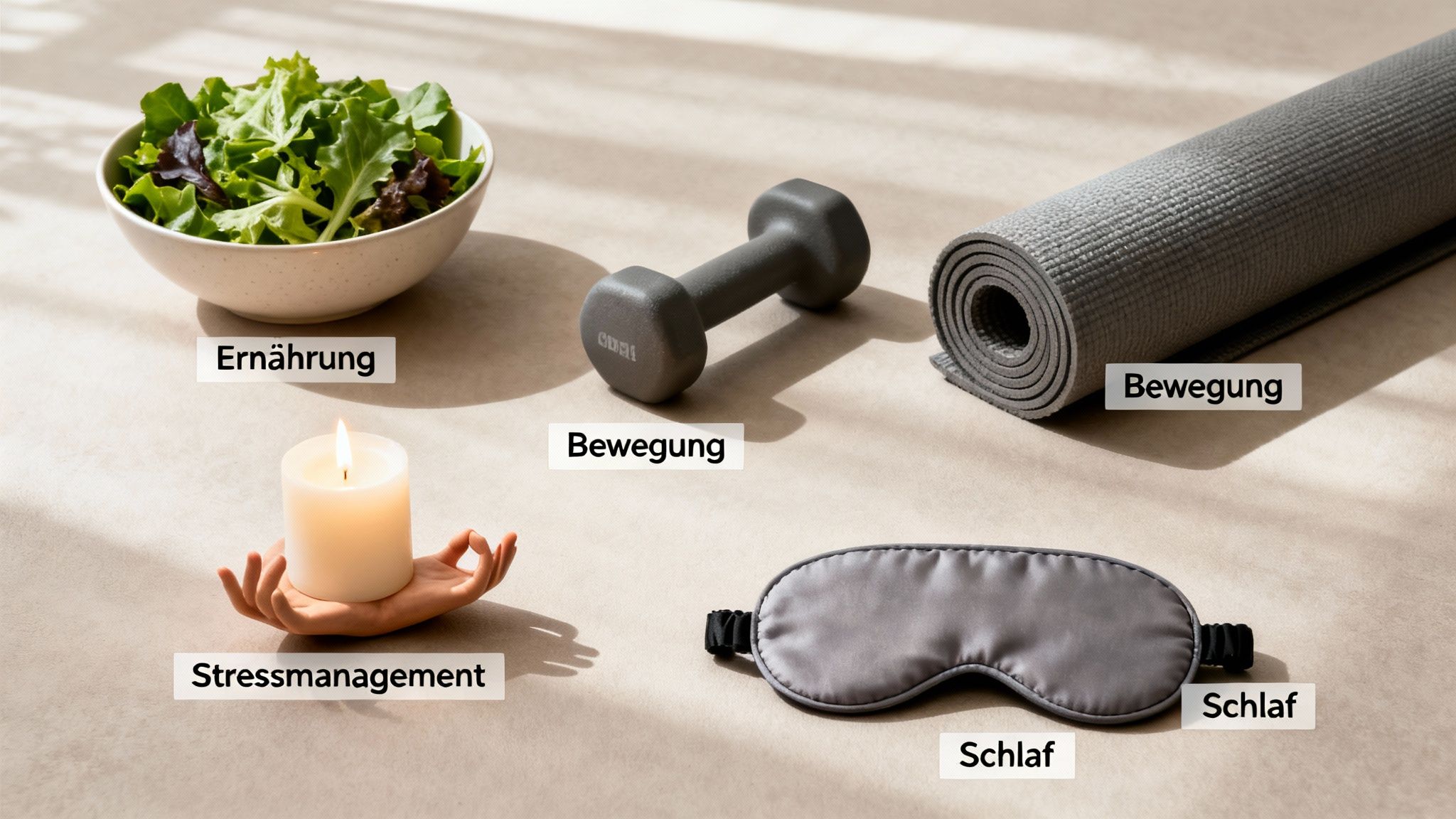
We focus on four key pillars that can help bring you back into balance: nutrition, exercise, stress management, and sleep. You will be amazed at what even small but consistent adjustments in these areas can achieve.
Nutrition as hormonal support
Your diet is now one of your most powerful tools. Certain foods can specifically support your body, while others may further fuel your symptoms. It is not about strict diets, but about making conscious, nutrient-rich choices.
- Incorporate phytoestrogens: These are plant compounds that can have a mild, estrogen-like effect in the body. They are found in abundance, for example, in flaxseeds, soy products (such as tofu or edamame), chickpeas, and legumes. They can help balance out hormonal fluctuations somewhat.
- Calcium and vitamin D for strong bones: Because the risk of osteoporosis increases now, these two nutrients are essential. Choose leafy greens such as kale or broccoli, nuts, and mineral water rich in calcium. The best way to get vitamin D is through sunlight or, if necessary, a good supplement.
- Reduce sugar and alcohol: These two are known triggers for hot flashes and sleep disturbances. Try consciously reducing them and observe how your body responds.
Movement for body and soul
Exercise during menopause is about so much more than just losing weight. Physical activity strengthens your bones, lifts your mood, and helps you sleep better. The important thing is to find a routine you genuinely enjoy—only then will you stick with it.
Just 30 minutes of moderate exercise on most days of the week can make a huge difference. A combination of endurance and strength training is ideal.
Exercise doesn’t have to be a strenuous marathon. A brisk walk during your lunch break, a bike ride, or a morning yoga session can already work wonders and strengthen your resilience to stress.
Unfortunately, menopause is still a taboo subject in the workplace. A Bundestag publication (20/8755) from 2023 shows how much the psychological and social burdens caused by hormonal changes are being ignored. At no fewer than 46% of workplaces, the subject is not discussed. At mybody-x.com, we want to change this by giving you the right tools. Our hormone and nutrient blood tests analyze important levels such as estrogen, testosterone, and magnesium, conveniently from home. You can find more information in these insights into the debate about menopause.
Stress management and restorative sleep
Inner restlessness and poor sleep are among the most distressing symptoms of all. That’s why active stress management is more important than ever right now. Establish small rituals that help you unwind and clear your mind.
Right now, it’s crucial to integrate practical self-care tips into your daily routine to maintain your inner strength and balance.
Here are a few simple but highly effective techniques:
- Mindful breathing exercises: Take a few minutes several times a day. Breathe in slowly through your nose and count to four, pause briefly, then slowly breathe out through your mouth while counting to six. This immediately calms your nervous system.
- Regular sleep times: Try to go to bed and get up at the same time every day—yes, even on weekends. This can do wonders for stabilizing your internal rhythm.
- Digital downtime before bed: The blue light from screens disrupts the production of the sleep hormone. Put your phone or tablet away at least an hour before going to bed. Instead, read a book or listen to relaxing music.
Your path to managing menopause with confidence and independence
Menopause is a completely natural part of life, there is no question about that. But that does not mean you have to simply put up with the unpleasant menopause symptoms. The most important thing you should take away from this guide is simple: knowledge is power. When you understand your body, you regain control and can actively take care of your well-being.
It is time not simply to let this phase of life happen, but to shape it yourself. Listen to your body’s signals—they are valuable guides. You are not alone in your experiences, even though your journey is naturally unique.
Take back control of your health
Instead of stumbling in the dark and wondering why you feel this way, you can easily gain clarity today. A blood test is a crucial first step. It provides you with tangible data about your hormone and nutrient status and helps you uncover the true causes of your symptoms.
Menopause does not mean losing control. Rather, it is an invitation to take control of your health more consciously and knowledgeably than ever before. Seize this opportunity.
A test from mybody-x.com gives you exactly this opportunity—conveniently and discreetly from the comfort of your own home. The analysis at our certified partner laboratory in Germany provides you with a reliable foundation for making informed decisions about your health.
Your next step toward greater well-being
Don’t wait any longer for the symptoms to disappear on their own. Take action now and shape this new phase of your life with vitality, energy, and confidence.
Order your mybody-x.com blood test and gain precise insights into your hormone and nutrient levels. With the personalized recommendations you receive based on your results, you can specifically adjust your lifestyle and finally give your body exactly what it needs now.
The most important questions about menopause symptoms
It is completely normal to feel uncertain when your body is changing. Here, we briefly and clearly answer the questions that concern women most often in connection with menopause, giving you greater clarity and confidence.
Can I already enter menopause in my early 40s?
Yes, absolutely. Many women are surprised to hear that the so-called perimenopause—the phase before the final period—can already begin eight to ten years beforehand. It is a common misconception that menopause only starts at 50.
Typical early menopause symptoms, such as irregular cycles, poorer sleep, or mood swings, are completely normal during this time, even if your period is still regular. A hormone test from mybody-x.com can help you understand these changes early and interpret them correctly.
Are hot flashes the only reliable sign?
No, not at all. Hot flashes may be the best-known symptom, but they are far from the only one—and not every woman experiences them. Their intensity can also vary considerably.
The signs of menopause are incredibly diverse. They can also be purely emotional, such as sudden feelings of anxiety or a shorter fuse. Joint pain, weight gain around the waist, and dry skin are also common companions.
It is not about a single symptom. The combination of different signs is much more important. Looking at the overall picture is key to correctly interpreting your body's signals.
Should I always see a doctor about my symptoms?
If your symptoms are causing you significant distress or you are unsure, seeing a doctor is always the right course of action to rule out other causes. However, a self-test from mybody-x.com is an ideal first step toward proactively and easily collecting data about your body.
This gives you a well-founded basis for a later conversation with your doctor. Or you gain the information you need to take control yourself by making targeted adjustments to your lifestyle.
Do the symptoms simply stop after the last period?
That would be nice, but unfortunately, this is not always the case. Medically speaking, menopause is only the one day of your last period. After that, postmenopause begins, accompanying you for the rest of your life.
While some symptoms, such as hot flashes, often subside, others related to long-term estrogen deficiency may persist or even worsen. These include, for example:
- Vaginal dryness
- An increased risk of osteoporosis
- Changes to the skin and hair
That is precisely why it is so important to ensure an adequate supply of all essential nutrients even after menopause, in order to stay fit and healthy in the long term. A nutrient test from mybody-x.com can help you identify deficiencies and take targeted action.
Are you ready to gain clarity about your menopause symptoms? A mybody-x.com hormone or nutrient test provides the facts you need to navigate this stage of life on your own terms. Discover your personal blood test now at mybody-x.com



Share now:
Benefits of Hormone Analysis – Understanding Individual Health
What is included in a check-up from age 50: prevention, tests, and benefits