
Naturally regulating hormones: How to bring your body back into balance
Do you often feel tired, irritable, or simply unlike yourself? Your hormone balance is very likely behind it. Naturally regulating your hormones means nothing more than bringing your body back into balance through a conscious lifestyle. With the right diet, targeted exercise, and effective stress management, you can specifically support the complex interplay of these messengers.
Understanding your body's language: What hormones really do
Imagine your hormones as the quiet directors of your well-being. They are tiny chemical messengers that travel through your bloodstream and control virtually every process in your body—from your energy and mood to your metabolism. When this finely tuned orchestra falls out of sync, you notice it immediately.

Unexplained weight gain, constant fatigue, sleep disturbances, or sudden mood swings are not imagined. They are often direct signals from your body that something is out of balance hormonally.
The key players in the hormonal interplay
To correctly interpret your body's signals, it is worth taking a closer look at the key players. Each has a specific role, but ultimately they all work as a team:
- Estrogen and progesterone: These two female sex hormones regulate far more than just the menstrual cycle. They also affect your skin, bones, and emotional well-being. An imbalance can manifest as PMS, menstrual irregularities, or hot flashes.
- Cortisol: Known as the stress hormone, cortisol is actually essential for survival because it provides you with energy in dangerous situations. However, chronically elevated levels caused by ongoing stress can throw everything off balance and lead to exhaustion and weight gain. If you want to take a deeper dive, learn what cortisol is exactly in our article and what role it plays.
- Thyroid hormones (T3/T4): They are the spark plugs of your metabolism. When they are not functioning optimally, everything feels as though you are going through life with the handbrake on—or constantly running at full speed.
Your body is constantly sending you messages. Symptoms such as low energy or mood dips are not weaknesses, but important signs that your hormonal system needs support.
Why the Interplay Is Crucial
No hormone acts alone. Chronic stress (and therefore high cortisol), for example, can inhibit the production of progesterone. This, in turn, disrupts the delicate balance with estrogen. This phenomenon is particularly relevant during menopause.
In Germany, around 9 million women are currently in this stage of life, which is characterized by a natural decline in estrogen and progesterone. Many women suffer from typical symptoms, but only around 11 percent use hormone replacement therapy—often because of uncertainty. This highlights how important it is to understand your own hormonal balance and know about natural ways to support it.
Understanding your body’s language is the first and most important step toward regaining control. Instead of ignoring symptoms, you can use them as signposts to restore your hormones to balance in a targeted and natural way.
Nutrition That Nourishes Rather Than Disrupts Your Hormones
What ends up on your plate has a direct and noticeable impact on whether your hormones are in balance. Think of your diet as the foundation of a house: If it is stable and built from the right materials, the entire building will stand. In the same way, the right foods provide the building blocks your body needs for smooth hormone production.
Sugar and quickly digestible carbohydrates, such as those found in white bread or sweets, are often hidden troublemakers. They send your blood sugar on a roller coaster, which in turn brings the hormone insulin into play. Constant blood sugar spikes can lead to insulin resistance over time—a condition that can throw the entire hormonal system off balance.
The Cornerstones of a Hormone-Friendly Diet
To nourish your hormones, you should focus on three key areas. It’s not about strict deprivation, but about giving your body what it truly needs.
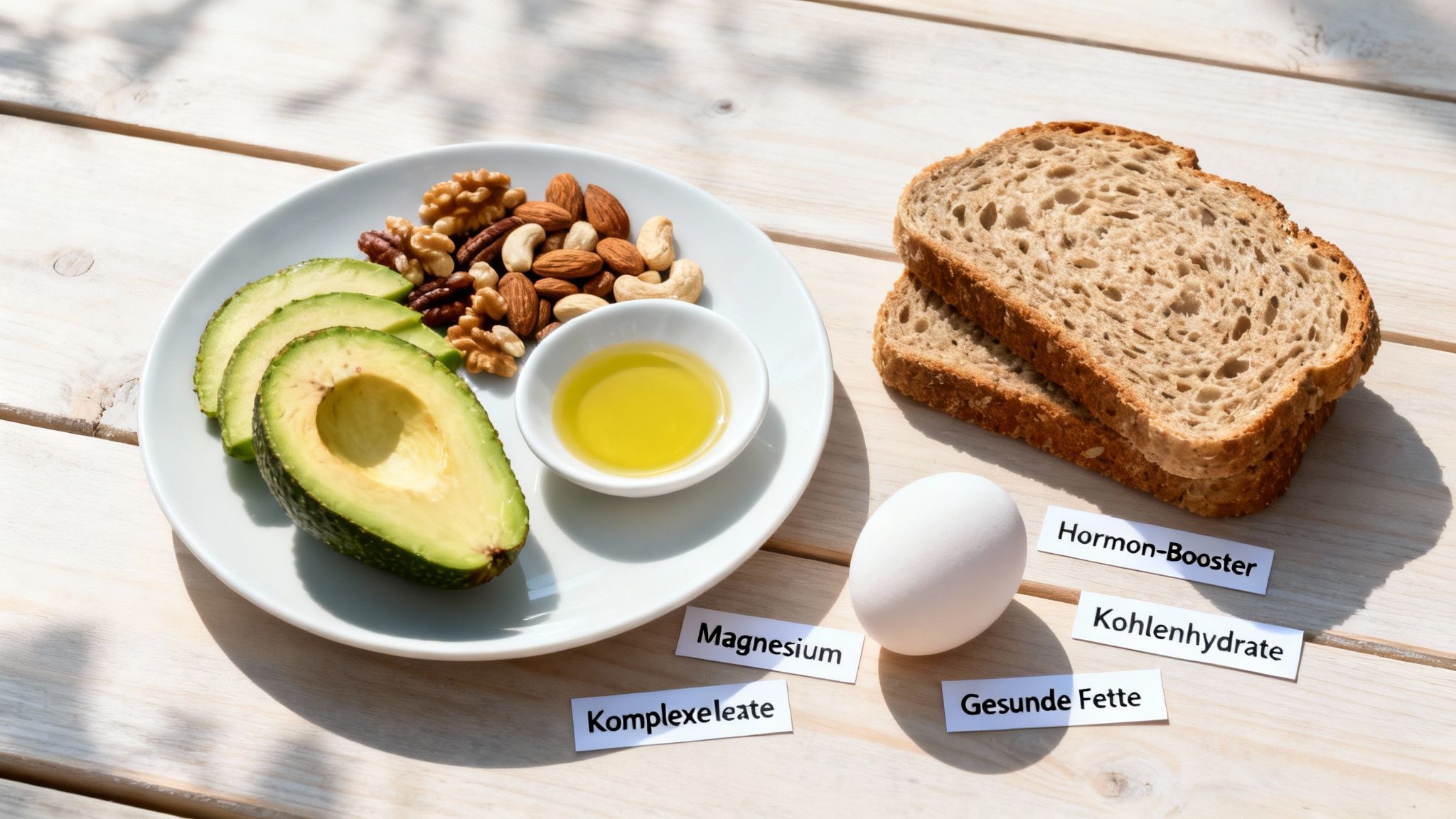
- Healthy Fats as Hormone Building Blocks: Many hormones, such as estrogen and testosterone, are produced from cholesterol. That’s why high-quality fats are absolutely essential. Make avocados, nuts (especially walnuts), seeds such as flaxseeds or chia seeds, and good olive oil a regular part of your diet.
- Protein for satiety and stability: Protein-rich meals not only keep you full longer but also help stabilize blood sugar levels. Choose a colorful mix of plant-based sources such as lentils and chickpeas, as well as animal-based sources such as fish, eggs, or lean poultry.
- Complex carbohydrates for consistent energy: Instead of fast-acting sugar, whole-grain products, oats, quinoa, and sweet potatoes provide energy slowly and steadily. This prevents cravings and keeps your insulin level balanced.
The connection between body weight and hormonal balance is particularly strong. In Germany, about 50 percent of women are overweight. This excess fatty tissue is hormonally active and produces, among other things, estrogen, which can quickly disrupt the delicate balance.
Micronutrients: small helpers with a big impact
In addition to the major building blocks—fats, proteins, and carbohydrates—it is often the small details that make the crucial difference. Certain vitamins and minerals are essential for supporting and regulating hormone production.
Your kitchen can be your strongest ally. Every meal is an opportunity to provide your body with exactly the nutrients it needs for stable hormonal balance.
Here is an overview of the most important nutrients and their role in your hormones:
Nutrients and their effects on your hormones
This table shows which essential nutrients are important for hormonal balance, which foods contain them, and which hormones they affect.
| Nutrient | Effects on hormones | Top food sources |
|---|---|---|
| Magnesium | Regulates the stress hormone cortisol and supports thyroid function | Leafy green vegetables, almonds, pumpkin seeds, dark chocolate |
| Zinc | Crucial for the production of thyroid and sex hormones | Pumpkin seeds, lentils, oats, beef |
| Vitamin B6 | Important for the production of progesterone and serotonin | Chickpeas, salmon, chicken, bananas |
| Omega-3 fatty acids | Have anti-inflammatory effects and form the basis for many hormones | Fatty fish (salmon, mackerel), walnuts, flaxseeds, chia seeds |
| Iodine & selenium | Essential for the conversion and function of thyroid hormones | Iodized salt, seafood, Brazil nuts (selenium) |
As you can see, each of these little helpers has an important job. Protection against oxidative stress also plays an important role in hormonal health. If you would like to learn more about how to protect your body with the right diet, take a look at our article about antioxidant foods.
Not sure whether you’re lacking certain nutrients? A nutrient test from mybody-x can provide clarity. It identifies individual deficiencies and gives you a precise basis for adjusting your diet to support your hormones optimally.
Stress and sleep as the foundation for your hormonal balance
Persistent stress is pure poison for your hormonal system. Imagine that your body is constantly in a low-level state of alarm. This causes your cortisol levels to rise permanently and triggers a whole cascade of negative effects—from nasty cravings and sleep problems to a weakened immune system.

The tricky part is that with chronic stress, your body gives top priority to producing cortisol. To do this, it draws on the same biochemical building blocks that it actually needs to produce the calming hormone progesterone. The result is a vicious cycle: Less progesterone leads to more inner restlessness, which further fuels stress.
Slowing down as a strategy for your hormones
To restore hormonal balance, reducing your stress levels is not only helpful but absolutely essential. This is not about completely transforming your life from one day to the next. Much more important are small, intentional islands of calm in your everyday life.
- Mindful breathing breaks: Take just two minutes three times a day. Breathe in deeply for four seconds, hold your breath for four seconds, and then exhale very slowly for six seconds. This simple technique immediately signals to your nervous system that it is allowed to relax.
- Short mindfulness exercises: Incorporate small moments of pause into your day. While drinking coffee, consciously feel the warmth of the cup in your hands, or focus solely on the feeling of your feet touching the ground while walking. This immediately pulls you out of the thought carousel.
Persistent stress forces your body to choose between producing stress hormones and feel-good hormones. By reducing stress, you give your body the chance to regain its balance.
If you feel that stress is a central issue for you, taking a closer look at your cortisol levels can be incredibly insightful. In our guide, you’ll find practical tips on how to lower cortisol naturally. A hormone test from mybody-x can also provide clarity by measuring your daily cortisol profile and showing you how your body responds to stress throughout the day.
The power of sleep for your hormone synthesis
Restful sleep is at least as fundamental as good stress management. At night, your body not only regenerates—it also recalibrates your entire hormonal system. Sleep deprivation throws the hunger hormones ghrelin (stimulates appetite) and leptin (signals satiety) completely out of balance. Incidentally, this is also why you often crave unhealthy foods much more after a short night’s sleep.
A relaxing evening routine is the key here. It specifically prepares your body for its resting phase and supports nighttime hormone production.
Your checklist for better sleep:
- End screen time: Turn off all screens at least one hour before going to bed. The blue light inhibits the production of the important sleep hormone melatonin.
- Dimmed lighting: In the evening, use only warm, dimmed light. This signals to your body that it is time to relax.
- Light evening meal: Avoid heavy, fatty meals shortly before bed. Digestion only keeps your body unnecessarily active.
- Relaxation ritual: Establish a short, consistent ritual—whether you read a few pages, listen to calming music, or meditate briefly.
These simple habits are the foundation for long-term hormonal balance and significantly improved well-being.
How exercise and your surroundings shape your hormones
The right exercise can work wonders for your hormones. But be careful: The old mantra “more is more” definitely does not apply here. Many people still believe that only sweaty, intense workouts really make a difference. That’s a misconception.
In fact, excessive training can put your body under massive stress and drive up your cortisol levels—achieving exactly the opposite of what we want.
The key is finding a smart balance. Even moderate exercise such as brisk walking, cycling, or swimming has been proven to improve your insulin sensitivity. This means your cells can absorb sugar from your blood much more effectively. Your blood sugar levels remain stable, and cravings barely stand a chance.
Find your perfect movement mix
A balanced routine that combines strength and gentle sessions is ideal for regulating your hormones naturally. Here’s what your week could look like:
- Strength training two to three times a week: Building muscle is incredibly valuable. More muscle mass not only boosts your basal metabolic rate but also improves how your body uses insulin. You don’t have to lift heavy weights for this—bodyweight exercises or resistance bands are a great way to get started.
- Gentle activities on the remaining days: Yoga, Pilates, or simply long walks in the fresh air are perfect. They calm your nervous system, reduce stress, and stimulate the release of feel-good hormones such as endorphins.
Your body loves variety. Listen closely to what it needs today. Sometimes that’s an invigorating workout; on other days, a gentle yoga session offers the greatest benefit for your hormonal balance.
But exercise is only one piece of the puzzle. Your immediate environment plays just as important a role, often without you even noticing. We’re surrounded by chemicals every day that can act as so-called endocrine disruptors. The problem is that these substances resemble the hormones naturally produced by our bodies and can therefore throw our delicate balance out of sync.
How to reduce hormone-disrupting environmental factors
You don’t have to turn your whole life upside down right away. Even small, intentional decisions in everyday life can make a huge difference.
Three simple tips for everyday life:
- Reduce plastic in the kitchen: Never heat food in plastic containers in the microwave. Instead, switch to storage containers made of glass, stainless steel, or ceramic. It’s a simple but effective step.
- Pay attention to ingredients in cosmetics: Many conventional personal-care products contain phthalates or parabens. Natural cosmetics are often the safer alternative here. It’s always worth taking a quick look at the ingredients list.
- Filter your water: A good water filter can help remove chemical and hormone residues from tap water.
By focusing on smart exercise and creating a hormone-friendly environment, you’re taking a holistic approach. This supports your body in regaining and maintaining its natural balance over the long term.
When a hormone test really makes sense
You’ve changed your diet, are sleeping more, and are taking intentional breaks, but the crushing fatigue, cycle problems, or that inner restlessness just won’t go away? Sometimes even the best intentions and lifestyle changes aren’t enough. Or maybe you simply want certainty instead of continuing to feel like you’re in the dark.
This is exactly where a targeted hormone test from mybody-x can provide valuable clarity. It’s like looking behind the scenes of your body, showing you in black and white exactly where an imbalance exists. That way, you stop guessing and start taking targeted action.
When symptoms demand answers
A hormone test is especially a good idea if you’re experiencing persistent, unexplained symptoms. It gives you a solid basis for planning the next steps—whether for yourself or as a starting point for a conversation with your doctor.
In the following situations, a test is often the crucial next step:
- Persistent exhaustion and lack of energy: You constantly feel as though you’re going through life with the handbrake on, even though you actually get enough sleep.
- Unexplained weight gain: Despite eating healthily and exercising, the number on the scale stays the same or even goes up.
- Menstrual irregularities and severe PMS: Your cycle is out of sync, very painful, or the days leading up to it drive you to the brink.
- Mood swings and irritability: You often feel downcast or anxious for no apparent reason, or you lose your temper over the smallest things.
- Sleep problems: You toss and turn in bed for hours or constantly wake up at night, even though you’ve created a good sleep environment.
This decision tree shows you how to adapt your physical activity to your current stress level to optimally support your hormones.
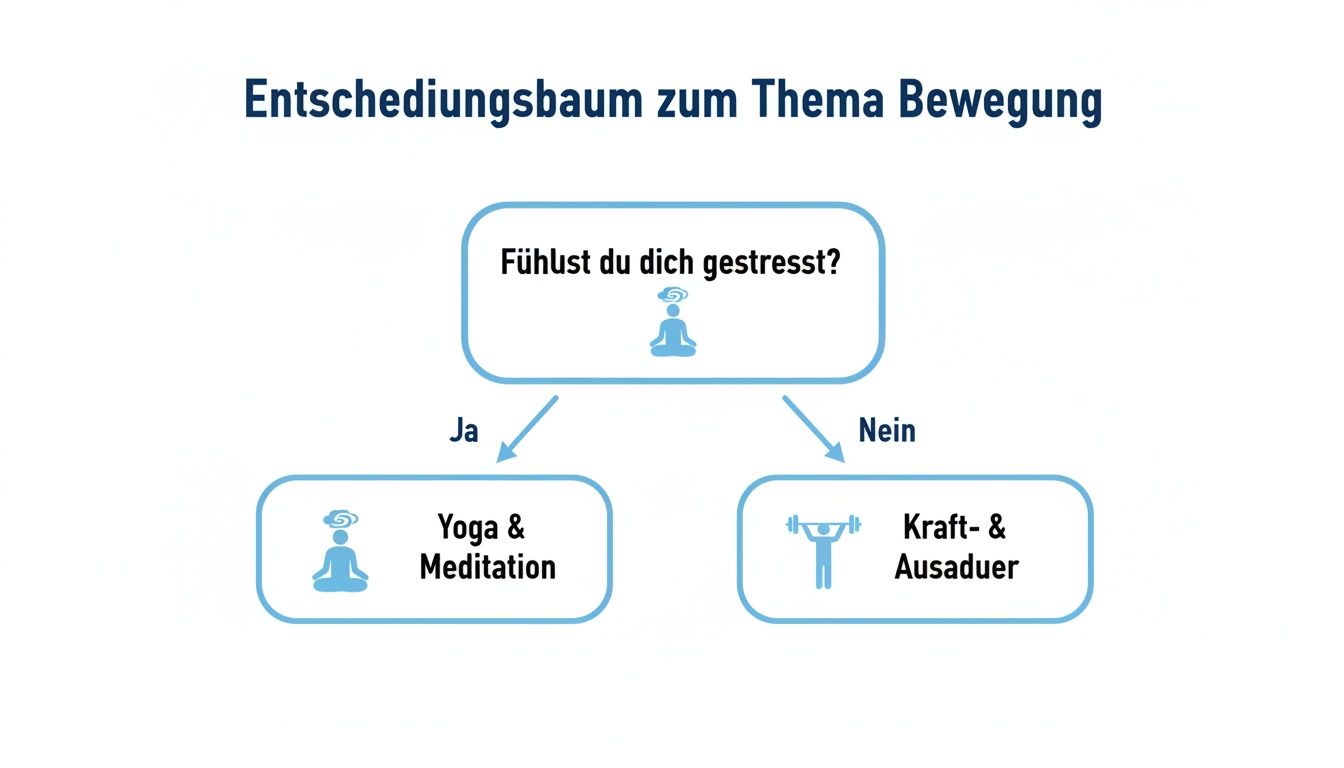
The graphic makes it clear: It’s about listening to your body’s signals instead of rigidly following a fixed training plan.
Which values really reveal something
A test is, of course, only as good as the values it measures. Some key indicators provide particularly valuable insight into the different areas of your hormone system:
- Cortisol throughout the day: Measures your stress hormone at different times and reveals how well your body can cope with stress.
- Estradiol & progesterone: The balance between these two female sex hormones is the linchpin of a healthy cycle and your overall well-being.
- Thyroid hormones (fT3, fT4, TSH): They are the chief regulators of your metabolism. If something is off here, you’ll notice it immediately in your energy levels.
Did you know that, according to a recent survey, nearly one in two women (46 percent) in Germany would like more information about hormones and their effects? This lack of knowledge shows how important clear information and accessible testing options are. You can find more about the background to this survey on statista.com.
A hormone test isn’t a verdict, but a tool. It gives you the data you need to make informed, independent decisions about your health.
This overview helps you identify, based on typical symptoms, which hormone or nutrient tests from mybody-x might be relevant for you.
Which test matches your symptoms
| Typical symptoms | Possible hormonal cause | Recommended mybody-x test |
|---|---|---|
| Fatigue, weight gain, sensitivity to cold | Underactive thyroid (TSH, fT3, fT4) | Thyroid test |
| Sleep disturbances, inner restlessness, exhaustion | Imbalance of the stress hormone cortisol | Stress hormone test (cortisol) |
| Cycle problems, PMS, mood swings | Imbalance of estrogen and progesterone | Hormone test for women |
| Loss of energy, low libido (men) | Low testosterone levels | Hormone test for men |
Of course, this is only an initial guide. Your body is a complex system, but a test can often be the decisive piece of the puzzle.
The hormone tests from mybody-x were developed specifically for this purpose. You can easily and discreetly collect the sample at home. Your result provides you with more than just raw data—it includes an easy-to-understand analysis that helps you understand the connections.
Would you like to learn more about how to test your hormone levels and correctly interpret the results? Our guide provides you with all the important information you need.
What you may still be wondering
When you start learning about your hormone system, questions naturally arise. That’s great, because it shows you’re on the right track! Here, I’ve collected some of the most frequently asked questions to give you a little more clarity.
How quickly will I actually notice a difference?
That’s probably the million-dollar question, and the honest answer is: it’s completely individual. Your body isn’t a machine with a reset button. Many people notice the first positive signs after just a few weeks when they start eating more mindfully or managing their stress better. Maybe you suddenly have more energy in the afternoon, or your cycle becomes a little more regular.
However, to achieve truly deep, stable hormonal balance, you should give your body time. Expect it to take around three to six months. That is often how long it takes for the hormonal system to adapt to new, healthy habits and find a new, more stable balance.
Be patient with yourself. Every small step counts, and it’s not about being perfect. Celebrate the small successes along your journey too!
Isn’t the whole hormone topic just for women?
Not at all! Although we often talk about the female cycle, hormonal balance is at least just as important for men. Here, the focus is mainly on the interplay between testosterone and the stress hormone cortisol. This balance affects everything: energy levels, muscle growth, libido, and your overall quality of life.
The foundations of healthy hormonal balance are the same for men and women. A nutrient-dense diet, smart stress management, good sleep, and appropriate exercise are absolutely fundamental to men’s hormonal health. Symptoms such as constant exhaustion, a lack of sex drive, or feeling unable to make progress in training can be clear signs of an imbalance in men. A mybody-x hormone test for men can quickly and discreetly provide clarity.
What role do dietary supplements play in this?
Dietary supplements can be an incredibly helpful tool—but only a tool, not the entire workshop. They are not a substitute for a healthy lifestyle. Their real strength lies in specifically filling gaps that may be difficult to close through diet alone.
But before you rush out and buy just any capsules, you need to know what you are actually lacking. Everything else is pure guesswork. A mybody-x nutrient test is the smartest first step. It shows you in black and white whether your body urgently needs any vitamins or minerals—and which ones. With this knowledge, you can make an informed decision and provide targeted support instead of fumbling in the dark.
Are you ready to stop guessing and finally gain clarity about your hormone or nutrient status? The at-home tests from mybody-x provide scientifically sound results and clear recommendations for action. This puts you in control of your well-being.



Share now:
Nutrition for Hashimoto’s: How the right diet can improve your well-being
Benefits of personalized nutrition for your health