

Omega 3 deficiency symptoms you should know
Have you been feeling exhausted lately, finding it hard to concentrate, or noticing that your skin is dry and tight? It's easy to attribute such nonspecific symptoms to everyday stress. But often, these are the first, subtle signals from your body that could indicate a deficiency in omega-3 fatty acids.
What exactly are Omega-3 fatty acids?
You've probably heard that not all fats are created equal. Omega-3 fatty acids are a perfect example. They belong to the group of essential, polyunsaturated fatty acids . The word "essential" is crucial here: it means your body cannot produce them itself. Therefore, you rely on obtaining them through your diet.
Think of these fats like high-quality motor oil for your body. Without them, many crucial processes simply don't function properly. Omega-3 fatty acids are a fundamental building block of every single cell membrane, ensuring that it remains supple and permeable. This is the absolute basis for effective communication between cells – from the nerve cells in your brain to the cells in your skin.
The most important representatives of the Omega-3 family
There are various omega-3 fatty acids, but three of them play a particularly important role in your health. Each of them has its own very specific functions in the body:
- EPA (eicosapentaenoic acid): This fatty acid is primarily known for its strong anti-inflammatory properties. It plays a key role in a healthy cardiovascular system.
- DHA (docosahexaenoic acid): Think of DHA as the most important building block for your brain and the retina of your eyes. Without it, cognitive processes and good vision are severely impaired.
- ALA (alpha-linolenic acid): This is the plant-based form of omega-3, which you can find, for example, in flaxseeds or walnuts. While your body can convert ALA into EPA and DHA, this process is extremely inefficient.
If these essential building blocks are lacking, it can manifest itself in a variety of ways. Almost every system in your body depends on a good supply – from your mood to the condition of your skin.
To truly understand how an omega-3 deficiency can disrupt your body, it's worth taking a brief look at the basics of metabolism . Only when you understand how your body processes nutrients will it become clear why a deficiency in one area can have such far-reaching consequences.
The most common symptoms of an Omega 3 deficiency
A deficiency in omega-3 fatty acids often creeps into your daily life quietly and unnoticed. The signs are so varied that you can easily dismiss them as stress or lack of sleep. But your body is sending clear signals – you just need to learn to interpret them correctly.
A deficiency in these important fats often first becomes apparent in our skin's protective barrier. Dry, perhaps even flaky or irritated skin can be an initial indication. This is no coincidence, as omega-3 fatty acids are crucial for maintaining a stable skin barrier and retaining moisture. Similarly, brittle nails or weak, dull hair can point to a deficiency.
These external signs are basically just the visible tip of the iceberg and show that the cells are lacking important building blocks.
When head and mood suffer
Imagine your brain as a high-performance machine. Omega-3 fatty acids, especially DHA , are like the premium oil that keeps everything running smoothly. A deficiency can noticeably impair mental performance. Are you finding it increasingly difficult to concentrate? Do you often feel mentally foggy or forgetful? These could be direct consequences of an omega-3 deficiency.
Your emotional state is also closely linked to your fatty acid balance. Low moods, constant inner restlessness, or inexplicable irritability can also be related to an insufficient supply. Why? Because omega-3 fatty acids play a role in regulating important neurotransmitters in the brain that control your mood.
The following graphic nicely summarizes how the different signals from your body can be related.

As you can clearly see, fatigue, concentration problems and skin changes are often not isolated problems, but can be traced back to a common cause – a nutrient deficiency.
Physical warning signs and inflammation
An omega-3 deficiency isn't just noticeable in the brain, but also throughout the rest of the body. EPA , the second important omega-3 fatty acid, is the body's own "fire extinguisher" for inflammation. A deficiency can therefore fuel silent inflammation in the body, which can manifest itself, for example, as joint pain or general morning stiffness.
Another classic sign is poor circulation, often manifested as constantly cold hands and feet. Omega-3 fatty acids help keep our blood vessels supple, thus promoting healthy blood flow even to the smallest capillaries.
Typical signs of an Omega 3 deficiency at a glance
The following table summarizes the most common symptoms and explains the biological connection in simple terms.
| symptom | Possible physical effects | The connection explained simply |
|---|---|---|
| Skin & Hair | Dry skin, eczema, acne, brittle nails | Omega-3 strengthens the skin barrier and keeps it moisturized. A deficiency leads to permeable and dry skin. |
| Cognition | Difficulty concentrating, memory problems, "brain fog" | The brain consists largely of fat (DHA). Without this building block, signal transmission is impaired. |
| Mood | Mood swings, irritability, depressive moods | Omega-3 influences the production of "happiness hormones" such as serotonin and dopamine. |
| Inflammation | Joint pain, stiffness, elevated inflammation markers | EPA acts as a natural anti-inflammatory. A deficiency can make inflammation flare up more easily. |
| Energy & Sleep | Persistent fatigue, sleep disturbances | A deficiency can disrupt the sleep-wake cycle and impair cellular energy production. |
| Cardiovascular system | Cold hands and feet, high blood pressure | Omega-3 keeps blood vessels elastic and promotes good blood circulation. |
| Eyes | Dry eyes, vision problems | The retina has a high concentration of DHA. A deficiency can impair vision and eye lubrication. |
The list is long, and unfortunately, the symptoms are often nonspecific. They can also indicate other deficiencies, which is why it's important to take a close look. You can read more about how to specifically address common nutrient deficiency symptoms in our guide.
Do you recognize several of these signs in yourself? Then it could be more than just a coincidence. Instead of continuing to guess, it makes sense to finally get some clarity.
What is really behind an Omega-3 deficiency?
You might also be wondering how a deficiency in omega-3 fatty acids can be so widespread – even among people who really take care of their health. The answer is usually right in front of us on our plates, deeply rooted in our modern eating habits. A deficiency rarely arises from a single mistake, but rather from the interplay of several everyday factors.
The main reason is often a rather unbalanced diet. In typical Western cuisine, the best sources of readily usable omega-3 fatty acids EPA and DHA simply don't appear on the table often enough. I'm talking about fatty fish like salmon, herring, or mackerel. But this deficiency is only one side of the coin.
The hidden problem with Omega-6
At the same time, we often consume far too many omega-6 fatty acids without realizing it. These are found in large quantities in highly processed foods, ready-made meals, and many vegetable oils such as sunflower or corn oil. You can think of omega-3 and omega-6 as two opposing forces in the body: While omega-3 inhibits inflammation, an excess of omega-6 can actually exacerbate it.
From an evolutionary perspective, the ratio of omega-6 to omega-3 fatty acids was once approximately 1:1. Today, our diets have shifted this ratio to 15:1 or even higher . This drastic imbalance inhibits the beneficial effects of omega-3 and can promote low-grade inflammation in the body.
Figures from the German Nutrition Report underscore the problem: around 16% of people in Germany don't eat any fish at all . On average, we consume just 100g of fish per week – far too little to meet our needs. This opens the door to deficiencies. Those who want to delve deeper into the figures can find fascinating details on the website of the Working Group on Fat (FET) .
Who is particularly at risk?
In addition to general dietary habits, there are also specific life stages and groups in which the need for omega-3 increases or obtaining it becomes more difficult. You should pay particular attention in these cases:
- Vegans and vegetarians: They forgo fish, their primary source of amino acids. While plant-based alternatives like flaxseeds do provide the precursor ALA, the body can only convert it into the important forms EPA and DHA with great difficulty and in small quantities. We examine this challenge in more detail in our article on a healthy vegan diet .
- Pregnant and breastfeeding women: During this special time, the need for DHA increases enormously, as it is essential for the development of the brain and nervous system in the child.
- Older people: With age, the body's ability to efficiently convert and absorb fatty acids often declines.
- People with chronic inflammatory diseases: They often have an increased need for Omega-3 to better control the inflammatory processes in the body.
All these points show how quickly you can slip into a nutritional deficit, even if you actually want to eat healthily. Understanding these causes is the first and most important step to taking control of your own nutrition.
How to reliably measure your Omega-3 status
When it comes to your own health, you shouldn't be in the dark. Guesses won't get you anywhere – measurable data will. If you recognize yourself in some of the described symptoms, it's time to move from guesswork to action. The only reliable way to truly gain clarity about your omega-3 fatty acid levels is a targeted blood analysis.

Instead of changing your diet on a whim or indiscriminately resorting to dietary supplements, a test provides you with a scientifically sound basis. Only in this way can you precisely tailor your measures to your actual needs and ensure that they really work.
The myBody-X nutrient test for home use
At myBody-X, we understand that going to the doctor can sometimes involve waiting and hassle. That's why we've developed a simple and discreet solution that empowers you to take control of your health: the myBody-X nutrient test . You can easily and conveniently perform this test in the comfort of your own home.
The entire process is kept as simple as possible:
- Order a test kit: You will receive everything you need for the test, sent directly to your home.
- Simple sample collection: Using a small lancet, you take a few drops of blood from your fingertip. It's quick and virtually painless.
- Free return shipping: Send your sample in the enclosed return envelope to our certified German specialist laboratory.
- Detailed results report: After a short time, you will receive your personal results report online, which clearly breaks down your values.
Your result is more than just a number. It's a clear set of instructions that shows you where you stand and what steps you should take next.
What the Omega-3 Index Tells You
A key value we measure is the so-called Omega-3 Index . This indicates the percentage of the important fatty acids EPA and DHA in the total fatty acids in the membranes of your red blood cells. You can think of it as a long-term storage level that reflects your intake over the past few months.
An optimal omega-3 index is above 8% and is associated with a significantly lower risk of cardiovascular disease. Values below 4% , on the other hand, are considered critical and indicate an urgent need for action.
If you'd like to delve deeper into the significance of this crucial marker, we recommend our detailed article on the Omega-3 Index test and its implications . With this knowledge, you can take targeted, data-driven control of your health.
Targeted correction of your Omega-3 deficiency
A test result indicating a deficiency is no reason to panic. Quite the opposite: it's your chance to take action. When you see in black and white where you stand, you can finally take targeted and effective countermeasures. The goal now is to replenish your Omega-3 stores and bring your body back into lasting balance.
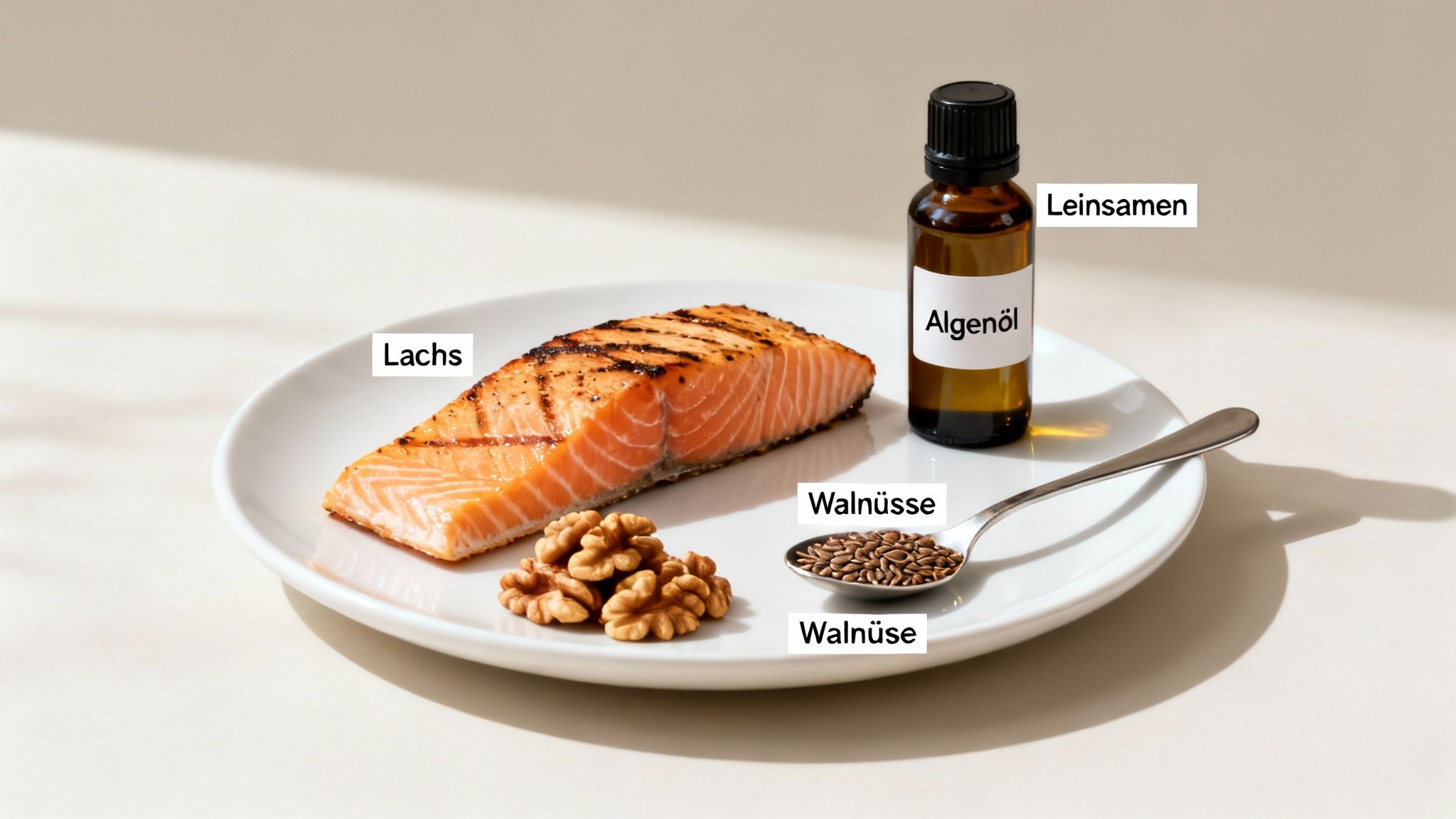
The most direct and natural way is through conscious nutrition. Nature provides us with a whole range of valuable foods that can often be easily integrated into everyday life.
The best natural sources of Omega-3
The most effective omega-3 fatty acids, EPA and DHA , which your body can directly utilize, are found primarily in fatty cold-water fish. They are the undisputed leaders.
- Salmon (especially wild salmon): A true powerhouse of EPA and DHA.
- Herring and mackerel: Often underestimated, but extremely rich in these healthy fats.
- Sardines: These little powerhouses are an excellent and inexpensive source of food.
For those who follow a plant-based diet, there are also very good options. However, it's important to know that most plant-based sources contain the precursor ALA (alpha-linolenic acid) . Your body first has to convert this into the active forms EPA and DHA – a process that, unfortunately, is not very efficient.
The major exception is algae oil . It is the only plant-based source that directly provides EPA and DHA, making it the perfect alternative to fish. These foods are also valuable additions:
- Flaxseed (ground) and flaxseed oil: The classic among plant-based Omega-3 sources.
- Chia seeds: Super versatile, whether in smoothies, muesli or as pudding.
- Walnuts: The ideal, healthy snack for in between meals.
It's not about completely overhauling your diet overnight. Often, small but consistent adjustments are enough to make a big difference to your health.
Choosing the right dietary supplement
Sometimes, diet alone isn't enough to quickly and effectively correct an existing deficiency. This is precisely where high-quality nutritional supplements can provide truly valuable support. But be warned: quality is paramount.
The key factors are the EPA and DHA content per capsule and the purity of the product. It should be completely free of contaminants such as heavy metals. As mentioned earlier, high-quality algae oil is the best choice for vegans.
Cardiovascular diseases are among the most common causes of death in Germany, and an omega-3 deficiency can increase the risk. However, the right balance is crucial, as too much can also be risky. One study showed that a daily intake of more than 1 gram of omega-3 over a prolonged period can even increase the risk of atrial fibrillation, a common heart rhythm disorder. You can read more about this fine line between benefit and risk on the Cardiopraxis website. This underscores once again how important a targeted approach based on your individual blood test results is.
To optimize your dietary change, you will find7 more valuable nutrition tips for better well-being in our guide.
Now it's your turn: Take your health into your own hands.
An omega-3 deficiency is not a fate you simply have to accept. Instead, see it as a clear message from your body – and as a challenge you can actively address with the right knowledge. You now understand how varied the symptoms of an omega-3 deficiency can be, what the underlying causes are, and how you can better assess your personal needs.
But a feeling alone isn't enough. The crucial step is moving from suspicion to certainty. Instead of groping in the dark or following general advice, you can determine your values precisely. A simple at-home test provides you with the reliable data you need to make truly smart decisions for your health.
From knowledge to targeted action
Once you have a clear result in hand, you can precisely tailor your diet and any supplements to your body. You no longer relinquish control, but become the manager of your own well-being.
Your body is constantly sending you signals. It's time not only to listen to it, but to truly understand it. The modern tools for doing so are readily available to you today.
The myBody-X Nutrient Vitality Check Basic provides you with a solid foundation for assessing your nutrient levels and taking targeted action. This not only secures and improves your health in the moment, but also lays the groundwork for long-term well-being. Listen to your body and give it exactly what it truly needs.
Frequently asked questions about Omega-3
After all this information, you might still have a few specific questions. That's perfectly normal. Therefore, we've compiled the most frequently asked questions here to clear up any remaining uncertainties surrounding Omega-3 deficiency symptoms and give you complete clarity.
How quickly can an Omega-3 deficiency be corrected?
This is a very individual matter that depends heavily on your personal starting point and your consistency. However, if you make targeted changes to your diet and supplement with high-quality products, blood values can often be noticeably improved within 3 to 6 months .
Many people report noticing initial positive effects, such as improved dry skin or difficulty concentrating, after just a few weeks. A follow-up test can then confirm that your efforts have paid off and you're on the right track.
Why is the ratio of Omega-6 to Omega-3 so important?
Imagine it like a seesaw that controls the level of inflammation in your body. On one side is omega-3, which inhibits inflammation. On the other side is omega-6, which, in excessive amounts—as often found in sunflower oil or processed foods—tends to promote inflammation.
A healthy balance is found in a ratio of approximately 3:1 (Omega-6 to Omega-3). However, the typical Western diet often dramatically tips this balance to a ratio of 15:1 or even higher.
So it's not just about consuming more Omega-3. It's equally important to consciously reduce excessive consumption of Omega-6 sources in order to restore balance.
Are flaxseeds and walnuts sufficient as a source of omega-3?
Flaxseeds, chia seeds, and walnuts are fantastic foods and rich in the plant-based omega-3 fatty acid ALA (alpha-linolenic acid) . However, there's a big catch: your body first has to laboriously convert this plant-based form into the truly crucial, directly usable fatty acids EPA and DHA.
This process is unfortunately extremely inefficient. The conversion rate is often less than 5% . Since EPA and DHA are responsible for the most important health benefits – from brain function to heart health – ALA alone is usually insufficient. Therefore, high-quality algae oil is the ideal solution for vegans and vegetarians to meet their EPA and DHA needs directly and reliably.
mybody-x helps you finally gain clarity about your nutrient levels. With our simple at-home self-tests, you receive a scientifically sound analysis, empowering you to take control of your health. Find out now what your body really needs: https://bodysperfect.com



Share:
Hair loss due to iron deficiency: causes, symptoms & what you can do
Regulating hormones naturally: How to bring your body into balance