
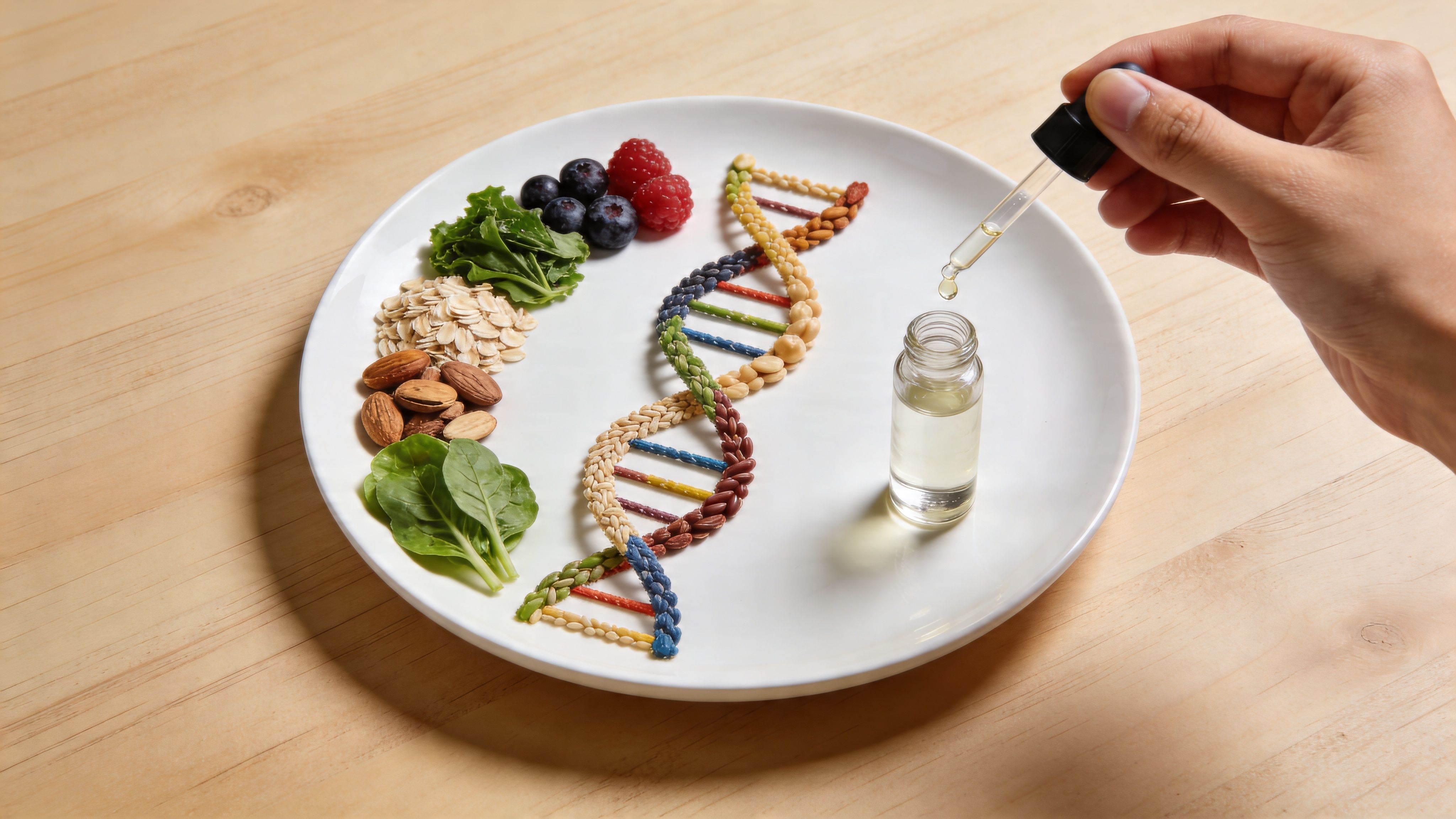
Personalized Nutrition: Your Guide for 2026
You might know the feeling. You try hard, you eat "pretty well," you try low-carb, then more protein, then intermittent fasting, and yet your body feels like it's playing by its own rules. Oatmeal works wonders for a friend, but you're hungry again shortly after. Your partner handles pasta without a problem, but you feel sluggish afterward.
This is where personalized nutrition becomes exciting. Not as a magic formula, but as a sober question: What does your body actually need, instead of what is recommended for "everyone"? If you understand this, nutrition often becomes much simpler. Not perfect. But clearer, more realistic, and better adapted to your everyday life.
What personalized nutrition really means
Personalized nutrition doesn't mean you suddenly have to eat only exotic superfoods or track every bite. It means something more down-to-earth. Dietary recommendations are adapted to your individual biology, your lifestyle, and your goals.
That sounds logical at first. Nevertheless, many people have worked with general dietary rules for years that only partially suited them. It's a bit like giving everyone the same shoe size and wondering why many can't walk well.
Why standard plans often fail
A general diet plan can provide a good foundation. More vegetables, enough protein, fewer highly processed products. That remains useful. But it doesn't answer how your body reacts to carbohydrates, fats, eating rhythms, or certain stresses.
Added to this is something very human. If a plan doesn't fit your daily routine, you rarely stick with it for long. Then the problem is not necessarily your discipline, but that the solution was too impersonal.
Personalization doesn't begin with perfection, but with a better fit between recommendation and everyday life.
Why the topic is currently occupying so many people
Interest in this is no longer a niche topic. In a 2023 DLG study, 47% of Germans surveyed stated that they would probably eat healthier through personalized dietary recommendations (DLG study on personalized nutrition).
This fits well with what many experience in everyday life. People don't want another rigid diet. They want to understand why their body reacts to certain patterns the way it does.
What personalized nutrition essentially means
This can best be thought of in three levels:
-
Your starting point
This includes genetics, digestion, current blood values, eating habits, and life rhythm. -
Your goals
Do you want to lose weight, stabilize your energy, recover better from sports, or better understand discomfort after eating? -
Your implementation
Recommendations are only useful if they fit into your real everyday life. That means into your shopping, your kitchen, your family life, and your work week.
Good personalized nutrition therefore doesn't just tell you what would theoretically be ideal. It also helps you make everyday decisions based on it.
The science behind your metabolism
Perhaps you know this from your circle of friends. Two people eat similarly for days, move about the same amount, and sleep roughly the same. Yet one person feels full for a long time after breakfast and clear-headed, while the other is hungry again two hours later. This is where metabolism becomes exciting, because it explains why the same diet plan works differently for different people.
Your metabolism works like a team of several systems that constantly communicate with each other. These include your genetic makeup, your gut microbiome, and your current physical condition. Anyone who wants to understand personalized nutrition should keep these three levels separate. Otherwise, big promises quickly seem more convincing than science can currently support.

Genetics as a basic blueprint
Genes give your body a kind of starting configuration. They don't determine every outcome, but they can influence how easily you get hungry, how you process certain nutrients, or how sensitively your metabolism reacts to things.
The appropriate analogy is a house plan. The plan specifies where walls, windows, and pipes are intended. How the house feels later still depends on how you use, maintain, and furnish it. Similarly, genetic data shows tendencies rather than firm predictions.
This is also the point where many waver between hope and skepticism. Rightly so. A DNA test can provide useful clues about predispositions. But it cannot reliably tell you what the perfect lunch is for you tomorrow. If you want to understand more precisely what genetic evaluations can actually do today, you can find a good classification in the article on Nutrigenetics and DNA testing.
Microbiome as an active player
Then the gut comes into play. A large community of microorganisms lives there, which can play a role in digestion, the processing of fiber, and even your feeling of fullness.
This part is more flexible than your genetics. Diet, sleep, stress, infections, or medications can change the microbiome. That's why some people react very differently to legumes, dairy products, or very fiber-rich meals. One stomach remains calm. The other reacts immediately.
Especially here, a sober look is worthwhile. There is a lot of enthusiasm around gut tests, but not every evaluation already provides clear, practical answers. It becomes scientifically useful when results are carefully interpreted and considered together with symptoms, habits, and other health data.
The current state counts every day
In addition to the blueprint and gut flora, there is a third level. Your current metabolic state.
This includes, for example, blood sugar reactions, sleep quality, stress, exercise, recovery, and nutrient status. These factors often explain more about your current well-being than a genetic predisposition alone. Someone who has slept poorly often reacts to hunger and satiety differently than on a well-rested day. Someone who is under constant stress notices this not only in their head, but often also in digestion, appetite, and energy.
This causes a lot of confusion. A genetic test describes what is generally more likely. Your current state shows what is actually happening in your body right now. Personalized nutrition therefore becomes particularly useful when it cleanly separates both and then sensibly combines them.
Rule of thumb: Genes set the framework. Gut, everyday life, and current metabolism determine how your body reacts within that framework.
Why general dietary rules often fall short
If you think about these three levels together, it quickly becomes clear why simple black-and-white statements rarely help. A food is not equally suitable for all people. It always works in conjunction with your biology and your everyday life.
A carbohydrate-rich breakfast can give one person long-lasting energy. Another will feel tired shortly afterward and quickly be hungry again. A fatter meal can be very filling or lie heavy in the stomach. Personalized nutrition does not try to morally evaluate food. It wants to find out which patterns suit your body and which tend to work against it.
That is precisely the scientifically sound part behind the hype. Not the idea that a test magically explains your life, but that different data sources together create a clearer picture.
Find out what your body needs
If you want to understand your body better, you don't immediately need ten tests. It makes more sense to answer the right question with the right tool. Otherwise, you get data, but no clarity.

What a DNA test can show
A DNA test primarily answers the question: What innate tendencies does your metabolism have? It therefore looks more at long-term patterns than at daily conditions.
This can be helpful if you want to understand why you cope better or worse with certain diets. Topics such as satiety or nutrient utilization can also play a role in such evaluations.
The important thing is to have the right expectation. A DNA test does not replace medical diagnostics and does not tell you what you ate wrong yesterday. It provides more of a map than a live tracker.
What a microbiome analysis can do
A microbiome analysis is interesting when digestion, gut feeling, or food reactions are in the foreground. It focuses on your gut and can help classify patterns better.
If you are interested in this topic, you can find a good introduction in the article on the Microbiome Test for Gut Health.
Here's a simple distinction:
| Method | Mainly helps with |
|---|---|
| DNA test | Predispositions in metabolism and nutrient processing |
| Microbiome analysis | Digestion, gut balance, individual food reactions |
| Blood or nutrient check | Current supply, possible deficiencies, current stresses |
Why blood values are often the reality check
Blood and nutrient tests answer a different question than DNA or microbiome. They do not primarily show how your body is fundamentally built, but how it is currently supplied.
This is enormously helpful because a theoretically good diet plan is of little use if a deficiency, severe exhaustion, or an imbalanced stress is present in the background. In the background information on personalized nutrition, it is therefore also recommended to practically include blood or microbiome data first and combine genetic clues meaningfully with them.
Anyone who relies on just one test often sees only a snippet. A clear picture usually only emerges when predisposition and current state are considered together.
Which question comes first
So that you don't get lost in the test jungle, this little orientation helps:
-
You want to understand which dietary type suits you better
Then a DNA-based approach is often a good start. -
You frequently have digestive problems or wonder why your gut reacts sensitively to many things
Then it's worth looking at the microbiome. -
You are exhausted, struggling with performance drops, or want to rule out deficiencies
Then blood or nutrient checks are usually particularly relevant.
This way, personalized nutrition doesn't become more complicated, but more targeted.
Your path to a personalized diet plan
You hold a test result in your hand and ask yourself: And what do I eat tomorrow morning? This is where many people get stuck. Not because of a lack of motivation, but because there is often a gap between analysis and everyday life.

A personalized diet plan is therefore not a PDF with prohibitions. It works more like an easy-to-read guide for your own body. The analysis provides clues. The plan translates these clues into concrete meals, shopping decisions, and repeatable routines.
From result to everyday recommendation
With DNA-based approaches, the process usually starts with a saliva sample for home use. In the lab, specific gene variants are analyzed that are studied in connection with appetite, satiety, or nutrient processing. However, the real benefit only arises from the classification.
Raw data is like the individual pieces of a puzzle. You only recognize a picture when the pieces are put together meaningfully.
That's precisely why a results report shouldn't just list technical terms, but answer questions that really matter in everyday life. Do you react better to more protein in meals? Do you need clearer meal structures so that the day doesn't end in snack mode? Or is a balanced distribution more realistic for you than an extreme eating style?
If you want to build a plan step by step from this, a guide to creating an individual diet plan helps, because it bridges the gap from recommendation to concrete implementation.
What a good plan should contain
A usable plan doesn't try to change everything at once. It sets priorities. This makes it practical and scientifically sound, because even the best analysis is of little use if your everyday life doesn't cooperate.
Pay attention to these components:
-
Clear main meals
What do you eat in the morning, at noon, and in the evening so that hunger, energy, and satiety become more predictable? -
A simple macro direction
You don't need complicated formulas. More important is whether more protein, a different amount of carbohydrates, or an adjusted fat distribution seems sensible for you. -
Suitable standard dishes
A good plan contains meals that you really want to eat multiple times a week. Routine beats perfection. -
Shopping and preparation
If the right foods are not at home, even the best plan remains theory. -
Room for real life
Restaurant visits, stressful days, and spontaneous evenings are part of it. A plan must be adaptable.
What genetics can and cannot do
Especially with genetic tests, there are two typical reactions. One side expects an almost precise answer to every dietary question. The other considers the whole topic exaggerated. Both fall short.
The sober stand is more practical. Genetic information can provide clues about useful directions. For example, it shows where it might be worthwhile to look more closely at satiety, meal rhythm, or nutrient distribution. However, it does not replace feedback from everyday life or current data such as blood values or complaints.
In other words: Your genes provide more of a map than the finished daily menu. Whether a route really suits you is determined by how you feel about it, how consistently you can implement it, and whether your goal is gradually approaching.
Practical rule: Use test results as guidance. The final decision is always made by combining science, everyday life, and your actual reaction.
How recommendations become real food
This is where personalized nutrition shows whether it just sounds interesting or really helps. Statements like "more protein" or "fewer fast carbohydrates" remain abstract as long as they don't become concrete meals.
The factual strength of an offer is therefore often shown in its translation. The DNA Test Nutrition from MYBODY Lab GmbH combines the DNA-based approach with an individual cookbook and recipe book. This is useful for people who don't just want to read a report, but need a plan that works in the kitchen.
A simple example: If your analysis indicates structured, more filling meals, you don't need a long theory. You need two or three breakfasts that really sustain you, a few lunches for workdays, and dinners that are quick without ending in ravenous hunger.
This is how information becomes a habit.
A Realistic Process
In practice, the process often works in five clear steps:
-
Define Your Goal
Do you want to better manage your weight, stabilize your energy, or better understand digestion and satiety? -
Choose the Right Data Basis
Depending on the question, DNA, microbiome, or blood values are helpful to varying degrees. -
Reduce Results to a Few Levers
Two to four concrete changes are usually sufficient to start. -
Translate These Levers into Meals
Plan suitable dishes, shopping lists, portion sizes, and a rhythm that fits your daily routine. -
Adjust Rather Than Sticking Rigidly
Your body is not a machine. If something doesn't work in daily life, the plan is adjusted, not your daily life forced.
A good personalized nutrition plan therefore doesn't feel like a strict system. It feels like a solution that suits you.
Achieving Specific Goals with Personalized Nutrition
Personalized nutrition is not an end in itself. It is a tool. How useful it is depends heavily on what you want to achieve.

When Weight Loss Needs to Finally Become More Understandable
Let's take Anna. She has tried several diet plans. During the week, she's disciplined, but in the evening, things often go awry. Not because she "doesn't want it enough," but because her meals don't keep her full for long.
For her, personalized nutrition can help shift the focus. Away from prohibitions, towards the question of which meals sustain her stably throughout the day. Perhaps she needs more protein in the morning, more structure at midday, and fewer spontaneous snack traps in the evening. The gain then often lies in better understanding, not in another strict diet.
When Longevity and Prevention Are the Focus
Then there are people who don't want to lose weight acutely. They want to understand early on how they can support their bodies long-term. For them, personalized nutrition is more of a preventive tool.
They pay attention to energy, regeneration, digestion, nutrient supply, and a lifestyle that feels good in the long run. Here, it's less about "Which diet is right?" and more about "Which patterns fit my biology and my daily life?"
Not every goal starts on the scale. For many, the benefit begins with more stability, a better body feeling, and smarter daily decisions.
When Sports and Regeneration Are Important
A third example is the physically active person. Training alone is often not enough if nutrition and recovery don't match. Personalized nutrition can help here to better coordinate meals around exertion, protein intake, and recovery phases.
This doesn't mean someone needs completely exotic sports nutrition. Often, it's about more precise basics. When do I eat what? Which meals satisfy without weighing me down before training? What actually supports my regeneration?
Three Goals, Three Different Applications
| Goal | Important Question | Possible Benefit |
|---|---|---|
| Weight Management | What keeps me full and stable? | Less guesswork in everyday life |
| Prevention and Longevity | Which patterns suit me long-term? | More sustainable habits |
| Sports and Performance | How do I support exertion and recovery? | Better coordination of food and training |
The common thread is always the same. You don't eat "perfectly." You eat more appropriately.
How to Recognize Reputable Providers
When it comes to personalized nutrition, there's justified curiosity and justified skepticism. Both are healthy. Especially with DNA tests, it's wise not to believe every marketing promise.
The German Nutrition Society (DGE) points out that scientific evidence for the sole superiority of genetic tests is often still lacking. Consumers should therefore look for providers who work holistically and consider lifestyle and other dynamic data in addition to genetics (DGE's assessment of personalized nutrition).
Good Providers Don't Promise Miracles
If someone suggests that a single test will solve all metabolic problems, you should be cautious. Reputable providers formulate their claims carefully. They state what a test can achieve, and also what it cannot.
This includes, for example, the clear statement that genetics provides clues, but no guarantee for a specific outcome. This very sobriety builds trust.
What You Should Specifically Look Out For
-
Laboratory Quality
It should be clearly evident that samples are processed in a certified laboratory. -
Data Protection
Especially with sensitive health data, it is crucial how samples are processed, pseudonymized, and handled after analysis. -
Understandable Reports
Good evaluations translate specialized knowledge into concrete, comprehensible recommendations. -
Holistic View
A provider should not view nutrition in isolation, but also consider daily life, behavior, and other health data.
If you want to get an overview, comparing various offers around online DNA tests can also help.
Warning Signs You Should Take Seriously
Some indications of a lack of trustworthiness are quickly recognizable:
-
Absolute Statements
"This test will show you the exact perfect diet." -
Unclear Methodology
It remains unclear what is actually being analyzed. -
Pressure Instead of Education
More urgency than understandable information.
A reputable provider doesn't just sell you hope. They clearly explain what kind of guidance you can realistically expect.
Frequently Asked Questions about Personalized Nutrition
Do I Need to Take a DNA Test Multiple Times?
Generally not. Your genetic makeup doesn't simply change in everyday life. However, what can change is your life situation. Therefore, DNA analysis remains the stable basis, while nutritional recommendations can be adjusted over time.
Is a Personalized Nutrition Plan Static?
No, and that's precisely what's important. Your daily life changes. Sleep, stress, exercise, age, digestion, or athletic goals don't always stay the same. A good plan is therefore more of a flexible system than a fixed meal plan forever.
Is Personalized Nutrition Also Suitable for Vegan or Vegetarian Diets?
Yes. Personalized nutrition does not mean you have to adopt a specific diet. Rather, it helps you better align your chosen diet with your body. Whether omnivore, vegetarian, or vegan, sensible implementation is crucial.
What is a More Sensible First Step?
That depends on your main question. If you want to better understand your metabolic type, a DNA-based approach can be useful. If digestion and abdominal discomfort are paramount, looking at the gut is often more obvious. If you feel drained or want to check your nutrient supply, current blood or nutrient data are often particularly insightful.
If you want to understand personalized nutrition not just theoretically, but also implement it practically, you'll find analyses for DNA, microbiome, metabolism, and nutrient supply at MYBODY Lab GmbH. This approach is particularly helpful if you want to translate your individual data into practical recommendations and concrete dietary routines.


Share:
Understanding Nutrigenomics: Personalized Nutrition for Your Genes
Personalized Food: Your Path to the Gene Diet