

Genetic test for weight loss: Discover the path to your personal ideal weight
You've tried countless diets, counted calories, and tortured yourself at the gym – but the yo-yo effect just won't leave you alone? Many people know this frustrating feeling. A genetic test for weight loss could be the missing answer. It examines your personal genetic blueprint and explains why standard diets might simply not work for you.
Why your body needs its own plan
Does this sound familiar? Your friend swears by a low-carb diet and is visibly losing weight, while you barely notice any change despite giving up bread and pasta. Or a colleague reaches their ideal weight with intermittent fasting, but you're just experiencing intense cravings. This isn't due to a lack of discipline, but rather to your unique genetic predisposition.
Each of us has an individual metabolism, as unique as a fingerprint. Your DNA determines how your body reacts to carbohydrates, fats, and proteins, how efficiently it burns calories, and even how strong your hunger is. A one-size-fits-all plan can never do justice to these subtle but crucial differences.
Feeding your body a one-size-fits-all diet is like trying to open a complex lock with a master key. The chances of success are vanishingly small.
The power of your genes
The science of nutrigenetics has made enormous progress in recent years. Researchers can now identify very specific gene variants that directly influence how well or poorly you can manage your weight. Two particularly exciting examples are the genes PPARG and APOA5 .
- The PPARG gene plays a key role in regulating fat and insulin sensitivity. An unfavorable variant can lead to your body processing fats less efficiently and storing them more readily.
- The APOA5 gene is crucial for the transport and breakdown of fats in the blood. If a specific variation of this gene is present, fat burning can be significantly slowed.
These genetic markers often explain why some people struggle to lose weight despite exercise and a healthy diet, while for others it seems to happen almost effortlessly.
When genes hold back success
Scientific studies impressively support these connections. We know that only about eight percent of Germans manage to lose weight and remain more active in the long term. Researchers suspect that the cause often lies precisely in these genetic differences.
For example, one study showed that participants with an unfavorable variant in the PPARG gene lost six times less weight under exactly the same physical exertion than subjects without this gene variation.
The situation is even more striking with the APOA5 gene: While participants with optimal DNA structure lost almost 13 kilograms , subjects with a genetic defect lost an average of only 0.3 kilograms . The alarming aspect is that around 96 percent of people carry at least one such unfavorable variant. You can read more about these fascinating scientific findings here .
A genetic test for weight loss brings these hidden processes to light. Instead of continuing to wonder what you're doing wrong, you receive a clear, scientific explanation based on your DNA. You learn that your body isn't working against you, but simply playing by its own rules. This realization is often the first and most important step away from diet frustration – towards a sustainable path that truly suits you.
Learn more in our follow-up article about how a personalized diet based on your DNA can be your key to success.
This is how a DNA metabolism test works in practice.
The path from your curiosity to a clear, scientifically sound plan for your body is often easier than you think. A modern genetic test for weight loss is not a complicated medical procedure. It's a straightforward and safe process that you can easily initiate from the comfort of your own home.
Let's take a look together at exactly how the whole process works – from the simple sample collection to your personal results report.
The idea of having your DNA analyzed sounds like a lot of work to many people. But the reality is quite different. The entire process is designed to fit seamlessly into your everyday life, without you having to visit a doctor's office or a laboratory. Everything you need comes directly to your home.
From saliva sample to laboratory
It all starts with ordering your test kit. Once it arrives, the actual, but very easy part begins: taking the sample.
- Activate your test kit: First, register your kit online with a unique code. This is crucial for data privacy, as your sample is pseudonymized from this point on. The lab only knows the code, not your name or other personal information.
- Taking a sample: Instead of drawing blood, a simple saliva sample is sufficient. You simply spit a small amount into the provided tube. This is completely painless, only takes a few minutes, and is absolutely safe.
- Send it back: Then pack the sample in the enclosed return envelope and send it free of charge to the specialized partner laboratory. From here, the experts take over.
Once at the lab, your DNA is isolated from your saliva. In a state-of-the-art, ISO-certified laboratory, specialized procedures then specifically examine the gene variations that are relevant to your metabolism – that is, precisely those sections of your genome that influence how you process fats, carbohydrates, and proteins.
The following graphic clearly illustrates the path from typical diet frustration to a data-driven approach, such as that made possible by a DNA test.
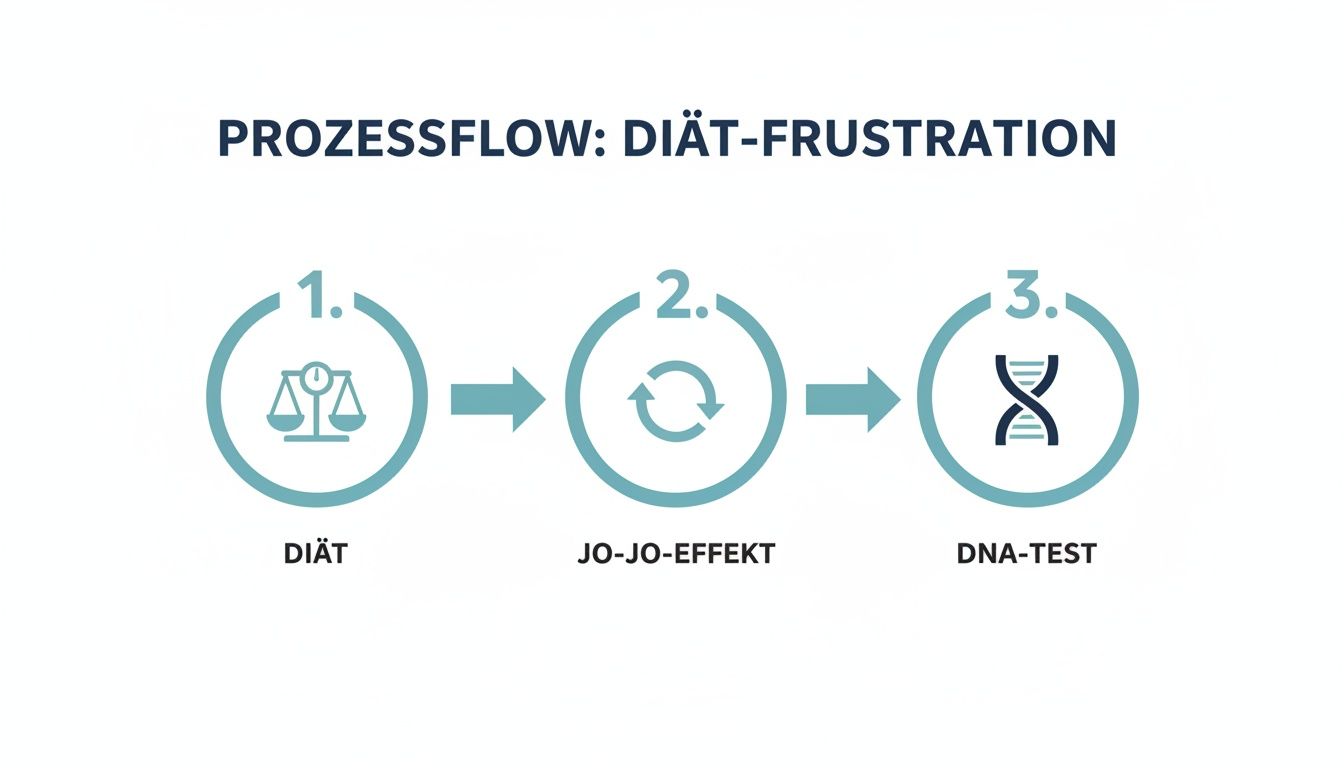
This endless cycle of dieting and yo-yo effect can be broken if you use a test as a tool to finally find a strategy that is truly tailored to your body.
Your personal results report
The laboratory analysis is completed after approximately two to three weeks . What you then receive is not an incomprehensible lab report, but a detailed and easily understandable results report. This report is the core of your genetic test.
Your results report is more than just a collection of data. It's your personal blueprint, translating complex science into clear, actionable recommendations for your everyday life.
Here you'll find out exactly what your metabolic type is. The report breaks down precisely how your body reacts to the three macronutrients – carbohydrates, fats, and proteins – and provides you with a percentage distribution that is optimal for you.
A good report, like the one from the mybody® DNA metabolism test , goes a step further. It provides you with:
- Practical food lists: You can see at a glance which foods are particularly good for you and which you should avoid.
- Individual calorie and nutrient goals: You will receive a clear recommendation for your daily calorie intake to achieve your goals – whether it's losing weight, maintaining weight or building muscle.
- Sports recommendations: Your genes also reveal whether you respond better to endurance sports or strength training to effectively boost fat burning.
Your privacy is of course our top priority. Your sample will be destroyed after analysis, and your data will be handled strictly in accordance with GDPR guidelines. You retain full control at all times.
Would you like to know more about how the process works? Then take a look at the detailed explanation of how the mybody® DNA metabolism tests work .
The scientific basis of gene-based diets
A genetic test for weight loss – does that sound like science fiction to you, or is there solid science behind it? Many people wonder if it's more than just a clever marketing trend. The short answer: Yes, science is increasingly showing that our genes play a key role in regulating our weight.

The research that deals precisely with this interplay is called nutrigenetics . It deciphers how our bodies react to different nutrients based on our unique genetic predisposition. It's not about finding a one-size-fits-all "gene-based diet," but about adapting your diet to your personal genetic blueprint.
Which genes really control your weight
Imagine your genetic makeup as a giant control center. Researchers have now identified a whole range of "switches"—that is, genes—that demonstrably influence our metabolism and body weight. Depending on how these switches are set in your body, certain processes occur more or less intensely.
The most well-known players include, for example:
- The FTO gene: Often referred to as the "obesity gene," it is one of the best-studied genes in this field. Certain variants can lead to a higher body mass index (BMI), increased appetite, and a preference for high-fat and high-calorie foods.
- The MC4R gene: This gene is a key regulator of your hunger and satiety signals. If certain variants are present, your brain may be less able to perceive satiety signals, causing you to feel hungry again more quickly.
These tiny differences in our DNA are called SNPs (Single Nucleotide Polymorphisms). They are the reason why your friend might be able to devour huge portions without gaining weight, while you feel like you gain a kilo just by looking at a pizza.
Important genes for your metabolism and what they mean
The following table gives you a brief overview of which genes are analyzed in a genetic test for weight loss and what they can reveal about your body.
| Gene markers | Function in the body | What an unfavorable option can mean |
|---|---|---|
| FTO | Control of appetite, satiety and energy consumption | Increased appetite, tendency towards fatty foods, higher BMI risk |
| MC4R | Regulation of the hunger and satiety signal in the brain | Reduced feeling of satiety, which can lead to overeating. |
| PPARG | Important for fat cell formation and insulin sensitivity | Increased susceptibility to weight gain with a high-fat diet |
| ADRB2 | Does it affect fat burning (lipolysis) during physical activity? | Reduced effectiveness of fat burning during exercise, more difficult weight loss |
| TCF7L2 | Involved in blood sugar regulation and insulin secretion | Higher risk of insulin resistance, especially with a high-carbohydrate diet. |
These genes are only a small part of the overall picture, but they impressively demonstrate how strongly our metabolism is influenced by our DNA.
Scientific studies support this. It is now known that there are 941 gene loci that – similar to the FTO gene – have a demonstrable link to obesity. Researchers from Marburg, for example, were able to show that certain alterations in the MC4R gene lead to fewer receptors in the brain. The result: increased appetite and reduced energy expenditure.
What are the real benefits of personalized nutrition plans?
The crucial question, of course, is: Can this knowledge be put to practical use? A growing number of studies suggest that dietary plans based on genetic data are indeed more effective than the usual "one-size-fits-all" diets.
In a groundbreaking study, participants who followed a diet tailored to their DNA lost significantly more weight than the control group on a standard plan. The logic behind this is simple: If you know whether your body metabolizes fats or carbohydrates best, you can adjust your diet accordingly. You're working with your body, not against it.
Your genes are not your destiny, but an extremely valuable map. They show you the easiest path to your goal and help you avoid unnecessary detours and dead ends.
Nevertheless, it's important to remain realistic. Your DNA is a fundamental building block, but it's not the only one. Your lifestyle, your sleep, your stress level, and your environment also play a huge role in your weight loss success.
A genetic test doesn't offer a magic pill, but rather a powerful tool. It provides you with a scientifically sound basis for finally making the right decisions for your body. Instead of groping in the dark and trying one diet after another, you receive a clear, personalized strategy.
If you want to delve even deeper into this fascinating world, then check out our article that explains what nutrigenetics is and how it shapes our lives .
For whom is a DNA test for weight loss really useful?
A genetic test for weight loss is a powerful tool, but is it right for you? That's the crucial question. The greatest benefit only comes when the results are applied to your life. Let's take a closer look at who benefits most from a DNA analysis – and when the test might not be the best choice.
Perhaps you recognize yourself in one of these scenarios. Of course, the test isn't a cure-all. But for some people, it can be the turning point they've been waiting for. It doesn't just provide data, but above all, clarity and a very personal guide to action.
When diets become an endless loop
Are you one of those people who feel like they've tried every diet imaginable? You start full of enthusiasm with low-carb, paleo, or intermittent fasting, maybe even see some initial success – but then the yo-yo effect strikes mercilessly. In the end, you might even weigh more than before.
A genetic test could be invaluable for you. It explains why your body simply doesn't react to certain diets the way you'd like. Perhaps you're not genetically predisposed to drastically reducing carbohydrates. Or your body metabolizes fats so efficiently that a low-fat diet has hardly any effect on you.
A genetic test breaks this vicious cycle of trying, frustration, and giving up. It replaces blind guesswork with a scientifically sound strategy tailored to your unique body.
So if you've reached a point where you distrust your own discipline and feel like your body is working against you, then DNA analysis will provide you with the missing answers.
For health-conscious optimizers
Perhaps you're not looking for the next diet, but simply want to take your health and fitness to the next level. You're health-conscious, exercise regularly, and pay attention to your diet, but you feel there's still more potential there.
In this case, the genetic test becomes your personal optimization tool. You will learn, for example:
- Your ideal macronutrient mix: Do you need more protein for muscle building, or are healthy fats your key to more energy?
- Your optimal training: Does your body respond better to intense strength training, or do you burn fat most efficiently during long endurance sessions?
- Your personal nutritional needs: Are you genetically predisposed to certain deficiencies and should you pay particular attention to your intake of certain vitamins or minerals?
With these insights, you can refine your previous efforts and get the most out of your healthy lifestyle.
For persistent weight problems
Sometimes the causes of being overweight lie deeper and are harder to pinpoint. Scientific studies are increasingly demonstrating the significant role genetics plays. For example, researchers at Charité Hospital found epigenetic changes in the POMC gene in women with a BMI over 35 , which increased the risk of obesity by a substantial 44 percent . A large meta-analysis with over 9,500 participants also confirmed that variants in the well-known FTO gene directly influence weight loss success during diets.
This data underscores why a personalized approach is so relevant, especially for persistent weight problems. If you'd like to delve deeper into this topic, you can find more information in the publications of the Robert Koch Institute .
For whom a genetic test is less suitable
Let's be honest: A genetic test isn't a magic button you press and everything will be alright. It provides you with the blueprint and the best possible strategy, but ultimately, the implementation is up to you.
A test is therefore probably not for you if:
- If you are not willing to change anything: The results are only as valuable as your willingness to implement them in everyday life.
- If you're expecting a quick overnight solution: A genetic test is the starting point for a sustainable lifestyle change, not a short-term diet hack.
- You are not open to new insights: Sometimes analysis reveals that cherished habits are unsuitable for your body. In this case, openness to new things is required.
Choosing to take a genetic test for weight loss is an investment in yourself. It makes the most sense when you are ready to accept the answers your DNA provides and use them as a compass for your future path.
Apply your genetic insights in everyday life
A results report full of scientific data is impressive, but it doesn't change anything on its own. The true value of your weight loss genetic test only unfolds when you translate the findings into your everyday life. It's about taking the knowledge from the page and putting it into practice in your refrigerator and your gym bag.

Here I'll show you how to transform the recommendations from your DNA analysis into concrete, sustainable habits. And don't worry: it's not about strict prohibitions, but about making smart choices that perfectly suit your body.
From knowledge to action in the kitchen
Your diet is the biggest lever you have. The results of your test give you a clear direction – now it's about actually following that course at the supermarket and when preparing your meals.
Imagine your results show that you metabolize protein particularly well and that it helps you lose weight. That's invaluable! Instead of blindly counting calories, you can now focus specifically on optimizing your protein intake.
This doesn't mean you should only eat chicken breast from now on. It's about smart integration:
- Breakfast: Swap the jam on your bread for cottage cheese or a boiled egg. Quark with berries or a protein-rich smoothie are also great alternatives.
- Lunch: Make sure your salad is more than just leafy greens. Add chickpeas, lentils, tuna, or grilled chicken strips. This will keep you feeling full longer.
- Snacks: Instead of reaching for a sugary granola bar, opt for a handful of nuts, Greek yogurt, or edamame. This will stabilize your blood sugar levels and prevent cravings.
Perhaps your test also shows that your body is sensitive to saturated fatty acids. Then it's time to be more mindful of your fat intake.
Your results report is like a personal shopping guide. It doesn't tell you what you can never eat again , but rather which foods your body loves and which ones are more of a burden.
Focus on high-quality, unsaturated fats. Use olive oil in your salad, regularly eat oily fish like salmon, and incorporate avocados or nuts into your meals. These small adjustments make a huge difference to your well-being and your figure in the long run.
If you want to delve deeper and restructure your diet plan step by step, you will find even more practical tips in our guide to optimizing your diet after a DNA test .
Your training with genetic backing
Not only your diet, but also your exercise program can be specifically improved through your DNA. Have you ever wondered why you jog for hours, but the fat burning just doesn't kick in? Your genes could hold the answer.
Your mybody® DNA metabolism test analyzes whether you are more of an endurance or a strength type. And this information is crucial for making your training as efficient as possible.
Scenario 1: You are an endurance type
Your body responds particularly well to longer, moderate exertion. You burn fat most effectively during activities such as:
- Jogging or brisk walking
- Ride a bike
- To swim
- rowing
Your goal should be to integrate three to four sessions of 30 to 60 minutes each into your daily routine every week. The point is not to completely exhaust yourself every time, but rather to maintain regularity and the duration of the activity.
Scenario 2: You are a strong type
Your metabolism really kicks into high gear thanks to the so-called afterburn effect. This means your body continues to burn more calories for hours after your workout. The best sports for you are:
- Classic weight training
- High-Intensity Interval Training (HIIT)
- Circuit training
- Calisthenics (exercises using your own body weight)
Two to three intense workouts per week are often perfectly sufficient. The focus is on short but very intense efforts that challenge your muscles. More muscle mass means a higher basal metabolic rate – so you burn more calories even at rest.
Always remember: The best plan is the one you stick to. Find a sport you truly enjoy and that suits your genetic profile. This will keep you motivated in the long run and finally help you see the results you desire. Putting your genetic insights into practice is a process, not a sprint. Be patient with yourself and celebrate even the small successes along the way.
Frequently asked questions about genetic testing
You've already read a lot about how genetic testing for weight loss can help you better understand your body and finally find a strategy that actually works. Nevertheless, a few specific questions often remain. No problem – here we answer the most important points that come up again and again, briefly and clearly.
Can I rely solely on my genes?
No, and that's a crucial point. Think of your genes as an incredibly valuable map that shows you the fastest and most efficient way to your goal. But they are not your destiny.
A healthy lifestyle, sufficient sleep, good stress management, and of course your daily choices regarding diet and exercise all play an equally important role. The test provides you with the scientific basis, but the implementation is up to you. See it as a powerful tool, not a magic pill that does everything for you.
Is a genetic test scientifically sound?
Yes, absolutely. Nutrigenetics – the science of the interplay between genes and nutrition – is a well-researched and established field. Reputable providers like mybody® work exclusively with ISO-certified laboratories and base their analyses on thousands of scientific studies.
This isn't about vague assumptions. Specific gene variants (so-called SNPs) are analyzed, whose influence on metabolism has been clearly scientifically proven. The mybody® DNA metabolism test focuses precisely on these relevant markers to provide you with reliable and scientifically sound recommendations.
It's important to choose a provider that operates transparently, relies on verified lab quality, and delivers understandable, actionable results. You shouldn't be left alone with a pile of raw data.
What happens to my data and my sample?
Data protection is of course essential when dealing with such a personal topic as one's own DNA. Reputable providers guarantee the highest security standards, which are fully compliant with the European General Data Protection Regulation (GDPR).
This is how we at mybody® ensure that your data is protected:
- Pseudonymization: Your sample is only linked to an anonymous code in the lab. The lab therefore has no way of knowing who the sample belongs to.
- No disclosure to third parties: Your genetic data will never be shared with other companies or individuals without your explicit consent.
- Secure destruction: After the analysis is complete, your saliva sample will be securely and completely destroyed in the laboratory.
You therefore retain full control over your data at all times, and your privacy is protected at all times.
How quickly will I see results?
A genetic test is the starting point for lasting change, not a short-term diet sprint. Many people notice the first positive effects after just a few weeks. This can include more energy in everyday life or a better feeling of satiety because the body is finally receiving the right nutrients.
Visible results on the scale naturally depend on how consistently you follow the recommendations. The big advantage: Because the plan is tailored to you personally, it often feels less like a diet and more like an intuitive, suitable way of eating. This is precisely what makes sticking with it so much easier and leads to long-term, sustainable results instead of the dreaded yo-yo effect.
Are you ready to stop the guesswork and discover your personal path to greater well-being? At mybody® you'll find scientifically sound DNA tests that provide clear answers and support you in finally achieving your health goals sustainably.
Discover the mybody® DNA metabolism test now and start your journey



Share:
Epigenetic analysis: Key to personalized health
Weight loss genetic testing: Experiences with 7 providers in a practical test for 2024