
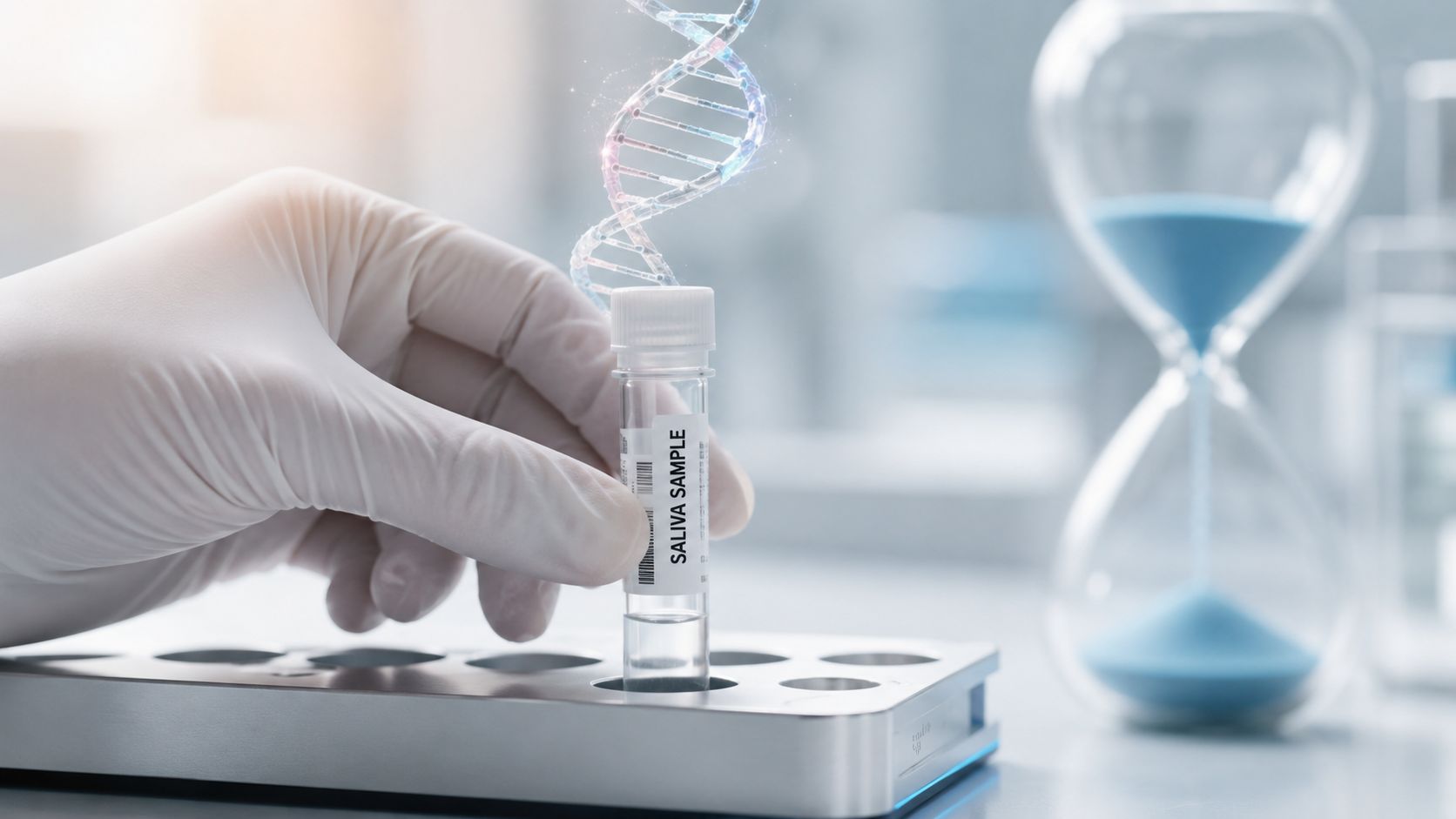
Why does a genetic test take so long? All steps explained
In German-speaking countries, a genetic test typically takes between 15 days and 8 weeks, with an average of about 45 days. That sounds like a long time, but there is usually a good reason: A reliable, thoroughly checked, and clearly interpreted result must first be produced from a small saliva sample.
If you are currently waiting for your result, this time often feels longer than it really is. You submitted and mailed the sample, and now you finally want to know what your genes reveal about nutrition, metabolism, or health predispositions. This is often where frustration arises, because the actual laboratory process feels like a black box to many people.
The good news is that the waiting generally does not mean that nothing is happening. Several steps take place one after another, and each has a clear purpose. When you understand where time is really needed, the answer to the question Why does a genetic test take so long? becomes much easier to understand.
Your genetic test is on its way, and now the waiting begins
You put the envelope in the mailbox, go home, and realize: From now on, everything is happening outside your view. That is exactly what makes the waiting period for a genetic test feel so arduous. You have completed your task, but you cannot observe the result live at every individual step like package tracking.
There is also something very human involved. You are not waiting for just any product, but for information about your own body. That makes every day feel longer.
How long does it realistically take
In German-speaking countries, a genetic test often takes several weeks. This is not because a sample simply sits around for a long time, but because a reliable finding must first be produced from just a few cells.
A genetic test is not a quick scan; it works more like carefully reading and translating a very long text. First, usable source material must be available. Then the DNA is analyzed. Finally, the data is checked and translated into an understandable result.
So if your result is not available after just a few days, that is often still within the normal timeframe. Especially when it comes to health-related topics, accuracy matters more than speed.
Why the wait often feels like a black box
A common assumption is that a laboratory only needs to take a quick look and then send a file. The actual process is much more detailed. Some of the time is spent on scientific work. Another part goes toward organization, documentation, and quality controls.
This exact distinction helps with understanding. Not every waiting period means that DNA is actively being read. Sometimes the sample is still in transit, being registered, or being prepared for analysis. So you can broadly divide the process into two areas: logistical steps related to shipping and laboratory intake, and the actual laboratory work with analysis.
If you want to understand what happens before shipping and during collection at home, the guide How a genetic test at home works can help.
What often goes through your mind during this stage
A few questions come up almost every time:
- Has my sample arrived yet? It can often only be reliably matched after receipt and registration.
- Why does the analysis take longer than the sample collection? Because the actual work only begins after shipping.
- Wouldn’t a faster result be better? With genetic data, what you want above all is a result that has been carefully checked.
The waiting period is therefore often not a sign that nothing is happening, but rather of a controlled process. A report is only useful if the sample has been processed correctly, the data has been carefully checked, and the findings have been explained clearly. That is precisely why a genetic test takes longer than it may seem from the outside.
Your sample’s journey from the mailbox to the laboratory
The first part of the waiting period has little to do with biology. It is primarily organizational. Your sample must first safely make its way to the laboratory and then be correctly entered into the process.
The first few days pass during this stage. This is not a sign that nothing is happening, but part of a controlled process.
What happens after you drop it in the mailbox
After shipping, your sample is in transit like any other sensitive test material. It is received, sorted, and assigned to the correct laboratory process. Only once this receipt has been properly documented can the actual analysis begin.
At the laboratory, the sample is not simply passed on loose. It is registered, assigned to a system, and prepared in a way that prevents mix-ups. This is crucial when dealing with health data.
Anyone who would like to understand more precisely how collection and shipping work for saliva samples will find an easy-to-follow explanation in the guide How does a saliva test work?.
Why registration and data protection take time
A laboratory does not only carry out scientific work; it is also required to keep documentation. This means that every sample needs a traceable journey.
This usually includes the following steps:
- Incoming inspection. The shipment is checked to ensure it is complete and the sample is generally suitable for processing.
- Registration in the laboratory system. The sample is recorded correctly so that the right result reaches the right person later.
- Pseudonymization. Internally, processing is not carried out using only your name. This protects your personal data.
The more cleanly this initial stage is organized, the lower the risk of mix-ups, follow-up questions, or uncertainty about the findings later on.
A practical example from everyday life
If you use, for example, a NutriCare | INFINITY DNA test, your submitted saliva sample does not immediately become a nutrition report. The laboratory must first ensure that the sample has arrived correctly and can be technically entered into the workflow. The test analyzes genetic nutrient utilization, food intolerances, micronutrient requirements, and metabolic type. However, the actual result is produced much later in the process.
You can think of it like checking in at the airport. Even if the plane is already there, you cannot simply go straight to the cockpit. The process can continue only once identity, assignment, and security procedures are all in order.
From saliva to pure DNA: the invisible preparatory work
As soon as the sample is registered at the laboratory, the actual laboratory work begins. None of this is visible from the outside. That is precisely why many people underestimate this part.
A saliva sample does not simply contain fully prepared DNA. The material contains various components from which the genetic information must first be extracted.
Why the sample cannot be read immediately
Saliva is biologically a mixture. For the test, however, the laboratory needs pure DNA whenever possible. Only then can the process continue reliably.
A good analogy is a cookbook lying in an overcrowded kitchen drawer. Before you can read the recipe, you first have to take out the right book, remove the dirt, and open the pages properly. In the same way, the laboratory separates usable genetic information from the rest of the sample.

What happens during DNA extraction
DNA extraction is the step in which the genetic material is isolated from the sample. The laboratory removes components that are not needed for the analysis and obtains a purified DNA concentrate.
It is not just about finding DNA at all. Its quality is also crucial. If the material is impure or has not been prepared well enough, everything that follows becomes more difficult.
Put simply, the preparatory work consists of three stages:
-
Lyse cells
The cells from the sample are treated so that the DNA is released. -
Remove contaminants
Anything that could interfere with the subsequent analysis is filtered out as much as possible. -
Check quality
The laboratory checks whether enough usable material is available.
Why this step is so important
Many people think the exciting phase only begins with sequencing. In fact, the quality of the rest of the process is often determined at this stage. Poor starting quality makes the subsequent analysis unnecessarily complicated.
Anyone who wants to understand this laboratory step in a clear and practical way will find a good introduction in Step by step to DNA analysis.
A genetic test does not take a long time because someone is dragging their feet. It takes time because everyday sample material first has to be turned into a precise analytical product.
What readers often confuse
It is common to think that saliva and DNA are practically the same thing. That is understandable, but not entirely correct. Saliva is only the transport medium. The DNA is the information it carries. And this information first has to be made technically accessible in a reliable way.
This invisible part is one of the reasons why a report is not simply available immediately after the sample arrives.
Sequencing: reading your genetic book
The lab is now beginning the part that many people associate with the actual genetic test. The machine reads the DNA. Only at this stage are the raw data generated from which a report can later be produced.
The lab often uses Next-Generation Sequencing, or NGS for short. The name may sound technical, but the principle is easy to understand. The DNA is divided into many small sections, prepared technically, and then analyzed in parallel. This makes it possible to measure a large amount of genetic material in a short time. “Short” is a relative term here. Several controlled intermediate steps take place before and after the measurement run, and these are often responsible for part of the waiting time.
What actually happens during sequencing
The machine does not simply read one long strand of DNA from beginning to end. It processes a large number of short fragments and generates digital signals from them. These signals are converted into sequences of the letters A, T, C, and G. This is the raw material for everything that follows.
Even small technical variations matter here. Some fragments are captured particularly well, while others are captured less effectively. Some regions of the genome can be read clearly, while others are more difficult. The lab therefore continuously checks whether the data are dense enough, clean enough, and uniform enough to be reliably evaluated later.

Anyone who wants to understand the technical process in more detail will find an easy-to-understand introduction at Gene sequencing explained simply.
Why this step takes time
From the outside, sequencing often looks like a single push of a button. In the laboratory, it is more like a chain of preparation, processing, quality control, and approval. Patient information from Swiss DNAlysis aptly explains that the duration depends not only on the measurement itself, but also on sample preparation, quality control, analysis, and medical reporting.
The volume of data also plays a role. Broader gene panels generate a great deal of raw data. This not only extends the subsequent computer analysis, but also increases the testing effort at this stage. The laboratory must ensure that the read sections are available in sufficient quality before meaningful further processing can begin.
A good illustration is the difference between a quick snapshot and a medical image. Both are created using technology. With a medical image, however, it is not enough for something to be visible at all. The image quality must be sufficient for a reliable assessment.
Why testing more genes often takes more time
A small, targeted test usually answers a narrower question. A broad panel searches many locations at the same time. This can be helpful, but it produces more material that must be checked.
There are typically three time factors:
- More fragments must be read accurately from a technical standpoint.
- More data points must be checked for completeness and quality.
- More notable findings may trigger additional questions or checks later.
That is why sequencing feels like a black box to many people. The sample has long been in the laboratory, but the result is still not available. The reason is usually not a standstill, but an ongoing precision process involving many checks.
Anyone familiar with such processes from another field will quickly recognize the pattern. Data-rich business processes also require clear testing rules and accurate analysis for effective automation. One example is provided in the article AI Strategies for Your Business.
The real bottleneck is often not the machine
The sequencing itself is highly automated. Time is not simply lost, however. It is used to ensure accuracy.
If individual sections are unclear, if a run is not technically clean enough, or if coverage of important regions is insufficient, the laboratory performs additional checks. Sometimes data is reviewed again; sometimes individual steps are repeated. This care is precisely what distinguishes a quick measurement from a result you can rely on.
That is why this stage often takes longer than it may appear from the outside. The machine reads. The laboratory assesses whether what has been read is reliable enough.
Bioinformatics: translating your genetic data into knowledge
After sequencing, there is not yet an understandable health report. At first, there is mainly raw data: long sequences of A, T, C, and G that, on their own, say very little.
At this point, bioinformatics takes over. It turns raw genetic data into a form of knowledge that experts—and later you—can use.
From a jumble of letters to meaning
If sequencing is reading, then bioinformatics is translation. Computer programs compare the DNA segments that were read with reference sequences, search for variants, and filter out what might be relevant.
It is a bit like finding an old manuscript written in a language that is difficult to understand. First, you have to check whether the text is complete. Then you compare individual passages with dictionaries and known versions. Only afterward can you say roughly what the content means.

What bioinformaticians and systems do in the process
The work involves more than just computing power. It is also a matter of assessment and filtering.
The following tasks are typical, among others:
-
Quality control of the raw data
It is checked whether the data that was read is sufficiently reliable. -
Alignment with reference sequences
The data is compared with known genetic references. -
Searching for variants
Differences are identified and flagged. -
Assessing relevance
Not every variant is automatically important for the specific question.
The background information on the waiting time explains that cross-referencing with databases such as ClinVar also significantly increases the effort involved. This is where much of the work that customers do not see takes place.
Why computers alone are not enough
Bioinformatics is highly technical, but not entirely automatic. Algorithms can pre-sort and compare data and flag unusual areas. The significance of these areas still needs to be reviewed using expert knowledge.
This is also a good reason why companies in other data-intensive sectors are now considering structured automation. Anyone interested in the general handling of complex data processes can find a cross-industry perspective in AI strategies for your company on how large volumes of data can become manageable decisions in the first place.
Raw data is not advice yet. Only when data has been filtered, checked, and meaningfully interpreted does a result emerge that can truly help you in everyday life.
Where readers often have false expectations
Many hope for a direct line from sample to PDF. In reality, there is a translation process in between. And translation takes time, especially when accuracy matters more than speed.
With topics such as nutrition, metabolism, and prevention, a superficial analysis would certainly be faster. But it would also be more prone to misunderstandings. That is why this step is so central to the quality of the test as a whole.
Quality assurance and your personalized results report
In the end, you do not want a pile of data, but an understandable answer. That is precisely why the technical analysis is followed by another particularly important stage: quality assurance and medical assessment.
This shows why a genetic test is more than laboratory automation. The goal is to turn analyzed variants into a report that is comprehensible and meaningfully usable.
Why medical validation is so crucial
A key reason for longer processing times is medical validation. DNA analyses often take several weeks because findings must be assessed in a clinical context. Even a positive result often does not allow for an exact prognosis, while a negative result does not reliably rule out a disease. When specifically looking for a known mutation, however, a result may be available after about 7 days. This information is provided by Gesundheitsinformation.de.
This is a key point that is often overlooked. A genetic variant alone is not yet a definitive statement about your future. It is more like a puzzle piece that must be understood as part of the bigger picture.

What is checked in the end
Before a report is approved, experts take another look at its plausibility, context, and comprehensibility. It is not only a matter of whether a variant is present, but also what it means for the specific test question.
Typical final steps include:
-
Plausibility check
Are the data correct, and do the results fit the analysis context? -
Expert assessment
Which statement is reliable, and which would be an overinterpretation? -
Report preparation in everyday language
The results must be prepared in a way that allows you to use them in practice.
Why data only becomes genuinely useful after processing
Especially with preventive or nutrition-related DNA analyses, the added value lies not in the raw information itself, but in how actionable it is. A report should help you understand connections and derive sensible decisions about nutrition or lifestyle.
An example of a product in this area is mybody®x’s DNA Metabolism Analysis. It identifies genetically determined metabolic types, fat and carbohydrate utilization, as well as individual weight-related risks, and serves as the basis for a customized nutrition and training plan. What matters here is not just the measurement, but the processed analysis.
A good genetic test doesn’t end with a variant in a data set. It ends with an understandable interpretation that you can work with sensibly.
What you can do and why patience pays off
Once you understand the sample’s entire journey, the waiting time usually seems much more logical. A genetic test doesn’t take a long time because nothing is happening somewhere. It takes time because shipping, registration, laboratory work, data analysis, and reporting all need to fit together properly.
Even so, there are a few things you can influence yourself.
What you can do yourself
These points help avoid unnecessary delays:
-
Follow the instructions carefully
A properly collected sample makes the entire process easier. -
Return the sample promptly
This helps you avoid additional delays on your end. -
Ask about the status if anything is unclear
If the processing time is significantly longer than expected, it makes sense to make a friendly inquiry. -
Read the results later, at your leisure
Set aside enough time so that you don’t just skim the report in passing.
The laboratory is not always the bottleneck
In some cases, the waiting time is not extended by the laboratory but by bureaucracy. Correspondence with health insurers and medical consultants regarding coverage can delay the decision on a genetic test by months, even though the laboratory work itself takes only weeks. This is highlighted in a report by Tages-Anzeiger.
This comes as a surprise to many people. Sometimes a test feels slow not because of the technology, but because of the healthcare system surrounding it.
Why patience makes sense here
Anyone who uses health data wants clarity. And clarity rarely comes from haste. It’s better to wait a little longer for a carefully prepared report than to receive a quick file that leaves more questions unanswered than answered.
So if you’re currently wondering, why does a genetic test take so long, the most honest answer is: because much more happens between the sample and the result than you can see from the outside. That very care is what distinguishes mere data from an evaluation that is genuinely helpful.
If you no longer want to understand your body based solely on assumptions, you can get an overview of DNA, microbiome, and nutrient tests from MYBODY Lab GmbH. The value lies not in satisfying quick curiosity, but in structured, clearly presented results that can provide genuine guidance for your diet, prevention, and everyday life.



Share now:
Genetic Basal Metabolism Explained: Your Basal Metabolic Rate
Boost Your Metabolism: Your Roadmap to More Energy in 2026