

Calorie Needs Calculator: Find Out What Your Body Really Needs
A calorie needs calculator is often the first step toward your health goals. It gives you a number—a estimate of how many calories you need each day. This number is the basis for everything else, whether you want to lose weight, build muscle, or simply maintain your weight. It is your strategic starting point.
How to truly understand your calorie needs

Your daily calorie needs are much more than just a number from an online tool. They consist of two key components that together make up your personal energy expenditure. Think of it as your body's energy budget: To achieve your goals, you need to understand what comes in and what goes out.
The foundation of it all is your basal metabolic rate, also known as the Basal Metabolic Rate (BMR). This is the energy your body uses in a state of complete rest just to maintain vital functions such as breathing, heartbeat, and regulating your body temperature. Even if you spent the entire day lying on the couch, you would burn these calories.
On top of that comes your activity expenditure. This includes every calorie you burn through movement—from walking to the mailbox and doing household chores to a sweat-inducing workout.
Why your needs are unique
General recommendations for calorie intake often fall short because our energy needs are highly individual. Several factors determine how high your basal metabolic rate and activity expenditure actually are at the end of the day:
- Age: As we get older, our metabolism naturally slows down, which slightly lowers our basal metabolic rate.
- Sex: On average, men have a higher proportion of muscle, which naturally results in a higher basal metabolic rate.
- Body composition: A crucial factor. Muscle is more metabolically active than fat. The more muscle mass you have, the more energy you use—even while sleeping.
- Daily activity: A construction worker naturally has a completely different activity expenditure than someone who sits in an office all day.
Your calorie needs are as unique as your fingerprint. Knowing them means understanding your body's language and giving it exactly what it needs to achieve your goals.
While many people try to calculate their needs down to the gram, some critics warn of the dangers of simply counting calories. So it is not just about finding a number. Much more important is interpreting it correctly in the context of your lifestyle and goals. This is the first and most important step toward gaining control over your energy balance.
Calculating your basal metabolic rate accurately

Your basal metabolic rate, often referred to as BMR, is the absolute foundation of your total calorie needs. Think of it as your body’s idling state: it is the amount of energy you use just to keep the lights on— for breathing, your heartbeat, and cell repair, even if you were to lie in bed all day.
To calculate this important value, people rely on proven scientific formulas. If you use an online calorie needs calculator, it almost always uses one of these formulas behind the scenes. The two best-known are the Harris-Benedict formula and the somewhat more modern Mifflin-St Jeor formula.
The most common formulas at a glance
Both methods use your sex, weight, height, and age to provide a reliable estimate of your basal metabolic rate. However, they assign slightly different weights to these factors, which can ultimately lead to different results.
- Harris-Benedict formula: The classic, developed in 1919 and revised in 1984. It was long considered the gold standard, but it tends to slightly overestimate basal metabolic rate.
- Mifflin-St Jeor formula: This formula dates back to 1990 and is considered the more accurate of the two today. Studies have shown that its results are closer to actual energy expenditure, which can otherwise only be determined through complex laboratory measurements.
A practical tip: Even though the Mifflin-St Jeor formula is considered more accurate, both methods provide a great starting point. Much more important than choosing the formula is working with the result and adjusting it over time to reflect your actual progress.
To make the differences more tangible, let’s take a look at how the two formulas are structured in practice.
| Comparison of the most common basal metabolic rate formulas |
|---|
| This table shows the Harris-Benedict and Mifflin-St Jeor formulas in direct comparison, making the differences in the calculations for men and women transparent. |
| Formula |
| Harris-Benedict |
| Mifflin-St Jeor |
| Calculation for men |
66.47 + (13.7 × weight in kg) + (5 × height in cm) – (6.8 × age in years) |
(10 × weight in kg) + (6.25 × height in cm) – (5 × age in years) + 5 |
| Calculation for women |
655.1 + (9.6 × weight in kg) + (1.8 × height in cm) – (4.7 × age in years) |
(10 × weight in kg) + (6.25 × height in cm) – (5 × age in years) – 161 |
You can see immediately that the formulas differ in complexity, but the principle is the same—they use your individual data to provide the most accurate estimate possible.
Calculating basal metabolic rate using practical examples
Let's run through the whole thing. We'll take two fictional people and run their data through both formulas.
Example 1: A 35-year-old woman
- Weight: 65 kg
- Height: 168 cm
- Harris-Benedict result: approx. 1,412 kcal
- Mifflin-St Jeor result: approx. 1,340 kcal
Example 2: A 45-year-old man
- Weight: 85 kg
- Height: 180 cm
- Harris-Benedict result: approx. 1,848 kcal
- Mifflin-St Jeor result: approx. 1,770 kcal
As you can see, the Harris-Benedict formula produces a slightly higher value in both cases. The difference may not seem huge at first glance, but over weeks and months it can make the crucial difference—whether you want to lose weight or build muscle.
These calculations are a fantastic first step toward getting to know your body better. Ultimately, every formula is only an approximation, because it cannot account for individual factors such as your genetics or hormonal balance. If you want to explore the topic in more depth and understand how your body processes energy, take a look at the basics. Our guide explains metabolism simply and shows you the crucial role it plays.
Assessing your activity level realistically

Okay, we have our basal metabolic rate. This is the foundation, so to speak—the idling mode of your body. But hardly anyone lies around all day. Now the exciting part comes into play: your daily movement.
Every activity, from walking to the coffee machine to an intense workout, uses additional energy. To get from your resting state to your actual calorie requirement, we need the PAL factor (Physical Activity Level).
The PAL factor is essentially a multiplier that condenses your typical daily routine into a single number. The formula is incredibly simple: Basal metabolic rate × PAL factor = Total daily calorie requirement. Sounds easy, right? But be careful—this is exactly where most people make the crucial mistake.
The art of honest self-assessment
The biggest hurdle on the way to an accurate result is truly being honest with yourself. It is tempting to rate your own activity a little higher than it actually is. But honestly, a 30-minute workout in the evening unfortunately does not turn an eight-hour office job into a physically demanding day.
It refers to the average of your entire waking time. The key question is: What is your daily routine really like? Do you spend most of your time at a desk? Or are you constantly on your feet, carrying boxes, or running after the children? Your job and lifestyle are the most important indicators here.
The following table is intended to help you find your personal PAL factor. Be as objective as possible—this is the key to an accurate calculation.
PAL factors for different activity levels
Here you will find an overview of the PAL values assigned to various daily activities. It will help you make a realistic self-assessment.
| Activity level | Description of activity | PAL factor |
|---|---|---|
| Sleeping | Basal metabolic rate during sleep (already included in the BMR formula) | 0,95 |
| Only sitting or lying down | Frail, bedridden people | 1,2 |
| Mostly sedentary | Traditional office job, with little to no additional physical activity during leisure time | 1,4 - 1,5 |
| Sedentary, with additional activity | Office work, but with regular standing/walking activities and moderate leisure activity | 1,6 - 1,7 |
| Mostly walking or standing | Jobs such as sales assistants, waiters, or tradespeople, who spend most of the day on their feet | 1,8 - 1,9 |
| Physically demanding | Heavy physical work (agriculture, structural construction) or competitive sports | 2,0 - 2,4 |
Choose the value that best applies to most of your day. Keep in mind that leisure activities also play a role here.
Everyday examples
To make this a little more tangible, let’s look at three very different lifestyles:
-
The software developer (PAL ≈ 1.5): They spend 8 hours working from home at a desk. Sure, they go to the gym three times a week, but their daily routine is primarily sedentary. A PAL factor between 1.4 and 1.5 is a realistic assumption here.
-
The active mother (PAL ≈ 1.7): She works part-time in an office, but also manages the household, carries heavy groceries, plays with the children in the garden, and takes the dog out every day. This combination of sedentary work and constant everyday movement justifies a higher PAL value.
-
The tradesperson (PAL ≈ 1.9): Their workplace is the construction site. They are on the move all day, lift heavy materials, and are constantly active. Their job alone results in high energy expenditure, so a factor of around 1.9 is appropriate here.
Expert tip: Is your life not the same every day? Completely normal. If you are significantly more active on some days than others, you can also use different values for training and rest days. This makes your calculation even more accurate.
This assessment is an extremely important step toward better understanding your body and its needs. If you want to take a deeper look at your physical performance, determining your VO2max value can provide insight into how efficiently your body uses oxygen—an important factor in endurance and fat burning.
Calorie intake – Your strategic lever
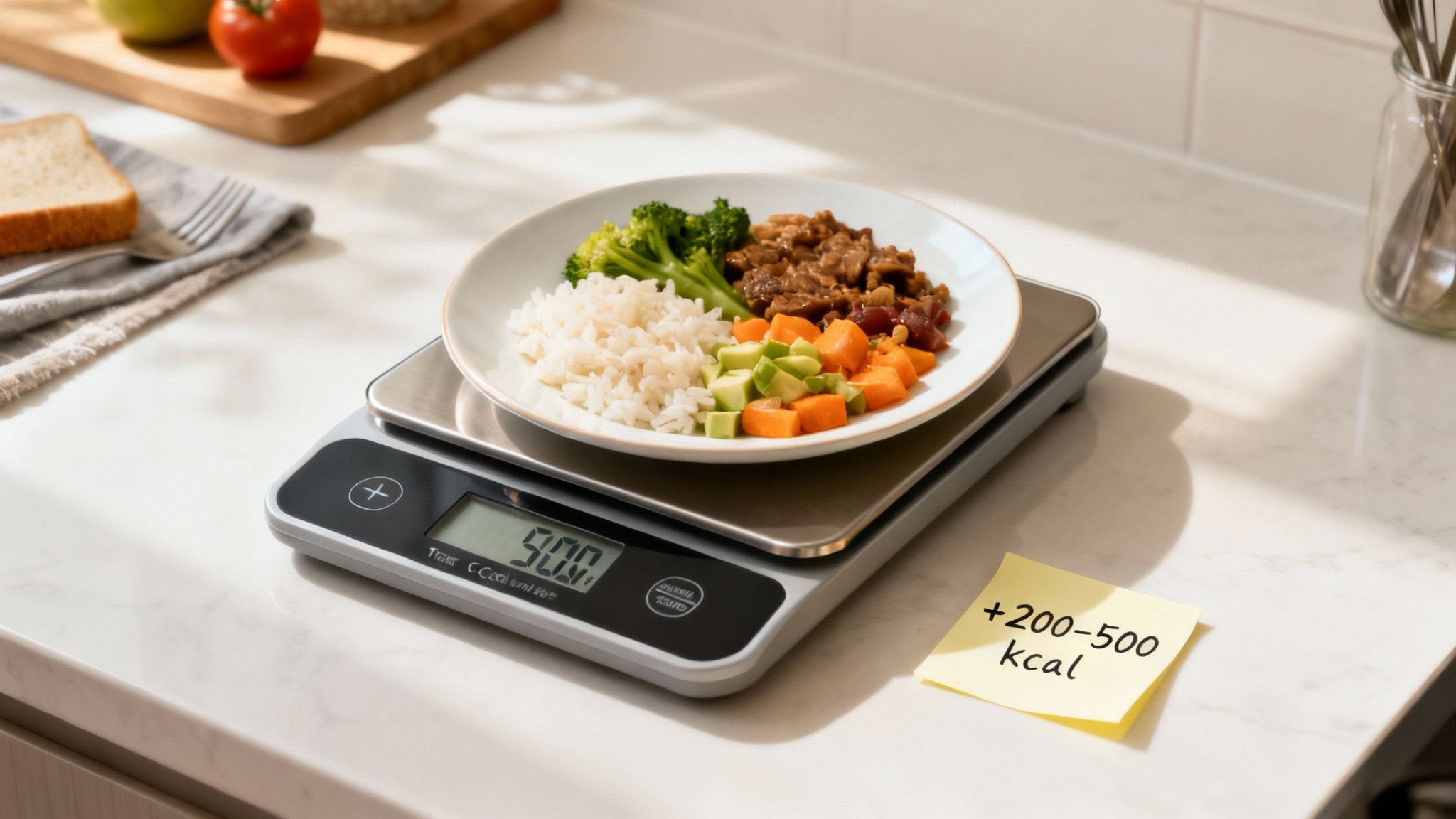
Great, you now know your total calorie requirement—the exact amount of energy your body needs to maintain its weight. This number is your personal starting point. Now it’s about adjusting it intelligently to suit your goals. Think of it like navigation: You know your current location, and now you set your desired destination.
Most people who calculate their calorie needs with a kcal needs calculator want to lose weight. The key lies in what is known as a calorie deficit. This simply means consciously consuming slightly less energy than your body uses. This forces it to draw the missing energy from its own stores—namely, body fat.
The smart calorie deficit: How to lose weight properly
A typical mistake many people make is being far too aggressive. Anyone who drastically cuts their calorie intake risks not only unpleasant cravings but also slowing down their metabolism. Your body then switches to energy-saving mode, which sabotages long-term success.
A moderate deficit is much smarter and more sustainable.
- The rule of thumb: A daily deficit of 300 to 500 kcal below your maintenance requirement is ideal for healthy weight loss.
- In practice: If your total calorie expenditure is 2,400 kcal, aim for a daily intake of 1,900 to 2,100 kcal for sustainable weight loss.
With this method, you may not lose weight overnight, but you will lose it steadily and in a healthy way that your body can easily handle. Patience is your best friend here. Would you like to give your body additional support so it can target fat reserves even more efficiently? Then take a look at our guide with valuable tips on how to stimulate fat burning.
The slight calorie surplus for building muscle
If, on the other hand, you want to build muscle, the situation is reversed. Your body needs additional energy—building blocks, in other words—to create new muscle mass. For this, you need a slight calorie surplus.
Caution: A surplus that is too large will not lead to more muscle, but will go straight to your hips as fat. Strategy is everything here. The aim is to give your body the signal to build muscle without overwhelming it with excess energy.
A small, controlled surplus ensures that the energy is used primarily for building muscle rather than for developing new pockets of fat.
- The rule of thumb: A daily surplus of 200 to 300 kcal above your maintenance needs is a great guideline.
- In practice: With a total daily energy expenditure of 2,400 kcal, your target would therefore be an intake of 2,600 to 2,700 kcal per day.
This strategic adjustment is crucial. Being mindful of your energy balance is the key to achieving your physical goals in a healthy and sustainable way.
What to do when online calculators are not enough?
An online calculator is a fantastic tool for getting started, without a doubt. It gives you an initial point of reference and helps you get a feel for the numbers. But at some point, even the best calorie needs calculator reaches its natural limits, because it cannot look inside your body.
What if you are actually doing everything right? You stick to your calculated calorie deficit, exercise—and yet the number on the scale simply does not change. This is exactly where the world of generalized formulas ends. A calculator treats two people with identical ages, weights, and activity levels exactly the same, even though their internal processes may work in completely different ways. It knows neither your individual metabolic rate nor your hormonal status.
Why formulas do not always know the whole truth
Your metabolism is not a clockwork mechanism that always runs at the same pace. Many factors can massively influence your actual energy expenditure—things a calculator can never capture. These include stress, the quality of your sleep, your genetic predisposition, and even undetected nutrient deficiencies.
Especially when conventional methods fail to deliver the hoped-for results, people often begin searching for alternatives. Unfortunately, this search sometimes leads to questionable shortcuts and ends with bizarre diets on the internet that promise more than they can deliver. Instead of relying on short-term trends, it makes much more sense to look deeper and get to the root causes.
When your progress stalls, it’s rarely because you’re “weak.” Usually, it’s a sign that your body is trying to tell you something—and that standard formulas simply don’t understand its language.
The step toward true personalization
This is exactly where deeper analyses come in, beyond the point where general calculators stop. Instead of continuing to guess, you can finally measure. A professional laboratory analysis provides precise data about the processes actually taking place in your body. It looks beyond the bare numbers and gives you insights that no calculator in the world can provide.
- Individual metabolic rate: How efficiently does your body really burn energy at rest?
- Hormonal balance: Are your hormones balanced, or might they be blocking fat loss?
- Nutrient supply: Are you lacking important vitamins or minerals that are essential for a properly functioning metabolism?
This information is the key to finally breaking through plateaus and truly understanding what your body needs. A detailed metabolic analysis from mybody® provides you with exactly these personalized insights. It helps you adjust your diet based not on estimates, but on real, scientifically sound data about your body. This creates the foundation for sustainable results based on facts, not mere assumptions.
Frequently asked questions about calorie needs
When you start thinking about your calorie needs, the first questions and uncertainties quickly arise. That’s completely normal, because putting theory into practice is often trickier than expected. We’ve collected the most common questions we encounter in everyday life to give you more confidence on your journey.
Do I have to eat exactly the same number of calories every day?
Many people put themselves under a lot of pressure at first to hit their calculated calorie target exactly. But honestly, that’s neither necessary nor really feasible in everyday life. The weekly average is far more important than daily perfection. Your body doesn’t keep an exact 24-hour account. If you’re 200 kcal over your target one day and 200 kcal under the next, it balances out over the course of the week. So focus on a consistent trend rather than daily perfectionism.
Do my needs change over time?
A very important question that is often overlooked. And the answer is a clear yes! Your calorie needs are not set in stone. When you successfully lose weight, your basal metabolic rate also decreases—your body simply has less mass to support. This is a completely natural process and is exactly why many people eventually reach a plateau and stop losing weight. To prevent this, you should recalculate your needs regularly, for example every few months using a calorie needs calculator. This allows you to adjust your calorie intake to your progress and stay on track.
Your body adapts to new circumstances. By regularly reviewing your calculations, you can ensure that your strategy continues to match your current body weight and goals.
How accurate are the calorie figures on packaging?
Calorie information on food products is a useful guide, but it is not an exact science. By law, deviations of up to 20 % allowed. This means that a product labeled as containing 200 kcal could actually contain anywhere between 160 and 240 kcal. So use nutrition labels as a rough guideline, but don't stress if you count one calorie more or less from time to time. It's more about developing a feel for the energy density of foods.
Should I eat back the calories I burn through exercise?
That depends entirely on your goal:
- Goal: Weight loss: In this case, it is usually wiser not to eat the calories burned through exercise in addition to your regular intake. They increase your calorie deficit and thus accelerate your progress.
- Goal: Muscle building: If you want to build muscle, you're likely already in a slight calorie surplus anyway. In that case, it may make sense to consume some of the calories you burned again to support recovery and provide your body with enough building blocks.
As you can see, the calculation itself is only the beginning. You achieve true precision and a deep understanding of your unique body when you go beyond the formulas. If you're ready to stop guessing and optimize your nutrition based on real data, the analyses by mybody® are the next logical step. Discover the possibilities of a personalized metabolic analysis at https://mybody-x.com.



Share now:
Hara Hachi Bu: What the 80-percent rule proves and what it does not
Avoid the yo-yo effect and maintain your weight permanently