
Losing belly fat: Why your metabolism is the key
Getting rid of belly fat is about far more than a purely cosmetic change—it is a crucial step toward your long-term health. The key is not fighting the visible fat under your skin, but reducing the dangerous visceral fat surrounding your organs. To achieve truly lasting results, you need an approach that goes beyond simply counting calories and takes your individual metabolism into account. Only when you know which foods your body processes well and which it does not can you lose belly fat in a targeted and lasting way.
Why belly fat is more than a cosmetic issue
When you think of belly fat, you probably immediately think of the “pinchable” kind—the fat pad you can feel directly under your skin. But the real reason why the topic of “losing belly fat” is so important for your health lies much deeper inside your body. Essentially, we are talking about two completely different types of adipose tissue.
Then there is subcutaneous fat. It sits directly under your skin and functions as an energy store and thermal insulator. Of course, in large amounts it can also become a burden, but by comparison it is relatively harmless.
Much more problematic is visceral fat. You store this fat not under your skin, but deep in your abdominal cavity, where it wraps around your internal organs like a mantle—around your liver, intestines, and pancreas. You can neither see nor touch it, but its presence is anything but passive.
The silent troublemaker in your body
Visceral fat is highly metabolically active. You can almost think of it as an organ of its own that continuously releases hormones and pro-inflammatory messengers. These substances enter your bloodstream directly and can throw off the delicate balance of your entire body.
The consequences of this ongoing internal stress are far-reaching and should definitely be taken seriously:
- Insulin resistance: Visceral fat impairs your cells’ ability to respond to the hormone insulin. As a result, your pancreas has to work harder and harder to regulate blood sugar—paving the way for type 2 diabetes.
- Cardiovascular diseases: The inflammatory substances released can damage your blood vessels and raise your blood pressure. This significantly increases the risk of heart attacks and strokes.
- Fatty liver: Excess visceral fat is directly linked to fat accumulation in the liver, which can severely impair its function over time.
It is a misconception that only people who are severely overweight are affected by visceral fat. Slim people can also unknowingly accumulate too much of it—a condition often referred to as “TOFI” (Thin Outside, Fat Inside).
This invisible fat is therefore not a local problem, but a burden on your entire system. In Germany, being overweight, and especially the accumulation of belly fat, has become a major health problem. The total societal costs arising from obesity and its related conditions amount to around 63 billion euros per year. This enormous figure makes clear how important prevention is. You can find more information about these statistics at marcusknispel.com.
That is precisely why it is so important to take a holistic view of the issue of “losing belly fat.” It is not about fitting into a particular clothing size, but about protecting your health from the inside out. The very first and most important step on this journey is to understand how your own body works—and especially your metabolism.
Understanding the Key Role of Your Metabolism

You surely know the situation: Some people can eat whatever they want without gaining even a gram. For you, on the other hand, even merely looking at a piece of cake seems to go straight to your hips. What feels like a great injustice is actually a simple biological fact: Every metabolism is unique.
Your metabolism is essentially your body's engine. It converts everything you eat and drink into vital energy. Without it, there would be no heartbeat, breathing, movement—nothing.
However, this engine runs at a different speed for each of us. Factors such as genetics, age, sex, and your lifestyle determine how efficiently your body burns calories or stores them as reserves—preferably as stubborn belly fat.
Why Your Body Is Not Standardized
Imagine filling a state-of-the-art diesel engine with the wrong gasoline. It will sputter, run roughly, and eventually stop working altogether. Your body and the food you give it work in much the same way.
Generic diet rules ignore this fundamental individuality. They act as though every body functions according to the same laws. But what is considered “healthy” and boosts the metabolism for one person can have exactly the opposite effect on another, sending their blood sugar levels on a roller coaster and promoting fat storage.
And this is precisely the sticking point when you want to specifically lose belly fat: It is not about simply eating less, but about eating the right foods—namely, exactly the foods your body can process optimally.
The key lies in personalization
Trying to reduce belly fat without knowing your individual metabolism is like taking a journey without a map. You try different paths and wander around, but never truly reach your destination because you simply cannot see the crucial turnoffs. A metabolism analysis provides exactly this personal map.
An analysis shows you in black and white which macronutrients—carbohydrates, fats, and proteins—your body converts into energy particularly well and which it tends to store as fat.
With this knowledge, you stop working against your body and start supporting it purposefully. You finally give it exactly the “fuel” that keeps its engine running at full power. A metabolism analysis from mybody-x.com helps you identify precisely that fuel.
- Are you a carbohydrate type? Then your body may love complex carbohydrates from whole-grain products or legumes and burn them highly efficiently.
- Or more of a protein-and-fat type? Then your metabolism performs at its best when it gets high-quality proteins and healthy fats as its primary energy source.
This knowledge is the foundation for sustainably reducing visceral belly fat. When your body processes food efficiently, your blood sugar levels remain stable. This not only prevents nasty cravings, but also ensures that your body does not constantly have to release insulin, the fat-storage hormone.
Your path to an efficient metabolism
Optimizing your metabolism is the most direct way to get rid of stubborn belly fat. You put an end to frustrating guesswork and replace it with a science-based strategy tailored to your unique body.
The benefits are clear:
- No constant hunger: You eat meals that truly satisfy and nourish you.
- More energy in everyday life: An efficient metabolism provides you with consistent energy instead of sending you into an afternoon slump.
- Long-term success: Instead of short-term diet results, you achieve lasting change because you act in harmony with your biology.
It is a fundamental change in perspective: away from prohibitions and deprivation and toward a deep understanding of your body's needs. If you would like to learn more about how you can naturally support your metabolism, you will find more valuable tips in our article on how to naturally boost your metabolism.
Your personal nutrition strategy for reducing belly fat
If you want to specifically lose belly fat, the biggest mistake you can make is following a generic “one-size-fits-all” diet. A successful strategy does not start with prohibitions, but with knowing what your body really needs to burn fat efficiently instead of storing it. A metabolic analysis provides exactly this knowledge: it shows you which foods your body processes well and which are more likely to promote the storage of belly fat.
Instead of blindly counting calories, you give your body exactly the nutrients it can process optimally. This stabilizes your blood sugar levels, prevents cravings, and finally switches your body into fat-burning mode.
The cornerstones of your diet
Don't worry, personalized nutrition isn't a complicated set of rules. Essentially, it is based on four simple yet extremely effective cornerstones that should be part of every meal you eat.
-
High-quality proteins: They are the building blocks of your muscles and provide a strong, long-lasting feeling of fullness. More muscle mass also means a higher basal metabolic rate, so you burn more calories even at rest. Choose sources such as lean meat, fish, eggs, Greek yogurt, or plant-based alternatives like lentils and chickpeas.
-
Complex carbohydrates: Forget being afraid of carbohydrates! Your body needs them as a source of energy. The key is choosing the right kind. Long-chain carbohydrates from whole-grain products, oats, quinoa, or sweet potatoes are digested slowly. This keeps your blood sugar stable and provides you with energy for hours.
-
Healthy fats: Fats are essential for life, especially for hormone production and the absorption of fat-soluble vitamins. Unsaturated fatty acids from avocados, nuts, seeds, and high-quality oils such as olive or flaxseed oil have anti-inflammatory effects and support your metabolism.
-
Fiber: These indigestible plant fibers from vegetables, fruit, and legumes are essentially a superfood for your beneficial gut bacteria and help you stay full for longer. A healthy gut is a key player in a well-functioning metabolism.
This image also clearly shows how simple lifestyle adjustments—such as getting enough sleep and managing stress smartly—can lower your cortisol levels and directly support the fight against belly fat.
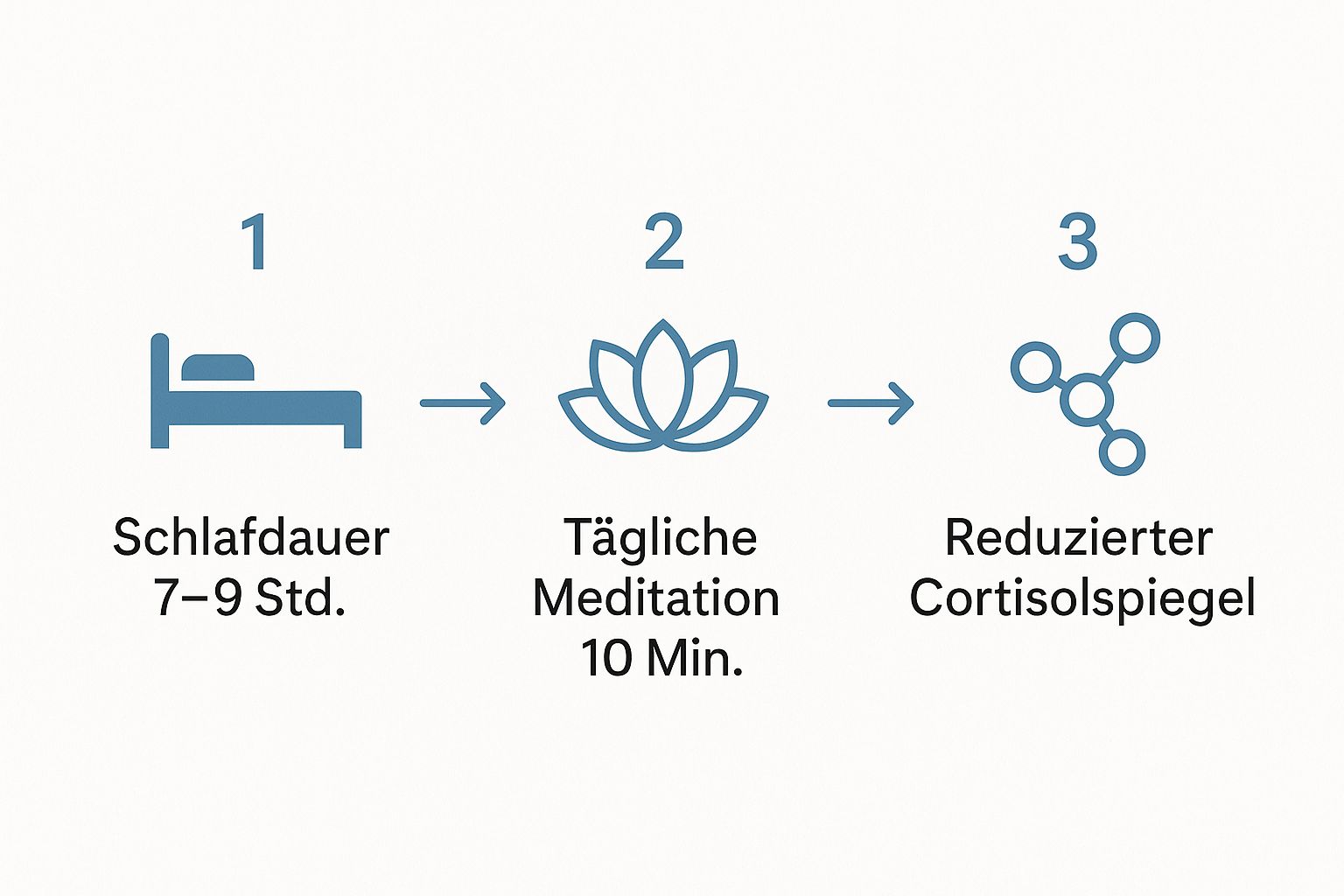
It quickly becomes clear that reducing belly fat goes far beyond nutrition alone. It is a smart interplay of several lifestyle factors.
From knowledge to action in everyday life
The theory sounds good, but how do you put it into practice? It is easier than you think. The first step is to see processed foods and sugar for what they are: the biggest enemies of your goal. They drive up your blood sugar, trigger a strong insulin release, and thus directly promote fat storage around the belly.
The key is not deprivation, but making smart swaps. Instead of white bread for breakfast, choose an omelet with vegetables and a slice of whole-grain bread. Instead of reaching for a chocolate bar in the afternoon, have a handful of nuts and an apple.
These small changes add up and have a huge effect. You will quickly notice how much longer you stay full and how your energy remains consistently high throughout the day. To make getting started even easier, we have compiled detailed tips on how to lose weight through nutrition without giving up the foods you love.
Here is a simple overview to help you make the right choices in everyday life.
Food swaps for less belly fat
This table shows simple and effective alternatives to foods that often contribute to belly fat storage.
| Instead (Promotes belly fat) | Better (Supports fat breakdown) |
|---|---|
| White bread, toast, sugary cereals | Whole-grain bread, oatmeal, vegetable omelet |
| Fruit yogurt, pudding | Plain Greek yogurt with fresh berries |
| Sugary drinks (soft drinks, juices) | Water, unsweetened tea, infused water |
| Chocolate bars, cookies, chips | A handful of nuts, an apple, vegetable sticks with hummus |
| Ready-made meals, fast food | Home-cooked meals with fresh ingredients |
| Margarine, sunflower oil | Olive oil, flaxseed oil, avocado |
With such small but deliberate swaps, you take control and actively counteract fat storage.
A personalized diet based on a metabolic analysis from mybody-x.com gives you the confidence to choose exactly the foods that are optimal for you. You'll find out whether your body prefers carbohydrates or fats as its primary energy source. With this knowledge, planning your meals becomes easy and success finally becomes predictable.
Unfortunately, belly fat in Germany is not merely a cosmetic problem. According to the German Diabetes Center, at least 9.1 million people in Germany have type 2 diabetes, a disease closely linked to overweight and visceral fat.
By adapting your diet to your metabolism, you're not only fighting visible fat. You're actively investing in your long-term health and reducing your risk of such lifestyle-related diseases. It's the smartest and most sustainable way to truly lose your belly fat.
Which Training Really Works Against Belly Fat

When it comes to specifically losing belly fat, one myth is particularly persistent: that hundreds of sit-ups and crunches are the key to a six-pack. But the truth is that you can't train fat away from a specific area. Your body decides for itself where to draw on its reserves—and unfortunately, this cannot be controlled through isolated abdominal exercises.
The truly effective approach is much smarter and more holistic. It is based on an intelligent combination of training methods that rev up your entire metabolism. This turns your body into a true fat-burning machine. The two key pillars are full-body strength training and high-intensity interval training (HIIT).
Strength Training as a Metabolism Booster
Strength training is your most important ally in the fight against visceral fat. Why? Because muscle is your most metabolically active tissue. The more muscle mass you have, the higher your basal metabolic rate—that is, the amount of energy your body burns when you're doing absolutely nothing.
Think of your muscles as small power plants that consume energy around the clock, even when you're sitting on the couch. By building muscle through regular strength training, you increase the number of these power plants. In the long term, this makes your body much more efficient at burning calories, which really helps tackle stubborn belly fat.
It's not about looking like a bodybuilder. Just two to three strength-training sessions per week targeting large muscle groups can significantly increase your basal metabolic rate. At the same time, your cells' insulin sensitivity improves—a crucial factor in stopping fat accumulation around the abdomen.
It is best to focus on compound exercises that challenge multiple joints and muscle groups at the same time. These include, above all:
- Squats: Train the legs, glutes, and your entire torso.
- Deadlifts: Activate the entire back, legs, and core.
- Bench press: Strengthens the chest, shoulders, and triceps.
- Pull-ups or rows: Engage the entire upper back and biceps.
These exercises not only burn a lot of calories during the workout, but also trigger the desired afterburn effect through muscle growth.
HIIT for maximum fat burning
While strength training lays the foundation for a higher basal metabolic rate, HIIT is the turbo boost for fat burning. With this method, you alternate between very short, extremely intense periods of exertion and brief recovery breaks. A typical HIIT workout often lasts only 15 to 20 minutes, but is incredibly effective.
The major advantage of HIIT lies in the so-called EPOC effect (Excess Post-exercise Oxygen Consumption). Even hours after training, your body continues to consume significantly more oxygen—and therefore energy—to recover. So you burn calories long after you have taken off your athletic shoes.
New findings impressively confirm this effectiveness. A study on the reduction of visceral fat in Germany showed that combining HIIT with an adapted diet works particularly well. The study found that just three 20-minute HIIT sessions per week reduced belly fat by an average of 17 percent over a period of twelve weeks.
Your personal training plan
The most effective strategy is to combine strength training and HIIT intelligently. For example, you could do a full-body strength workout two days a week and a short HIIT session on two additional days. It is especially important to give your body enough time to recover, because muscles only grow during breaks.
But the same applies here: individuality is key. Not every training stimulus affects every person in the same way. Your genetics play a decisive role in whether you respond better to strength, endurance, or interval training. A DNA analysis can provide valuable insights into which type of exercise is most effective for you to achieve your goals. Find out how to create your personal DNA training plan.
So forget the endless crunches. Instead, focus on a smart combination that challenges your entire body, boosts your metabolism, and makes belly fat melt away sustainably.
How Stress and Sleep Affect Your Success
You give it your all in the kitchen and stick to your training consistently, but that stubborn belly fat simply refuses to budge? That is not only frustrating but also an extremely common problem. The reason often has nothing to do with your diet or exercise routine. In most cases, the culprits are two overlooked but extremely powerful adversaries: stress and sleep deprivation.
These two factors often work behind the scenes, but they can completely sabotage your progress. They throw your hormones out of balance, affect your appetite, and cripple your ability to burn fat—in ways that you can hardly compensate for with even the greatest discipline. So if you want to lose belly fat sustainably, you cannot avoid looking at your lifestyle as a whole.
The Hidden Contributor to Weight Gain: Cortisol
When you are constantly under pressure—whether due to deadlines at work, personal worries, or being permanently reachable—your body releases huge amounts of the stress hormone Cortisol. Originally, this was a clever survival mechanism that quickly provided energy in dangerous situations. The problem is that in our modern world, stress is often chronic, leading to persistently elevated cortisol levels.
And this exact state has serious consequences for your midsection. A high cortisol level is a clear signal to your body to conserve energy and build up reserves—preferably in the form of visceral fat, right in the abdominal area.
Chronic stress puts your body into a permanent state of alarm. It fuels cravings for sugar and fat while simultaneously slowing down your metabolism—a toxic combination for anyone who wants to get rid of belly fat.
Additionally, cortisol blocks muscle growth and can even cause existing muscle to break down. This lowers your basal metabolic rate even further and makes it almost impossible to achieve a calorie deficit. If you want to explore the topic in more depth, our article explains the symptoms of high cortisol levels in women in detail and what you can do about them.
Why sleep deprivation puts a stop to fat burning
Sleep is not a luxury. It is by far the most important recovery phase for your body. While you sleep, your hormone balance is regulated, cells repair themselves, and your metabolism recharges for the next day. Just one night of too little sleep can throw this sensitive system completely out of balance.
Sleep deprivation directly affects the hormones that control your appetite:
- Ghrelin levels rise: This hormone cries “Hunger!” to your brain. More of it is produced when you are sleep-deprived, which is why you often feel insatiable the next day.
- Leptin levels drop: Leptin is the satiety hormone. Less of it means you have to eat much more to finally feel full.
This hormonal shift does more than just make you eat more. Your body also specifically craves quickly available energy—that is, carbohydrates and sugar. At the same time, your insulin sensitivity decreases, further fueling fat storage around the abdomen.
Practical strategies for better sleep and less stress
The good news is: You are not helplessly at its mercy. With a few targeted adjustments to your daily routine, you can reduce stress and dramatically improve your sleep quality.
Your checklist for effective stress management:
- Mindful breathing breaks: Take just three minutes several times a day to breathe deeply in and out into your abdomen. This immediately calms your nervous system.
- Short meditations: Use apps like Calm or Headspace for a guided 5-minute meditation during your lunch break. A little reset for your mind.
- Exercise in nature: Even a 20-minute walk in nature has been shown to lower cortisol levels.
- Digital downtime: Consciously put your smartphone away for an hour in the evening. Read a book instead.
Your checklist for better sleep hygiene:
- Consistent sleep schedule: Go to bed at the same time every day and get up at the same time. Yes, even on weekends. Your body loves routine.
- Dark & cool bedroom: Create an optimal sleep environment. The ideal temperature is around 18°C.
- No blue light before bed: Avoid screens (smartphone, TV, laptop) for at least one hour before going to bed.
- No heavy meals in the evening: Eat your last large meal two to three hours before going to bed.
By giving stress and sleep the same priority as your diet and exercise, you create the hormonal foundation for successful fat loss. This allows you to finally work with your body instead of against it and paves the way for visible, sustainable results.
Frequently asked questions about losing belly fat
The path to a flatter stomach often raises many questions. If you sometimes feel unsure, you are definitely not alone. We have collected the most frequently asked questions here to clear up any remaining uncertainties and give you even more confidence.
Here you will find clear, directly applicable answers to help you stay motivated and achieve your goals.
Can I lose weight specifically just around my stomach?
This is probably the most persistent myth of all. Unfortunately, the short answer is no. We cannot simply tell our bodies to burn fat in one specific area. Exercises such as crunches or sit-ups are great for strengthening your abdominal muscles, but they do not melt the fat covering them.
To effectively lose belly fat, you need a holistic plan. That means achieving a moderate calorie deficit through a smart diet combined with training that challenges your entire body. Your body then decides for itself where to tap into its fat reserves first.
This is where a metabolic analysis comes into play. It gives you a crucial advantage because you can adjust your diet so that your body burns fat more efficiently overall. This global fat loss will sooner or later also become visible around your stomach.
How quickly can I expect to see results?
Patience and consistency are your most important allies here. Radical crash diets almost always lead to the dreaded yo-yo effect and are anything but sustainable. A healthy and realistic rate of weight loss is around 0.5 to 1 kilogram per week.
When you see changes around your stomach depends on your starting point, your genetics, and your consistency. This may happen after a few weeks, but it may also take a few months.
Other signs of your success are often much more important than the number on the scale:
- Your waist circumference: Measure it regularly with a tape measure. You often lose centimeters here even when your weight temporarily stalls, because you are building muscle at the same time.
- Your clothes: Does your waistband suddenly feel looser?
- Your energy level: Do you feel fitter and more alert in everyday life?
These measurements are often much more informative and motivating than body weight alone.
What role do hormones play in belly fat?
Hormones are the invisible directors in your body and have a tremendous influence on where you store fat—especially around your abdomen.
- Cortisol: As we have already discussed, this stress hormone promotes the accumulation of visceral fat—the dangerous fat directly inside the abdominal cavity.
- Insulin: A constantly elevated insulin level, often caused by too much sugar and simple carbohydrates, blocks fat burning. It essentially signals to the body: “Store fat, don’t burn it!”
- Sex hormones: An imbalance of estrogen and testosterone can also play a role. Especially in women during menopause, declining estrogen levels often cause body fat to shift from the hips to the abdominal area.
A personalized diet tailored to your metabolism is the key to bringing these hormones back into balance. By keeping your blood sugar stable and giving your body the right nutrients, you create the ideal hormonal environment to finally get rid of belly fat.
Are special “fat burner” foods really effective?
The idea is tempting, but there are no magic foods that specifically melt away belly fat. The term “fat burner” is often more marketing hype than science.
However, some foods can genuinely give your metabolism a slight boost or improve feelings of fullness, indirectly supporting fat loss.
These include, for example:
- Green tea: The catechins it contains may slightly stimulate the metabolism.
- Chili: The capsaicin it contains can temporarily increase the body's heat production (thermogenesis).
- Protein-rich foods: Your body uses more energy to digest protein than it does to digest fats or carbohydrates.
See these foods as a useful supplement, but do not rely on them alone. They only work in combination with a solid foundation of personalized nutrition, exercise, good sleep, and stress management—no more and no less.
Stop guessing and start truly understanding your body. A metabolic analysis from mybody-x.com provides the scientific foundation for your success. Find out which foods your body processes optimally and create a nutrition strategy that really works.
Discover your personal metabolic analysis now at https://mybody-x.com


Share now:
Coffee or Tea: Which Is Better for Your Metabolism?
DNA analysis for weight loss: Finally find your personal path to your ideal weight