

Metaphorical language in the microbiome: Meaning and applications
The microbiome is one of the most fascinating and, at the same time, most misunderstood topics in modern health research. Trillions of microorganisms live in our gut, influencing our digestion, immune system, and even our mood. But how can something so complex be explained clearly? This is precisely where metaphorical language comes in. Figurative comparisons help us make abstract biological systems tangible. They shape not only our understanding but also the dietary decisions we make and how we manage our health.
Table of contents
- What does metaphorical language mean in the context of the microbiome?
- The most common microbiome metaphors and their impact
- Metaphors, Misunderstandings, and Limitations in Microbiome Communication
- Metaphors in practice: How do they influence diet and health?
- Next steps: How to understand your microbiome even better
- Frequently Asked Questions
Key findings
| Point | Details |
|---|---|
| Metaphorical language simplifies complexity | Figurative comparisons help us better understand and apply knowledge about the microbiome. |
| Metaphors influence health | The images we choose shape our eating habits and understanding of health. |
| Critical reflection is necessary | Not every metaphor is appropriate — questioning them leads to individualized, evidence-based health. |
| Practical tips can be derived | Metaphorical language makes everyday recommendations more tangible and promotes mindful eating. |
What does metaphorical language mean in the context of the microbiome?
Metaphorical language refers to the deliberate use of metaphors, or figurative comparisons, to make complex subjects understandable. In science communication, it is an indispensable tool. Anyone learning about the microbiome for the first time faces an almost overwhelming number of technical terms and connections. A well-chosen metaphor can make this introduction considerably easier.
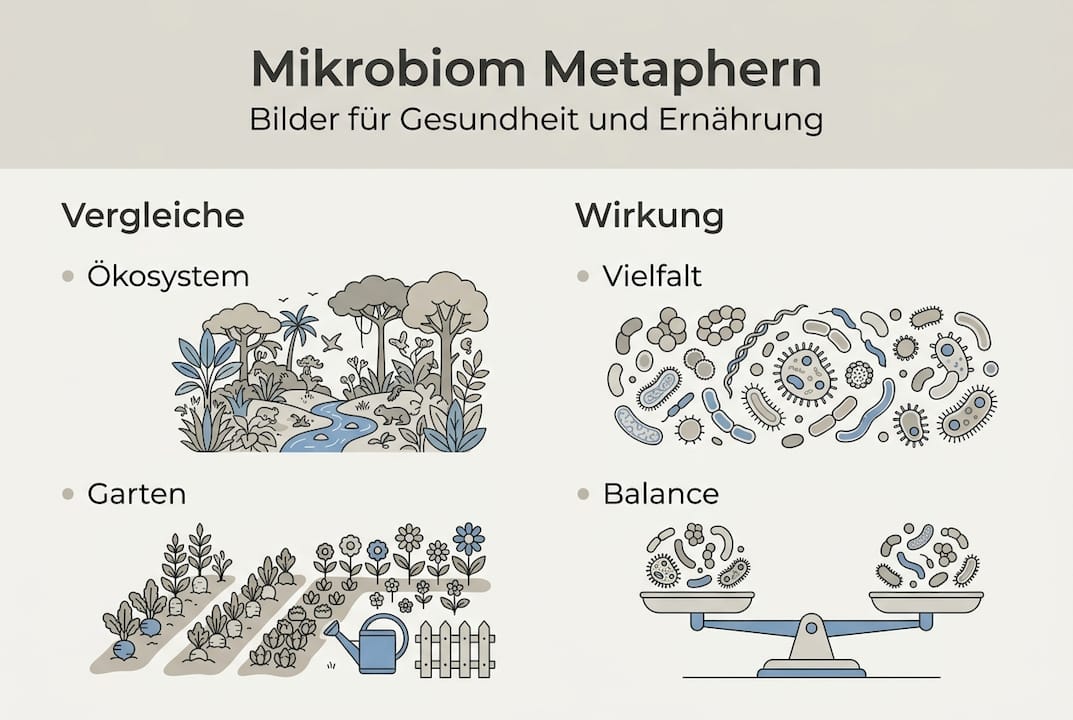
Especially in microbiome research, metaphors have become established as a bridge between science and everyday life. Metaphors such as “the microbiome as an ecosystem” aid understanding because they draw on familiar concepts. Everyone knows an ecosystem from nature: there are producers, consumers, and a delicate balance. This image can be directly applied to the gut.
The most important functions of metaphors in microbiome communication:
- They make invisible processes visible
- They connect new knowledge with existing understanding
- They motivate concrete action
- They simplify medical recommendations for everyday life
- They create an emotional connection to an abstract topic
“Language shapes thought. Someone who understands the microbiome as a living garden tends it differently from someone who sees it as merely an accumulation of bacteria.”
The importance of the microbiome for our health only becomes truly tangible through images like these. Metaphor is therefore not a luxury but a necessary communication tool.
The most common microbiome metaphors and their impact
There are several metaphors that have become particularly established in microbiome communication. Each emphasizes different aspects and leads to different conclusions for health. Comparing the microbiome with familiar systems makes its importance for health visible.
| Metaphor | Key message | Practical consequence |
|---|---|---|
| Ecosystem | Diversity and balance are crucial | Promote a varied diet |
| Orchestra | All microbes play together | Do not overemphasize any single bacterial species |
| Garden | Care and nutrients are necessary | Consume prebiotics and fiber |
| Factory | Production of substances such as vitamins | Pay attention to nutrient supply |
The ecosystem metaphor emphasizes diversity. Anyone who views the gut as an ecosystem intuitively understands that monocultures are harmful. This directly leads to a more varied diet. The orchestra metaphor, on the other hand, makes it clear that no single instrument—that is, no individual bacterial species—creates harmony on its own. Probiotic supplements containing only one bacterial culture seem unconvincing in this context.

The garden metaphor is particularly popular because it conveys a sense of agency. Anyone who has a garden knows that without regular care, it becomes overgrown. Fiber, fermented foods, and sufficient sleep thus become natural “fertilizers” for the gut. Tips for gut health are especially easy to communicate using this metaphor.
A study on the microbiome shows that the way we talk about the microbiome directly influences the actions people take. Language is therefore not neutral; it guides behavior.
Pro tip: Deliberately choose the metaphor that fits your current health situation. Anyone suffering from dysbiosis (an imbalance in the gut flora) can benefit from the garden metaphor: What does my garden need right now to thrive again?
Metaphors, Misunderstandings, and Limitations in Microbiome Communication
Metaphors help, but they inevitably simplify. And that is precisely where their greatest risk lies. Misinterpretations caused by oversimplifying metaphors are possible when images are taken too literally.
A typical example: Anyone who understands the microbiome as a garden might think that more fertilizer is always better. Applied to health, this means more probiotics, more dietary supplements, and more interventions. But the microbiome does not respond linearly. Too much of a good thing can disrupt the balance just as much as too little.
Common misunderstandings caused by microbiome metaphors:
- “More bacteria are always better”: False. Diversity matters, not quantity.
- “Bad bacteria must be eliminated”: False. Many supposedly harmful microbes perform important functions.
- “The microbiome is static”: False. It changes daily through diet, stress, and sleep.
- “One metaphor explains everything”: False. Every image has blind spots.
“The microbiome is not a garden, an orchestra, or a factory. It is all of these at once, and much more.”
Research into the microbiome’s dark matter shows that we still do not know or understand all the microorganisms in the gut. Metaphors can conceal this lack of knowledge and create a false sense of certainty. Anyone who looks at microbiome tests compared quickly realizes that reality is more complex than any image.
Critical thinking therefore remains indispensable. A good understanding of microbiome analysis helps us use metaphors for what they are: useful starting points, not complete explanations.
Metaphors in practice: How do they influence diet and health?
Metaphors do not stay in the mind; they change behavior. That is their true value. Metaphors sustainably influence dietary recommendations because they create emotional and cognitive anchors.
In nutritional counseling and health coaching, metaphors are used intentionally to inspire change. Those who see the gut as a garden shop differently. Those who understand the microbiome as an orchestra stop idolizing individual superfoods.
| Metaphor | Dietary behavior | Everyday example |
|---|---|---|
| Garden | Diversity and care | 30 different plants per week |
| Orchestra | Balance instead of soloists | Combine fermented foods |
| Factory | Provide raw materials | Ensure a foundation of fiber |
How to use metaphors specifically for your health:
- Choose your guiding metaphor: Garden, orchestra, or factory? Which image motivates you personally the most?
- Derive concrete measures: What does your “garden” need today? Water, fertilizer, or rest?
- Review regularly: Does the metaphor still fit your current situation?
- Combine images: Use different metaphors for different aspects of your health.
- Question simplifications: If a recommendation sounds too simple, ask about the data behind it.
The influence of diet on the microbiome is well documented scientifically. Metaphors help translate these findings into everyday life without losing the scientific core. The function of microbiome analysis goes one step further: It provides individual data that goes beyond any metaphor.
Pro tip: Keep a brief food journal and ask yourself every day: “What have I given my garden today?” This simple question changes your perspective and makes more conscious choices more likely.
Next steps: How to understand your microbiome even better
Metaphors are an excellent starting point, but they do not replace personal data. Anyone who truly wants to understand the state of their own microbiome needs more than an image. mybody® Lab GmbH offers ISO-certified microbiome analyses that create a detailed profile of your gut flora based on a stool sample. The results go far beyond general recommendations and provide personalized dietary and lifestyle tips tailored to your individual composition. More than 11,300 satisfied customers already trust these scientifically validated analyses. Discover more well-founded articles on gut health, nutrition, and the microbiome at mybody-x.com, and take the next step from metaphor to measurable insight.
Frequently Asked Questions
How can metaphors influence my understanding of the microbiome?
Metaphors illustrate the function of the microbiome and make complex relationships tangible. They support targeted health decisions by connecting abstract processes with familiar images.
What are the best-known microbiome metaphors?
The microbiome is most commonly described as an ecosystem, orchestra, garden, or factory. Each of these metaphors emphasizes different aspects and leads to different practical consequences for diet and lifestyle.
Are there risks associated with using metaphors in healthcare?
Yes, oversimplified metaphors can encourage misconceptions, such as the assumption that more probiotics are always better. The limitations of metaphors should always be kept in mind, so critical questioning is advisable.
How can I use metaphors to optimize my diet?
By imagining the microbiome as a garden, you embrace diversity and natural foods for better gut health. Metaphorical approaches improve dietary choices by translating abstract recommendations into concrete actions.



Share now:
Understand gut function and sustainably improve your well-being
Healthy Gut – More Energy Through a Strong Digestive System