
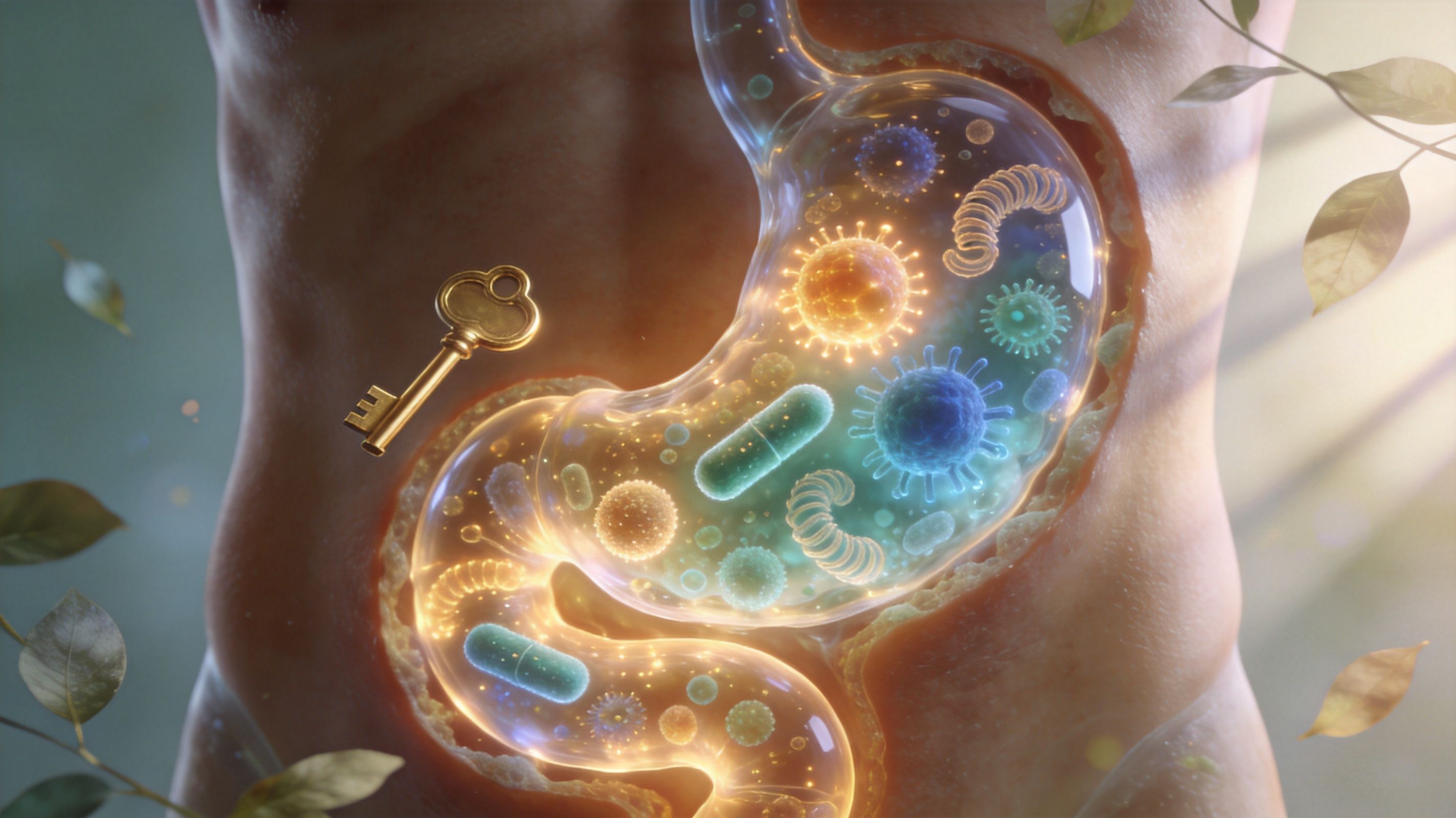
Gut microbiome: Your key to health & well-being
You pay attention to your diet, drink enough, and stay active. And yet your body keeps sending signals that are difficult to interpret. Sometimes it’s bloating after a meal, sometimes that strange afternoon fatigue, sometimes mood swings, skin issues, or the feeling that your stomach is simply never truly calm.
If this sounds familiar, you’re not being oversensitive. Many people sense that something is out of balance but can’t clearly identify where to start. That’s exactly where one term is appearing more and more often: gut microbiome.
This doesn’t simply mean “digestion.” It’s about your gut’s inner ecosystem—the community of microorganisms that helps determine how you process food, how stable your intestinal barrier is, and how your body responds to stress. Other people are already taking a more targeted approach to their gut health. Not because it’s trendy, but because they realize that more precise data often provide more value than the next blanket dietary tip.
Do you often feel unwell for no apparent reason
There are days when everything seems fine first thing in the morning. Then lunch comes, and by early afternoon your stomach suddenly feels tight and bloated. You’re tired even though you’ve slept enough. In the evening, you wonder whether you ate something you couldn’t tolerate. The next day, it’s different again.

Many people then end up in a spiral of speculation. Maybe less gluten. Maybe more fiber. Maybe a probiotic from the pharmacy. Maybe it’s stress. None of these ideas is entirely unreasonable. The problem is that without a clear understanding of the cause, it often remains a guessing game.
When symptoms feel vague
Especially with issues such as bloating, fluctuating digestion, low energy, or irritability, the connection often seems unclear. That can be frustrating. Because diffuse symptoms may look harmless from the outside, but they can be very noticeable in everyday life.
Typical thoughts include:
- “I actually eat quite healthily”, and yet I still don’t feel light.
- “My results have always been unremarkable”, but my stomach continues to cause problems.
- “It’s not severe enough for an emergency”, but it’s not normal enough to ignore either.
- “I finally want to understand what my body is trying to tell me” instead of constantly trying something new.
You are on the right track with questions like these. Your body often sends signals long before symptoms become clear.
Why your gut microbiome may be important in this context
For many people, the gut microbiome is the missing piece of the puzzle. Not because it explains every complaint, but because it plays a role in digestion, nutrient utilization, the gut barrier, metabolism, and even the gut–brain axis.
When this internal ecosystem becomes imbalanced, it can manifest in very different ways. For one person, it may be more noticeable in the abdomen. For another, through energy, weight, or mood. That is why blanket advice is often only of limited help. What you feel is real. And it is worth taking a closer look.
What exactly is your gut microbiome
Your gut microbiome is like a vibrant city inside you. Countless microorganisms work together there. Some help process food, others support the gut’s protective barrier, while still others are closely connected with your immune and nervous systems.

The exciting news is that this system is enormous and highly individual at the same time. Recent meta-analyses have identified between 90,000 and 150,000 different microbial strains within the human gut microbiome. Each person is estimated to have around 150 to 400 resident bacterial species. This is precisely why two people can react very differently to the same diet, as described on the specialist page about the gut–oral microbiome and general health.
Anyone who wants to review the basics in a concise format can find a good introduction in the article What Is the Microbiome.
It is more than just digestion
Many people equate the gut microbiome only with “good digestion.” That falls short. Your internal ecosystem has several tasks at the same time.
| Area | What this can mean in everyday life |
|---|---|
| Digestion | Food is broken down more effectively, and some components can only be processed by microorganisms in the first place |
| Protective barrier | The intestinal lining is supported, and unwanted substances are intended to have a harder time getting through |
| Immune system | The gut and immune defenses are closely interconnected |
| Metabolism and signals | The gut microbiome influences how your body responds to food, stress, and internal signals |
Why so many people are confused
You often hear simple advice such as "Eat more fiber" or "Take a probiotic". This isn't fundamentally wrong, but it overlooks individuality. If your gut microbiome is as unique as a fingerprint, then general advice can never be equally suitable for everyone.
Key point: A healthy gut microbiome isn't a rigid ideal. It's an individual balance.
What your gut microbiome helps with
Four areas in particular often lead to aha moments:
-
How your body utilizes nutrients
Your body can't process everything you eat effectively on its own. Your gut microbiome helps with this. -
Your everyday defenses
A stable gut is important not only for how your abdomen feels, but also for communication with your immune system. -
Your metabolism
If you feel that your body reacts "strangely" to food, it may be related to the interplay within your gut. -
Your mood and resilience
Through the gut-brain axis, the gut and brain communicate with each other. That's why gut-related issues often don't feel purely physical.
Three typical signs of dysbiosis
You wake up tired even though you've had enough sleep. After eating, your abdomen feels tight. In the afternoon, your mood dips or you crave something intensely even though you're really trying. Such combinations often seem random. But they can fit a pattern.
Dysbiosis simply means that your gut microbiome has become unbalanced. The symptoms don't look the same for everyone. It's more like a garden where it isn't simply that "everything is bad", but individual areas have fallen out of balance. Sometimes something grows rampant, sometimes something is missing, and sometimes the whole system becomes sensitive.

The irritated gut
This is the pattern many people think of first. The gut reacts quickly. After normal meals, you feel bloated, your bowel movements vary, or your stomach feels unsettled even though you haven't eaten anything "extreme".
Typical examples include:
- Bloating after ordinary meals
- Irregular bowel movements
- A feeling of pressure or rumbling in the abdomen
- Greater sensitivity to highly processed or very rich foods
Food isn't the only factor here; how your internal ecosystem responds to it also matters. If certain beneficial bacteria are scarce or fermentation processes don't run optimally, even everyday foods can trigger discomfort. This also explains why two people can eat the same meal and only one of them feels afterward that their gut is "out of sync".
The sluggish metabolism
Some people have hardly any noticeable digestive complaints and still do not feel balanced. It is more as if the body is stuck in place. Energy levels fluctuate, appetite is difficult to predict, and weight barely changes despite reasonable habits.
In this context, Akkermansia muciniphila is often studied. Earlier research, already referenced above, describes associations between low levels of this bacterium and unfavorable metabolic patterns such as elevated BMI or insulin resistance. This does not mean that a single bacterium is the cause. However, it shows that fatigue, intense cravings, and stubborn weight are not always simply a matter of discipline or calories.
That is exactly what causes frustration for many people. You are "doing everything right" and still not making progress. In that case, it is worth taking a closer look at the pattern behind the symptoms instead of repeatedly trying generic tips.
The strained gut-brain axis
This profile is particularly confusing because the signals come from two directions. Your gut is sensitive. At the same time, you feel irritable more quickly, less resilient, mentally scattered, or noticeably exhausted.
The connection is well documented. The gut and brain are in constant communication. A review of psychobiotics describes how certain bacterial strains, including Bifidobacterium longum, are associated with mood and stress processing and are being studied as a possible approach to depressive symptoms, as discussed in the review Psychobiotics and the Manipulation of Bacteria-Gut-Brain Signals.
Typical signs of this pattern include:
- Mood swings together with digestive complaints
- Difficulty concentrating or mental restlessness
- Exhaustion despite getting enough sleep
- More symptoms during stressful periods
What matters is that such symptoms can have many possible causes. The gut microbiome is not automatically the explanation for everything. However, it is an area that is often overlooked, even though several complaints can converge here.
Why these patterns often overlap
In practice, hardly anyone fits perfectly into just one category. An irritated gut can occur alongside fatigue. Mood swings can coincide with bloating or intense cravings. That is exactly why gut-related issues can be so difficult to pin down.
Initial self-observation can still be helpful. Ask yourself:
- Which symptom do you notice first in everyday life
- Which symptoms often occur together
- Are there triggers such as stress, certain meals, or irregular daily routines
- Did the pattern develop gradually or change suddenly
This gives you initial insights into your personal profile. It does not replace a reliable answer. But you can better understand why “just eat more fiber” often falls short when a very specific imbalance may be behind your symptoms.
Why guessing and experimenting do not lead to the goal
Many people understandably start with self-experiments. Less sugar. More fermented foods. A different breakfast. A new probiotic. That is only human, because you want to actively do something.
The problem is that with the gut microbiome, trial and error is often costly, slow, and unnecessarily frustrating. You are working with a highly individual system. If you do not know whether you lack diversity, have low levels of certain key bacteria, or are mainly dealing with a stressed gut barrier, you ultimately end up treating assumptions.
Why general tips often fall flat
Two people can both have “stomach problems” and still need completely different things. One may benefit from more prebiotic foods. The other may be temporarily sensitive to them. One may need more calm in everyday life. The other may need a targeted dietary adjustment.
A self-check can give you clues, but not a reliable answer. It is similar to a map: You can roughly guess where you are. But you can only find the best route once you know your actual location.
Practical rule: Self-observation is valuable. Precise decisions only emerge from data about your own gut microbiome.
If you have already been focusing intensively on your diet, you are not too late. Quite the opposite. You have created the foundation. A test simply makes your path more precise and saves you from further guesswork.
A reliable answer only with the gut microbiome test
You may know this situation: Your stomach is not the main problem every day, but something still does not feel quite right. Sometimes you tire quickly, sometimes you feel irritable, and sometimes your weight stubbornly refuses to change despite your efforts. That is exactly when a test can turn a vague feeling into a clearer picture.

A microbiome test does not simply assess whether “everything is okay or not okay.” It examines which microbes are present in your gut and the proportions in which they occur. So you do not get a crystal ball, but you do get considerably more guidance than by simply trying things out.
This is especially helpful because similar symptoms can have very different causes. Fatigue may be related to low microbial diversity. For some people, mood swings may be associated with a strained gut-brain axis. Stagnant weight may be linked to metabolic processes, signs of inflammation, or dietary responses. From the outside, these issues may look similar. But something entirely different may be out of balance within the inner ecosystem.
What such a test actually shows you
A good test works like an inventory of your inner ecosystem. It can provide insights into:
- The diversity of your gut microbes
- Noticeable shifts in important bacterial groups
- Patterns that could be related to digestion, energy, or mood
- Starting points for nutrition and everyday habits that better match your results
That is precisely the difference. You are no longer treating only symptoms; you are working from a tangible starting point.
Who may benefit most
A test can be particularly useful if you have been noticing for some time that your body is sending mixed signals:
| Situation | Why a test can be useful |
|---|---|
| Recurring digestive problems | Because bloating, irregularity, or a feeling of fullness can have many different underlying causes |
| Fatigue, restlessness, or low moods | Because the gut is connected to the nervous system, immune system, and energy metabolism |
| Frustration after trying many diets | Because you can make more targeted decisions instead of repeatedly starting over |
| Stable weight despite considerable effort | Because looking at your microbiome can help you better understand patterns |
A test does not replace medical evaluation in the case of severe or persistent symptoms. However, it can help you ask the right questions and choose your next step more wisely.
A straightforward, practical at-home option
If you are looking for an at-home solution, the mybody x Gesundheit microbiome gut test is one possible option. The article about the at-home gut test and how to interpret the results shows you how such analyses generally work and what you should pay attention to when interpreting them.
Ultimately, what matters is not the name on the packaging. What matters is whether you can really draw conclusions from the result. A good test helps you recognize your pattern instead of continuing to guess between fiber, probiotics, and new routines.
Your roadmap to gut balance after the test
A test is not an endpoint. It is more like your starting map. Once you know which direction makes sense for your gut microbiome, measures become much more tangible. Not perfect, but more targeted.
Diet as a lever
Most changes begin with the food for your microbes. What matters is rarely a single superfood. More important is a pattern that suits your test result.
A common approach is to eat prebiotic foods. A prebiotic-rich diet with 10 to 20 g of inulin per day can increase butyrate production by up to 30 percent within four weeks, as described in the available data. It also mentions that symptoms such as bloating and fatigue may be noticeably reduced as a result.
In practice, this does not mean you have to make radical changes immediately. A controlled approach is often more sensible, for example by adding suitable fiber-rich foods and well-tolerated sources such as chicory, if they are right for you.
Don’t underestimate everyday influences
The gut microbiome responds not only to food and supplements. Your everyday life is also constantly sending signals.
- Sleep affects how steadily your body regulates itself overall.
- Stress can noticeably strain the gut-brain axis.
- Exercise often supports overall balance.
- Regularity helps many people more than extreme short-term programs.
Small, consistent steps are better than frantic changes. Your gut microbiome responds more to patterns than to activism.
How to put results to good use
A simple framework helps many people more than complicated plans:
-
Change only a few variables at a time
Otherwise, in the end you won’t know what really helped. -
Track symptoms
Not just gut feeling, but also energy, sleep, and mood. -
Personalize recommendations
A test result makes standard tips much more precise. -
Plan for patience
Your internal ecosystem is changing, but rarely overnight.
Those who want to explore the topic in greater depth can find a solid foundation for putting it into practice in everyday life in the article on the healthy gut flora.
Frequently asked questions about the gut microbiome and the tests
When should I see a doctor instead?
Sometimes a microbiome test is the wrong first step. If you have severe abdominal pain, notice blood in your stool, experience persistent diarrhea, unintended weight loss, or suddenly develop new, pronounced symptoms, you should have them medically evaluated.
A self-test can help you understand patterns better. If there are warning signs, it does not replace medical diagnosis.
Are probiotics always a good idea
Probiotics are not automatically suitable for every gut. Your gut microbiome functions more like an internal ecosystem than an empty surface onto which you can simply place a few “good” bacteria. What helps one person may instead increase bloating, a feeling of fullness, or irregular stools in another.
That is precisely why the connection to your symptoms is so important. If, for example, you are struggling with fatigue, mood swings, or persistent digestive problems, a different kind of imbalance could be behind these symptoms. In that case, it makes more sense to understand the pattern first rather than trying products at random.
How quickly can the gut microbiome change
Changes are possible, but they rarely become visible immediately. Some people notice within days or a few weeks that their digestion, energy levels, or how their stomach feels have changed. Whether this develops into a lasting improvement usually depends on how well the measures fit your results and your everyday life.
In short: Your gut responds to habits, not isolated actions.
What is the difference compared with an intolerance test
An intolerance test answers a different question. It checks whether certain foods trigger symptoms for you or are less well tolerated.
A microbiome test, on the other hand, looks at the environment in your gut. For example, it examines how balanced your internal ecosystem appears to be and which functional patterns could be linked to your symptoms. An intolerance test can therefore explain why you react to milk or fructose. A microbiome test is more helpful for understanding why your gut has generally become sensitive, sluggish, or unpredictable.
The two can complement each other. They are simply not the same thing.
If you want to understand your body better instead of continuing to guess, mybody x Gesundheit offers at-home self-tests covering gut health, nutrients, intolerances, and hormones. This can be a sensible next step if you want to make your approach more precise in an evidence-based and practical way.



Share now:
Understand digestive problems and relieve them effectively
Your Gut Microbiome Test: What Your Gut Really Needs