
How much zinc per day? Reference values, upper limit, and what a blood test shows
The essentials at a glance
The German Nutrition Society does not give a single number, but a range. Women aged 19 and over need 7 to 10 mg per day, and men 11 to 16 mg, depending on phytate intake (DGE 2019). Phytate is a plant compound found in whole grains, legumes, and nuts that binds zinc. The tolerable upper limit for total intake is 25 mg per day (SCF 2003).
So the question of the right amount is not a question of one value, but of your diet. Those who eat a lot of plant-based foods need more zinc on their plate because less of it reaches the body. Those who eat meat, eggs, and dairy products need less. The number on a package says nothing about this.
The article goes through the range in the table, explains phytate, puts the upper limit of 25 mg into context, shows the connection with copper, and clears up three misconceptions. At the end, it explains what a blood test can and cannot contribute to answering this question.
What to expect in this article
1. The short answer is a range, not a number
2. The DGE reference values at a glance
3. What phytate is and where zinc comes from
4. The upper limit: 25 mg is not a target
5. Why copper is part of the zinc question
6. Three misconceptions about the daily amount
7. Measure instead of guess: which test also measures zinc
8. What you can do now
Frequently asked questions
Sources
How much zinc per day? The short answer is a range
Anyone searching for “how much zinc per day” wants one number. They get six. In 2019, the German Nutrition Society derived its reference values anew. It bases the recommended intake on how much phytate is present in the food.
A reference value is not a minimum amount below which something happens. It is the amount that covers intake requirements for practically all healthy people in a group. Zinc itself is a trace element, meaning a mineral that the body needs only in milligram amounts and cannot produce itself.
For adults aged 19 and over, the range is from 7 mg for women with low phytate intake to 16 mg for men with high phytate intake (DGE 2019). The difference between these two ends is more than double. That is precisely why every blanket answer is misleading.
7-16 mg
Reference value for adults aged 19 and over per day, adjusted according to phytate intake. Derived by the German Nutrition Society in 2019.
25 mg
Tolerable upper intake level per day for adults, derived by the European Commission's Scientific Committee on Food (SCF) in 2003.
6.5 mg
Maximum amount proposed by the German Federal Institute for Risk Assessment in 2021 for adding zinc per recommended daily serving of a food supplement.
Key message
It is not the amount of zinc on the plate alone that matters, but how much of it is absorbed - and that depends on the accompanying diet.
The DGE reference values at a glance
The following table shows the complete tiered scale for adults aged 19 and over, in milligrams per day. The three columns represent low, moderate, and high phytate intake. First find your row, then the column that matches your diet. The next chapter explains which column that is.
| Group | Low phytate intake Phytate: plant compound that binds zinc |
Moderate phytate intake | High phytate intake |
|---|---|---|---|
| Men aged 19 and over | 11 mg | 14 mg | 16 mg |
| Women aged 19 and over | 7 mg | 8 mg | 10 mg |
| Pregnant women, 1st trimester | 7 mg | 9 mg | 11 mg |
| Pregnant women, 2nd and 3rd trimesters | 9 mg | 11 mg | 13 mg |
| Breastfeeding women | 11 mg | 13 mg | 14 mg |
Source: German Nutrition Society, Zinc reference values, basis of derivation as of 2019. Phytate, also known as phytic acid, occurs naturally in whole grains, legumes, and nuts and binds zinc, so less of it is absorbed.
What stands out about the pregnancy row
In the first trimester, the reference value for pregnant women is at the same level as for women aged 19 and over; from the second trimester onward, it increases by 2 to 3 mg respectively (DGE 2019). For breastfeeding women, it is even higher. Anyone who is pregnant or breastfeeding should nevertheless discuss zinc with their healthcare provider rather than follow a row in a table.
What phytate is and where zinc comes from
Phytate, also known as phytic acid, is naturally present in foods according to the BfR (2021) and has a negative effect on the availability of zinc. It binds zinc before the body can absorb it. The DGE describes this process in one sentence.
Documented source
“Phytate binds zinc in the gastrointestinal tract, so it can no longer be absorbed by the body.”
German Nutrition Society
Zinc reference values, 2019
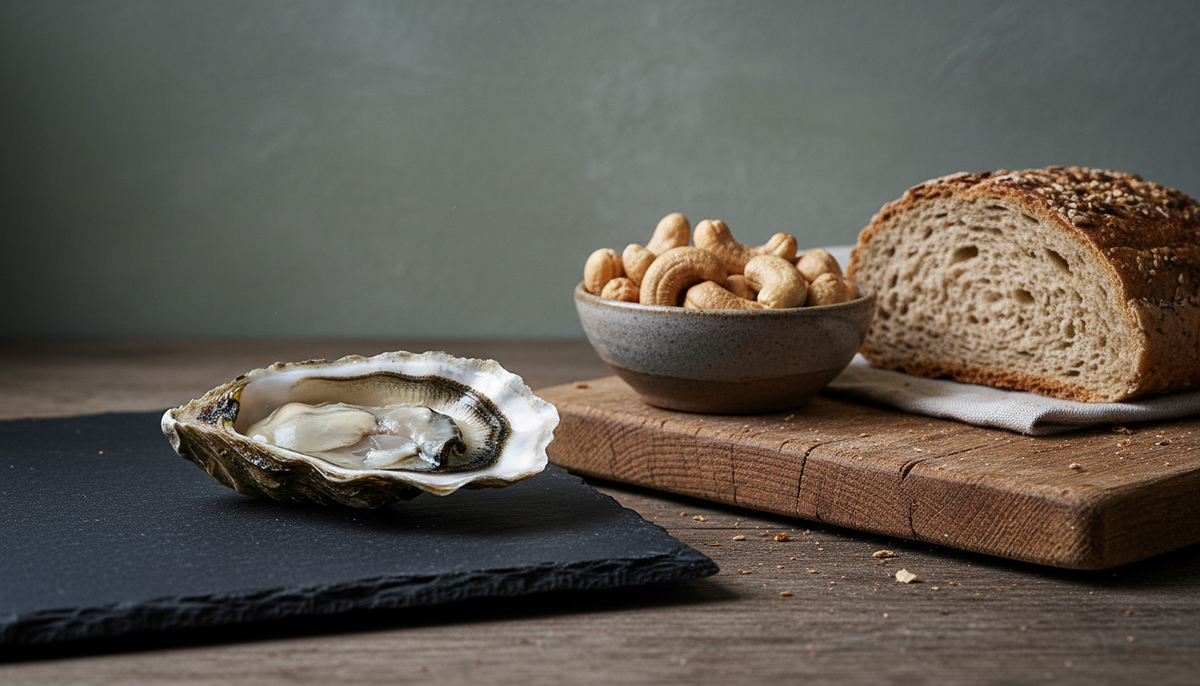
This also explains why the tiers exist. Anyone who gets most of their zinc from whole-grain bread, lentils, and nuts eats it together with the substance that binds it. The amount on the plate is right, but the amount in the body is not. This is what is meant by bioavailability: the proportion of a nutrient that is actually absorbed and made available to the metabolism.
The German Federal Institute for Risk Assessment put it plainly in 2021: “Phytic acid or phytates are naturally present in foods and have a negative effect on the bioavailability of zinc.” Two sources, the same statement, and a practical consequence follows.
Kitchen techniques beat the slide rule
In line with the DGE 2019, soaking, sprouting, and sourdough fermentation break down phytate and thus improve absorption. These are techniques already found in every kitchen. Soak lentils overnight, make bread with sourdough instead of a leavening agent, and let grains sprout. Anyone who does this anyway moves one column to the left in the table without eating a single extra gram of zinc.
Regarding what provides zinc in the first place, the DGE wrote in 2019: “Good sources of zinc are meat, eggs, milk (and dairy products), as well as legumes, whole-grain products, and nuts. In general, zinc is absorbed better from animal-based foods than from plant-based foods.” Those who eat a plant-based diet will find a more detailed discussion of the question of which column is appropriate in our article on selenium and zinc in a plant-based diet.
The upper limit: 25 mg is not a target
If a package states 25 mg, the obvious objection is: If it is allowed to be sold, it must be appropriate. That is not the case, and the reason lies in the term itself.
25 mg per day is the Tolerable Upper Intake Level for adults, or UL for short. In a footnote, the BfR explains it as “tolerable daily chronic intake of a nutrient.” It was derived in 2003 by the European Commission’s former Scientific Committee on Food, or Scientific Committee on Food. In its 2025 overview, EFSA lists the same value unchanged at 25 mg per day for adults, including during pregnancy and breastfeeding.
What the figure refers to is decisive. The UL applies to the total intake from all sources: food, fortified foods, and supplements added together. It is not a dosage specification for a capsule, and it is certainly not a recommendation. The reference value of 7 to 16 mg is the target; the UL is the amount that, according to the BfR (2021), is considered a tolerable daily chronic intake.
What the BfR proposes for supplements
For food supplements, the German Federal Institute for Risk Assessment gives a separate, significantly lower figure: “The German Federal Institute for Risk Assessment (BfR) recommends a maximum amount of 6.5 milligrams (mg) for the addition of zinc to food supplements (NEM) per recommended daily serving of an NEM.” This is a proposal by the institute from 2021, not a legally applicable maximum amount.
The logic behind this is arithmetic. The body already gets zinc from food. In essence, according to the BfR 2021, exceedances of the UL are possible in men with high zinc intake from their usual diet, which is why the institute sees no room for additional enrichment of foods. A supplement therefore adds to an amount that nobody knows until it has been assessed.
At a glance
Recommendation: 7 to 16 mg per day depending on the group and phytate intake (DGE 2019). Supplement: no more than 6.5 mg per recommended daily serving according to the BfR proposal (BfR 2021). Total intake from all sources: no more than 25 mg per day (SCF 2003, confirmed in the 2025 EFSA overview).
Why copper is part of the zinc question
The upper limit for zinc was not based on zinc itself, but on another trace element. In essence, according to SCF 2003, copper status was the critical endpoint used to derive the UL. In other words: The limit is set where zinc gets in copper's way.
The mechanism described, in essence according to SCF 2003: High zinc intake increases the production of metallothionein, a small protein that binds metals, in the intestinal mucosal cells. This protein binds copper particularly strongly. When the intestinal cells contain a lot of it, correspondingly little copper passes through the cells into the body.
So anyone who unilaterally increases the dose is shifting a ratio they are not measuring. How closely the two trace elements are connected and what this means for interpreting a laboratory result is explained in the article about copper and zinc in relation to each other.
Too much zinc: symptoms that have been described
In essence, according to SCF 2003, signs of acute zinc overdose include nausea, vomiting, upper abdominal pain, abdominal cramps, and diarrhea. For longer-term intake of zinc preparations at 50 to 300 mg per day, the same report describes a range of biochemical and physical changes, without this becoming a basis for self-assessment in everyday life.
This is no reason for drama, but an argument against guessing. Symptoms of this kind can have many possible causes, and none of them can be clarified at the kitchen table. If they occur while you are taking zinc, both belong in the same account at your medical appointment.
Three misconceptions about the daily amount
You hear the three statements below in front of the shelf. Each contains a kernel of truth, and each leads in the wrong direction at a different point.
Misconception
“More zinc provides better protection.”
What has been established
Above the reference value, the logic of more comes to an end. The upper limit of 25 mg per day was set based on copper status because high zinc intake inhibits copper absorption in the intestine (in essence, according to SCF 2003).
Misconception
“I eat lots of whole grains and legumes, so I’m covered.”
What has been established
These exact foods provide both zinc and phytate. Phytate binds zinc in the gastrointestinal tract (DGE 2019), which is why the reference value is higher, not lower, with high phytate intake.
Misconception
“25 mg on the package means that 25 mg is right for me.”
What has been established
25 mg is the tolerable upper limit for total intake from all sources (SCF 2003), not a recommendation. For the zinc content of food supplements, the BfR recommends 6.5 mg per recommended daily serving (BfR 2021).
Measure instead of guessing: which test also measures zinc
Up to this point, the focus has been on amounts on the plate. The question that remains is a different one: Where do you stand right now? A table describes groups; no blood test describes you. Anyone who wants to add to the picture has exactly one sensible step to take first.
If you want to supplement, measure first. Otherwise, you are filling a store whose contents you do not know.
At mybody®x (MYBODY Lab GmbH), zinc can be measured as part of a nutrient profile from capillary blood, that is, from a few drops from the fingertip that you collect yourself. Such a value does not replace an assessment; it provides the basis for one.

Blood test
VitalCheck | Complete Nutrient & Mineral Test
Measures, among other things, zinc and selenium from capillary blood, that is, from a few drops from the fingertip, as well as vitamin D, B12, folate, and iron status. The test shows your blood zinc level at the time of collection. It does not diagnose nutritional status, tell you how much you should eat, or replace interpretation at the doctor's office.
What such a test does not provide belongs in the same place as what it does provide. It shows a value at one point in time. Whether this value fits your symptoms cannot be decided based on the number alone. And whether a deficiency is present at all is a separate question, addressed in the article about zinc deficiency and its signs in women.
What you can do now
The scale only becomes a number once you have clarified four things. Together, they take half an hour and spare you the question of whether 10, 15, or 25 mg was right.
Determine the column
Look at your main meals for a week. Lots of whole grains, legumes, and nuts means a high phytate intake; animal-based foods every day means a low one. This determines which column of the 2019 DGE table applies to you.
Add up the supplements
Lay out everything you take side by side and add up the zinc amounts. Multivitamins and fortified drinks count too. What matters in the end is the total intake, not the individual capsule.
Measure the level
Have your zinc level measured before changing anything, not afterward. A baseline value will later show whether anything has changed at all. Without it, every change is just a guess.
Interpret it at the doctor's office
Take the report and list of supplements with you to the doctor's office. Reference ranges depend on the laboratory and method, and the person who knows you can answer what the value means for you. These steps prepare you for the conversation; they are not self-diagnosis.
One thing remains open, and it belongs here: When you take a supplement may affect how much of it is absorbed. This question is outside the scope of this text, and it is addressed in the article on zinc on an empty stomach.
The search begins with a number and ends with a column. That is not a worse outcome, but a more precise one. You now know what your number depends on - and where the line lies that you do not want to cross.
Frequently asked questions
Is 25 mg of zinc per day too much?
25 mg per day is the tolerable upper intake level for total intake from all sources in adults, derived from the European Commission’s Scientific Committee on Food in 2003 and still listed unchanged in the 2025 EFSA overview. It is not a target value. Anyone who already obtains zinc from food and additionally takes a supplement containing 25 mg will exceed this level. For the amount added to food supplements, the BfR recommends no more than 6.5 mg per recommended daily serving in 2021.
Do vegans need more zinc?
In 2019, the DGE did not differentiate its reference values by dietary pattern, but by phytate intake. Since phytate is found mainly in whole grains, legumes, and nuts, a predominantly plant-based diet tends to fall into the medium or high column. For women aged 19 and over, this means 8 or 10 mg instead of 7 mg; for men, 14 or 16 mg instead of 11 mg. The DGE also notes that zinc is generally absorbed better from animal-based than from plant-based foods.
What happens when there is too much zinc in the body?
In essence, according to the 2003 report by the Scientific Committee on Food, signs of acute overdose include nausea, vomiting, upper abdominal pain, abdominal cramps, and diarrhea. For prolonged intake of zinc supplements at 50 to 300 mg per day, the same report describes biochemical and physical changes. The reason the upper limit was set at 25 mg in the first place is copper status: A high zinc intake inhibits copper absorption in the intestine.
Is there a reliable statement about vitamin B6 and zinc?
“Vitamin B6 and zinc” is searched for as a combination because both substances appear in the same combination products. There is no reliable source for this in this article, so it makes no statement here about an interaction between the two. What is established concerns zinc alone: the DGE reference values from 2019, the upper limit of 25 mg per day, and the connection with copper. Anything beyond that would be speculation.
Is a blood value enough to determine the right amount of zinc?
No. A blood value shows a snapshot at the time of collection and replaces neither an assessment of your diet nor a conversation with your doctor. It is still useful because it establishes a baseline: Without a baseline value, it is impossible to say later whether a change had an effect. Reference ranges depend on the laboratory, method, and age; the information on your own test report is always authoritative.
Next step
The value first, then the decision
If you are already considering changing your zinc intake, getting a baseline value is the most cost-effective part of the decision. It does not tell you what to do, but it puts an end to guessing.
View nutrient blood test Zinc and copper in contextRead more
You may also be interested in
Why zinc rarely appears alone in a blood count and which accompanying values provide additional information.
What you may eat and drink before a blood draw so that the values remain comparable.
Sources
- German Nutrition Society (DGE): Reference values for zinc (as of 2019) - dge.de
- German Federal Institute for Risk Assessment (BfR): Proposed maximum levels for zinc in foods, including food supplements (as of 2021) - bfr.bund.de
- Scientific Committee on Food (SCF) of the EU Commission: Opinion on the Tolerable Upper Intake Level of Zinc (as of 2003) - ec.europa.eu
- EFSA: Overview on Tolerable Upper Intake Levels as derived by the SCF and the EFSA NDA Panel, Version 11 (as of 2025) - efsa.europa.eu
All reference values and information on phytate and zinc sources are based on [1]. The maximum amount of 6.5 mg for food supplements and the explanation of the term Tolerable Upper Intake Level come from [2]. The upper limit of 25 mg, the connection with copper status, and the information on signs of overdose come from [3] and are reproduced here in English in an adapted form because the source is in English. [4] confirms that this value still applies. The product name, price, and image on this page were checked against mybody®x's product pages on 14.09.2026.

mybody®x editorial & specialist team
Micronutrients Understanding blood values
This article was created by mybody®x's specialist team, comprising experts in nutritional science and laboratory diagnostics. The contributors are listed on the authors page.
Published on 14.09.2026 · Last updated on 14.09.2026
The content is for general information and does not replace medical advice, diagnosis, or treatment. Reference ranges depend on the laboratory, method, and age - the information on your test report is always authoritative.
Our products are not intended to diagnose, treat, cure, or prevent diseases.



Share now:
TSH level too high: Symptoms, meaning, and what the level does not say
Itching all over the body without a rash: which blood tests can help