

Zinc on an empty stomach: A good idea or a risk of nausea?
Are you wondering whether taking zinc on an empty stomach is a good idea? The quick and honest answer is: in most cases, probably not. In theory, absorption may be better without food to interfere, but in practice, things often look different. Many people experience nausea and stomach pain when taking it because zinc can significantly irritate the stomach lining.
For your well-being, it is therefore almost always the better choice to take zinc with a meal.
Is taking zinc on an empty stomach a good idea?
The question of the perfect timing for taking zinc concerns many people who care about their health. On the one hand, you naturally want to ensure the best possible absorption, but on the other, you absolutely want to avoid unpleasant side effects. The dilemma is rooted in a simple biochemical principle: Without food, there are fewer “interfering factors” that could bind the mineral and inhibit absorption.
But this purely theoretical consideration overlooks one crucial point—your tolerance. If undiluted zinc comes into contact with your sensitive stomach lining, it can cause direct irritation. Your body will then often send you an unmistakable signal: nausea.
Finding the balance between absorption and well-being
It is therefore about finding the ideal compromise for you. Taking it with a meal creates a protective buffer. The mineral is gently distributed in the stomach, which significantly improves tolerability.
The following decision tree makes the recommendation simple and easy to understand visually:
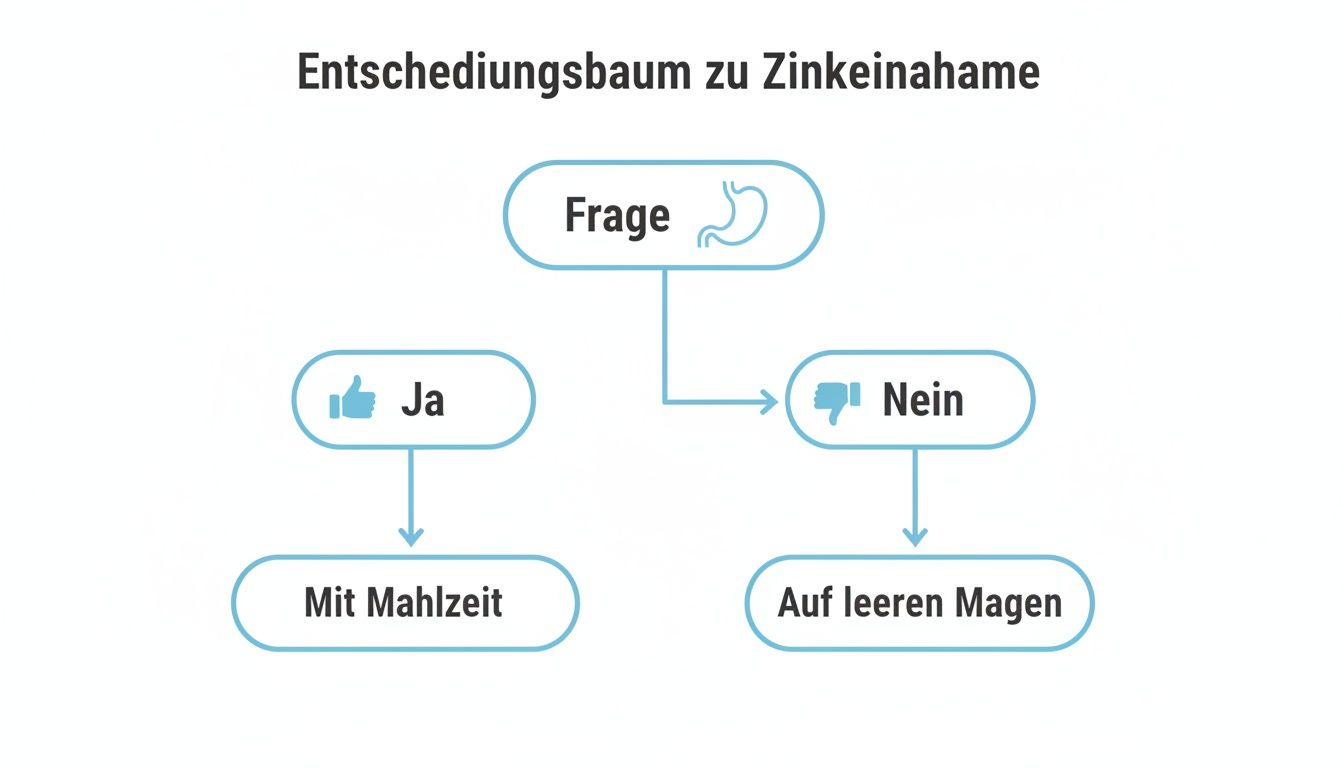
The graphic makes it clear: If your stomach is rather sensitive, taking it with a meal is the safest way to avoid discomfort.
Incidentally, zinc deficiency is more widespread in Germany than many people think. Data from the German National Nutrition Survey II show that an estimated 17 to 44 percent of the population could be affected. Such a deficiency can in turn interfere with the absorption of other important nutrients, such as iron and copper—further underscoring the need for proper intake. Learn more about the complex relationships between minerals in our body in our article. Getting the right amount is essential, but it should always be tailored to your personal well-being.
The key to successful zinc supplementation lies not in maximizing theoretical absorption, but in taking it regularly and tolerating it well, so you can integrate it into your everyday life over the long term without problems.
Before you simply adjust your zinc intake, however, it is important to first find out where you stand. Guessing is rarely a good strategy for your health.
Taking zinc on an empty stomach: Pros and cons
Should you take zinc with or without food? This table shows you the main advantages and disadvantages at a glance and helps you make your decision.
| Aspect | Taking it on an empty stomach | Taking it with a meal |
|---|---|---|
| Absorption | Advantage: Potentially higher absorption, as there is no competition from other nutrients (e.g., phytates). | Disadvantage: Absorption may be slightly reduced by certain components of food. |
| Tolerability | Disadvantage: High risk of nausea, stomach pain, and irritation of the stomach lining. | Advantage: Significantly better tolerability, as food serves as a buffer. |
| Everyday convenience | Disadvantage: Requires planning and a time gap between meals. | Advantage: Easy to incorporate into a meal, for example at breakfast. |
| Recommendation | Only for people with a very robust stomach who have tested their tolerance. | The standard recommendation for most people to avoid side effects. |
As you can see, for the vast majority of people, the benefits of taking it with a meal clearly outweigh the drawbacks. The slightly lower absorption is more than offset by much better tolerability and easier integration into everyday life.
Why your stomach rebels against zinc
Anyone who has ever taken zinc on an empty stomach may know this feeling: a sudden, rising wave of nausea that seems to come out of nowhere. But what is actually behind it? Imagine dripping concentrated lemon juice onto a sensitive area of skin—it burns and irritates. You can imagine the effect of zinc in much the same way when it comes into contact with your unprotected stomach lining in a highly concentrated form.
If the buffer provided by a meal, which effectively dilutes and distributes the mineral, is missing, local irritation occurs. The zinc ions then react directly with the cells of your stomach lining. Your body classifies this as potentially harmful and activates a clever defense mechanism: nausea. It is essentially a warning signal that tells you unmistakably: “Hey, something is wrong here!”

Dosage and zinc compound are crucial
Interestingly, not every stomach rebels to the same extent. Whether you tolerate taking zinc on an empty stomach well or not depends primarily on two factors: the dosage and the chemical form in which the zinc is present.
It’s quite logical: A higher dose leads to a higher concentration and therefore more severe irritation. It makes a huge difference whether you take 10 mg or 25 mg of zinc. If you are unsure, it is better to start with a lower dose to see how your body reacts.
Zinc tolerability varies enormously from person to person. While some people barely notice anything, others experience significant discomfort even with small amounts on an empty stomach.
However, it’s not just the amount that matters, but also the type of zinc compound. There are huge differences here that you should definitely know about:
- Inorganic compounds: Zinc sulfate is a widely used form, but it is often poorly tolerated. It tends to irritate the stomach lining particularly strongly.
- Organic compounds: Zinc citrate, zinc gluconate, or zinc picolinate are bound to organic acids. These “buffered” variants are generally much gentler on the stomach and are usually also better absorbed by the body.
Your individual sensitivity and what you can do
Your individual stomach sensitivity naturally also plays a major role. If you are already prone to heartburn, gastritis, or a nervous stomach, there is a high likelihood that you will react sensitively to taking zinc on an empty stomach. Similar symptoms, such as discomfort or a feeling of pressure, can also occur with other digestive problems. If you would like to learn more about the causes of stomach pressure and bloating, you can find useful information in our health portal.
Fortunately, the solution is usually quite simple: Take your zinc supplement with a small meal. It doesn’t have to be an extravagant feast. A yogurt, a banana, or a handful of nuts is already enough to protect your stomach and dramatically improve tolerability. This way, you can ensure that your body makes optimal use of this valuable mineral without compromising your well-being.
The myth of better absorption on an empty stomach
The idea of taking zinc on an empty stomach sounds completely logical at first: Without food, there are no “interfering factors,” so your body should be able to absorb the trace element much better, right? The idea isn’t entirely wrong, because certain substances in our food can indeed bind to zinc and block its absorption.
The best-known of these “zinc robbers” is phytic acid. It is found mainly in whole-grain products, legumes, and nuts. So if you take your zinc supplement directly with a bowl of oatmeal, some of the zinc may be bound before your body even has a chance to absorb it.
Why the interplay in the gut is more complex
But the simple equation “empty stomach = better absorption” is far too simplistic. Our digestive system is not a sterile test tube, but an incredibly complex ecosystem. A balanced meal contains not only potential disruptors, but often also substances that actively promote zinc absorption.
Animal proteins play a particularly important role here. The amino acids they contain, such as histidine and cysteine, form stable bonds with zinc. These complexes act like a protective shield, preventing phytates from binding to the zinc and effectively ushering it safely through the intestinal wall. A protein-rich meal can therefore easily offset or even outweigh the inhibitory effect of phytic acid.
The supposed advantage of taking zinc on an empty stomach is often negated by poor tolerability and the complex interactions in the gut. A smart combination with the right food is almost always the better approach.
A look at the facts about zinc intake
The National Nutrition Survey II (NVS II) paints a clear picture: Zinc intake in Germany often only just reaches the lower end of the recommendations. Women consume an average of 9.1 mg/day, while men consume 11.6 mg/day. If a diet very high in phytates is added to the mix, this can quickly be too little.
Your body can store only about 1.5–2.5 g of zinc in total, most of it in muscles and bones. A regular supply is therefore absolutely crucial. You can read more about the importance of trace elements in the findings published by the German Federal Institute for Drugs and Medical Devices.
Ultimately, absorption is always a trade-off. Even if, theoretically, on an empty stomach 10–15 % could absorb more zinc—but what good is that if you feel extremely nauseous afterward and would rather skip the capsule entirely next time?
A consistent and well-tolerated intake is infinitely more valuable to your body than a one-time absorption record that leaves you feeling unwell. So instead of relying on an empty stomach, it is much smarter to combine zinc with a protein-rich meal that is also low in phytates. This way, you get the best of both absorption and tolerability.
The golden rule for taking zinc
Now let’s get practical. We’ve established why taking zinc on an empty stomach isn’t a good idea for most of us. But how do you do it correctly to get the most out of your supplement without feeling unwell?
The answer is pleasantly simple and can be summed up in a single golden rule: Always take your zinc supplement with a meal. It really is that simple. This small step is the key to preventing bothersome nausea from the outset and making supplementation an uncomplicated part of your routine.
The best time and ideal pairings
But which meal is best? Lunch or dinner is ideal. The reason is that these meals often contain a good source of protein—whether meat, fish, lentils, or tofu. Proteins, or more precisely the amino acids they contain, can even improve zinc absorption in the intestines. They act almost like a natural “absorption booster.”
To optimize absorption even further, you should keep a few simple timing rules in mind:
- Keep your distance from coffee and tea: These beverages contain tannins, which can bind to zinc and block its absorption. Ideally, wait one to two hours after your coffee or black tea before taking your zinc supplement.
- Be careful with fiber: A very high-fiber breakfast, such as a large bowl of muesli with lots of whole grains, is not the ideal partner for zinc. The phytates it contains can inhibit absorption.
- Avoid competition in the intestines: Never take zinc at the same time as high-dose iron or calcium supplements. These minerals compete for the same transport pathways in the intestines—which ultimately means less of each is absorbed.
The most effective way to take zinc is the one you can consistently and comfortably incorporate into your daily routine. Tolerability always outweighs the purely theoretical maximum absorption on an empty stomach.
Practical examples for your everyday routine
To make this as easy as possible for you, here are a few examples of meals that are perfect to have with zinc:
- Lunch: A chicken breast salad, a hearty lentil stew, or a bowl with quinoa and vegetables.
- Dinner: Pan-fried salmon with potatoes and broccoli or a classic beef goulash.
- Vegetarian option: A chickpea curry with rice or an omelet with mushrooms and spinach.
If you follow these simple principles, you can easily integrate your zinc supplement into your daily routine—and, above all, in a way that is gentle on your stomach. This ensures that your body gets the important trace element it needs without compromising your well-being. The next logical step is to find out exactly how high your personal requirements are.
Determine your personal zinc requirements
Taking zinc on suspicion alone is a bit like driving a car through fog. You do not know whether you actually have a deficiency, whether you may already be taking far too much, or whether taking zinc on an empty stomach is even right for you. There is a huge difference between a blanket recommendation and what your body actually needs.
Because taking too much can be just as problematic as having a deficiency. For example, too much zinc interferes with the absorption of copper, another essential trace element. Just like that, you have created a new imbalance. So instead of continuing to guess, it is time for clarity.
Clarity instead of guesswork: How to find out what you really need
With a nutrient test from mybody-x, you will find out your exact zinc status—precisely, scientifically sound, and without any guesswork. The entire process is remarkably straightforward and easy to fit into your everyday routine.
You conveniently collect a small blood sample at home, which is then professionally analyzed in our ISO-certified German laboratories. This ensures that, in the end, you have results you can truly rely on.
It is not about taking zinc blindly. It is about giving your body exactly what it needs—no more and no less. That is the essence of personalized health.
More than just a lab result
In the end, your result is far more than just a bare number. You receive an understandable, clearly structured evaluation of your zinc level that shows you exactly where you stand. Even more important, however, are the highly personal recommendations for action based on it. They are your roadmap for managing your health in a targeted and effective way.
You will find out whether zinc supplementation is actually beneficial for you and, if so, in what dosage. Perhaps your level is already in the optimal range and you do not need an additional supplement at all. But the test may also reveal a significant deficiency that absolutely justifies targeted supplementation.
A reliable laboratory test is the key to tailored supplementation and the safest way to optimally support your body. If you want to learn how to check your nutrient status more comprehensively, take a look at our guide on vitamin and mineral testing.
When your body needs particularly high amounts of zinc
Your daily zinc requirement is not a fixed quantity set in stone. Rather, it is dynamic and adapts to your circumstances. There are phases and situations in which your body virtually demands more of this important trace element. At precisely these times, optimal intake is crucial to prevent deficiency and protect your health.
Perhaps you recognize yourself in one of the following groups? If so, you should pay particular attention to your zinc intake. This means either adjusting your diet accordingly or considering supplementation after checking your zinc status.
Groups with increased requirements
-
Athletes and active people: Those who sweat a lot lose not only water but also valuable minerals such as zinc. For ambitious athletes, an adequate intake is therefore essential. Zinc plays a key role in recovery, muscle building, and energy production—all processes that operate at full speed after training.
-
Vegans and vegetarians: Although many plant-based foods contain zinc, there is a catch: So-called phytic acid, which is abundant in whole-grain products and legumes, can bind zinc in the intestines. This makes it harder for your body to absorb the trace element and increases the risk of deficiency.
-
Pregnant and breastfeeding women: During these special stages of life, your body performs at its peak. Zinc is absolutely essential for the healthy growth and development of your child. Your requirement increases noticeably during this time to optimally support not only you but also your baby.
-
People with weakened immune systems: Especially during cold season or periods of chronic stress, your immune system is constantly hard at work. Zinc is one of the most important players in immune defense and supports the function of your immune cells. Adequate intake can help reduce your susceptibility to infections.
Your lifestyle, diet, and special circumstances directly affect your zinc requirements. Knowing when your body needs more support is the first step toward targeted and effective supplementation.
These examples make it clear how much your nutrient requirements can vary. If you belong to one of these groups, it is all the more important to keep an eye on your intake. The safest way to find out whether your zinc levels are truly in the healthy range is through a precise blood analysis. A mybody-x nutrient test gives you clarity and helps you tailor your intake perfectly to your individual needs.
Your most important questions about taking zinc
To make taking zinc as easy as possible, I have collected the answers to the questions we encounter time and again in practice. This way, you will be well informed and avoid the typical pitfalls from the outset.
Can I take zinc in the evening?
Yes, absolutely! Taking it in the evening is actually a very good idea, especially if you have it with a small snack. There is even evidence that zinc may improve sleep quality.
The golden rule applies here too: Never take it on a completely empty stomach to avoid the dreaded nausea. A small yogurt, a handful of pumpkin seeds, or a banana is perfect.
Which zinc compound is easiest on my stomach?
If you have a sensitive stomach, choosing the right zinc compound is crucial. The differences in tolerability are enormous:
- Organic compounds: Forms such as zinc picolinate, zinc citrate, or zinc gluconate are bound to organic acids. Think of it this way: They essentially arrive in the body with a “taxi” that makes absorption easier and is gentler on the stomach. They are generally much kinder to your stomach.
- Inorganic compounds: Zinc sulfate is widespread and often inexpensive, but unfortunately causes the familiar stomach problems and irritation much more frequently.
How quickly will I feel the effects of zinc?
This is highly individual and depends largely on the state of your zinc stores. If you have a pronounced deficiency, visible symptoms such as poor wound healing or skin blemishes can often improve after just a few weeks of regular use.
Strengthening your immune system, on the other hand, is more of a marathon than a sprint. It requires patience and consistent use. To measure your progress objectively rather than remain in the dark, taking another nutrient test after a few months is the best way to monitor your levels and see whether you are on the right track.
At mybody-x, the goal is to give you precise insights into your body instead of leaving you in the dark. A nutrient test shows you in black and white how your zinc levels are doing and gives you the confidence to support your health in a targeted way based on your actual needs.


Share now:
Pimples during your period – understand the causes and take targeted action
Nutrition for vaginal yeast infections that really helps: Your guide