

Copper and zinc: why the ratio matters
The key points at a glance
There is a documented association between copper and zinc, and it runs in one direction: chronically high zinc intake affects copper metabolism.
This association is why the two values appear together in the professional literature. It is not, however, a ratio that constitutes a separate laboratory value with its own reference range.
You will read the quoted source verbatim, three documented facts, three common statements examined in a fact check, four ways to interpret the two values, and an open point that concerns us as well.
What to expect in this article
1. Why two values are mentioned together
2. The documented source
3. What copper does in the body
4. Three facts about the association
5. How a copper measurement is determined
6. Three statements in the fact check
7. What a zinc measurement indicates
8. The key point in one sentence
9. Why the ratio is not a laboratory value
10. Four ways to interpret the two values
11. A gap we openly acknowledge
12. Who can benefit from a zinc measurement
13. What a capillary blood test can show here
14. Limitations: what both values leave unanswered
15. What matters about these two values
Frequently asked questions
Sources
Why two values are mentioned together
Most trace elements are discussed individually. Copper and zinc are different, and there is a factual reason for that.
The MSD Manual, Professional Edition, explicitly lists excessive zinc intake as a cause of acquired copper deficiency (as of May 2025). Thus, one value appears in the other’s list of causes.
This has become a figure of its own online. People read about a copper-to-zinc ratio, target ranges, and a number they should aim for.
This article examines what the reviewed sources actually support on this point. The result goes in both directions: the association is documented, but the figure is not.
The documented source
The sentence in question does not appear in the chapter on zinc deficiency, but in the chapter on the opposite condition.
Documented source
“Over an extended period, an intake of elemental zinc at a dose of 100–150 mg/day affects copper metabolism and leads to low blood copper levels.”
MSD Manual, Professional Edition
Zinc intoxication, Johnson LE, fully reviewed May 2025
Three components of this sentence convey the message: an amount, a period, and a direction.
The amount is specified as 100 to 150 milligrams per day. The period is described as over an extended period and does not refer to a single dose. And the direction is clear: zinc affects copper here, not the other way around.
The same source states in the same section that chronic intoxication can lead to copper deficiency and cause nerve damage (as of May 2025). The figure given is therefore a harm threshold from the specialist literature, not an intake recommendation. This article does not specify an amount anyone should take.
What copper does in the body
Before discussing the ratio, the lesser-known of the two values should be briefly put into context.
IQWiG describes copper as an essential trace element and notes that the body needs it only in small amounts (as of March 20, 2025). The same source identifies two functions: copper helps the body absorb and use iron from food, and it plays a role in building connective tissue, tendons, and bones.
The MSD Manual adds the biochemical perspective. It states that copper is a component of many body proteins and that almost all copper in the body is bound to proteins (as of May 2025). These include cytochrome c oxidase, ceruloplasmin, and lysyl oxidase.
The last point is crucial for interpreting a measurement. When an element is bound almost entirely to proteins, a serum value also always reflects the condition of those proteins.
Three points about the connection
Three pieces of information from the reviewed sources. They provide context and do not constitute a diagnosis.
Documented information
100–150 mg
elemental zinc per day over an extended period can affect copper metabolism and lead to low blood copper levels—listed as a harm threshold, not as an amount to take (MSD Manual, professional edition, as of May 2025)
10,7–26,6
µmol/l is the reference range for copper in women over 18; for men over 18, 11.0–22.0 µmol/l is given (IQWiG, as of March 20, 2025)
5 %
of healthy people fall outside the reference range because its limits are set so that 95% fall within it (IQWiG, as of April 2, 2025)
The second figure already reveals one peculiarity of the copper value. The reference range for women is broader than the one for men and begins at a different point.
As with every laboratory value, the reference range provided on your own test report is decisive, because reference values can vary from one laboratory to another (IQWiG, as of April 2, 2025).
How a copper value is determined
Anyone who wants to calculate a ratio between two numbers should know how stable those numbers are. With copper, the answer is uncomfortable.
IQWiG notes that, in addition to sex, the copper level also depends on age. The same source also describes variation over the course of the day: the level is usually higher in the morning than in the evening (as of March 20, 2025).
A second influencing factor comes into play. It states: Women who take estrogen or are pregnant have significantly higher levels (as of March 20, 2025).
This means that a single copper figure depends on at least four conditions: sex, age, time of day when the sample is taken, and hormonal status. A quotient based on such a figure inherits all of these conditions while also making them invisible, because in the end only a single number remains.
Why ceruloplasmin is measured as well
A point from the previous chapter becomes practical here. If nearly all the copper in the body is bound to proteins, a serum level always reflects both the element and its transport protein.
The MSD Manual lists ceruloplasmin among the essential copper proteins and explicitly includes it alongside the copper level in diagnostics (as of May 2025). The two values appear together there, and both come with the same caveat.
What this means for interpretation: A copper level is not a direct readout of a store. It is a snapshot of a transport system, and anyone who puts it into a calculation continues calculating with that snapshot.
Three statements in the fact check
These three statements come up regularly when copper and zinc are discussed.
Checked against the available evidence
Widespread
“There is a target value for the copper-to-zinc ratio.”
Documented
The sources reviewed list reference ranges for copper and zinc separately. Neither IQWiG (as of March 20, 2025) nor the MSD Manual (as of May 2025) provides a reference range for a quotient of the two.
Widespread
“A low copper level proves copper deficiency.”
Documented
The MSD Manual states that the diagnosis of acquired copper deficiency is based on low serum levels of copper and ceruloplasmin, although these tests are not always reliable (as of May 2025).
Widespread
“Every intake of zinc comes at the expense of copper.”
Documented
The cited source ties the effect to two conditions: an amount of 100–150 mg of elemental zinc per day and a longer period (MSD Manual, as of May 2025). This statement says nothing about smaller amounts.
What a zinc level indicates
The other half of the ratio is not a simple value either, and that needs to be said here.
The professional edition of the MSD Manual notes that laboratory diagnosis of zinc status is difficult and requires special collection techniques (as of May 2025). The reason lies in the sample itself: Zinc is present in materials that may come into contact with a blood sample.
A zinc value is therefore reliable when the sample was collected properly, and less reliable when that cannot be established. This condition applies regardless of whether the value stands alone or is used in a calculation.
The specific caveats that apply to zinc and selenium are discussed in the companion article Selenium and Zinc: Two Values with a Measurement Problem.
The key point in one sentence
This is where the topic can be brought together.
A ratio of two uncertain numbers is no more reliable than its components. It only looks that way.
That is precisely what makes such a metric appealing. Two values with conditions, fluctuations, and caveats become one smooth number, and all the caveats disappear in the calculation.
This is not an argument against knowing both values. It is an argument for interpreting them side by side rather than calculating a ratio.
Why the ratio is not a laboratory value
It is worth drawing a clear distinction between a relationship and a metric.
A relationship is established when a source describes it. That is the case here: The MSD Manual lists excessive zinc intake among the causes of acquired copper deficiency (as of May 2025).
A metric needs more. It requires a defined calculation method, specified units for both components, a reference range, and information about the conditions under which the components are measured. None of this is found in the reviewed sources for a copper-zinc ratio.
The difference can be illustrated well using cholesterol. The IQWiG explicitly identifies non-HDL cholesterol as a derived value and provides the calculation method. The reviewed sources do not contain an equivalent for copper and zinc, which is why this article does not state a target value.
Four ways to interpret the two values
The table compares four approaches. It provides context and does not constitute a diagnosis.
| Approach | What supports it | What the sources say about it | What remains unresolved |
|---|---|---|---|
| Calculating a ratio | A single number is easy to remember and compare | No reference range for such a ratio was found in the sources reviewed (IQWiG, as of March 20, 2025; MSD Manual, as of May 2025) | What the number is measured against—without a reference range, there is no benchmark |
| Look only at the zinc value | Zinc is commonly included in capillary blood panels and documented with a date | Laboratory diagnosis of zinc is difficult and requires special collection techniques (MSD Manual, as of May 2025) | The copper side – a zinc value says nothing about it |
| Read both values side by side | The documented connection remains visible without being calculated | Excessive zinc intake is cited in the medical literature as a cause of acquired copper deficiency (MSD Manual, as of May 2025) | The interpretation – that takes place in a medical practice |
| Go by how you feel | No appointment or kit is needed | A disease usually cannot be inferred from a single laboratory value – and without a value, this piece of the puzzle is also missing (IQWiG, as of March 20, 2025) | Everything measurable – how you feel does not assign meaning to either value |
The third line is the only one consistent with the status of the cited sources. It is also the most uncomfortable, because it leaves two numbers side by side instead of providing one.
A gap we name openly
This is where a sentence belongs that advisory articles rarely contain.
Copper is not included in any of the blood tests from mybody®x (MYBODY Lab GmbH) that were reviewed. Anyone who wants to see both values side by side cannot get them from our current range.
We state this because the alternative would be to promote a ratio and then provide only half of it. The zinc value is part of the VitalCheck; the copper value is not, and the headline of this article does not change that.
Anyone who needs the copper value can obtain it through a medical practice or a laboratory with the appropriate request. That is the honest answer, and it appears here before the product card, not behind it.
Who a zinc value makes sense for
The comparison concerns whether a documented zinc value would help you.
It makes sense for you if …
You have been taking zinc for some time and have never had a baseline value measured.
You want to bring a dated number to a consultation at your doctor’s office.
You want to see several values from the same sample instead of individual reports from several years.
You want to know where you stand before considering any supplement.
Probably not if …
You need the copper value. It is not included in our tests.
You expect a ratio. This article does not provide one, and neither does the test result.
You are already undergoing evaluation. In that case, the practice that started it is the one that guides you.
You expect a diagnosis. That comes from a medical practice, not a self-test.
What a capillary blood test can show here
A capillary blood self-test does not provide a diagnosis or establish a ratio. What it can do is document one of the two numbers with a date.
VitalCheck measures zinc as one of 18 values from the same sample. Copper is not included, and this article makes no claim otherwise.
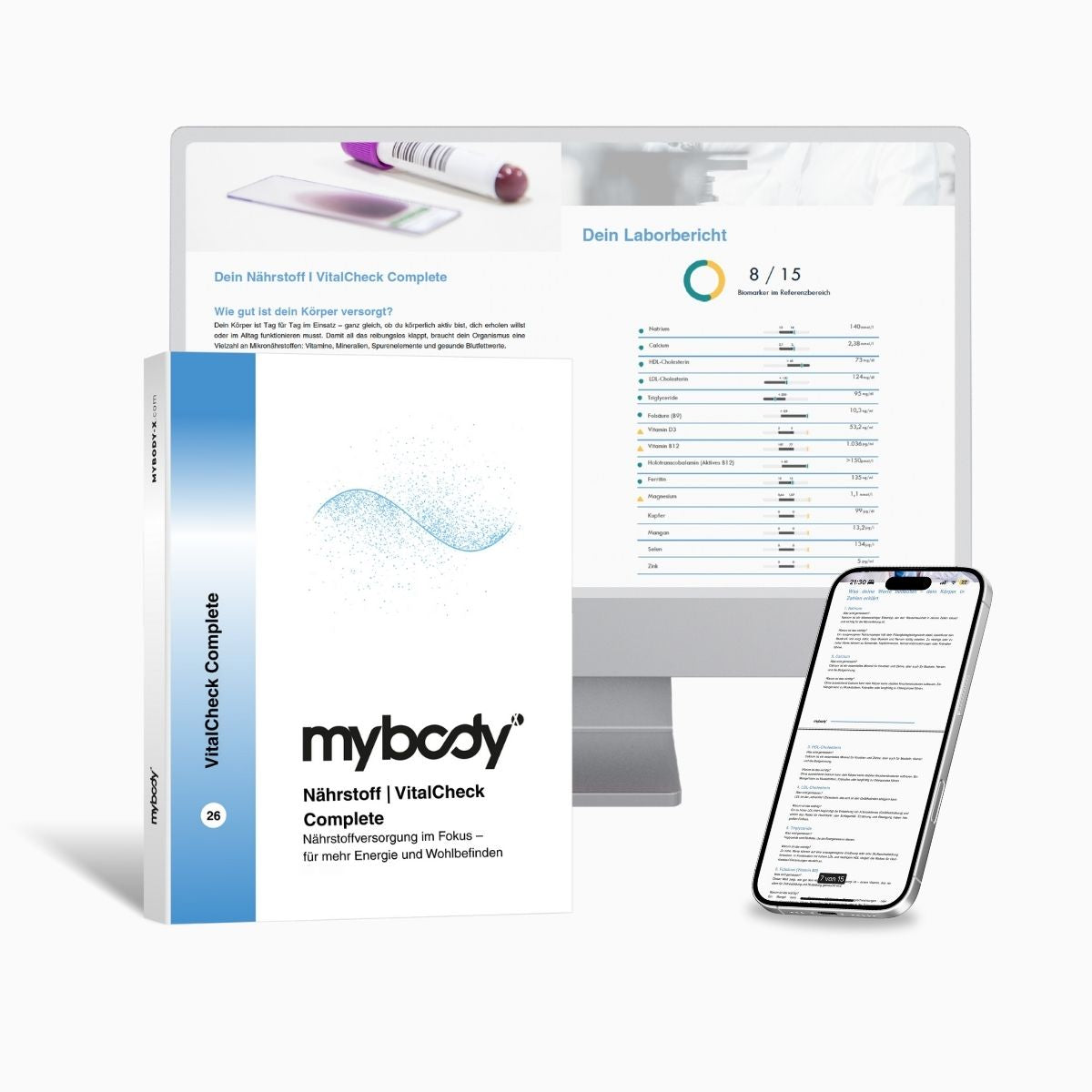
Capillary blood test
VitalCheck | Nutrient & Mineral Test Complete
Measures 18 values from the same sample, including zinc, selenium, calcium, magnesium, phosphate, ferritin, iron, transferrin, 25-OH vitamin D3, vitamin B12, folic acid, albumin, CRP, long-term blood sugar, as well as total cholesterol, HDL, LDL, and triglycerides. What the test does not provide: copper is not included, so a copper-to-zinc ratio cannot be calculated from it. It does not recommend a supplement, specify a quantity, provide a diagnosis, or replace a medical examination. The reservations regarding sample collection mentioned in the article apply to the zinc value.
Laboratory analysis 3–5 business days after receipt of the sample
Product page information, accessed August 17, 2026
Chapter at a glance
A capillary blood test documents the zinc level with a date but does not establish a ratio. Copper is not included, so a quotient cannot be calculated from it, and interpreting both values belongs in a medical practice.
Limitations: what both values leave unanswered
The first limitation is reliability. Regarding the diagnosis of acquired copper deficiency, the MSD Manual states that it is based on low serum levels of copper and ceruloplasmin, although these tests are not always reliable (as of May 2025). For the hereditary form, it states that the diagnostic value of these tests is limited.
The second limitation is the conditions. Copper levels depend on sex, age, and time of day, and are significantly higher in women taking estrogen or who are pregnant (IQWiG, as of March 20, 2025). Without this information, it is difficult to interpret an individual number.
The third limitation is the sample. According to the specialist literature, laboratory diagnosis of zinc is difficult and requires special collection techniques (MSD Manual, as of May 2025).
The fourth limitation is diagnosis. All classifications in this article provide context and do not constitute a diagnosis. A diagnosis is made in a medical practice based on several components, and no self-test can anticipate it.
What matters about these two values
If you take away just one thing from this article, let it be this: The relationship between copper and zinc is established, but the resulting metric is not.
The direction of the relationship is established. Excessive zinc intake is listed as a cause of acquired copper deficiency, and the effect of 100 to 150 milligrams of elemental zinc per day over an extended period on copper metabolism has been described (MSD Manual, as of May 2025).
A target value has not been established. The sources reviewed contain no reference range for a quotient calculated from the two values, which is why this article does not provide one. What remains is to read the two values side by side, document them with the date, and leave their interpretation to a medical practice.
Frequently asked questions
Is there a target value for the copper-to-zinc ratio?
Not in the sources reviewed for this article. IQWiG gives a reference range for copper (as of March 20, 2025), while the MSD Manual describes the relationship between high zinc intake and copper metabolism (as of May 2025). Neither source provides a reference range for a quotient calculated from the two values.
At what amount of zinc has an effect on copper been described?
The professional edition of the MSD Manual states that an intake of 100 to 150 milligrams of elemental zinc per day over an extended period can affect copper metabolism (as of May 2025). This information appears in the section on zinc toxicity and describes a threshold for harm. It is not a dosage recommendation, and this article does not provide one.
How reliable is a copper blood level?
The MSD Manual states that diagnosing acquired copper deficiency is based on low serum levels of copper and ceruloplasmin, although these tests are not always reliable (as of May 2025). IQWiG also describes fluctuations over the course of the day, with levels usually being higher in the morning (as of March 20, 2025).
Why do copper reference ranges differ between women and men?
For women over 18, IQWiG gives a range of 10.7 to 26.6 µmol/l, and for men over 18, 11.0 to 22.0 µmol/l (as of March 20, 2025). The same source cites hormonal status as one reason: women who take estrogen or are pregnant have significantly higher levels. The reference range on your own report is always decisive.
Is copper included in an at-home blood test?
Not in the tests reviewed for mybody®x. Zinc is included in the VitalCheck, but copper is not. Anyone who needs their copper level can obtain it through a medical practice or a laboratory with the appropriate order.
Next step
Document one of the two values
VitalCheck measures 18 values from capillary blood, including zinc. Copper is not included, so a ratio cannot be calculated from it. The test does not recommend a supplement, specify an amount, make a diagnosis, or replace medical evaluation.
Go to VitalCheckRead more
You might also be interested in
Why both values can be measured and still be difficult to interpret.
What the evidence says about the order of steps—and what it leaves open.
Sources
- MSD Manual, Professional Edition: Zinc intoxication, Johnson LE (full review May 2025) – msdmanuals.com
- MSD Manual, Professional Edition: Copper deficiency, Johnson LE (full review May 2025) – msdmanuals.com
- Institute for Quality and Efficiency in Health Care (IQWiG): Copper, as of 20 March 2025 – gesundheitsinformation.de
- MSD Manual, Professional Edition: Zinc deficiency, Johnson LE (full review May 2025) – msdmanuals.com
- IQWiG: Understanding laboratory values correctly, as of 2 April 2025 – gesundheitsinformation.de
The verbatim quotation regarding an intake of 100–150 mg of elemental zinc and the statement on chronic intoxication come from source [1]. The excessive intake of zinc as a cause of acquired copper deficiency, the statements on the reliability of copper and ceruloplasmin tests, and the information on copper’s protein binding come from [2]. The description of the trace element, the reference ranges for women and men, the dependence on age and time of day, and the information on estrogen and pregnancy come from [3]. The statement about the difficult laboratory diagnosis of zinc comes from [4]. The explanation of the reference range and the figure of 95 percent come from [5]. Information on price, values, sample type, and laboratory comes from the mybody®x product page, accessed on 17 August 2026; processing times follow the standard specification for blood tests. All sources were accessed and reviewed on 17 August 2026.

mybody®x Editorial & Expert Team
Laboratory diagnostics Blood analysis interpretation Nutritional science Nutrigenetics
This article was created by the mybody®x editorial and expert team. The team combines laboratory diagnostics, nutritional science, and the interpretation of blood analyses. The people involved can be found on the authors page.
Published on 17 August 2026 · Last updated on 17 August 2026
The content is for general information and does not replace medical advice, diagnosis, or treatment. Reference ranges depend on the laboratory, method, and age—the information on your test report is always authoritative.




Share now:
Blood Values on a Plant-Based Diet: Five That Matter
Transferrin complements the iron panel.