

Vitamin D, zinc, and CRP: three values, three statements
The key points at a glance
These three values appear one below the other on many test reports, which can easily create the impression that together they provide a picture. We found no source linking them into a common statement.
What we find instead is something different for each of the three: one value with disputed thresholds, one value that is difficult to measure, and one nonspecific response marker.
You will first read why the three are often mentioned together. Then come three common statements fact-checked, a fourth value that is relevant to zinc, the figures from the authoritative sources, and a comparison of the three.
What to expect in this article
1. Why these three are often mentioned together
2. The sentence urging caution
3. What vitamin D describes in a test result
4. Three statements fact-checked
5. What zinc describes in a test result
6. What the three have in common and what they do not
7. Why albumin is relevant to zinc
8. The figures from the authoritative sources
9. What CRP contributes
10. The three values compared
11. What a panel can do
12. Who may benefit from a measurement
13. What a test from capillary blood can show here
14. Limitations: what we could not substantiate
15. What matters about these three values
Frequently asked questions
Sources
Why these three are often mentioned together
Vitamin D, zinc, and CRP often appear together in many overviews. The reason is initially a practical one, not a scientific one.
All three can be determined from the same blood sample, all three are widely used, and all three are associated in everyday practice with the keyword “defenses.”
Whether they belong together scientifically is another question. We searched the reviewed sources for a statement linking these three values into a common statement about the immune system. We did not find one.
What this means for this article
Instead of asserting a connection that we cannot substantiate, this article takes the opposite approach. It examines the three values individually and shows what each of them actually describes.
This is less sensational and more useful in the end. It turns out that, besides measuring different things, the three values also provide different types of information.
The sentence urging caution
A sentence from the authoritative vitamin D source applies in principle to all three values and is therefore placed right at the beginning.
Documented source
“Low blood levels alone do not yet indicate vitamin D deficiency.”
Institute for Quality and Efficiency in Health Care
IQWiG, gesundheitsinformation.de, Vitamin D deficiency, as of November 15, 2023
The word alone carries this sentence. It says that a number below a threshold is a number, and not yet a finding.
The same caution applies to the other two values for different reasons: zinc because of the measurement, and CRP because of its lack of specificity.
What vitamin D describes in a test result
The vitamin D level describes a nutritional status. Unlike CRP, it does not measure a response but a reserve.
IQWiG gives a threshold and its source: According to the Robert Koch Institute, vitamin D status is inadequate when blood levels are below 12 nanograms per milliliter (as of November 15, 2023).
Using this threshold, according to the same source, approximately 13 percent of children and adolescents and approximately 15 percent of adults have low levels (as of November 15, 2023).
Two factors that shift the level
The first factor is the season. According to IQWiG, vitamin D blood levels depend on it (as of November 15, 2023). The same person may have different levels in February and August without anything else having changed.
The second factor is the laboratory. The values differ depending on the laboratory’s measurement method (as of November 15, 2023). Two results from two facilities are therefore not readily comparable.
In addition, the assessment itself is inconsistent. IQWiG notes that low levels are sometimes already called a deficiency, although this is professionally disputed (as of November 15, 2023).
The cited page was created on November 15, 2023, and announces an update for 2026. Its age is part of the information.
Three statements in a fact check
These three statements regularly appear together when the three values are mentioned.
Checked against the evidence
Widespread
“Together, these three values provide a picture of the immune system.”
Documented
We found no statement in the sources reviewed that links these three values into a single composite measure. Something is documented for each individual value, and the three statements are different in nature: a nutritional status, a difficult-to-measure level, and a nonspecific response value.
Widespread
“A low vitamin D level means a deficiency.”
Documented
IQWiG writes: Low blood levels alone do not yet indicate vitamin D deficiency (as of November 15, 2023). The same source identifies the season and the laboratory’s measurement method as influencing factors and notes that the assessment of low levels is professionally disputed.
Widespread
“The blood zinc level reliably indicates nutritional status.”
Documented
The MSD Manual, Professional Edition, states: Laboratory diagnosis is also difficult and requires special collection techniques. It further states: Low albumin levels, which frequently occur with zinc deficiency, make determining the serum zinc level difficult (as of May 2025).
What zinc describes in a test result
Zinc is widespread throughout the body, and this can be seen from a list.
The MSD Manual, Professional Edition, describes it as a component of several hundred enzymes, including nicotinamide adenine dinucleotide dehydrogenases, RNA and DNA polymerases, DNA transcription factors, as well as alkaline phosphatase, superoxide dismutase, and carbonic anhydrase (as of May 2025).
This list explains why zinc is mentioned in so many contexts. At the same time, it explains why little can be inferred from a single blood value: what is present in several hundred enzymes is simply not found predominantly in the blood.
What makes the measurement more difficult
The same source is unusually clear on this point. Laboratory diagnosis is also difficult and requires special collection techniques (as of May 2025).
And it rules out two obvious alternatives: urine zinc levels are not reliable in acute deficiency, nor are hair zinc levels (as of May 2025).
That leaves the serum zinc level, which also has a documented problem. What that problem is is explained below in a separate chapter.
What the three have in common and what they do not
At this point, the result of the previous chapters can be summed up in one sentence.
Three values side by side do not yet make a picture. They produce three questions, and each requires its own answer.
What the three have in common is that they can come from the same sample and that each one has its own limitation.
What they do not have in common is the type of information they provide. Vitamin D describes a store, zinc a difficult-to-measure level, and CRP an ongoing response.
A store, a level, and a response cannot be reduced to a single number. Anyone who tries loses precisely the differences that make the three values useful.
Why albumin belongs in the discussion of zinc
This point is rarely mentioned and is the most practically useful one in this article.
The MSD Manual, Professional Edition, states that low albumin levels, which frequently occur with zinc deficiency, make determining the serum zinc level difficult (as of May 2025).
Albumin is a protein in the blood and can be measured in the laboratory without any additional effort. Anyone who has both values on the same test result can therefore interpret the zinc level better than someone who knows only the zinc level.
What this means for a test result
A low zinc level with simultaneously low albumin is different from a low zinc level with normal albumin. The number in the zinc line looks the same in both cases.
What follows in an individual case is determined by a medical practice. What can be established here is the prerequisite for that: Both lines must be present.
When reading a test report, it is therefore worth checking whether albumin is included at all. If it is missing, the zinc value is more difficult to interpret than it appears.
The figures from the key sources
Three figures, each with a source and date. They provide context and do not constitute a diagnosis.
Evidence-based classifications
below 12
Nanograms per milliliter: According to the Robert Koch Institute, vitamin D status is inadequate below this level (IQWiG, as of November 15, 2023)
approximately 15%
of adults are below this threshold; among children and adolescents, the figure is around 13 percent (IQWiG, as of November 15, 2023)
up to 5
mg/l: CRP reference range for women and men over 18 years of age (IQWiG, as of March 20, 2025)
There is no number for zinc here, and there is a reason for that. In the specialist source on zinc deficiency that we reviewed, we found no reference values with units, so we do not provide one here.
And as with every laboratory value, the decisive factor is the reference range shown on your own report, because reference values can vary from one laboratory to another (IQWiG, as of April 2, 2025).
What CRP contributes
CRP is the third member of the group and the most different. It does not describe a reserve, but a response.
IQWiG describes it as a blood protein produced during inflammation (as of March 20, 2025). It therefore only develops once something has happened and is not present in this quantity beforehand.
Its most important characteristic is also its most important limitation. Elevated C-reactive protein levels are a nonspecific indicator of an infection or inflammation (MSD Manual, professional edition, as of February 2024).
The sister article CRP: what the value indicates and what it does not discusses what this means in detail.
The three values compared
The table compares the three values and the fourth from the albumin chapter according to the same three questions.
| Value | Type of statement | What makes interpretation more difficult | Evidence |
|---|---|---|---|
| Vitamin D | A state of supply over a longer period | Season, the laboratory’s measurement method, and a professionally disputed assessment of low values | IQWiG, as of November 15, 2023 |
| Zinc | A serum level, while the substance is found in several hundred enzymes | Laboratory diagnosis is difficult and requires special collection techniques; low albumin makes determination more difficult | MSD Manual, professional edition, as of May 2025 |
| CRP | An ongoing immune response | Nonspecific: infection, tissue damage, and chronic processes cause the same increase | MSD Manual, as of February 2024; IQWiG, as of 20 March 2025 |
| Albumin | A protein value that serves here as an aid for interpreting zinc | It does not answer a separate question in this context; instead, it helps interpret another one. | MSD Manual, professional edition, as of May 2025 |
The second column shows what this article is about. Three different types of statement can be placed side by side, but they cannot be combined into a single calculation.
What a panel can provide
Based on what has been said so far, a conclusion seems obvious, but it would go too far: that several values together are of no benefit.
What several values from the same sample can provide is something more modest, yet still useful. They come from the same day, the same laboratory, and under the same conditions.
This makes it possible to relate them to one another without a time gap interfering with interpretation. The relationship between zinc and albumin is an example of exactly this.
They also eliminate the need to ask whether a value is accidentally missing. A complete report can be interpreted more quickly in a consultation than three individual sheets from three months.
Who may benefit from a measurement
The comparison concerns the joint measurement of several values from one sample.
Makes sense for you if …
So far, you have only individual values from different years and find it difficult to relate them to one another.
You are missing the albumin value for zinc, which is needed for interpretation.
You want to establish a complete baseline with a date.
You want to bring several figures from one sample to a consultation at a medical practice.
Probably not if …
You expect a single statement about your immune system based on several values. The sources do not support that.
You want to make a decision about supplements. That should be done in a medical practice.
You have symptoms. In that case, the right course is to visit a medical practice.
You expect a diagnosis. That comes from a medical practice, not a self-test.
What a capillary blood test can show here
A capillary blood self-test does not provide a diagnosis or an overall assessment of the immune system. What it can do is provide multiple values from the same sample, along with the date and reference range.
The VitalCheck by mybody®x (MYBODY Lab GmbH) measures vitamin D, zinc, and CRP together, as well as albumin, which plays a role in interpreting the zinc level according to the cited source.
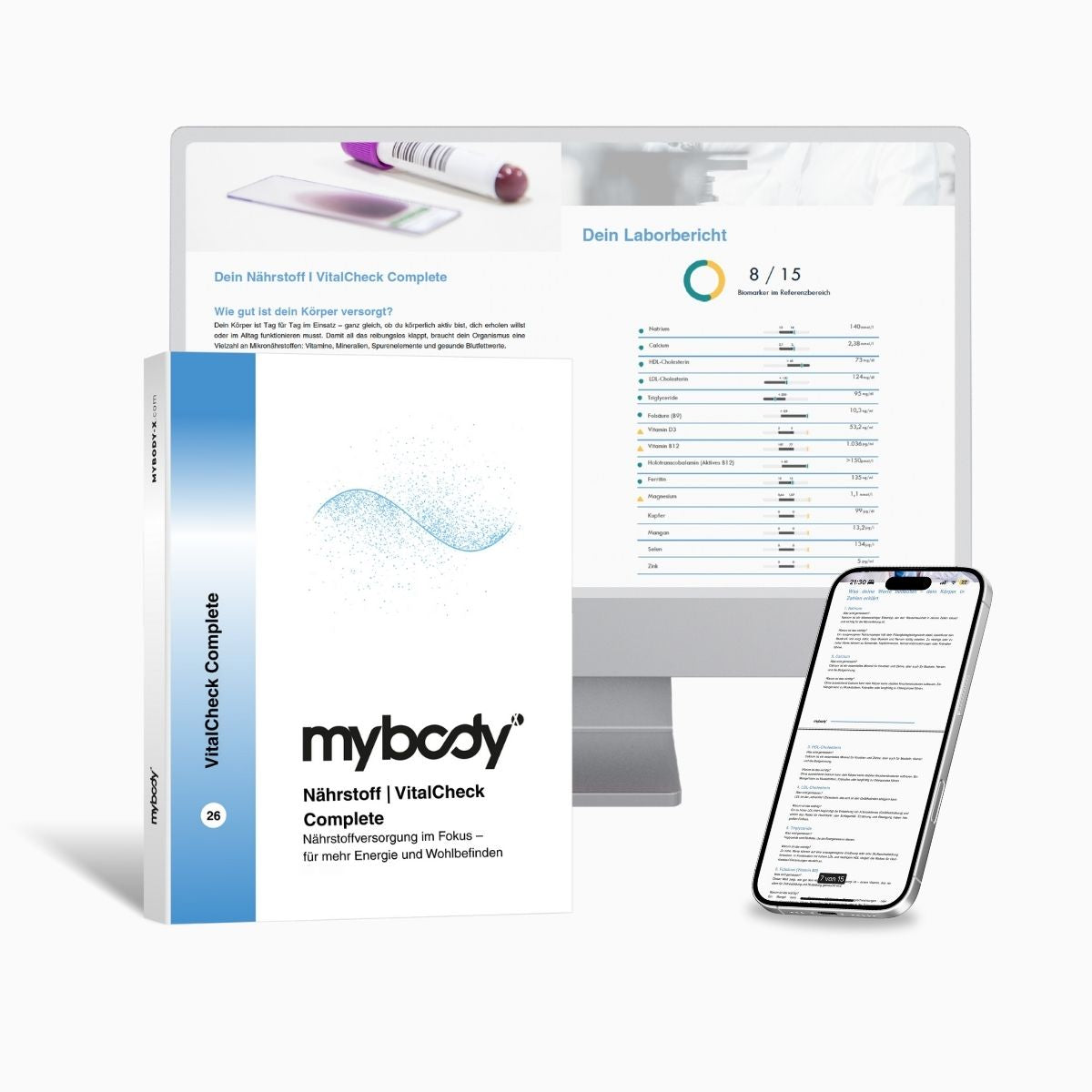
Capillary blood test
VitalCheck | Nutrient & Mineral Test Complete
Measures 18 values, including 25-OH vitamin D3, zinc, CRP, and albumin from the same sample. It also measures vitamin B12, folate, ferritin, iron, transferrin, calcium, magnesium, phosphate, selenium, long-term blood sugar, as well as total cholesterol, HDL, LDL, and triglycerides. What the test does not provide: It does not offer an overall assessment of the immune system, evaluate supplements, provide a diagnosis, or replace a medical examination.
Laboratory results 3–5 working days after sample receipt
Product page information, accessed 15 August 2026
Four points determine whether several values become useful information.
Read them individually
A reserve, a level, and a response cannot be combined into a single calculation.
Consider albumin
Low albumin makes it more difficult to determine the serum zinc level.
Note the season
According to IQWiG, the vitamin D value depends on the season.
Discuss the interpretation
According to IQWiG, low blood values alone do not yet constitute a finding.
Chapter at a glance
A capillary blood self-test provides vitamin D, zinc, CRP, and albumin from the same sample and does not provide a diagnosis. Its benefit is that the values come from the same day and can be considered in relation to one another. Four points are decisive: read them individually, consider albumin, note the season, and discuss the interpretation.
Limitations: what we could not substantiate
The first limitation is the lack of a connection. In the reviewed sources, we found no statement that links vitamin D, zinc, and CRP to a common conclusion about the immune system.
The second limitation is the missing zinc reference value. In the reviewed specialist source on zinc deficiency, we found no reference values with units, and this article does not add one.
The third limitation is the age of a source. The IQWiG page on vitamin D deficiency was created on 15 November 2023 and announces an update for 2026.
The fourth limitation is diagnosis. All the interpretations in this article provide context and do not constitute a diagnosis. A diagnosis is made in a medical practice based on several components, and no self-test can anticipate it.
What matters about these three values
If you take away just one thing from this article, let it be this: The three values appear side by side because they come from the same sample, not because they describe the same thing.
Vitamin D describes a reserve with disputed interpretation, zinc a level that is difficult to measure, and CRP a response without indicating its location. Three values, three types of information.
The initial question was about the overall picture. The honest answer is: There is no established shared metric, but there is a genuine advantage when the values come from the same day. The relationship between zinc and albumin is the best example.
Frequently asked questions
Do vitamin D, zinc, and CRP together provide a picture of the immune system?
We found no statement in the sources reviewed that combines these three values into a shared metric. The evidence says something different about each: vitamin D describes a nutritional status, zinc a difficult-to-measure level, and CRP a nonspecific response. The three can be presented side by side, but they cannot be combined mathematically into one conclusion.
At what vitamin D level is supply considered inadequate?
The IQWiG cites the Robert Koch Institute's threshold: Supply is considered inadequate when blood levels are below 12 nanograms per milliliter (as of November 15, 2023). However, the same source states: Low blood levels alone do not yet indicate vitamin D deficiency. The values also depend on the season and the laboratory's measurement method.
How reliable is a zinc value from a blood test?
The MSD Manual, professional edition, states this clearly: Laboratory diagnosis is also difficult and requires special collection techniques. It also states: Low albumin levels, which frequently occur with zinc deficiency, make it difficult to determine the serum zinc level (as of May 2025). The same source says that urine and hair values are not reliable in cases of acute deficiency.
Why is albumin relevant to the zinc value?
Because it changes the interpretation. According to the MSD Manual, low albumin levels make it difficult to determine the serum zinc level, and they frequently occur with zinc deficiency (as of May 2025). A low zinc value with low albumin is therefore different from one with normal albumin, even though the number in the zinc row looks the same.
Is it worthwhile to measure several values from one sample?
The advantage is not an overall assessment, but that the values come from the same day, the same laboratory, and the same conditions. This makes it possible to relate them to one another without a time gap interfering with interpretation. The relationship between zinc and albumin is one example. A medical practice can assess what follows from this.
Next step
The values from the same day have
Values from the same sample can be related to one another; individual reports from different years cannot. VitalCheck measures vitamin D, zinc, CRP, and albumin together with 14 other values from capillary blood. It does not provide an overall assessment of the immune system, does not diagnose conditions, and does not replace medical evaluation.
Go to VitalCheckRead More
You Might Also Be Interested In
Why CRP Is a Nonspecific Marker and What That Means.
What makes two measurements comparable and how quickly the value changes.
Sources
- Institute for Quality and Efficiency in Health Care (IQWiG): Vitamin D Deficiency, prepared 15.11.2023, announced update 2026 – gesundheitsinformation.de
- MSD Manual, Professional Edition: Zinc Deficiency, Johnson LE (complete review May 2025) – msdmanuals.com
- IQWiG: C-reactive Protein (CRP), as of 20.03.2025 – gesundheitsinformation.de
- MSD Manual, Professional Edition: Molecular Components of the Immune System, Delves PJ (complete review February 2024) – msdmanuals.com
- IQWiG: Understanding Laboratory Values Correctly, as of 02.04.2025 – gesundheitsinformation.de
The verbatim quotation about low blood levels, the threshold of 12 nanograms per milliliter according to the Robert Koch Institute, the proportions of approximately 13 and approximately 15 percent, and the information on season, measurement method, and disputed assessment come from source [1]. The statements about the difficulty of laboratory diagnosis, special collection techniques, albumin levels, urine and hair levels, and the list of enzymes come from [2]. The definition of CRP and the reference range up to 5 mg/l come from [3]. The statement about the nonspecific indicator comes from [4]. The explanation of the reference range comes from [5]. The fact that no source was found linking the three values to a shared statement about the immune system is explicitly identified in the text as a research finding. Information on price, values, sample type, and laboratory comes from the mybody®x product page, accessed on 15.08.2026; processing times follow the central specifications for blood tests. All sources were accessed and reviewed on 15.08.2026.

mybody®x Editorial & Specialist Team
Laboratory Diagnostics Blood Analysis Interpretation Nutritional Science Nutrigenetics
This article was created by the mybody®x editorial and specialist team. The team combines laboratory diagnostics, nutritional science, and the interpretation of blood analyses. Anyone involved can be found on the authors page.
Published on 15.08.2026 · Last updated on 15.08.2026
The content is for general information and does not replace medical advice, diagnosis, or treatment. Reference ranges depend on the laboratory, method, and age—what always matters is the information on your test report.




Share now:
Silent inflammation: what CRP reveals about it
TSH self-test and lab test: what each one can do