

Selenium and zinc: two values with a measurement problem
The essentials at a glance
Both trace elements can be measured in the laboratory. What the specialist literature says about this is unusually cautious, and for selenium it is even explicitly dismissive.
In none of the expert sources we reviewed did we find a link to a plant-based diet for either of the two. What we did find for both was a problem with the measurement itself.
You will first read a fact check of three common statements. This is followed by the statement that clarifies selenium, the numbers and non-numbers from the sources, a comparison of testing methods, and the fourth value associated with zinc.
What to expect in this article
1. Two substances that are rarely separated
2. Three statements in a fact check
3. What the sources say about zinc
4. The statement that clarifies selenium
5. Where selenium comes from in the diet
6. Numbers and non-numbers
7. The key point in one sentence
8. The fourth value associated with zinc
9. Comparing the testing methods
10. Why the values still appear on test reports
11. Who may benefit from testing
12. What a capillary blood test can show here
13. Limitations: what we could not substantiate
14. What matters for these two
Frequently asked questions
Sources
Two substances that are rarely separated
Selenium and zinc are almost always mentioned together in compilations. Both are trace elements, both appear on the same nutrient lists, and both feature in the same guides.
Scientifically, they have less to do with each other than their proximity might suggest. They belong to different contexts, and their laboratory values present different problems.
However, they do have one thing in common, and that is what this article is about: For both, measurement is more difficult than a test result might suggest.
What this article does not do: It says nothing about what the two substances do in the body, recommends no supplement, and evaluates no dietary pattern.
Three statements in a fact check
These three statements regularly come up when selenium and zinc are mentioned together.
Reviewed against the available evidence
Commonly reported
“Plant-based diets are especially often lacking in selenium and zinc.”
Documented
In none of the expert sources we reviewed did we find a link to a particular dietary pattern. The IQWiG cites chronic gastrointestinal disease, kidney failure, or an unbalanced diet as causes of selenium deficiency.
Commonly reported
“A blood zinc level shows nutritional status.”
Documented
The MSD Manual, Professional Edition, states: Laboratory diagnosis is also difficult and requires special collection techniques. It also states: Low albumin levels, which frequently occur with zinc deficiency, make determining the serum zinc level difficult (as of May 2025).
Commonly reported
“Zinc levels can also be measured through hair.”
Documented
The same source rules out two obvious approaches: urine zinc levels are not reliable in acute deficiency, nor are zinc levels in hair (as of May 2025).
What the Sources Say About Zinc
The specialist literature provides extensive information on the distribution of the element in the body.
The MSD Manual, professional edition, describes zinc as a component of several hundred enzymes, including nicotinamide adenine dinucleotide dehydrogenases, RNA and DNA polymerases, DNA transcription factors, as well as alkaline phosphatase, superoxide dismutase, and carbonic anhydrase (as of May 2025).
This list explains why the element is mentioned in so many contexts. At the same time, it explains the difficulty: What is contained in several hundred enzymes is not predominantly free in the blood.
The same source is equally clear about measurement. Laboratory diagnosis is also difficult and requires special collection techniques (as of May 2025). This is an unusually clear limitation for a value that appears on many test reports.
The Sentence That Clarifies Selenium
For the second of the two elements, the statement in the specialist literature is even more fundamental, and it appears in a single sentence.
Documented source
“Blood tests to detect this deficiency are currently unavailable.”
Larry E. Johnson, MD, PhD
MSD Manual, consumer edition, Selenium Deficiency, as of July 2025
This sentence requires careful reading, because otherwise it claims more than it says. It does not say that selenium cannot be measured. It says that a blood test does not establish a deficiency.
The preceding sentence makes this clear. It says: Suspicion of selenium deficiency is based on the affected person’s circumstances and symptoms (as of July 2025).
This shifts the burden of proof away from the laboratory and toward medical assessment. For a selenium value on a test report, this means: it is a measurement, not proof.
Where Selenium in Food Comes From
There is one statement about the source of the element in food, and it is the only indirect reference to a dietary pattern that we found.
IQWiG describes selenium as a mineral essential to humans, found primarily in fish, meat, grains, nuts, and organ meats.
This list places animal and plant sources side by side. It includes grains and nuts, so no exclusion can be inferred from it.
The same source lists chronic gastrointestinal disease, kidney failure, or an unbalanced diet as causes of deficiency. It does not list any particular dietary pattern.
Numbers and non-numbers
This strip of numbers looks different from usual, and the reason is the source situation itself.
Documented information and blanks
several hundred
Enzymes in which zinc is considered a component according to the specialist literature (MSD Manual, Professional Edition, as of May 2025)
three
Zinc measurement methods that the same source classifies as difficult or unreliable: serum, urine, and hair (as of May 2025)
none
Reference values with units for zinc or selenium in the specialist sources reviewed here—this is a research finding, not a cutoff value
The third entry is explicitly marked as a blank. Reference ranges for these two values naturally exist; they appear on the respective test report and come from the laboratory that performed the measurement.
This is precisely what the general principle points to: The decisive factor is the reference range shown on your own test report, because reference values may vary from one laboratory to another (IQWiG, as of April 2, 2025).
The core in one sentence
At this point, the findings from the research can be brought together.
A value that can be measured is not automatically a value that proves something.
This distinction may sound pedantic, but it is crucial in practice. A measurement produces a number. Whether that number demonstrates a condition is a separate question, and it is answered outside the measuring device.
For most laboratory values, the two questions practically coincide. For these two, they diverge, and the specialist literature says so explicitly.
The fourth value for zinc
For one of the two values, the specialist literature provides a specific aid for interpretation, and it rarely appears on a nutrient list.
The MSD Manual, Professional Edition, states: Low albumin levels, which frequently occur with zinc deficiency, make determining the serum zinc level difficult (as of May 2025).
Albumin is a protein in the blood and can be measured at the same time without additional effort. Anyone whose report includes both values can interpret the zinc level more accurately than someone who knows only the zinc level.
A low zinc level together with low albumin is different from a low zinc level with normal albumin. On the test report, the zinc line looks the same in both cases.
Comparing the measurement methods
The table compares four measurement methods mentioned in connection with the two elements. It provides context and does not constitute a diagnosis.
| Measurement method | What the specialist literature says about it | What follows from this | Evidence |
|---|---|---|---|
| Serum zinc | Laboratory diagnosis is difficult and requires special collection techniques; low albumin makes measurement more difficult | The value should be interpreted together with albumin | MSD Manual, professional edition, as of May 2025 |
| Zinc in urine or hair | Urinary zinc levels are not reliable in acute deficiency, nor are zinc levels in hair | According to this source, neither approach is an alternative to the serum value | MSD Manual, professional edition, as of May 2025 |
| Blood selenium | Blood tests to detect this deficiency are currently unavailable | A measured value is a number, not proof of a deficiency | MSD Manual, consumer edition, as of July 2025 |
| Albumin | Often low in zinc deficiency, which then makes measurement more difficult | It does not answer a question of its own here, but makes another one easier to understand | MSD Manual, professional edition, as of May 2025 |
The third line is the clearest statement in this article, and it appears that way in the source. The fourth line is the most practically useful entry.
Why the values nevertheless appear on test reports
Based on the foregoing, an obvious question arises: Why are the two values measured at all?
One answer is banal and still correct. A value that is part of a profile is measured because the same sample is being analyzed anyway.
The second answer is more practically important. A dated result remains a dated result, even if its interpretation has limitations. It can serve as a starting point in a consultation where there would otherwise be none.
What this does not imply is a self-assessment. This is precisely where the specialist literature refers to living circumstances and symptoms, both of which are assessed by a medical practice.
Who may benefit from testing
The comparison concerns measuring both values as part of a profile.
Useful for you if …
The values are already part of a profile you are having measured for other reasons.
You are missing the albumin value for zinc, which is needed for proper interpretation.
You want to bring dated results to a consultation.
You are aware of the reservations the specialist literature expresses about both values.
Probably not if …
If you expect proof of a deficiency. For selenium, the source explicitly states that blood tests cannot provide this.
If you only want these two values measured. Individually, they have little significance according to the specialist literature.
If you want to derive a decision about a supplement. That belongs in a medical practice.
If you expect a diagnosis. That requires a medical practice, not a self-test.
What a capillary blood test can show here
A capillary blood self-test does not provide a diagnosis or demonstrate a deficiency. What it can do is provide both values together with albumin from the same sample.
The VitalCheck by mybody®x (MYBODY Lab GmbH) measures selenium, zinc, and albumin side by side. According to the cited source, this is the appropriate context for the zinc value; for the selenium value, the stated caveat remains unchanged.
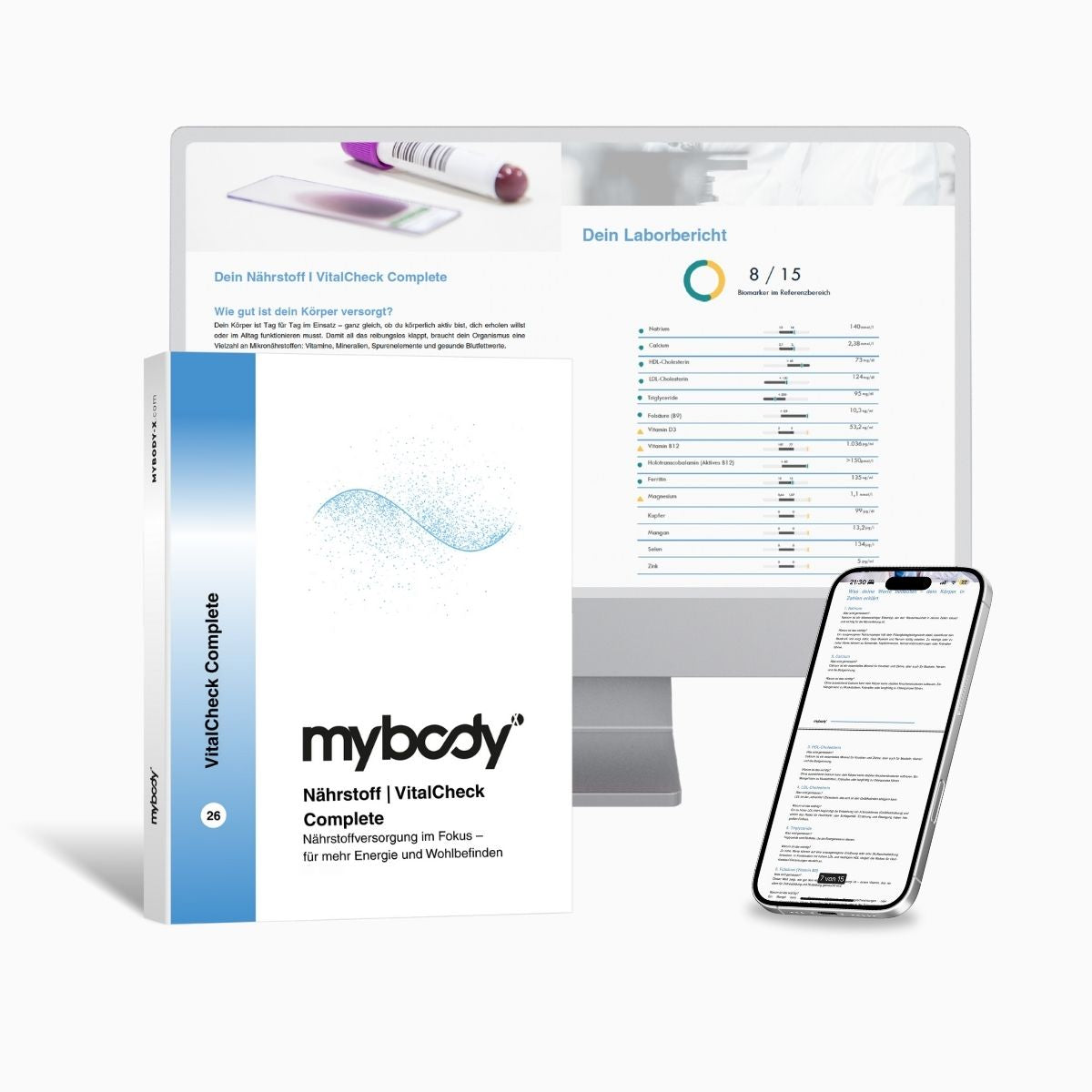
Capillary blood test
VitalCheck | Complete Nutrient & Mineral Test
Measures 18 values, including selenium, zinc, and albumin from the same sample. It also measures vitamin D, vitamin B12, folate, ferritin, iron, transferrin, calcium, magnesium, phosphate, HbA1c, CRP, and the cholesterol profile. What the test does not do: It does not detect selenium deficiency—the cited specialist source states that blood tests for this purpose are currently unavailable. It does not assess any specific diet, provide a diagnosis, or replace a medical examination.
Laboratory analysis 3–5 business days after receipt of the sample
Product page information, accessed 15 August 2026
Four points determine whether these two values provide useful information.
Consider albumin
A low albumin level makes it more difficult to determine the serum zinc level.
Understand the caveat
Regarding selenium, the source states that blood tests do not detect a deficiency.
Avoid detours
The source describes urine and hair values as unreliable in cases of acute deficiency.
Discuss the interpretation
The source explicitly refers here to living conditions and symptoms.
Chapter at a glance
A capillary blood self-test measures selenium, zinc, and albumin from the same sample, but it does not detect a deficiency or provide a diagnosis. Four points are decisive: consider albumin, understand the caveat, avoid detours, and discuss the interpretation.
Limitations: what we could not substantiate
The first limitation is the lack of a dietary connection. In the specialist sources we reviewed, we found no statement linking a deficiency of either element to a specific diet.
The second limitation is the lack of reference ranges. In the specialist sources we reviewed, we found no reference ranges with units for zinc and selenium. The range on your own lab report is therefore decisive.
The third limitation is stated verbatim in the source. Blood tests to detect selenium deficiency are currently unavailable (MSD Manual, Patient Version, as of July 2025).
The fourth limitation is diagnosis. All the assessments in this article provide context and do not constitute a diagnosis. A diagnosis is made in medical practice based on several factors, and no self-test can anticipate it.
What matters for these two
If you take away just one thing from this article, let it be this: With these two values, measurability is not the problem; interpretation is.
For zinc, the specialist literature mentions difficult laboratory diagnosis and a second value that helps with interpretation. For selenium, it says that a blood test does not demonstrate a deficiency.
The question at the beginning was whether people eating a plant-based diet should take a closer look at their own status. The honest answer is: Taking a closer look is worthwhile, but for a different reason than expected. Not because of the dietary pattern, but because of the reservations that are not supported by any finding.
Frequently asked questions
Are selenium and zinc deficiencies more common with a plant-based diet?
We found no such connection for either of the two in the specialist sources reviewed. IQWiG cites chronic gastrointestinal disease, kidney failure, or an unbalanced diet as causes of selenium deficiency and lists fish, meat, grains, and nuts among the sources. It does not identify any particular dietary pattern.
Can selenium deficiency be detected in the blood?
The MSD Manual, patient edition, states: Suspected selenium deficiency is based on the affected person's circumstances and symptoms. Blood tests to detect this deficiency are currently unavailable (as of July 2025). A selenium level can be measured; the source says that it does not demonstrate a deficiency.
How reliable is a zinc level from a blood test?
The MSD Manual, professional edition, states: Laboratory diagnosis is also difficult and requires special collection techniques. It also states: Low albumin levels, which commonly occur with zinc deficiency, make determining the serum zinc level difficult (as of May 2025). The value should therefore be interpreted together with albumin.
Are hair analyses useful for zinc?
The cited source rules out this approach in acute cases: urine zinc levels are not reliable in acute deficiency, nor are hair zinc levels (MSD Manual, professional edition, as of May 2025).
Why measure at all, then?
Because a value with a date provides a starting point that would otherwise not exist, and because the values in a profile come from the same sample anyway. What follows from this is decided in medical practice, and the specialist literature explicitly points to circumstances of life and symptoms for both elements.
Next step
Zinc and albumin side by side
According to the specialist literature, a zinc value alone is more difficult to interpret than one accompanied by an albumin value. VitalCheck measures selenium, zinc, and albumin along with 15 other values from capillary blood. It does not detect a deficiency, provide a diagnosis, or replace medical evaluation.
Go to VitalCheckRead more
You might also be interested in
Which values belong on a list and why.
Why three values can be placed side by side but cannot be combined mathematically.
Sources
- MSD Manual, Consumer Version: Selenium deficiency, Johnson LE (full review May 2025, last updated July 2025) – msdmanuals.com
- MSD Manual, Professional Edition: Zinc deficiency, Johnson LE (full review May 2025) – msdmanuals.com
- Institute for Quality and Efficiency in Health Care (IQWiG): Glossary entry on selenium – gesundheitsinformation.de
- IQWiG: Understanding laboratory values correctly, status 02.04.2025 – gesundheitsinformation.de
The verbatim quote about blood tests for selenium deficiency and the sentence about living circumstances and symptoms come from source [1]. The statements about the difficulty of laboratory diagnosis, special collection techniques, albumin levels, urine and hair values, and the list of enzymes come from [2]. The description of selenium as an essential mineral, the food sources mentioned, and the stated causes of deficiency come from [3]. The explanation of the reference range comes from [4]. Reference values with units for zinc and selenium, as well as a reference to a specific dietary pattern, were not found in the reviewed specialist sources; both are explicitly identified as such in the text. Information on price, values, sample type, and laboratory comes from the mybody®x product page, accessed on 15.08.2026; processing times follow the central specification for blood tests. All sources were accessed and reviewed on 15.08.2026.

mybody®x Editorial & Specialist Team
Laboratory diagnostics Blood analysis interpretation Nutritional science Nutrigenetics
This article was created by the mybody®x editorial and specialist team. The team combines laboratory diagnostics, nutritional science, and the interpretation of blood analyses. Everyone who contributes to it is listed on the authors page.
Published on 15.08.2026 · Last updated on 15.08.2026
The content is for general information and does not replace medical advice, diagnosis, or treatment. Reference ranges depend on the laboratory, method, and age—your test report always provides the authoritative information.




Share now:
TSH self-test and lab test: what each one can do
Vitamin D in summer: levels don’t rise automatically