
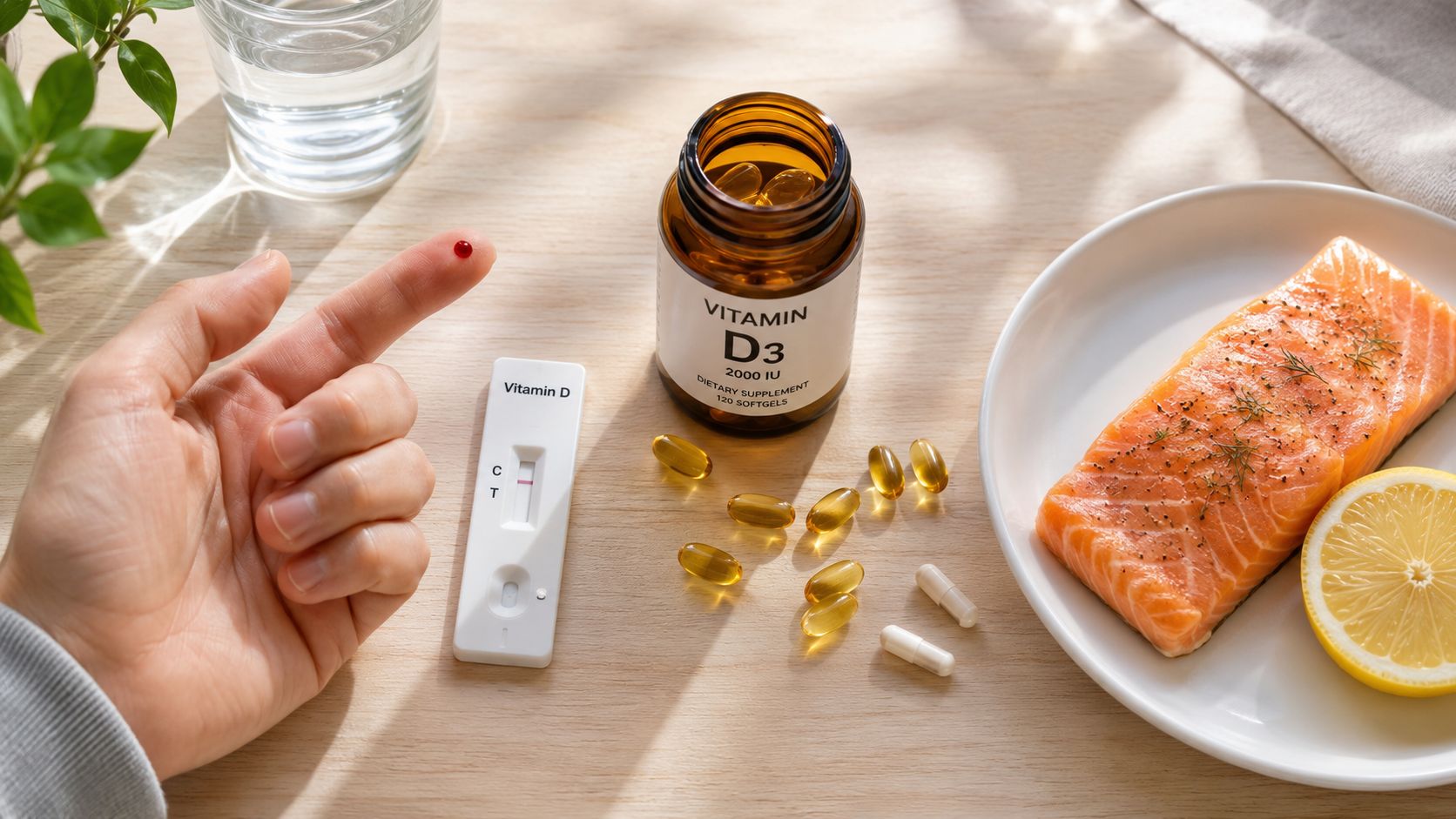
Vitamin D3 deficiency: symptoms
You get enough sleep, but still have trouble getting going in the morning. You cannot focus at the office, your energy crashes in the afternoon, and it feels as though every cold immediately throws you off balance. This is precisely the gray area where things often become unclear: Is it simply everyday life, stress, and the season? Or is there actually a deficiency behind it?
This gray area is especially typical with vitamin D3 deficiency symptoms. Many symptoms are nonspecific. They can also be caused by lack of sleep, strain at work, little exercise, or an overall demanding period. As a result, many people go for months feeling “not quite themselves” without having a clear starting point.
If you want to understand your body better, at some point you need more than just speculation—you need a measurable value. Only then can you determine whether your fatigue, susceptibility to infections, or muscle pain may be related to your vitamin D status.
Constantly tired and sluggish? How to recognize a vitamin D deficiency
Persistent exhaustion is often explained too hastily. Too much work, too little sleep, too much screen time. All of that may be true. Even so, it is worth taking a closer look if you feel sluggish for weeks, have low stamina, or constantly feel as though your battery never fully recharges.
Vitamin D plays a role in many processes in the body. When your levels are inadequate, this can show up in precisely this vague way: less energy, greater susceptibility to infections, and reduced physical resilience. The tricky thing is that these symptoms do not immediately look like a “deficiency.”
Looking at how widespread it is makes the issue more tangible: A study by the Robert Koch Institute shows that 30.2% of adults in Germany have a vitamin D deficiency. This means that almost one in three people do not have optimal levels, as summarized in the IKK classic overview of vitamin D deficiency.
When fatigue is more than just fatigue
It becomes especially confusing when different strains overlap. People who are under constant stress, work shifts, or are under psychological pressure often attribute symptoms to just one cause. If you are wondering how to distinguish stress symptoms from other physical causes, the Personal 1 guide to bullying can also help you better identify typical warning signs in the workplace.
Fatigue is not proof of a vitamin D deficiency. But it is a good reason to take a closer look when it no longer fits your everyday life.
Many people get stuck at precisely this point. They notice that something is wrong but have no clear next step. If you are particularly interested in the connection between exhaustion and vitamin D, the article on Vitamin D Deficiency and Fatigue provides a more in-depth explanation.
The most common symptoms of vitamin D deficiency
In practice, a recurring pattern often emerges. Three early complaints stand out most frequently: persistent fatigue despite sleep, muscle and bone pain, and frequent infections. Many people report this exact triad before anyone even considers a nutrient deficiency.
This is consistent with the fact that vitamin D deficiency often presents clinically with nonspecific symptoms. Chronic fatigue, muscle weakness, and bone pain are typical complaints. A blood level below 12 ng/ml (30 nmol/l) is considered a manifest deficiency that increases the risk of osteomalacia, as described in the DocCheck Flexikon entry on vitamin D deficiency.

The typical triad in everyday life
These three signs seem banal. That is precisely why they are so often overlooked.
-
Fatigue despite sleep
You spend long enough in bed but wake up feeling unrefreshed. The day feels like a struggle, even without acute sleep deprivation. -
Muscle and bone pain
The symptoms are often diffuse. Not necessarily a clear injury, but rather a pulling sensation, pressure, or feeling of weakness. -
Frequent infections
You feel as though you catch every cold or recover more slowly after infections.
Subtle symptoms that are easily misinterpreted
Not everyone affected experiences severe pain. Many people fall somewhere in the gray area. They feel less resilient, more irritable, or less mentally clear. Mood swings and concentration problems can also be part of it.
A symptom that is surprisingly often overlooked is suddenly increased hair loss. Many people initially associate it with stress, hormones, or the changing seasons. That is understandable. Nevertheless, a low vitamin D level may also play a role here. If you are interested in the connection between nutrient status and skin or hair, you can find more background information at Vitamin D Deficiency and Skin Problems.
What you should look out for: What matters is not a single symptom, but the pattern over several weeks.
When a pattern should be taken seriously
This simple self-check can help:
| Observation | More likely nonspecific | More likely to require evaluation |
|---|---|---|
| Fatigue | After brief periods of stress | For weeks despite sleep |
| Pain | Clearly explained by exercise | Diffuse and recurring |
| Infections | An occasional seasonal cold | Noticeably frequent |
| Hair | Normal shedding | Significantly more hair loss than usual |
If several factors come together, a blood test is often more useful than more guesswork. For people with a confirmed deficiency, a targeted supplement such as Vitamin D3 K2 Complex | Shield may also be relevant later. According to the product description, it combines high-dose D3 with K2 for optimal calcium utilization, bone health, and immune function. It is intended for use after DNA or blood testing has confirmed a deficiency.
The real causes of depleted vitamin D stores
Many people eat consciously, pay attention to nutrients, and are still undersupplied. At first, this seems contradictory. But with vitamin D, the main reason is usually not what is on the plate, but what is outside the front door. Or, more precisely, where you simply do not spend enough time.

About 80–90% of the body’s vitamin D requirements are met through the skin via sunlight. In Germany, 10–30 minutes of sun on the face, hands, and forearms two to three times a week between March and October is generally sufficient, according to the University Hospital Zurich’s information on vitamin D deficiency.
The real core issue is often a lack of light
This explains why even health-conscious people can be affected. You can eat a balanced diet and still produce too little vitamin D if your daily routine is mostly indoors. Working from home, office work, shift work, and a busy schedule can quickly and significantly reduce natural UV exposure.
There is also a seasonal effect. During the darker months, levels are more likely to drop, and early symptoms are often dismissed as the “winter blues.”
Who should take a closer look
Certain situations particularly increase the risk:
-
Lots of time indoors, little daylight
If your job is mainly desk-based, you often lack regular sun exposure. -
Darker skin type
In that case, the body’s own production may be impaired. -
Older age
As you age, the body’s own production changes. -
Chronic conditions
Especially with issues affecting fat metabolism, the kidneys, or the intestines, maintaining adequate levels can be more difficult.
Not every case of insufficient levels is caused by “poor nutrition.” Often, everyday life simply does not support the body’s own vitamin D production.
The gut can also play a role
Another factor is often underestimated: malabsorption. Chronic intestinal diseases such as Crohn’s disease or celiac disease can impair nutrient absorption. For those affected, the situation can then feel particularly frustrating because they make an effort but still do not reach a healthy range.
So if you identify several risk factors in yourself and also have vague symptoms, it makes sense not to rely on how you feel alone.
How to find out your exact vitamin D level
When you have symptoms of vitamin D3 deficiency, guessing is not a good strategy. The symptoms are too nonspecific, and any countermeasure should not be taken based on suspicion alone. If you want to know whether your symptoms match your vitamin D status, you need a blood test for 25-OH vitamin D.
For context: A level below 20 ng/ml is considered a deficiency, 20–30 ng/ml indicates insufficient levels, and 30–100 ng/ml is considered the optimal range, as described in femna’s guide to interpreting vitamin D levels.

Why a measurement is more useful than guessing
A laboratory value turns a vague feeling into a clear basis for decision-making. This helps in several ways at once:
-
You can identify your current status
Not every instance of fatigue is a deficiency. The blood value distinguishes suspicion from a confirmed finding. -
You can take more targeted action
There is a practical difference between mild undersupply and a significant deficiency. -
You have a basis for medical assessment
This is particularly important if your symptoms are severe or your levels are very low.
What options you have
Traditionally, testing is carried out through a doctor’s office. For many people, this makes sense, especially if they already have medical conditions or several symptoms need to be investigated at the same time.
There are also home tests. The at-home vitamin D test explains how this measurement works using a small blood sample from the fingertip. The mybody x blood test is one option for people who want to conveniently determine their levels at home and are looking for a laboratory result as a starting point.
What you can do with the result
A single value is not yet a solution. But it is the point at which your next steps become clearer. You can make a better decision about whether more sun exposure is realistic, whether supplementation is an option, or whether you should discuss the findings with a doctor.
For people who want to take a broader, long-term view of their health, the Longevity ALL IN ONE DNA Test may also be of interest. According to the product description, it analyzes genetic risk factors for aging, inflammation, nutrient utilization, and metabolism. This is not a substitute for a current vitamin D blood test, but it can reveal additional connections related to nutrient utilization.
Your plan for optimal vitamin D levels
As soon as you know your level, the issue suddenly becomes concrete. It is no longer about vague symptoms, but about an actionable plan. In practice, this works best through three components: light, nutrition, and targeted supplementation.
It is also worth looking at milder cases. Research suggests that even insufficient levels in the range of 30–50 nmol/l (approx. 12-20 ng/ml) can lead to subtle symptoms such as reduced performance, a slight susceptibility to infections, and mood swings, even without severe bone pain, as described by Bioscientia in its information on vitamin D.
Three levers that work together
Here is a practical framework:
-
Use the sun sensibly
Spending regular time outdoors can help if your daily routine has so far taken place almost entirely indoors. It is not about extreme sunbathing, but about establishing predictable routines. -
Putting nutrition into perspective
Food can help, but it often cannot correct a significant deficiency on its own. That is why it is important not to have unrealistic expectations of your diet. -
Use supplements strategically rather than blindly
When a deficiency has been confirmed, supplementation is often the most pragmatic step. Dosage should be based on the findings and, in the case of significant deviations, discussed with a doctor.
Practical rule: The less clear your symptoms and the clearer your lab value, the easier it becomes to make good decisions.
A specific example from practice
A female client in her early 40s came in with fatigue, joint pain, and hair loss. Her vitamin D3 level was 10 ng/ml. After 10 weeks of targeted supplementation with 4,000 IU plus K2, she reported that her energy had increased significantly, her hair loss had stopped, and her joint pain was barely noticeable.
These outcomes show why a targeted plan works better than chance. What matters is not simply taking anything, but using the findings as a starting point. A useful practical complement can be the article on addressing vitamin D deficiency if you want to translate the next steps into your everyday life.
When You Should Consult a Doctor
Especially in cases of very low levels, severe symptoms, or known medical conditions, the findings should also be reviewed by a doctor. This also applies if you are already taking medication or have known diseases of the intestines, kidneys, or metabolism.
From Test Result to a New Sense of Well-Being
Simply having a result in hand often changes something important. You stop merely speculating. Instead, you can see in black and white whether your feeling has a measurable basis. This relieves many people, even if the result is not ideal.
After the test, the truly decisive part begins: putting the results into practice. If you have a significant deficiency, you should discuss the result with your primary care doctor, especially if your symptoms are severe or have persisted for some time. A lab result helps assess the situation properly and determine what to do next.
Support in everyday life can also make a big difference. Especially when it comes to supplements, routines for getting more daylight, or questions about the next check-up, many people otherwise remain uncertain.
“I have energy again without having to force myself.”
This feedback is particularly common in coaching when vitamin D3 levels are balanced. Many people report this within 6–8 weeks of starting supplementation. This is not a promise for every individual case. But it clearly shows what really matters: not just a lab result, but feeling more balanced, alert, and resilient again.
If you have been feeling somewhere between “I’m getting by” and “I don’t really feel well” for a while, having a clear result is often the first sensible step. That is exactly where the guesswork ends and a decision that suits you begins.
If you recognize vitamin D3 deficiency symptoms in yourself and finally want clarity instead of guesswork, a mybody x blood test could be the right place to start. You will receive a measurable result as a basis for your next steps at home, in coaching, or in a conversation with your doctor.
Share:
Muscle weakness—what to do? Find the causes and build strength
Cortisol levels: Reduce stress and find balance