

Dysbiosis symptoms and causes: what the term really means
The essentials at a glance
Dysbiosis describes an imbalance in the composition of the gut microbiome. The term sounds like a diagnosis, but it is not: there is no laboratory value above which dysbiosis is present, and no binding normal range for a healthy gut microbiome. Anyone who reads the term is reading a description, not a finding.
This article explains what lies behind the word, which factors have been shown to change the composition of the gut microbiome, and where the evidence ends. Whenever an institution makes a statement, it is identified here by name and year.
You will first read why there are no standard values. This is followed by symptoms that should be medically evaluated, factors affecting the gut microbiome, four common statements examined for accuracy, and the question of what an examination actually tells you about them.
What to expect in this article
1. What dysbiosis means and why the term remains vague
2. Why there is no standard value for a healthy gut microbiome
3. When abdominal symptoms should be medically evaluated
4. What is meant by dysbiosis symptoms
5. Which factors change the gut microbiome
6. Antibiotics, diet, and stress considered individually
7. Four statements about dysbiosis and what remains of them
8. What a microbiome test result shows about dysbiosis
9. Which approach suits which question
10. How you can have your gut microbiome examined
11. Who may benefit from an examination
12. What matters when it comes to dysbiosis
Frequently asked questions
Sources
What dysbiosis means and why the term remains vague
The word is made up of two Greek parts. Dys means disturbed or faulty, while Biose means living together. Literally translated, dysbiosis therefore means disturbed coexistence.
This refers to an imbalance in the community of microorganisms inhabiting the gut. Certain groups increase, others decrease, and the diversity shifts. That is the extent of the description, and at that level it is undisputed.
The difficulty begins one level below that. To identify an imbalance, you need a point of reference representing balance. That exact reference point is missing, and the frequent use of the term does not change this.
Key point
Dysbiosis is a descriptive term for an altered balance of gut bacteria, not a clinical diagnosis with a defined threshold.
Where the term comes from
Dysbiosis is not a new word. It comes from microbiology, where it has long described an altered microbial community, regardless of whether it refers to a person, an animal, or an ecosystem.
In recent years, the term has moved from technical language into advice texts. Along the way, it has acquired something it never had in technical language: the sound of a diagnosis. Someone who reads that they have dysbiosis is reading something different from the microbiologist who uses the same word.
This shift is why this article starts with the term itself rather than with a list of symptoms. If you do not know what a word claims, you cannot assess what an examination of it can establish.
There is also a linguistic side effect. Technical terms sound more precise than everyday words, even when they are not. “My gut flora is out of balance” sounds vague, while “I have dysbiosis” sounds like a finding. Both sentences say the same thing.
Once you have noticed this, you read texts on the subject differently. The question is no longer whether dysbiosis is present, but which specific measure is meant and how it was measured.
The difference from a genuine diagnosis
A clinical diagnosis has three components that dysbiosis does not. It has a definition agreed upon by professional societies. It has criteria used to diagnose it. And it has a code in a classification system used for billing and documentation.
Irritable bowel syndrome meets all three of these points. It is described as a disease, there are criteria for diagnosing it, and it appears in the classification systems. Dysbiosis meets none of the three.
That does not make the term worthless. It makes it something different from what many texts suggest: an observation about a bacterial community, not a statement about a person.
Why there is no normal value for a healthy gut flora
For a blood value such as hemoglobin, reference ranges exist. They are based on measurements from many people and indicate what is considered usual. There is no equivalent for the composition of the gut flora.
The reason lies in the nature of the matter itself. The gut flora of two healthy people can differ so greatly that no single target state can be derived from it. The German Federal Institute for Risk Assessment notes that there are major differences in the composition of the stool microbiota between individuals (BfR, 2026).
This statement comes from a position paper on infant formula with probiotic additives. The context is different from the one here, but the observation about variability gets to the heart of the question of a normal value.
What a report actually shows
A microbiome report compares your values with those of a comparison group. So it does not say whether your gut flora is right; it says how it compares with that of other people.
The difference sounds academic, but it is not. A deviation from the average is not a medical finding in the true sense. People differ in many ways without any of those differences being wrong.
In practical terms, this means that a reference to dysbiosis in a report is a comparative classification, not a finding that a disease state is present. Chapter 8 explains how this reference is arrived at.
Why two healthy people can look so different
The composition of the gut microbiome develops over many years. It depends on how someone was born, what they ate as a child, where they live, which medications they have taken, and how they eat today.
Two people with the same ZIP code and the same age can therefore have gut microbiomes that differ significantly in their proportions. Both may be completely symptom-free.
Such a range would be unusual for a blood value. For the gut microbiome, it is the norm, and that is precisely why the attempt to define a single target state fails.
What enterotypes are and what they cannot do
The term enterotype appears in many reports. It refers to the attempt to divide gut microbiomes into a few basic patterns, similar to blood groups.
This classification helps with interpretation because it reduces large amounts of data to a manageable number of patterns. However, it does not replace a reference range, because it only indicates which pattern your sample most closely resembles.
An enterotype is therefore a description like hair color. It classifies without evaluating. Anyone who wants to infer something about their health from their enterotype is asking too much of the category.
When abdominal symptoms should be medically assessed
This chapter appears deliberately near the beginning. A text that places the criteria for stopping at the end reaches precisely the reader for whom they are intended.
Anyone who notices warning signs should not take a test but make an appointment.
Anyone who notices warning signs should not take a test but make an appointment. The following list does not replace an examination; it indicates the order of priority.
These signs should be assessed by a doctor
Blood in the stool
Reddish, black, or very dark stool, regardless of the amount
Unexplained weight loss
without any change in diet or physical activity
Bowel habits that have changed over several weeks
when the usual pattern changes significantly and permanently
Fever together with abdominal symptoms
especially if it persists for several days
Fatigue and weakness accompanied by paleness
that do not improve with rest
The points follow the compilation by the Institute for Quality and Efficiency in Health Care on intestinal symptoms requiring clarification (IQWiG, 2021). The same source explicitly notes that all these signs are nonspecific and usually have other causes.
This is neither an all-clear nor an alarm, but a sequence. A single sign means little; several at once, or one lasting for weeks, means making an appointment.
What is meant by dysbiosis symptoms
Guide articles usually contain a long list: bloating, alternating bowel movements, a feeling of fullness, fatigue, skin problems, and difficulty concentrating. The list is so broad that it applies to almost everyone in at least one respect.
That is precisely where its problem lies. A symptom list that includes everything distinguishes nothing. It allows no attribution; instead, it creates a sense of recognition that anyone can experience.
Documented source
“The causes of irritable bowel syndrome have not yet been clearly established.”
Institute for Quality and Efficiency in Health Care (IQWiG)
Irritable bowel syndrome, as of 2023
This quotation comes from a text about irritable bowel syndrome, not dysbiosis. It is included here nonetheless because both topics share the same list of complaints, and because, unlike dysbiosis, irritable bowel syndrome is a recognized clinical term. If the causes are unclear even there, the same list of complaints certainly cannot be used to draw any conclusions about the gut microbiome.
Why the Direction of the Statement Matters
A statement such as “people with irritable bowel syndrome are more likely to have an altered gut microbiome” is entirely different from “your complaints are caused by your gut microbiome.” The first describes an observation in a group; the second claims a cause in an individual.
The medical literature regularly makes statements of the first kind. Informational articles turn them into statements of the second kind. The entire difference between an observation and a diagnosis lies between the two.
For you as a reader, this means that complaints are a reason to look more closely. They are not proof that the gut microbiome is the cause.
Why the List of Complaints Is So Broad
There is a factual reason why these lists are so long. The gut is involved in many things: digestion, defense, and the production of certain vitamins. So anyone looking for possible effects will find something in many areas.
The problem arises from reversing the logic. The statement “the gut is involved in many things” becomes “many complaints come from the gut.” The first is supported by evidence; the second is a fallacy.
A symptom list can therefore never be the starting point. At best, it is a reason to look more closely—and to start by ruling out an illness.
What Fatigue and Skin Appearance Have to Do With It
Fatigue, difficulty concentrating, and skin problems are mentioned particularly often. These three are the most nonspecific complaints of all, and each has dozens of possible causes.
Fatigue, for example, can result from too little sleep, iron deficiency, a thyroid disorder, or a stressful phase of life. The gut is on this list, but it is not at the top—and certainly not the only possibility.
Anyone who has their gut microbiome examined first when experiencing persistent fatigue is checking one possibility among many while leaving the more common ones unexamined. That is the wrong order, and it costs time.
Factors That Alter the Gut Microbiome
Unlike the symptoms, the evidence on these influences is considerably stronger. That the composition of the gut microbiota can be changed is undisputed. What this means for an individual remains contested.
The most important influencing factors have long been described: diet, medication, age, illness, and everyday stress. They act at different speeds and with different strengths.
Diet has the broadest body of evidence behind it. The Max Rubner Institute states that a varied diet containing different plant foods is generally associated with high ecological diversity in the gut microbiota (MRI, 2026).
How quickly things change
The gut microbiota responds to a changed diet within weeks. This fundamentally distinguishes it from genetic predispositions, which never change, and from blood values, which shift over the course of months.
This has an implication for testing that is often overlooked in everyday life. A single result describes one point in time. Anyone who wants to know whether a change has had an effect needs two measurements and, in between, a record of what they changed.
Antibiotics, diet, and stress in detail
Of all the influences, antibiotic therapy is the fastest and most pronounced. An antibiotic does not distinguish between the pathogen it is used against and the bacteria that already live in the gut.
This is not an argument against antibiotics. They are prescribed because an infection needs to be treated, and that decision is made by a medical practice, not by an advisory text. The only conclusion is an expectation: after such treatment, the gut microbiota looks different than it did beforehand.
The dietary-fiber lever and its scale
When it comes to diet, the best-supported lever is dietary fiber. The German Nutrition Society recommends a guideline value of at least 30 grams per day for adults.
Actual intake is significantly lower. According to data from the National Nutrition Survey II, median intake in Germany is 18 grams per day for women and 19 grams for men (MRI, 2026). There is therefore a gap of around one-third between the guideline and reality.
This is the most concrete figure in the entire field. Anyone who wants to change their gut microbiota and is looking for a starting point is more likely to find it here than in a single food.
How to close the gap in practice
An additional eleven to twelve grams of dietary fiber may sound like a lot. In practice, they can be achieved through a few adjustments, without anyone having to overhaul their diet.
The Max Rubner Institute identifies bread as by far the most important source of dietary fiber in Germany, followed by fruit, vegetables, and grain products (2026). The key lever is therefore not an exotic food, but a decision that is already made every day.
Fluids are important here. The German Nutrition Society points out that fiber from whole grains binds water and that, especially with larger amounts, it is important to ensure adequate fluid intake.
And the change happens gradually. Anyone who doubles the amount from one day to the next will very likely have a few unpleasant days. Spread over two or three weeks, the same increase is barely noticeable.
What can be said about stress
Stress is mentioned in almost every text on the subject. The connection between stress and digestion is easy to understand in everyday life, and many people know it from personal experience.
However, there is no documented figure for how much a stressful phase of life shifts the composition of the gut microbiome. That is why this article contains no such figure. An estimate would be the worse error.
Chapter at a glance
The composition of the gut microbiome can be influenced, most clearly by antibiotics and diet. The best-supported point of intervention is fiber intake: The DGE recommends at least 30 grams per day, while median intake in Germany is 18 grams for women and 19 grams for men (MRI, 2026). There is no equivalent figure for stress as an influencing factor.
Four statements about dysbiosis and what remains of them
These four statements appear in almost every text on the subject. All four sound convincing, and all four stand up to scrutiny only in part.
Checked against the evidence
Common
“Dysbiosis is a diagnosis that can be made.”
Documented
A diagnosis requires a reference range. The BfR describes major differences between people in the composition of the stool microbiota (2026). A single normal state cannot be derived from this.
Common
“My symptoms prove that my gut microbiome is disrupted.”
Documented
Even in irritable bowel syndrome, a recognized term for the same list of symptoms, the causes have not yet been clearly established, according to IQWiG (2023).
Common
“A single superfood brings the gut microbiome back into balance.”
Documented
The MRI describes the association in terms of the diversity of plant foods and total fiber intake, not individual foods (2026).
Common
“Greater diversity in a test result is automatically better.”
Documented
In a randomized seventeen-week study, diversity remained stable on a high-fiber diet, while it increased with fermented foods (Wastyk et al., Cell, 2021). Each group comprised eighteen people.
All four statements reflect the same legitimate need: an explanation for something that has not changed for months. The need is understandable, but taking a shortcut through a technical term is not.
What a microbiome test reveals about dysbiosis
A microbiome report may contain an indication of dysbiosis. What matters is what this indication is and what it is not.
It arises by comparing your values with those of a reference group. If the composition deviates in certain respects, this is reported as an indication. This is a mathematical classification, not a medical diagnosis.
What such a finding additionally provides are specific metrics: species diversity, the ratio of major bacterial groups to one another, and the proportion of certain metabolic functions. These figures are the actual content, not the word dysbiosis.
Which metrics actually appear in the report
A microbiome gut test report provides several measurements. Biodiversity describes how many different species are present and how evenly they are distributed. The enterotype assigns the sample to a basic pattern.
There are also bioindicators that describe a function rather than a species. Butyrate producers, for example, are bacteria that produce a short-chain fatty acid from dietary fiber. Sulfate-reducing and methane-producing organisms describe other metabolic pathways.
Finally, the FODMAP index indicates how significantly fermentable carbohydrates affect you. This is the measure with the most direct relevance to everyday life because it can be related to food groups.
These metrics are the content of a report. The statement about possible dysbiosis summarizes them; it adds nothing to them.
How this article differs from its neighbors
This text explains a term and puts it into context. Anyone who wants to know what the diversity value in a report specifically means can find that information in Microbiome Diversity in the Report. Anyone wondering whether a health insurance provider covers such an examination can find the answer in Microbiome Test and Health Insurance.
Which bacterial species and markers may appear in a report can be looked up in advance. The Gut Lexicon lists them in a searchable overview.
What a finding does not say about the cause
Suppose a report indicates dysbiosis. What follows from that? Initially, only that the composition differs in certain respects from that of the comparison group.
Whether this deviation is the cause of your symptoms, a consequence of them, or whether both exist independently cannot be determined from the findings. An image shows a state; it does not show how that state came about.
This is the most important limitation of all, and it is almost never mentioned in consumer information texts. Knowing it helps you interpret a finding correctly: as a description that clarifies a question rather than answers it.
Which approach fits which question
There are three ways to approach the question of dysbiosis. They are not mutually exclusive, but they answer different questions. The table compares them according to the same four criteria.
| Criterion | Medical evaluation | Analysis of gut flora | Change your diet |
|---|---|---|---|
| Answers the question | Is there an illness behind my symptoms? | What is the current composition of my gut flora? | Does anything change if I eat more fiber? |
| Detects dysbiosis | No, the term is not a clinical diagnosis | Only as an indication compared with the reference group | No |
| Cost | Generally covered by health insurance when medically indicated | Self-pay service | none additional |
| Time required | Appointment and waiting time | Kit shipping 1–3 working days, laboratory analysis 5–10 working days | several weeks until effects appear |
A finding describes a condition, not a cause. That is why medical evaluation appears in the first column rather than the last.
How to have your gut flora analyzed
If, after reading the text so far, the question remains of how your own gut flora is composed, it can be answered with a stool sample. The mybody®x Gut Microbiome Test (MYBODY Lab GmbH) reads the genetic material of the microorganisms in the sample.
What it does not reveal is stated on the card itself. For a term without a reference range, this information is more important than any sales argument.
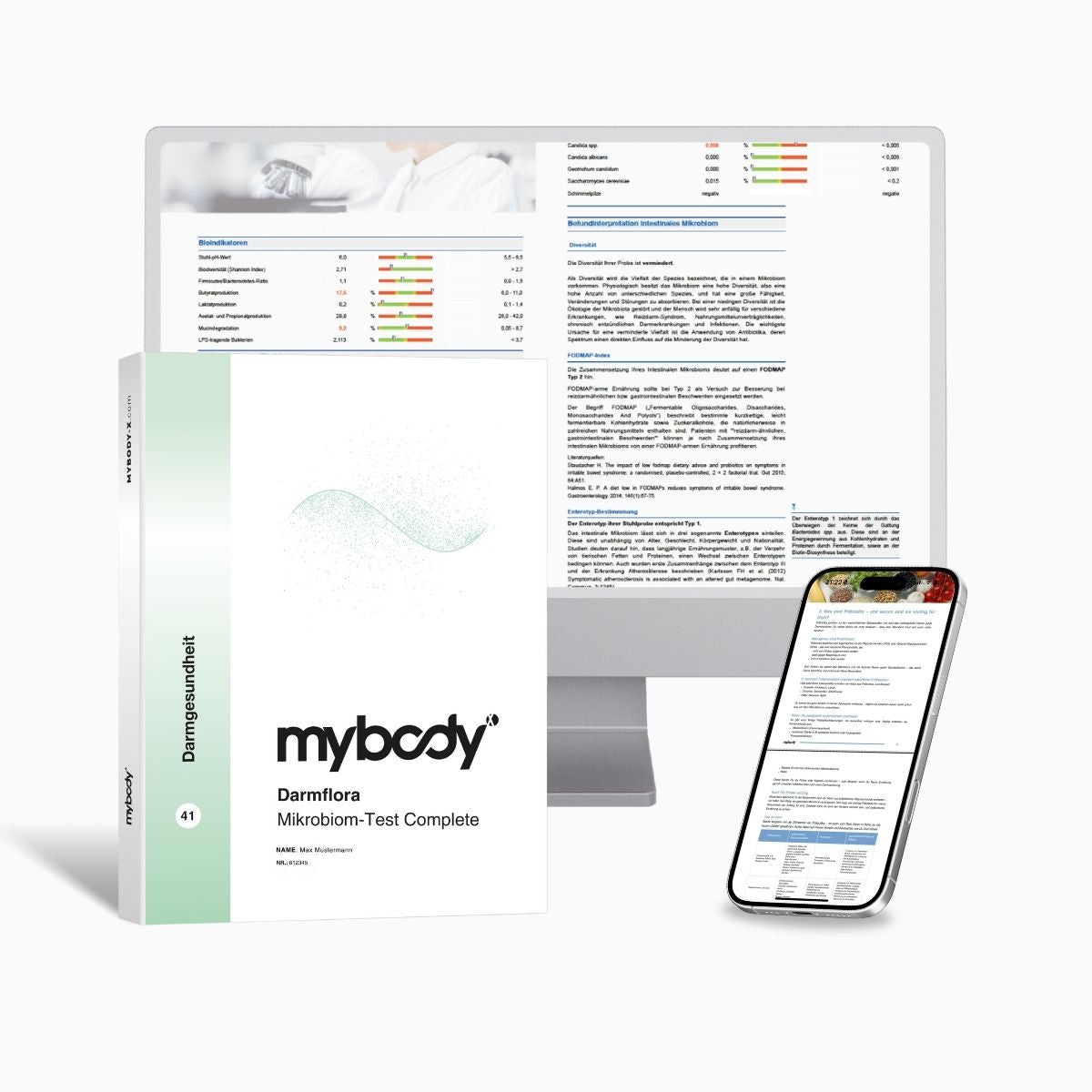
Gut test from a stool sample
Gut microbiome test | Complete
Analyzes over 1,500 bacterial species using DNA sequencing, as well as biodiversity, enterotype, the FODMAP index, and eight bioindicators. The report also indicates possible dysbiosis. What the test does not do: It does not provide a diagnosis, and such an indication is a classification compared with a reference group, not a disease finding. It does not detect chronic inflammatory bowel disease, a tumor, an infection, or celiac disease.
Laboratory analysis 5–10 working days after sample receipt
Product page statement, accessed 27 August 2026
The statement of over 1,500 bacterial species comes from the product page. The specific species and markers are listed in the Gut Encyclopedia.
Why the second measurement is the more important one
A single test result describes one point in time in a system that changes within weeks. It is therefore a starting point, not an answer.
The matter becomes meaningful only in comparison. If you measure, make a specific change for three months, and then measure again, you can see a direction. Without that change in between, you are comparing two random snapshots.
This leads to an uncomfortable recommendation: if you do not plan to change anything about your diet in the coming months, you usually do not need the first measurement either. It then describes a state from which nothing follows.
What is possible without any measurement
For many people, the most useful first step is not a test but a record. Writing down for two to four weeks when which symptoms occur and what was eaten that same day costs nothing.
Such a record provides something a test result does not: a temporal connection. It shows whether symptoms coincide with certain meals, days of the week, or periods of stress.
It also shortens the medical consultation. Anyone who brings it along does not have to reconstruct from memory how often and how severely something occurred.
Who an examination makes sense for
It makes sense for you if …
your symptoms have persisted for months, have been medically evaluated, and you are looking for a baseline assessment.
you want to increase your fiber intake and track the progress with one measurement beforehand and another after three months.
you want to see what your gut flora currently looks like after antibiotic treatment.
Probably not if …
you expect confirmation that dysbiosis is present. The result provides a reference value, not a diagnosis.
you notice one of the warning signs from Chapter 3 in yourself. Then making an appointment is the right order, not taking the test.
you have never looked at your fiber intake. That is where the better-supported and cost-free leverage lies.
What matters when it comes to dysbiosis
If you take away one action from this article, let it be this: roughly count your fiber intake for one week. Not down to the gram, but by order of magnitude, and compare the result with the DGE’s 30 grams.
The reason is unremarkable. Of everything stated in this text, this is the only measure with a clear target value, a documented current value for Germany, and an opportunity for change that costs nothing.
What is misleading here is the order. First go through the warning signs in Chapter 3 and make an appointment if necessary. Then look at fiber intake. Only afterward, if the question of your own composition remains unanswered, should you consider an examination.
This order is inconvenient because it starts with the cheapest option and ends with the most expensive. It is still the right one, because each step can make the next unnecessary.
It began with the question of what dysbiosis means. The most honest answer is: a descriptive word for a shift whose reference point no one has defined. That is less than the term promises, and more than any list of symptoms could ever show.
Frequently asked questions
What is dysbiosis in simple terms?
Dysbiosis describes a shifted balance of bacteria in the gut. The word comes from Greek and literally means disturbed coexistence. It is a descriptive term, not a recognized clinical diagnosis: There is no laboratory value above which dysbiosis is present, because the gut flora varies considerably among healthy people (BfR, 2026).
Which symptoms indicate dysbiosis?
The symptoms mentioned in health guides are nonspecific: bloating, alternating bowel movements, a feeling of fullness, and fatigue. None of these symptoms can reveal the composition of the gut flora. Even in irritable bowel syndrome, which shares the same list of symptoms, the causes have not yet been clearly established according to IQWiG (2023). Symptoms are a reason for medical evaluation, not proof.
What has the greatest effect on the gut flora?
Antibiotic therapy has the fastest and most pronounced effect because an antibiotic does not distinguish between the pathogen and the gut bacteria that are already present. With diet, the best-supported lever is fiber: The DGE recommends at least 30 grams per day for adults, while median intake in Germany is 18 grams for women and 19 grams for men (MRI, 2026).
Can a test detect dysbiosis?
A microbiome report can indicate dysbiosis. This indication is generated by comparison with a reference group and is therefore a calculated classification, not a medical diagnosis. The actual content of a report consists of specific metrics: species diversity, the ratio of major bacterial groups, and the proportion of certain metabolic functions.
When should I see a doctor instead of getting tested?
If you have blood in your stool, unexplained weight loss, changes in bowel habits lasting several weeks, fever together with abdominal symptoms, or fatigue and weakness accompanied by paleness, this should be evaluated at a medical practice (IQWiG, 2021). These signs are nonspecific and usually have other causes, but they should be assessed before an examination of the gut flora is considered.
Next step
Look it up first, then decide
Before deciding on an examination, you can check the Gut Encyclopedia to see which markers a finding actually contains. If you then want a comprehensive assessment, you can find it with the Microbiome Gut Test.
To the Gut Encyclopedia To the gut microbiome testRead more
You may also be interested in
What species diversity means and why a high value alone does not determine anything yet.
When a test is covered by health insurance and when you have to pay for it yourself.
The searchable overview of all markers that may appear in a report.
Sources
- Institute for Quality and Efficiency in Health Care (IQWiG): Irritable bowel syndrome (as of 2023) – gesundheitsinformation.de
- Institute for Quality and Efficiency in Health Care (IQWiG): Signs of colorectal cancer (as of 2021) – gesundheitsinformation.de
- Max Rubner Institute (MRI), Federal Research Institute of Nutrition and Food: Scientific assessment of dietary fiber (as of June 2026) – mri.bund.de
- Federal Institute for Risk Assessment (BfR): Health benefits of infant formula with added probiotics still not scientifically proven, Opinion 005/2026 – bfr.bund.de
The literal quotation about the unresolved causes comes from source [1], which discusses irritable bowel syndrome rather than dysbiosis; this differing context is disclosed in the body text. The warning signs in Chapter 3 follow [2]. The statement about the diversity of plant foods, the guideline value of 30 grams of fiber, and the median intake values of 18 and 19 grams from the National Nutrition Survey II come from [3]. The statement about the major differences in the composition of the stool microbiota comes from [4], a position statement on infant formula with probiotic additives; this differing context is also identified in the text. The randomized seventeen-week study mentioned in the fact check is by Wastyk and colleagues, Cell, 2021. Information on price, marker scope, sample type, and laboratory comes from the mybody®x product page, accessed on 27 August 2026; processing times follow the central specification for gut tests. All sources were accessed and reviewed on 27 August 2026.

mybody®x Editorial & Specialist Team
Microbiome science Gut science Nutritional science Laboratory diagnostics
This article was created by the mybody®x editorial and specialist team. The team combines microbiome and gut science, nutritional science, and laboratory diagnostics. Contributors are listed on the author page.
Published on 27 August 2026 · Last updated on 27 August 2026
The content is intended for general information and does not replace medical advice, diagnosis, or treatment. Reference ranges depend on the laboratory, method, and age; the information on your report is always decisive.




Share now:
Personalized nutrition based on DNA: what’s behind it
Pressure in the abdomen: understanding the causes and recognizing warning signs