

Personalized nutrition based on DNA: what lies behind it
The essentials at a glance
Personalized nutrition means recommendations derived from your own data rather than from the average. DNA analysis is one of several ways to get there—it shows how your nutrient needs, metabolism, and tolerances are determined.
This article explains what lies behind the term, what the science actually says about it, how the routes to a personalized recommendation differ, and how to use DNA results in everyday life.
The most uncomfortable number appears right at the beginning, in Chapter 2—so you know what you are getting into before any test is mentioned.
What to expect in this article
1. What personalized nutrition means
2. What the science says about it
3. Why nutrition does not affect everyone in the same way
4. What your DNA reveals about your nutrition
5. Three ways to get a personalized recommendation
6. What a nutrition DNA test actually provides
7. How to apply the recommendations in everyday life
8. What ultimately matters
Frequently asked questions
Sources
What personalized nutrition means
You may know the situation: A friend swears by her way of eating, you try it, and little changes for you. Not because you are doing anything wrong, but because the two of you have different bodies. This is exactly where the idea of personalized nutrition comes in.
This does not refer to a specific diet or product, but to a principle: nutritional recommendations are derived from data about the individual—from their genetic predisposition, blood values, or eating habits. The alternative is general recommendations formulated for the population as a whole.
Both approaches have their place. General recommendations, such as those from the German Nutrition Society, are broadly supported by evidence and provide a good framework for most people. What they do not answer is why the same framework is applied so differently by two people—and that is the gap personalization addresses.
The term appears in many forms: personalized nutrition, DNA-based nutrition, nutrition based on genes, genetically tailored nutrition. The field behind it is called nutrigenetics—the science of how genetic differences influence the way a body responds to nutrients.
Important for everything that follows: Personalization is a matter of the data source, not the brand. Anyone who has their blood values measured and adjusts their diet accordingly is practicing personalized nutrition. The same applies to anyone who keeps a food diary and draws conclusions from it. DNA analysis is the approach this article focuses on—but it is one of several, and the approaches can be combined.
The question people bring to this topic
Hardly anyone searches for “personalized nutrition” because they are interested in the term itself. Almost always, there is a more specific question behind it: Why can’t I tolerate something that others eat without any problems? Why am I constantly tired despite eating reasonably well? Why doesn’t the plan that works for others work for me?
These questions have one thing in common: General recommendations cannot answer them because they do not account for the individual case. Anyone who wants to make progress here needs data about themselves. Which data are appropriate depends on the question—and the rest of this article is devoted precisely to making that connection.
What the science says about it
An article that ultimately presents you with a DNA test must begin with the most inconvenient source, otherwise it is advertising. In 2022, the German Nutrition Society summarized the state of research as follows:
Documented source
“Although it has been offered commercially in various forms for more than 20 years, the effectiveness of personalized nutrition has so far been very disappointing.”
German Nutrition Society (DGE)
Rethinking Personalized Nutrition, 2022
The same statement makes the distinction in the next sentence: Studies indicate moderate effects, primarily through increased motivation; the analyses themselves—genetic, blood, or microbiome data—usually produced no statistically significant improvements in eating behavior (DGE, 2022). This is not a rejection of personalization, but a clear message to its sellers: Anyone who promises more is promising too much.
What does this mean for you? Two things. First: A DNA result is not a switch that transforms your health. Second: The proven effect is motivation—and when it comes to nutrition, that is not the smallest problem but the biggest one. Most people do not fail because they lack knowledge of what would be healthy. They fail to stick with it because general rules do not feel tailored to them.
Key message
According to the DGE (2022), the proven benefit of personalized nutrition lies primarily in increased motivation—not in a measurable effect of the analysis itself. Knowing this helps you buy a test with the right expectations—or not at all.
The reverse perspective is also worth stating honestly: Nutrigenetics is a young field, and some individual associations—such as those between genetic variants and lactose tolerance or caffeine metabolism—are well documented. In this area, however, the gap between what advertising promises and what studies show is particularly large. That is precisely why it is worth knowing both sides.
One more point about how to read these studies. The fact that a measurable effect of the analyses was “usually not statistically detectable” means that, in group comparisons, people with genetic findings did not eat demonstrably differently on average from people without them. It does not mean that a finding is of no benefit to anyone—averages conceal individual cases in both directions. But it does rule out the reverse conclusion used in advertising: that the test itself would already constitute an improvement.
The objection is obvious: Why would a provider of tests like these offer these figures at all? Because the opposite would be dishonest. Anyone who sells you a DNA test without stating the evidence is selling you a promise they cannot keep. We state the evidence and leave the decision to you—with the right expectations, a result is exactly what it can be: an aid to understanding, not a miracle cure.
Why nutrition does not affect everyone in the same way
The fact that there is anything to personalize at all becomes clear when you look at energy expenditure. According to the Institute for Quality and Efficiency in Health Care, it is divided into three very unequal categories:
How calorie needs are distributed
~70 %
Resting energy expenditure—what your body burns while completely at rest, depending primarily on muscle mass
~20 %
Activity energy expenditure—everything you do, from climbing stairs to exercising
~10 %
Thermic effect of food—the energy that digestion and utilization itself require
Source: IQWiG, Causes of Obesity, 2022
According to IQWiG (2022), a person's resting energy expenditure depends primarily on the proportion of muscle mass relative to body weight. This also explains why two people with the same body weight can burn vastly different amounts of energy—and why strength training has a bearing on nutrition, even though it is not on any plate.
So the largest factor is the one you cannot see—and it differs from person to person, partly because of muscle mass and genetic predisposition. There are also differences in how the body processes individual nutrients: how quickly caffeine is broken down, whether lactose is still tolerated in adulthood, and how much of each vitamin is needed.
These differences are why two people can follow the same plan and respond to it differently. And they are the objective core behind the marketing term “personalized”: there really is something individual to learn. The only question is how you find it out and what you expect from it.
Two examples that let you feel the difference
The clearest example is caffeine. According to the German Federal Institute for Risk Assessment, healthy adults can consume up to 400 milligrams spread throughout the day without health concerns; a 200-milliliter cup of filter coffee contains about 90 milligrams (BfR, 2026). That is the guideline for everyone. How long caffeine remains effective, however, differs from person to person—one person drinks an espresso at 5 p.m. and sleeps at 10 p.m., while another is still awake at midnight after the same cup.
The second example is lactose. Whether lactose is still processed well in adulthood depends on an enzyme whose production is genetically determined. Two people eat the same cheese; one notices nothing, while the other has an unsettled evening. Neither of them is doing anything wrong; their bodies work differently. The distinction remains important: Whether an intolerance actually exists at present is determined not by the predisposition, but by medical diagnosis.
What DNA reveals about your diet
A DNA analysis for nutrition examines selected gene variations, known as SNPs—individual inheritable sections of DNA that influence how your body processes nutrients. A saliva sample thus creates a picture of your predisposition: metabolic type, indications of your need for vitamins and minerals, predispositions to intolerances such as lactose or gluten, and how your body handles caffeine and alcohol.
Two characteristics distinguish this approach from all others. Your DNA does not change. That is why one test is enough for a lifetime. A blood value describes the moment of measurement and shifts over months; the predisposition remains. Remember: DNA explains the why, blood the now.
The second characteristic is the limitation, and it deserves to be stated just as clearly. A predisposition is a probability, not a predetermined outcome—genetic variants describe frequencies in population groups, not your personal destiny. A DNA nutrition test does not provide a diagnosis, identify an existing intolerance, or replace medical evaluation if you have symptoms.
What your genetic predisposition is still useful for: It explains patterns you have long observed—why afternoon coffee keeps you awake until night, why your friend has no problems after eating cheese while you already do. Being able to put such patterns into context helps you make everyday decisions based on reasons rather than gut feeling. That is less than a promise of a cure and more than nothing.
Process and data protection: what happens to your sample
The process for obtaining the results is similar with all reputable providers: order a test kit, collect a saliva sample at home, and send it in. With mybody®x, the kit is shipped within 1 to 3 business days, and the laboratory analysis takes 15 to 25 business days after the sample is received. The results report is then available digitally.
With DNA data, the data question comes before the purchase question. The sample is pseudonymized and sent to a laboratory in Germany, where it is analyzed using certified processes; the transmission is SSL-encrypted and GDPR-compliant, and both the saliva sample and DNA sequence are destroyed two months after the analysis. Your report remains, but the raw material does not. If a provider cannot answer these three questions—where the analysis is performed, what happens to the sample, and how long the data are stored—you should not send anything there.
Three paths to a personalized recommendation
Personalization is not an either-or choice. The table places the three common approaches side by side using the same criteria—including the row that is usually missing from advertising copy.
| Criterion | General recommendations | DNA analysis | Blood test |
|---|---|---|---|
| Data basis | population-based studies, such as the DGE recommendations | your genetic variations from a saliva sample | your current values from a blood sample |
| What it shows | what benefits most people | how your body is genetically predisposed—the reason behind your patterns | where you stand today, for example regarding vitamin D or ferritin |
| How often it is needed | continuously; recommendations are updated | once in a lifetime; your genetic predisposition does not change | every 6 to 12 months; values shift |
| What it does not provide | does not explain why the same framework affects you differently | no diagnosis, no current status, no proven effect beyond motivation (DGE, 2022) | does not explain why an abnormal value is present |
This table is best read from left to right: The general recommendations are the foundation on which everything else rests. The DNA analysis provides the underlying, lasting explanatory layer, while the blood test provides a current assessment of where you stand. Those who consider all three together get the most complete picture—those who treat only one of them as absolute overestimate its significance.
The three approaches do not compete; they answer different questions. An example makes this tangible: The DGE generally recommends drinking around 1.5 liters a day and eating no more than 300 grams of meat and sausage per week (DGE, as of 2024). That is the framework for everyone. Whether you should pay more attention to your iron status within that framework, however, is a personal question—your DNA shows your predisposition, while a blood value shows your current status.
The order in which the two tests are worthwhile depends on your question; the article DNA test or blood test: which comes first goes through this in detail. Whether a DNA test can actually improve your diet is discussed with the same honesty in the article Can a DNA test improve your diet.
How to recognize a reputable service
Whichever option you choose, three features distinguish reputable services from empty promises. First: The service clearly states its limitations upfront—what the test does not measure is clearly indicated, not hidden in the fine print. Second: It uses classifications rather than prohibitions; anyone who eliminates entire food groups after a saliva sample has traded the evidence for a sales pitch.
Third: It answers the data questions before you ask them—where the analysis is performed, what happens to the sample, and how long the data is stored. These three checks take five minutes on the product page and spare you the most expensive experience in this field: receiving a result you do not trust.
What a nutrition DNA test actually provides
If you want to take the DNA route, NutriCare from mybody®x (MYBODY Lab GmbH) | The INFINITY DNA Test is designed for this purpose. It analyzes more than 140 genetic variations from a saliva sample, compiled into 54 analysis reports spanning 200 pages—including an assessment of more than 1,000 foods categorized according to your genetic predisposition (information from the product page, accessed on August 27, 2026).
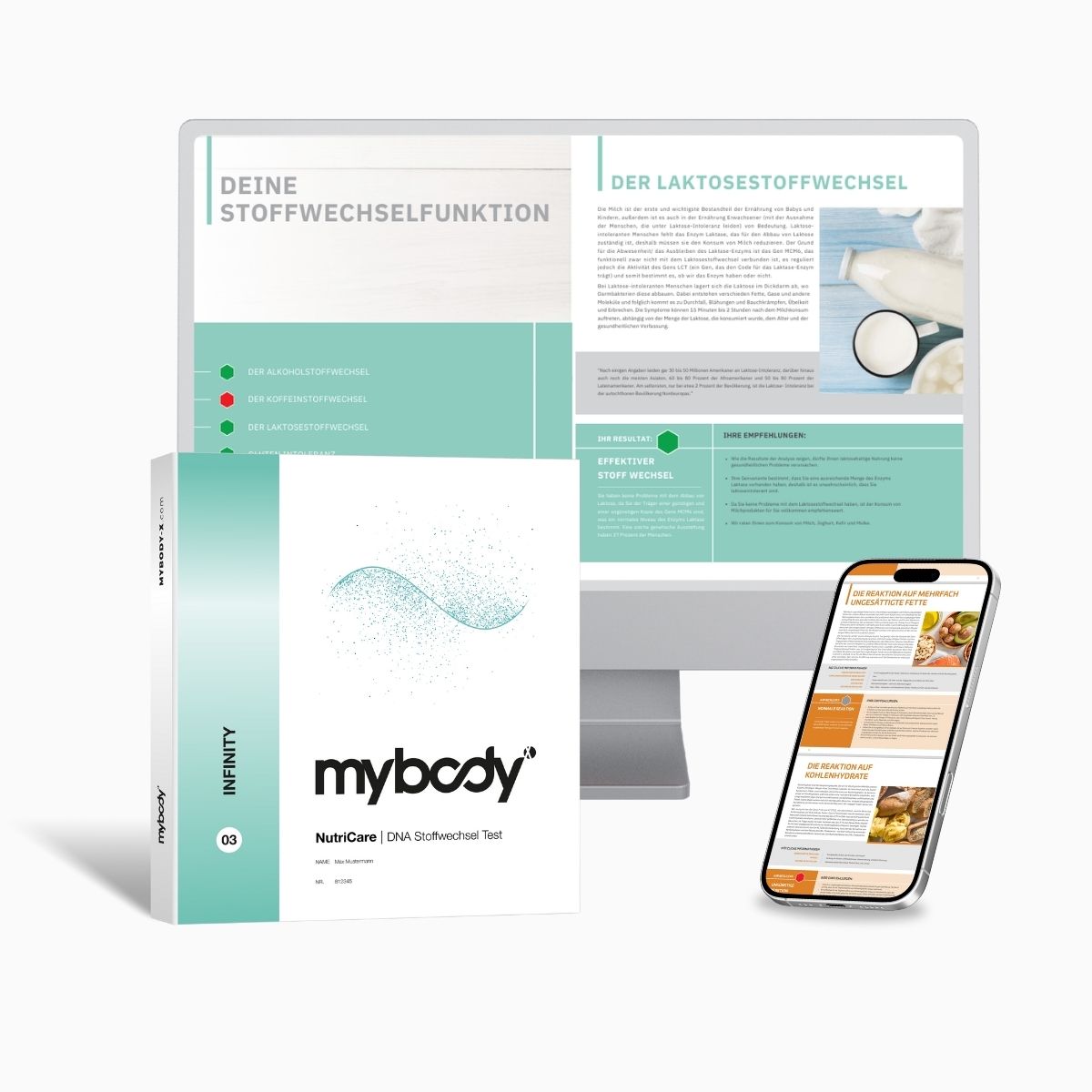
Nutrition DNA test from a saliva sample
NutriCare | INFINITY DNA Test
More than 140 genetic variations related to nutrient requirements, metabolism, and intolerances, with an assessment of more than 1,000 foods. What the test does not do: It does not provide a diagnosis, identify an existing intolerance, or prescribe a diet plan.
Laboratory analysis: 15–25 business days after sample receipt
Product page information, accessed August 27, 2026
If you would prefer the same analysis with a structured approach right away, you can find it as the INFINITY DNA test with a 28-day plan and recipe book (€297.00, as of August 27, 2026; subject to change). The DNA test product finder can help determine which analysis suits your question; the DNA encyclopedia with 170 genetic variations explains what individual genetic variations mean.
What the food assessment means in practice: Instead of a list of forbidden foods, you receive an assessment of which foods suit your predisposition and which require more effort from your body. It remains guidance, not a prescription—you still decide for yourself what goes on your plate. And one limitation should be stated openly: NutriCare does not include a report on protein requirements | Not INFINITY; if that is specifically what you want to know, you’ll be better served by a different analysis or a consultation.
For context within our range: The article DNA nutrition test: what analyses are available breaks down which analyses a DNA nutrition test includes and what is scientifically supported; the DNA nutrition test review describes what taking such a test is like in everyday life. This article deliberately focuses on the basics and on what personalization can achieve.
How to work with the recommendations in everyday life
A result doesn’t reveal its value when you read it, but when you put it into practice—and that’s where it becomes clear whether the test will be more than a PDF in your inbox. Three basic principles have proven useful for this.
First: make one change at a time. If you overhaul breakfast, coffee, and dinner all at once after receiving the results, you won’t know what worked after four weeks—and you won’t stick with any of it. Use the report as a sorting tool: What explains a pattern you’re genuinely struggling with? Start there.
Second: The report supplements the general framework; it does not replace it. The basic recommendations regarding vegetables, whole grains, and fluid intake apply to you just as they do to everyone else. Personalization takes place within this framework—at the levers where your body reacts differently from average.
Third: If you have symptoms, go to the doctor, not to the shopping cart. A DNA report can help prepare you for a medical consultation because you can describe patterns instead of making guesses. It does not replace the consultation. The recommendation is not new; its rationale is.
The recommendation is not new; its rationale is.
A simple weekly exercise shows what this looks like in practice. Choose exactly one point from the report—for example, how you handle caffeine in the afternoon—and change only that for one week. Each evening, write down in one sentence what was different. After seven days, you will know more about yourself than after a month of good intentions, and the next point from the report gets its own week.
That is precisely where the realistic benefit lies: advice that is justified by your body is more likely to be followed than the same advice from a brochure. This aligns with what the DGE describes as a moderate motivational effect—it is not magic, it is psychology. And it works only if you give the report a chance to reach your everyday life.
Chapter at a glance
A DNA report has an impact through implementation: one change at a time, within the general dietary framework, and if you have symptoms, consult a doctor first. Its realistic benefit is a well-founded recommendation—it is more likely to be followed than a general rule.
What holds up in the end
It started with the friend whose way of eating had no effect on you. The honest answer of this article is that it was probably neither her fault nor yours, but rather that you have different circumstances—and that neither of you knew your own.
If, after the DGE chapter, you considered abandoning the idea altogether, that too would be a misunderstanding. The criticism is aimed at exaggerated promises, not at the idea of knowing your own body. Between “the test changes everything” and “the test is useless” lies the realistic middle ground, and that is exactly where the decision is worthwhile.
Personalized nutrition is not a miracle cure, and the DGE figures belong in any honest description of it. What remains is a sober, useful core: a general framework that applies to everyone, plus an understanding of your own levers for change—DNA for the why, blood values for the now.
If you want to find out which approach is right for your question—or whether you need a test at all—the consultation is free and does not sell you anything.
Frequently asked questions
What is personalized nutrition?
Nutrition recommendations derived from an individual's data—from genetic predisposition, blood values, or eating behavior—instead of population averages. They supplement general recommendations; they do not replace them.
What does a DNA test for nutrition really do?
It shows how your nutrient requirements, metabolism, and tolerances are predisposed, providing a basis for everyday decisions. The DGE (2022) identifies the main evidence-based effect as increased motivation—a measurably better diet solely as a result of the analysis has not been demonstrated.
What is the difference between a DNA test and a blood test?
DNA shows the predisposition that never changes—which is why a test once in a lifetime is sufficient. A blood test shows your current status, for example your vitamin D or ferritin levels, and is repeated every 6 to 12 months. In short: DNA explains the why, blood shows the now.
How much does a DNA test for nutrition cost?
At mybody®x, the NutriCare costs | INFINITY DNA test €269.00; the version with a 28-day plan and recipe book €297.00 (both prices as of August 27, 2026; subject to change). Since DNA does not change, the price is paid only once in a lifetime.
Does a DNA test replace nutritional counseling?
No. According to IQWiG (2021), nutritional counseling is primarily aimed at healthy people, while nutritional therapy is intended for people with illnesses—both involve conversations with professionals who respond to your individual needs. A DNA report can help prepare for these conversations and support them with data, but a person must conduct them.
Next step
If you want to know what suits your body
The NutriCare | INFINITY analyzes more than 140 gene variants related to nutrient requirements, metabolism, and tolerances. If you are unsure whether DNA or blood values are the right first measurement, the Product Finder can help with a few questions.
Go to NutriCare | INFINITY Go to Product FinderRead more
You might also be interested in this
The individual reports in detail – and what is substantiated.
What the evaluation feels like in everyday life, from sample to report.
Sources
- German Nutrition Society (DGE): Rethinking personalized nutrition (2022) – dge.de
- Institute for Quality and Efficiency in Health Care (IQWiG): Causes of obesity (as of 24 August 2022) – gesundheitsinformation.de
- German Nutrition Society (DGE): DGE recommendations – eating and drinking well (as of 30 April 2024) – dge.de
- Institute for Quality and Efficiency in Health Care (IQWiG): Nutritional counseling and nutritional therapy (as of 19 May 2021) – gesundheitsinformation.de
The verbatim quotation on the effectiveness of personalized nutrition and the classification of the moderate motivational effects are taken from [1]; the following sentence there on genetic, blood, and microbiome analyses was reproduced with attribution. The distribution of calorie requirements among resting metabolic rate, activity-related energy expenditure, and the thermic effect of food is taken from [2], while the recommendations on fluid intake and meat consumption come from [3]. The distinction between nutritional counseling and nutritional therapy comes from [4]. Sources [1] through [3] were accessed and checked live on 27 August 2026; [4] is a documented source from the editorial team’s quotation archive. The caffeine information comes from the documented BfR sources in the quotation archive (as of 5 January 2026). Information on price, sample type, scope, and laboratory comes from the mybody®x product pages, accessed on 27 August 2026; processing times follow the central specification for each test type.

mybody®x Editorial & Expert Team
Nutrigenetics Nutritional science Laboratory diagnostics
This article was created by the mybody®x editorial and expert team. The team combines nutrigenetics, nutritional science, and laboratory diagnostics. The contributors are listed on the author page.
Published on 27 August 2026 · Last updated on 27 August 2026
The DNA analysis is intended for nutritional and lifestyle counseling. It is not a diagnostic procedure, does not predict disease, and does not replace a medical examination or consultation. Genetic variants describe probabilities in population groups, not fixed outcomes for individuals.




Share now:
Understanding water retention: where it comes from and when it matters
Dysbiosis Symptoms and Causes: What the Term Really Means