

Sleep disturbances in early pregnancy: causes and how to find peace and quiet again
You feel as if you have been run over by a truck during the day, but as soon as you lie down in bed, your eyes are suddenly wide awake again? This strange phenomenon is a classic sign of sleep disturbances in early pregnancy. There is no need to worry: your body is currently working extremely hard, and the restless nights are usually just a side effect of this major adjustment.
Why you lie awake despite fatigue in early pregnancy
Welcome to what may be the most exciting roller-coaster ride of your life! Countless expectant mothers know the feeling of wanting to sleep all day but being unable to sleep at night. It is a clear sign that your body is working at full speed to create a little miracle.
The main culprit behind this nightly drama is the hormone progesterone. Think of it as a somewhat overzealous director: during the day, its rapid rise causes the leaden fatigue that makes it hard to keep your eyes open. At night, however, this high level can disrupt your deep-sleep phases and cause you to wake up again and again. Progesterone also relaxes the muscles—great for the uterus, but less helpful when it leads to frequent urination or heartburn. Both are absolute sleep killers.
Your body is currently performing an incredible feat. Sleep disturbances are often just a side effect of this enormous adjustment. It is about understanding your body’s signals and responding to them with care.
The influence of your hormone cocktail
But progesterone is not the only hormone involved. Other hormones, such as the pregnancy hormone hCG and rising estrogen levels, can also cause inner restlessness. Add the usual stress—whether from excitement, worries, or physical exertion—and your body releases more of the stress hormone cortisol. Persistently elevated cortisol levels can significantly disrupt your sleep-wake cycle. If you want to learn more about what cortisol is and exactly how it works, take a look at our article.
You are definitely not alone with this problem. A study by Friedrich-Alexander-Universität Erlangen-Nürnberg (FAU) found that fatigue, at 92.9 percent, is the most common symptom in the first trimester, closely followed by sleep disturbances at 79.4 percent. Another survey shows that an impressive 44 percent of pregnant women in Germany report insomnia during the first trimester. You can read more about these study results here.
This initial overview is intended to help you better understand the complex processes taking place in your body. In the following sections, we will look specifically at what you can do to get back to more restful nights.
Sleep problems in early pregnancy—what actually causes them?
When you lie awake at night staring at the ceiling, you are not alone. It is rarely just one thing. Most often, it is an interplay of various factors that rob you of sleep. It is best to think of it as a trio consisting of hormones, physical changes, and your psyche.
Once you understand how these three “sleep thieves” work together, you can much better recognize what exactly is keeping you awake—and take targeted action against it.
The hormonal cocktail in your body
Your hormones clearly play the leading role in this nighttime drama. Chief among them is progesterone, which you may already know as the “sleepiness hormone.” Although it often makes you feel sluggish during the day, paradoxically it can disrupt your sleep at night by shortening the all-important deep-sleep phases.
But progesterone is not the only culprit. The pregnancy hormone hCG and rising estrogen levels also play a significant role. They affect your central nervous system and can cause inner restlessness or emotional ups and downs. This hormonal cocktail is why your body sometimes feels as though it is being controlled remotely and simply cannot switch off at night.
Studies show that in Germany, 44 to 46 percent of women in early pregnancy suffer from sleep disorders. One major reason is the hormonal changes, which particularly affect restorative REM sleep.
When your body simply refuses to cooperate
Alongside all the hormonal chaos, there are also very tangible physical reasons why you cannot relax. Your body is currently working extremely hard, and you notice that at night too.
The most common culprits are:
- Constant urge to urinate: Your kidneys are working overtime and producing more urine. At the same time, your growing uterus is already pressing on your bladder—which explains why you need to go more often.
- Tender, sensitive breasts: Hormone-related sensitivity can be so intense that even a slight turn in bed becomes uncomfortable and jolts you awake.
- Latent nausea: Unfortunately, typical pregnancy nausea does not stick to fixed working hours. An unsettled feeling in your stomach can make falling asleep a real test of patience.
- Restless legs: Many pregnant women are familiar with this unpleasant tingling or pulling sensation in their legs. Restless legs syndrome (RLS) occurs two to three times more often during pregnancy and is often linked to an iron or magnesium deficiency. You can find out more, for example, in the guide Sleeping during pregnancy on sbk.org.
The thought carousel that keeps turning
Last but not least, your mind naturally plays a huge role too. Pregnancy is a time of profound emotional change. There is immense anticipation, but perhaps also new worries and questions about how everything will turn out. This mix can set a real thought carousel in motion.
These are exactly the thoughts that keep you awake, make you worry, and prevent your mind from calming down. It is completely normal to have concerns. The only important thing is to find ways to stop this carousel at night.
When nutrient deficiencies can sabotage your sleep
Sometimes your sleep disturbances in early pregnancy are not simply due to hormonal chaos. They can also be a quiet but urgent signal from your body that it is lacking important building blocks. Your need for vitamins and minerals is rising sharply right now—after all, you are not only nourishing yourself but also building a small new life.
When these important nutrient stores run low, they can greatly intensify your sleep problems. So instead of merely treating the symptoms, it is worth taking a closer look under the hood and getting to the root of the real causes. A nutrient or hormone test can help you gain clarity.
The following graphic gives you a good overview of the three major “sleep stealers” that are particularly active in early pregnancy: your hormones, your body, and your mind.
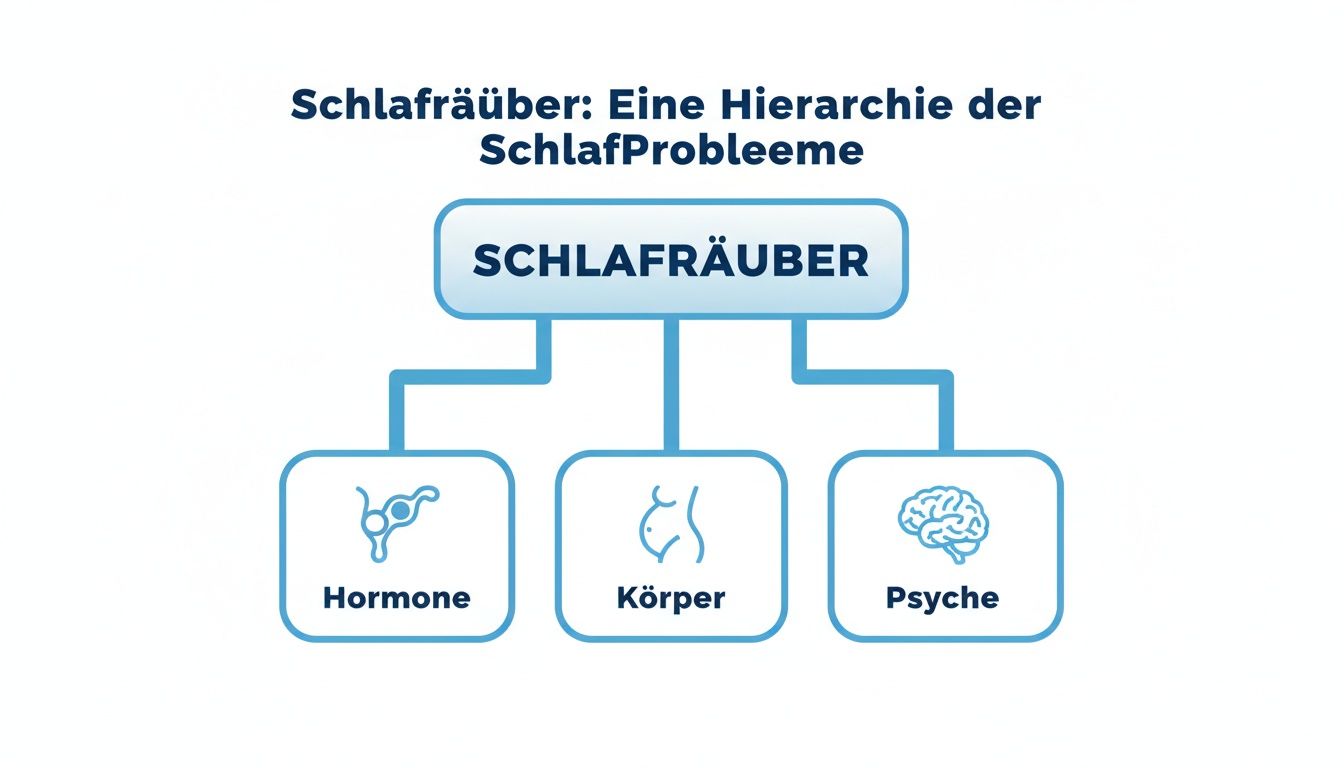
It quickly becomes clear here: Nutrient deficiencies often sit exactly at the intersection between physical and hormonal causes and can throw the entire system out of balance.
Key values that affect your sleep
Certain nutrients play a major role in a restful night's sleep. If you lack them, this can manifest through very specific symptoms that may already sound familiar to you.
- Iron (ferritin): Do you know that unbearable tingling in your legs just before you want to fall asleep? That constant urge to move them? It could be restless legs syndrome (RLS), which occurs more frequently during pregnancy and is often linked to iron deficiency. The ferritin level shows how full your iron stores actually are.
- Thyroid levels (TSH): Your thyroid is essentially your body's power plant. If it is running on low power, as with mild hypothyroidism, it does not just make you tired during the day. It can also cause inner restlessness and sleep disturbances. The TSH level is the first important indicator here.
- Magnesium: This mineral is the relaxation expert for muscles and nerves. A deficiency often manifests as nasty nighttime calf cramps, muscle twitches, or general tension that makes falling asleep a real test of patience.
Even an imbalance in just one of these values can be enough to make your nights restless. But the good news is: Once you know the cause, you can take targeted action.
Here is a brief overview to help you better understand the connections.
Important nutrients and hormones for your sleep
This table shows which values are important for restful sleep and why a deficiency can lead to problems.
| Lab value | Function for sleep | Possible symptom of a deficiency |
|---|---|---|
| Iron (ferritin) | Important for dopamine production in the brain, which regulates movement. | Restless legs syndrome (restless legs), difficulty falling asleep. |
| Thyroid (TSH) | Regulates metabolism and energy levels; an imbalance disrupts the sleep rhythm. | Restlessness, a racing heart, difficulty staying asleep. |
| Magnesium | Relaxes muscles and nerves and supports the production of the sleep hormone melatonin. | Calf cramps, muscle twitches, difficulty falling asleep. |
| Vitamin D | Plays a role in regulating the sleep-wake cycle. | Poor sleep quality, frequent waking during the night. |
These values are naturally only part of the puzzle, but they are often the key levers.
A deficiency in these or other important nutrients can further worsen your fatigue and lack of energy. In our guide, you can learn more about how to identify and address a nutrient deficiency causing fatigue and lack of energy.
So if you suspect that your sleep problems are caused by more than just pregnancy hormones, you no longer have to feel in the dark. There are simple ways to gain clarity and take control of your well-being again.
How to Gain Clarity About Your Values from Home
Do you feel that there is more behind your restless nights than typical pregnancy-related stress, but the mere thought of crowded waiting rooms and additional doctor's appointments is driving you up the wall? We know that feeling all too well. The good news is that you no longer have to guess—you can finally measure, all from the comfort of your sofa.
We developed mybody-x's home self-tests specifically for situations like these. They give you the opportunity to regain control and gain clear insights into your body without even having to leave your home.
The Easy Way to Your Lab Results
The entire process is deliberately kept simple to give you peace of mind instead of causing additional stress. It works in three easy steps:
- Simple sample collection: Simply order your test kit online. The set contains everything you need, including easy-to-follow instructions. With a small prick to your fingertip, you collect a few drops of blood—it really only takes a moment and is barely noticeable.
- Shipping to a certified laboratory: Place your sample in the enclosed return envelope and send it to one of our certified German partner laboratories. There, it will be professionally analyzed according to the highest quality standards.
- Easy-to-understand results report: Your results will reach you after just a few days—in a report that everyone can understand. No medical jargon, just clear explanations of what your values mean for you and where they should ideally be.
If you would like to take a closer look at the whole process, our guide explains step by step how you can safely and easily perform a blood test yourself.
From Results to a Solution: A Concrete Example
Imagine your results report arriving and showing a low ferritin level. In plain English: Your iron stores are quite depleted. This single value could suddenly explain so many of your symptoms—the crushing fatigue, concentration problems, and above all that agonizing tingling in your legs (restless legs syndrome) that simply keeps you from settling down in the evening.
A test result is not a verdict, but a signpost. It gives you the power to move from passively enduring things to taking active action.
Instead of continuing to feel your way in the dark, you now have a concrete starting point. The mybody-x report provides you not only with the raw numbers, but also with personalized, actionable recommendations. In this case, your next steps could look like this:
- Adjust your diet: You could deliberately add more iron-rich foods such as lentils, spinach, or lean red meat to your diet. A little pro tip: Always combine them with foods rich in vitamin C, such as bell peppers, or a glass of orange juice; this greatly improves iron absorption.
- Targeted supplementation: With these clear findings in hand, you can discuss possible iron supplementation with your doctor. This way, you avoid simply taking random supplements based on pure guesswork.
A simple nutrient or hormone test can therefore make all the difference. It transforms the vague feeling that “Something is wrong” into clear knowledge and gives you the right tools to finally improve your sleep problems in early pregnancy and your overall well-being in a targeted way.
Immediately actionable tips for calmer nights
While you may still be waiting for test results or getting to the bottom of the exact causes of your sleep problems in early pregnancy, you don’t have to simply put up with restless nights. Fortunately, there are a whole range of effective strategies you can implement immediately to help you find peace and quiet again.

This isn’t about clichéd advice like “just relax,” but about practical, actionable tips that clearly signal to your body: It’s time to wind down.
Create your personal evening ritual
A consistent evening ritual is like a gentle switch that shifts your body from active daytime mode into relaxed nighttime mode. It helps immensely to stop the carousel of thoughts and mentally prepare for sleep.
Even small but deliberate actions can make a huge difference:
- Drink calming teas: A cup of warm, caffeine-free lemon balm or lavender tea can work wonders. These herbs have been known for their relaxing effects for ages.
- Avoid screens: The blue light from smartphones, tablets, and televisions inhibits the production of the important sleep hormone melatonin. Try switching off all screens at least one hour before going to bed.
- Gentle breathing exercises: The 4-7-8 breathing technique is highly effective for calming the nervous system. Simply inhale through your nose for 4 seconds, hold your breath for 7 seconds, and then exhale audibly through your mouth for 8 seconds. Repeat this a few times.
The right nutrition for the night
What you eat in the evening has a direct impact on how well you sleep. Heavy, fatty, or very sugary meals can keep your body active at night and lead to heartburn or blood sugar fluctuations—all of which can disrupt sleep.
A light, nutrient-rich evening meal is key. Your body should be able to wind down instead of being occupied with heavy digestive work.
Instead, choose foods that promote sleep. A small bowl of oatmeal with a banana or a handful of almonds is ideal. They contain important nutrients such as magnesium and tryptophan, a precursor to the sleep hormone melatonin. A glass of warm milk with honey is also more than just an old home remedy—it provides your body with sleep-promoting nutrients as well. Learn more in our article about why magnesium for the nerves is so important for restful sleep.
Design your bedroom as a relaxing oasis
Your bedroom should be a place of peace and relaxation, not an extension of your living room or office. With a few simple adjustments, you can create the ideal environment for restful sleep.
- Regulate the temperature: For most people, the optimal sleeping temperature is between 16 and 18 degrees Celsius. A cool room helps the body transition into sleep mode.
- Create complete darkness: Light signals to the brain that it should stay awake. Use blackout curtains or a sleep mask to create complete darkness.
- Minimize disruptive noises: If noises from outside disturb you, earplugs or a white noise device can help create a consistent and soothing soundscape.
The most important questions about sleep problems in early pregnancy
Here we have collected the answers to the most pressing questions that expectant mothers ask us again and again. Concise, easy to understand, and straight from practice, so you can quickly find peace and quiet again.
Is it normal to have bad dreams in early pregnancy?
Yes, that is absolutely normal, and you are definitely not alone. The sudden and intense hormonal changes, especially the rapidly rising progesterone levels, can make your dreams much more vivid and sometimes quite wild. Your brain is working at full speed to process all the new feelings and impressions of this incredibly exciting time.
As long as these nighttime adventures do not permanently burden you, they are usually just a harmless, though tiring, accompanying phenomenon.
Can I take herbal sleep remedies during pregnancy?
Great caution is truly advised here. The safety of many herbal remedies during pregnancy has simply not been sufficiently researched. Even with supposedly harmless herbs such as valerian or St. John's wort, you should always speak to your doctor or midwife first. Please do not take any risks here.
It is better to rely on proven and safe methods. Why not try a soothing lemon balm tea, simple breathing exercises before bedtime, or improved sleep hygiene?
Do sleep problems improve after the first trimester?
Fortunately, for most women, the answer is yes! The second trimester is often called the “feel-good phase” of pregnancy for good reason. Hormone levels gradually stabilize, the initial nausea subsides, and your body has adjusted to the major changes.
However, be aware that new challenges in the third trimester, such as a growing belly or the baby's movements, can disrupt your sleep again. So make the most of the potentially quieter nights in the second trimester!
Gain clarity about your health and find the causes of your symptoms. The at-home self-tests from mybody-x help you understand your nutrient and hormone levels conveniently from home. Get started now and take control of your well-being at https://mybody-x.com.



Share now:
Which vitamins am I lacking? Your quick check for more energy & well-being
Night Sweats in Women: Understanding the Causes and Finally Sleeping Better