
Hormone Test for Women: which values are measured when during the menstrual cycle
The essentials at a glance
“Hormone Test for Women” encompasses around a dozen different values. Estradiol, progesterone, FSH, and LH fluctuate so much throughout the menstrual cycle that the number is difficult to interpret without the appropriate cycle day. A university hospital specifies the period between cycle days 2 and 5 for most of these values. Other values, such as TSH or ferritin, are not dependent on the cycle.
This article is therefore organized around two questions rather than products: Which value answers which question, and at what stage of life does that question arise? Between ages 20 and 35, the useful selection looks different than from age 45 onward. Every figure is accompanied by the institution and year. Where no substantiated figure is available, that is stated as well.
First, you will read which values are meant and why the day of the menstrual cycle determines how meaningful the result is. This is followed by the endocrinology professional society’s position on self-tests, the timing during the cycle, the individual values, signs that medical assessment is needed, and a comparison of the three stages of life. The latter part covers sample preparation and the limitations.
What to expect in this article
1. Which values are covered by “Hormone Test for Women”
2. Why a hormone level says little without the day of the menstrual cycle
3. What the endocrinology professional society says about self-tests
4. When each value is measured during the menstrual cycle
5. The individual values and what they describe
6. When a question does not belong in a test
7. Between 20 and 35: when the menstrual cycle raises the question
8. Between 35 and 45: when exhaustion is the main question
9. From age 45: menopause and what a value can tell you then
10. How medications, breastfeeding, and the thyroid shift the results
11. Three stages of life and the corresponding question compared
12. What you can have measured at home on this topic
13. How to prepare for sample collection
14. Limitations: what a hormone level cannot clarify in women
15. Who may benefit from testing—and who may not
16. What ultimately matters
Frequently asked questions
Sources
Which values are covered by “Hormone Test for Women”
The search term sounds like a test. In reality, it refers to a selection of about a dozen individual values, and no provider measures all of them in a single session. Anyone who orders a test without knowing what is included receives numbers answering questions they did not ask.
The Federal Institute for Public Health lists eight groups of values for assessing fertility in women: estrogens, especially estradiol; thyroid hormones; prolactin; androgens including testosterone and DHEA-S; luteinizing hormone (LH); follicle-stimulating hormone (FSH); progesterone; and, when needed, anti-Müllerian hormone (AMH) (BIÖG, as of January 7, 2026).
These eight groups answer different questions. Estradiol and progesterone describe what is currently happening in the cycle. FSH and LH describe how hard the control center in the brain has to work to make it happen. Prolactin, thyroid values, and androgens describe disruptive factors that can affect the cycle from outside.
Key message
A hormone test for women is not a fixed examination but a selection from around a dozen values—and the selection follows the question, not the sex.
Cycle-dependent and cycle-independent values
The most important dividing line is not between “female” and “other” hormones. It is between values that shift within a cycle and those that do not.
The first group includes estradiol, progesterone, FSH, and LH. The second includes thyroid values, ferritin as stored iron, vitamin B12, and vitamin D. Anti-Müllerian hormone occupies a special position: it is often measured as well and, according to Ulm University Hospital, is independent of the menstrual cycle (2026).
This distinction determines whether the time of day and the calendar matter when the sample is taken. They do for the first group. For the second group, they are secondary.
Why a hormone level means little without the cycle day
According to the Federal Institute for Public Health, the menstrual cycle normally lasts between 25 and 32 days, and every woman has her own rhythm (BIÖG, 2026). Within this range, the four cycle hormones do not change slightly but by several times over.
That is precisely why reproductive medicine determines the timing of blood sampling before discussing the numbers. A fertility center at a German university hospital puts it plainly.
Documented source
“Because female hormone levels depend heavily on the menstrual cycle, hormone blood samples should always be taken at the beginning of the cycle, that is, during the period, for example between cycle days 2 and 5.”
Ulm University Hospital, UniFee Fertility Center
Information page “Hormone Analysis,” 2026
The sentence contains two details that are often lost in everyday practice. The first is the reason: hormone levels depend on the cycle. The second is the practical consequence: a narrow window at the beginning of bleeding.
The same point is made in more general terms by the Federal Institute for Public Health: “Some hormones must be measured on different days of the menstrual cycle because hormone production fluctuates during a cycle” (BIÖG, as of January 7, 2026).
For you, this means: The cycle day is not an additional field on the accompanying form. It is part of the measurement result. If it is missing, half the information is missing.
What this means for a result without a cycle day specified
Low progesterone in the first half of the cycle is the norm, not an abnormal finding. According to the U.S. National Library of Medicine, the level rises only after an ovary has released the egg (NLM, 2025).
So, anyone who measures during the first half of the cycle and sees a low result has not learned anything about a deficiency. They have learned that ovulation had not yet occurred at the time the sample was taken.
The same applies to FSH in reverse. A single elevated result on cycle day 20 cannot be meaningfully compared with the usual reference ranges for the early cycle. The result and the comparison range must come from the same cycle phase.
What the endocrinology professional society says about self-tests
At this point, the text needs to include a position that opposes the business of hormone testing. It is included here because it is relevant to the topic, not despite being uncomfortable.
The German Society for Endocrinology advises against using at-home hormone self-tests; the results of these tests are reportedly not valid. This is how Deutsches Ärzteblatt reported it in its October 31, 2024, article. The same report also gives the reason: Hormone tests are heavily dependent on external conditions, beginning with the time of day when the sample is taken (Deutsches Ärzteblatt, 2024).
This position is not softened in this article. It is put into context. The criticism is directed at the idea that a self-initiated test result could replace medical evaluation. It is not directed at a woman wanting to have any number about her body at all.
The objection is justified. Even so, something else is decisive: A result whose collection conditions are documented is a reason to start a conversation. A result without the cycle day, time, and list of preparations is not.
Two of this article’s three cluster neighbors explore this in greater detail. How an at-home test works technically and what a single result says is explained in At-Home Hormone Test. This article focuses specifically on which values are measured in women at all and when.
When each value is measured during the cycle
The cycle follows a set sequence, and the measurement times follow it. The four stages below are listed in the order in which they occur during the cycle. Anyone who knows when their sample was taken can place their result within that sequence.
The cycle as a timetable
Cycle days 2 to 5, meaning during menstruation
The time window that a university hospital's fertility center identifies as the standard case (Ulm University Hospital, 2026). FSH, LH, and estradiol are measured here, along with usually prolactin, thyroid levels, and androgens. The first day of bleeding counts as cycle day 1.
Around the middle of the cycle, shortly before ovulation
Luteinizing hormone rises and triggers ovulation (BIÖG, 2026). This surge is brief. According to the same institute, ovulation itself occurs approximately 10 to 14 days before the next period, and the egg remains capable of fertilization for a maximum of 24 hours afterward.
Second half of the cycle, after ovulation
Only now does progesterone rise because it is initially produced by the corpus luteum (BIÖG, 2026). The U.S. National Library of Medicine describes the same process: during the second half of the cycle, an ovary releases the egg, after which progesterone levels begin to rise (NLM, 2025). If pregnancy does not occur, the level falls again.
Independent of the cycle day
According to Ulm University Hospital, anti-Müllerian hormone is independent of the menstrual cycle and can therefore be measured at any time (2026). The same practically applies to thyroid levels, ferritin, and vitamin levels.
This schedule leads to an inconvenient insight for tests collected at home: a single appointment cannot cover all four stages. Anyone who measures FSH on cycle day 3 is not measuring progesterone during its peak phase.
This is not a weakness of any particular provider. It is a characteristic of the cycle, and it affects every blood draw, whether at a clinic or at home.
The individual values and what they describe
Each value answers a different question. The following paragraphs organize the most common values according to what they describe and indicate where their relevance ends.
Estradiol, the predominant estrogen
According to the Federal Institute for Public Health, estradiol is important for the maturation of egg cells and the growth of the uterine lining (BIÖG, 2026). It therefore indicates how far the first half of the cycle has progressed.
The U.S. National Library of Medicine notes that estrogen levels change significantly: they rise during puberty, are highest during pregnancy, and decline after menopause (NLM, 2025). A healthy level depends, among other things, on age, the reason for the test, and which form of estrogen was measured.
Progesterone, the hormone of the second half of the cycle
Progesterone regulates the female menstrual cycle together with estrogens (BIÖG, 2026). It is initially produced by the corpus luteum; from around the tenth week of pregnancy, the placenta takes over this production.
Because the level changes throughout the cycle and pregnancy, the U.S. National Library of Medicine states that repeated measurement may be necessary (NLM, 2025). A single number describes one point on a curve, not the curve.
FSH and LH, the control hormones from the brain
According to the Federal Institute for Public Health, follicle-stimulating hormone is important for estrogen production and egg maturation. Luteinizing hormone rises during the cycle and triggers ovulation (BIÖG, 2026).
Both values therefore say less about the condition of the ovaries than about the effort made by the control center. Persistently elevated FSH is therefore considered an indicator of the hormonal phase, not a measure of symptoms.
Prolactin, the silent cycle brake
According to the U.S. National Library of Medicine, prolactin originates from the pituitary gland and causes breast tissue to grow during pregnancy and milk production after birth (NLM, 2024). High prolactin levels inhibit ovulation (BIÖG, 2026).
Elevated levels can appear as irregular or absent bleeding or as milk production outside pregnancy and breastfeeding. According to the same source, small increases can already result from stress, exercise, and sexual intercourse (NLM, 2024). This makes prolactin a value for which the conditions of sample collection matter particularly.
Androgens, thyroid, and AMH
If there are too many androgens in the female body, ovulation may become irregular or fail to occur (BIÖG, 2026). Testosterone and DHEA-S are usually measured for this purpose.
Thyroid hormones are checked because thyroid dysfunction can affect ovulation (BIÖG, 2026). They are also the value that most often provides the explanation when fatigue and cycle changes occur together.
Anti-Müllerian hormone is measured as needed to assess ovarian function (BIÖG, 2026). It is part of fertility evaluation, not a general status check.
When a question does not belong in a test
Before a measurement is useful at all, it is worth comparing your situation with the following list. If any of these points apply, the next step is an appointment at a medical practice, not ordering a test.
These signs belong in a medical practice
Bleeding after the period had been absent for twelve months
Menopause is considered to have been reached when no period has occurred for twelve months (NLM, 2026). Any bleeding afterward is investigated.
Milk production without pregnancy or breastfeeding
A sign listed by the U.S. National Library of Medicine in connection with elevated prolactin levels (NLM, 2024).
The period remains permanently absent before the age of 40
The usual age for menopause is between 45 and 55 (NLM, 2026). If periods stop significantly earlier, this should be investigated.
An unfulfilled desire to have children
Here, hormone testing belongs in the hands of a medical specialist from the outset, because timing, test selection, and interpretation are interconnected.
Significant unintentional weight change
When neither eating habits nor physical activity have changed and the change persists.
Very heavy or very long bleeding
Especially when the duration or severity has changed and stays that way.
None of these issues is made better or worse by a test result. They are the reason why the sequence begins with a visit to a medical practice and only afterward moves on to the question of a number.
Between 20 and 35: when the cycle raises the question
At this stage, the starting question is almost always: Why is my cycle the way it is? Irregular intervals, missed periods, premenstrual symptoms, or a desire to have children that is taking longer than expected.
The relevant values here are cycle-dependent: estradiol, FSH, and LH at the beginning of the cycle, and progesterone in the second half. These are joined by the three factors that can influence the cycle from outside: prolactin, thyroid values, and androgens.
Timing is most important at this stage of life because a cycle is present, and therefore a cycle phase as well. Anyone who measures without noting the cycle day produces a number that no one can interpret.
What a test does not clarify at this stage is the question of fertility. In addition to hormone levels, this includes further examinations that the Federal Institute for Public Health summarizes under the term fertility testing (BIÖG, 2026). A single blood value cannot answer it.
Between 35 and 45: when exhaustion is the guiding question
Here, the question shifts. The cycle is often still regular, but your energy is not. Fatigue despite adequate sleep, hair loss, mood swings, concentration problems.
The reflex leads to the cycle hormones. The clue often leads somewhere else. Thyroid disorders, low iron stores, or a vitamin deficiency cause the same symptoms and can be measured independently of the cycle day.
That is the practical advantage of these values: they do not require a specific time window. A number without a cycle day tells you nothing about yourself, only about a moment in time—this applies to estradiol and progesterone, not to TSH or ferritin.
A number without a cycle day tells you nothing about yourself, only about a moment in time.
Prolactin also belongs in this phase when bleeding has become irregular. High levels inhibit ovulation (BIÖG, 2026), and they can be caused by medications taken for an entirely different reason.
When exhaustion coincides with a high level of stress, cortisol regularly appears as a search term. Which signs in women actually point to this and where the boundary to illness lies is explained in High Cortisol: Symptoms in Women.
From 45 onward: menopause and what a test result can tell you
According to the U.S. National Library of Medicine, the usual age for menopause is between 45 and 55. The transition usually begins in the forties, occasionally earlier, and can last several years (NLM, 2026).
Menopause itself is not diagnosed through a laboratory value. It is considered to have been reached when no period has occurred for twelve months (NLM, 2026). This is an observation over a year, not a measurement taken on one day.
A hormone level can still contribute something during this phase. It describes a point in time and can sharpen the question of whether the symptoms fit the hormonal transition or whether another cause is also involved. It cannot answer that question on its own.
The most common mistake during this phase concerns the order of events. Many people measure first and then look for an explanation for the number. The more sensible approach is the reverse: record the symptoms for several weeks, then decide whether a number would add anything.
If sleep is the main concern, it is worth looking at the underlying causes. The factors that come together there and which of them a hormone level can actually address are explained in Sleep Disorders During Menopause.
Chapter at a glance
The usual age for menopause is between 45 and 55, and the transition usually begins in the forties (NLM, 2026). Menopause is not diagnosed through a laboratory value, but through twelve months without a period. During this phase, a hormone level describes a point in time and can sharpen a question. The decision as to whether the symptoms are part of the hormonal transition is still made in conversation, not by the measuring device.
How medications, breastfeeding, and the thyroid shift hormone levels
Three accompanying circumstances alter hormone levels so significantly that a result can be misread without them. They belong on the same note as the cycle day.
The first is hormonal contraceptives. A level measured while using hormonal contraception describes the state under that contraception. It does not describe how the cycle would proceed without it, and it cannot be meaningfully compared with reference values for an unaffected cycle.
The second is breastfeeding. Prolactin is expected to be elevated during this phase because after birth it stimulates milk production (NLM, 2024). An elevated level is the norm here, not an abnormal finding.
The third factor is medication and supplements unrelated to contraception. Certain medicines can raise prolactin levels (NLM, 2024). Stress, exercise, and sexual intercourse can also cause small increases according to the same source—enough to exceed a threshold.
There is also one factor that can work in both directions: the thyroid. Thyroid disorders can affect ovulation (BIÖG, 2026), while also causing symptoms that are easily attributed to hormonal changes.
Three stages of life and the corresponding question compared
The table compares the three phases across the same five criteria. The age ranges are guidelines, not boundaries: the question matters, not your birthday.
| Criterion | Around 20 to 35 | Around 35 to 45 | From around 45 |
|---|---|---|---|
| Typical initial question | Why is my cycle irregular? | Why am I tired even though I sleep? | Am I going through menopause? |
| Relevant values | Estradiol, FSH, LH, progesterone, prolactin, androgens, and thyroid values | Complete thyroid panel, ferritin, vitamin B12, vitamin D, and prolactin | FSH, estradiol, progesterone, and LH, plus thyroid values for differentiation |
| Suitable time to provide the sample | Cycle days 2 to 5 for FSH, LH, and estradiol; the second half of the cycle for progesterone | Cycle day is secondary because the relevant values do not depend on the cycle | As long as you have a menstrual cycle, record the cycle day; afterward, any time |
| What a result cannot clarify | Fertility. This requires additional examinations (BIÖG, 2026) | The cause of exhaustion when sleep, stress, or mood are factors | Menopause itself. The determining criterion is twelve months without a period (NLM, 2026) |
| Suitable test in the product range | Menopause Check, because it is the only one that includes all four menstrual-cycle hormones | Women’s Wellness Check, because it covers the thyroid, iron, and vitamins | Menopause Check, because FSH and estradiol are relevant to questions about the phase of menopause |
The last line is the shortest answer to the question of which of the two tests is suitable for what. The next chapter explains this in detail, including what neither test covers.
What you can have measured at home on this topic
mybody®x (MYBODY Lab GmbH) offers women two blood tests whose measurements barely overlap. One covers menstrual-cycle hormones; the other covers values measured independently of the cycle.
First, the context this article owes you: The German Society for Endocrinology advises against at-home hormone self-tests because the results are not valid (as reported in Deutsches Ärzteblatt, 2024). This position also applies to the two tests below, and it is not downplayed here. What these tests provide are laboratory-measured values at a specific point in time for a discussion—not a medical evaluation or diagnosis.
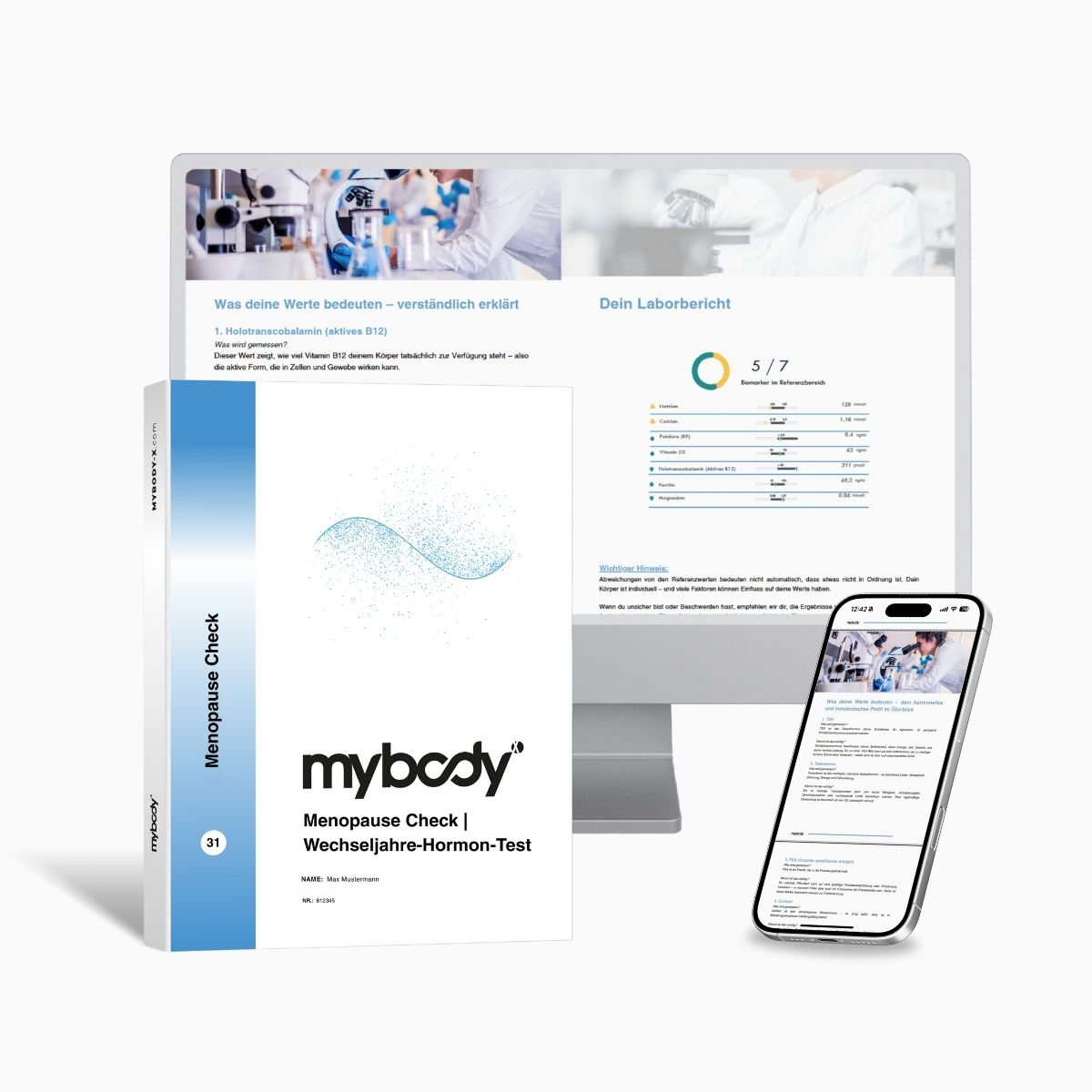
For questions about the menstrual cycle and its phases
Menopause Check | Menopause Hormone Test
Eight values from a single blood sample: progesterone, estradiol, FSH, LH, testosterone, DHEA-S, SHBG, and TSH. It is the only test in the range that includes the four cycle-dependent values, making it the right choice when the question concerns hormonal phase or the cycle. What it does not provide: It does not determine whether someone is going through menopause—twelve months without a period are the key criterion (NLM, 2026). Ferritin, vitamin B12, vitamin D, prolactin, and AMH are not included in its scope. The product page itself points out that estradiol, progesterone, FSH, and LH fluctuate significantly throughout the cycle and that the cycle day must be recorded as long as a cycle continues.
Laboratory analysis 3–5 business days after sample receipt
accessed 27 August 2026
The second test answers a different question. It does not measure cycle hormones, but instead measures values that may be associated with persistent exhaustion and do not require a specific point in the cycle.
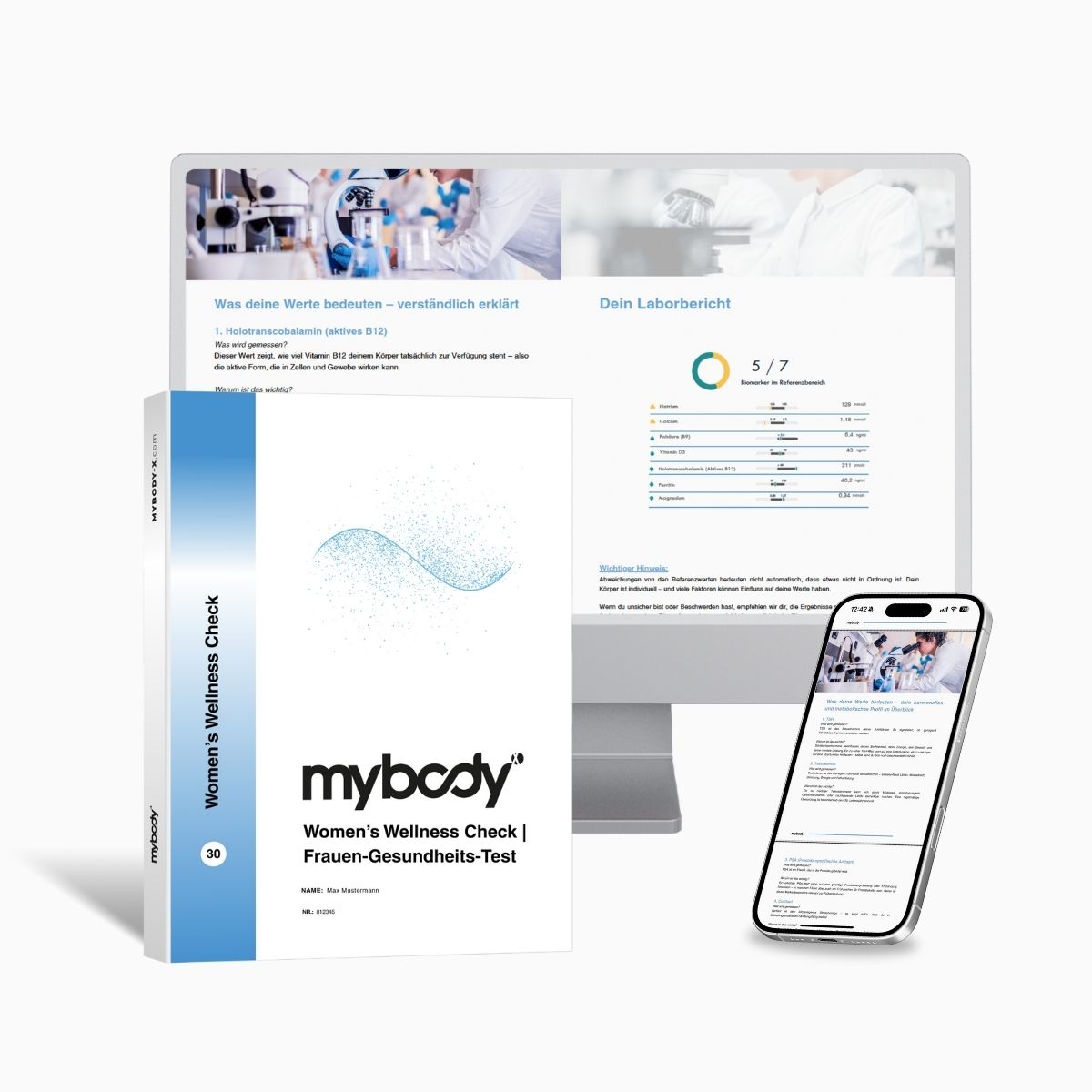
For questions about exhaustion
Women’s Wellness Check | Women’s Health Test
18 values from a single blood sample, including a complete thyroid profile with TSH, fT3, and fT4, as well as ferritin, vitamin B12, vitamin D3, cortisol, prolactin, SHBG, and liver, kidney, blood glucose, and cholesterol values. What it does not provide: According to the product page, it does not measure cycle hormones. Estradiol, progesterone, FSH, and LH are not included; the same page explicitly refers to the Menopause Check for questions about menopause. It provides cortisol as a single value at the time of sampling, not as a daily profile.
Laboratory analysis 3–5 business days after sample receipt
accessed 27 August 2026
Where both tests have a gap
Anti-Müllerian hormone is included in neither test. Anyone looking for an assessment of ovarian function will not find it here; this assessment belongs in a specialist medical evaluation anyway (BIÖG, 2026).
The second gap is larger and affects both tests equally: Neither of them captures a cycle. Both provide a snapshot from a single blood sample. There is no product in the range for tracking changes across several cycle phases, and this article does not pretend that there is.
Assessing the provider means looking at what can be verified: The analysis is carried out in a laboratory, the transmission of results is encrypted, the samples are processed using pseudonyms, and processing complies with the GDPR. Neither product page states the laboratory location; that is why it does not appear in either of the cards above.
How to prepare for sample collection
The four steps below take just a few minutes and determine whether the test result will be interpretable later. They are preparation for a conversation, not instructions for self-diagnosis.
Determine the cycle day
The first day of bleeding is cycle day 1. For FSH, LH, and estradiol, a university hospital specifies the period between cycle days 2 and 5 (2026).
Note the time
The time of day affects how hormone levels are assessed (Deutsches Ärzteblatt, 2024). Providing the time makes two measurements comparable.
List your medications
Hormonal contraception, thyroid medication, and other medicines belong on the list. Certain medications raise prolactin levels (NLM, 2024).
Make a note of your symptoms
Bleeding intervals, sleep, mood, hot flashes. Four weeks of notes are more useful in a conversation than a single number.
Before taking the sample, follow the instructions of the respective provider, because kits differ in how they are handled. In any case, it helps to drink enough, keep your hands warm, and rest before the appointment.
Limitations: what a hormone level does not clarify in women
The first limitation concerns timing. A value describes the moment when the sample was taken. It says nothing about the course of a cycle, the coming months, or whether a change is lasting.
The second limitation is methodological. Reference ranges depend on the laboratory, method, and age. Results from two laboratories therefore cannot easily be compared side by side, even if both use the same unit.
The third limitation is substantive. Symptoms rarely arise from a single source. Sleep, stress, diet, physical activity, and the thyroid interact, and none of these factors can be determined from an estradiol level.
The fourth limitation is the clearest. The relevant professional society considers the results of hormone self-tests invalid (as reported in the Deutsches Ärzteblatt, 2024). Anyone who knows this and still wants to test should treat the result accordingly: as a reason for a discussion, not as an answer.
And one limitation concerns this text itself. It explains which values exist and when they are measured. It does not replace medical assessment, and it makes no statement about your test result.
Who a measurement may be useful for—and who it may not be useful for
The decision does not depend on age, but on the question and on your willingness to take the timing of the sample seriously. Both sides of the comparison are meant to be taken equally seriously.
Makes sense for you if …
you have a clear, specific question—such as whether the thyroid could be causing your fatigue.
you are prepared to note the cycle day and time and include both with the test result.
you want a documented baseline value for a conversation you have so far had to have without numbers.
you want to monitor a progression and are prepared to measure again under the same conditions.
Probably not if …
one of the signs from Chapter 6 applies to you. Then the appointment is the next step, not the order.
you want to investigate an unfulfilled desire to have children. In that case, selection, timing, and interpretation belong in the hands of a medical specialist from the outset.
you use hormonal contraception and expect a value that describes your cycle without contraception. The measurement cannot provide that.
you expect a diagnosis from the result. The responsible professional society considers the results of such tests invalid (German Medical Journal, 2024).
What matters in the end
The question “hormone test women” cannot be answered with a product recommendation because it contains three different questions. The cycle, exhaustion, and hormonal phase require different values and different times.
This leads to an order that differs from the usual one. Not measuring first and then interpreting, but clarifying the question, determining the timing, and only then measuring.
Specifically for the next four weeks: note the intervals between periods, sleep, and mood; write down your guiding question in one sentence; and mark the appropriate day of your cycle on the calendar. Only once these three details are in place is it worth deciding about a test.
At first, the idea was that a hormone test for women was an examination. It is a selection. And you make it.
Frequently asked questions
On which day of my cycle should I have my hormones measured?
For FSH, LH, and estradiol, the Fertility Center at Ulm University Hospital specifies the period between the 2nd and 5th day of the cycle because female hormone levels depend heavily on the menstrual cycle (2026). Progesterone rises only in the second half of the cycle, after an ovary has released the egg (NLM, 2025); that is when it is measured. Ovulation occurs approximately 10 to 14 days before the next period (BIÖG, 2026). Thyroid levels, ferritin, vitamin levels, and anti-Müllerian hormone are independent of the cycle.
Which hormones are measured in women at all?
The German Federal Institute for Public Health lists eight groups for evaluating women: estrogens including estradiol, thyroid hormones, prolactin, androgens including testosterone and DHEA-S, LH, FSH, progesterone, and, if needed, anti-Müllerian hormone (BIÖG, as of January 7, 2026). Estradiol is important for egg maturation and the development of the uterine lining; LH triggers ovulation, while high prolactin levels inhibit it. Which of these values make sense for you depends on the question—not on completing the list.
Can a hormone test determine whether I am going through menopause?
No. Menopause is considered to have been reached when no period has occurred for twelve months (NLM, 2026)—this is an observation over a year, not a measurement taken on a single day. The usual age is between 45 and 55, the transition usually begins in the forties and can last several years. A hormone result describes the situation at a given point during this phase and can help clarify whether the symptoms fit the hormonal transition. The interpretation itself belongs in a medical consultation.
What do medical societies say about at-home hormone tests?
The German Society for Endocrinology advises against at-home hormone self-tests because the results are not valid, as reported by Deutsches Ärzteblatt in its article dated October 31, 2024. The same article cites the strong dependence on external conditions as the reason, starting with the time of day when the sample is taken. This position also applies to the tests mentioned in this article. It does not rule out using a laboratory-measured result as a documented baseline for a conversation, provided the cycle day, time, and supplements or medications are recorded.
Menopause Check or Women’s Wellness Check—which one is right for my question?
The Menopause Check measures the four cycle-dependent values progesterone, estradiol, FSH, and LH, making it suitable for questions about the cycle and hormonal phase, typically from around age 45. According to its product page, the Women’s Wellness Check does not measure cycle hormones; with a complete thyroid profile, ferritin, vitamin B12, and vitamin D3, it covers values that may contribute to persistent exhaustion. The same product page explicitly refers to the Menopause Check for questions about menopause. Neither test includes anti-Müllerian hormone.
Next step
Start with the question, then choose the test
If your question concerns your cycle or hormonal phase, the Menopause Check covers the four cycle-dependent values. If it concerns exhaustion with a regular cycle, the Women’s Wellness Check, with thyroid, iron, and vitamins, is a better fit. Both provide a snapshot, not a diagnosis.
View Menopause Check View Women’s Wellness CheckRead more
You may also be interested in
The test category itself: what types are available and how a point-in-time value is generated.
In case the nights are the real question, not the cycle.
Sources
- University Hospital Ulm, Department of Gynecology and Obstetrics, UniFee Fertility Center: Information page “Hormone analysis,” as of 2026 – uniklinik-ulm.de
- Federal Institute for Public Health (BIÖG), familienplanung.de: “Fertility: Examinations for women,” as of 07.01.2026 – familienplanung.de
- U.S. National Library of Medicine, MedlinePlus: “Menopause,” as of 03.08.2026 – medlineplus.gov
- Deutsches Ärzteblatt: “Professional society advises against at-home hormone self-tests,” report dated 31.10.2024 – aerzteblatt.de
The verbatim quote at the time of blood collection, the reference to the 2nd to 5th day of the cycle, and the note that anti-Müllerian hormone is independent of the cycle are taken from source [1]. The eight groups of values supporting statements about estradiol, LH, FSH, prolactin, androgens, and the thyroid, as well as the verbatim quote about measurements on different cycle days, are based on [2]; the information on cycle lengths of 25 to 32 days, ovulation 10 to 14 days before the next period, fertility for a maximum of 24 hours, and progesterone production in the corpus luteum comes from the same publisher's encyclopedia entries “Cycle” and “Progesterone.” The age of 45 to 55 years, the twelve-month threshold, and the duration of the transition come from [3]. The position of the endocrinological professional society and the information on time of day come from [4]. The information on estrogen (as of 2025), progesterone (as of 2025), and prolactin (as of 2024) comes from three additional resources of the U.S. National Library of Medicine; they are attributed in the running text with the institution and year and are therefore not included in this list. Information on price, values, sample type, and laboratory comes from the mybody®x product pages, accessed on 27.08.2026; processing times follow the central specification for blood tests. All sources were accessed and reviewed on 27.08.2026.

mybody®x Editorial & Specialist Team
Women's health Hormone diagnostics Laboratory diagnostics Blood analysis interpretation
This article was created by the mybody®x editorial and specialist team. The team combines laboratory diagnostics, blood analysis interpretation, and nutritional science. Those who contribute to it are listed on the authors page.
Published on 08.12.2025 · Last updated on 27.08.2026
The content is intended for general information and does not replace medical advice, diagnosis, or treatment. Reference ranges depend on the laboratory, method, and age; the information on your report is always authoritative.




Share now:
Perform a blood test at home: Instructions for accurate results
Silent Inflammation Test: Uncover Hidden Dangers in the Body