

High cortisol: which symptoms in women really point to it
The essentials
Fatigue, abdominal fat, sleep problems, and an unsettled menstrual cycle are the symptoms women search for when they suspect high cortisol. None of these signs alone proves an elevated level. They occur with high everyday stress, with other hormonal issues, and with the rare disease that actually means too much cortisol.
This article therefore draws a line through the middle of the topic. On one side is an increased stress burden that no one needs to prove with a number. On the other is pathological hypercortisolism, for which there is a dedicated diagnostic process under medical supervision. Both use the same search terms and require completely different next steps.
First, you’ll learn what the term actually refers to and where the line to illness lies. Next come the symptoms in order, the signs that warrant seeing a doctor, and four common explanations put to the fact check. The latter part covers everything that can shift cortisol levels in women without anything being wrong, the medical evaluation process, and the limitations of testing yourself.
What to expect in this article
1. What “cortisol too high” actually refers to
2. The line between stress burden and illness
3. The symptoms women notice first
4. Which signs belong in a doctor’s office
5. Four common explanations and what remains of them
6. What can shift the level without anything being wrong
7. Why something else is often behind it in women
8. How a suspected case is medically evaluated
9. What you can observe before testing
10. Where the three cases diverge
11. Which at-home test includes a cortisol measurement
12. How to interpret an abnormal result
13. Who may benefit from testing—and who may not
14. Limitations: what a single cortisol level cannot clarify
15. What ultimately matters
Frequently asked questions
Sources
What “cortisol too high” actually refers to
Cortisol is a hormone produced by the adrenal cortex. It keeps blood sugar stable in everyday life, affects protein and fat metabolism, and dampens inflammatory processes. The body cannot function without this hormone.
In everyday language, the search term “cortisol too high” means something different than it does in medicine. In everyday life, it describes a feeling: constantly on edge, never fully rested, and changes in the body. In medicine, it describes a finding confirmed by several tests.
Key point
A single elevated cortisol level is not a finding but a reason to look more closely. The medical term for persistently elevated cortisol is hypercortisolism, and it is never diagnosed based on a single measurement.
Why the time of day affects the level more than stress does
Cortisol follows a pronounced daily rhythm. Its level is highest in the morning, falls throughout the day, and is lowest around midnight. Two blood samples from the same person can therefore differ severalfold without anything in their life having changed.
For this article, that means it does not address how to measure cortisol correctly at home. How a sample is collected, what each sample type shows, and why two measurements are comparable only when taken at the same time of day are explained in Measuring Cortisol at Home. Here, the question comes first: Do your symptoms actually suggest too much cortisol?
The basics of the hormone itself—production, regulation by the pituitary gland, and functions in metabolism—are described in What Is Cortisol. This text assumes that background and begins with the signs.
The line between stress and disease
There are two conditions that share the same name online but are very different in reality. The first is a high level of stress in everyday life, along with all the symptoms it brings. The second is Cushing’s syndrome, a disease in which the body is permanently exposed to too much cortisol.
Cushing’s syndrome is rare. According to the German Society for Endocrinology (2026), around four in 100,000 people in Germany have endogenous Cushing’s syndrome, meaning the form that originates within the body itself. In its MedlinePlus portal, the National Library of Medicine describes the condition as rare (as of 2025).
Documented source
“Because similar symptoms can also occur as part of other diseases, Cushing’s syndrome often remains undetected for a long time.”
German Society for Endocrinology (DGE)
Press release “Cushing’s syndrome: Four years to diagnosis,” 2026
This sentence explains both at once. It explains why so many women with nonspecific symptoms end up looking into this issue. And it explains why a disease whose signs can look like everyday life is, according to the same professional society, diagnosed in Germany only after an average of four years.
What the delay reveals about the issue
In addition to these four years, the German Society for Endocrinology (2026) cites two further figures: internationally, the time to diagnosis is 2.8 years, and affected individuals consult an average of 4.6 different doctors before the connection is recognized.
This leads to a conclusion that runs counter to the initial impression. If even medical practices need several attempts, then a home test is even less able to settle this question. It can provide a number, and a number is the beginning of a conversation, not the end.
The equation also works in the other direction. Because the condition is rare, something else is behind almost all the complaints that brought you to this article. That is not reassurance, but a guide: the search continues, just in another direction.
The symptoms women notice first
The following complaints are most frequently reported by women in connection with sustained high stress. They are nonspecific. That means they occur with many causes and do not prove an elevated cortisol level.
Fatigue that sleep does not relieve
The classic starting point in every search is fatigue that is present in the morning even though the night was long enough. A second pattern often follows: becoming alert in the evening even though the day was exhausting.
This pattern fits a shifted daily rhythm of the hormone. But it fits iron deficiency, an underactive thyroid, and a depressive episode just as well. Fatigue is the most nonspecific finding on the entire list.
Weight gain around the trunk
The German Society for Endocrinology identifies substantial weight gain around the trunk as a typical sign of Cushing syndrome (2026). What matters is not the gain itself, but the pattern: the trunk and face become larger while the arms and legs become slimmer.
The National Library of Medicine describes the same combination as “upper body obesity” together with “thin arms and legs” (MedlinePlus, as of 2025). A uniform increase throughout the body looks different and points in another direction.
Menstrual cycle, skin, and hair
Irregular or absent bleeding, increased body hair in unusual places, and skin changes lead many women to search for cortisol first. But these exact signs are also central to another, much more common constellation, which is discussed in Chapter 7.
One skin sign is less interchangeable than the others: broad, reddish-purple stretch marks that have newly appeared. The guideline of the German Society for Endocrinology on polycystic ovary syndrome lists these striae rubrae, together with fatigue and muscle weakness, as signs that should prompt consideration of Cushing syndrome (AWMF registry number 089-004, 2025).
Head and mood
Concentration problems, irritability, and a low mood are among the symptoms that cause the most distress and say the least. The German Society for Endocrinology lists depressive moods as one of the signs of Cushing’s syndrome (2026).
The connection has a second direction that is rarely mentioned. A severe depressive illness can itself be associated with elevated cortisol levels, without any adrenal or pituitary disease being present. A high value is therefore not the explanation even when it is genuinely high.
Which signs belong in a medical practice
The following list separates distressing symptoms from those requiring evaluation. If any of these points apply to you, making an appointment is the next step—not searching for the right test.
These signs should be medically evaluated
New, broad stretch marks that are red or purple
on the abdomen, thighs, or upper arms, without pregnancy and without rapid changes in weight
Muscle weakness in the thighs and upper arms
when climbing stairs or getting up from a chair becomes noticeably more difficult
Weight gain in the trunk and face while the limbs become thinner
in other words, a pattern rather than uniform weight gain
Newly developed high blood pressure or elevated blood sugar
the German Society for Endocrinology (2026) considers both typical signs
Bone fractures without an adequate cause
According to the same source, osteoporosis is one of the consequences of a persistent excess.
Bruising after the slightest bumps
the National Library of Medicine lists “easy bruising” as one of the signs (MedlinePlus, current as of 2025)
Long-term use of cortisone preparations
Tablets, injections, or high-dose sprays belong in the hands of the treating practice, not in a self-experiment.
This list is not a diagnostic checklist. It marks the point at which taking your own measurement would be the wrong sequence.
Two points stand on their own: new reddish stretch marks and muscle weakness in the muscles close to the body. Of all the signs associated with this topic, both are the least interchangeable, and each warrants a visit to a medical practice on its own.
For the remaining points, it is the interaction that matters. The pattern becomes noticeable when several signs occur at the same time and persist for months. A single tired month does not constitute such a pattern.
Four common explanations and what remains of them
The following four statements appear in many texts on this topic. All four sound convincing, and none of them fully withstands scrutiny.
Checked against the available evidence
Common belief
“When I’m exhausted and gaining weight around my abdomen, my cortisol is too high.”
Established
Both symptoms are nonspecific. Polycystic ovary syndrome alone affects 8 to 13 percent of all women of reproductive age according to the guideline of the German Society of Endocrinology (AWMF 089-004, 2025) and causes similar signs.
Common belief
“A high cortisol level means that I have Cushing syndrome.”
Established
Endogenous Cushing syndrome affects approximately four in every 100,000 people in Germany (German Society of Endocrinology, 2026). The National Library of Medicine explicitly describes the condition as rare (MedlinePlus, as of 2025).
Common belief
“The pill has no effect on my cortisol level.”
Established
Koops, Heijboer, Bisschop, and Hillebrand report in the Journal of Clinical Endocrinology & Metabolism (2026) that total serum cortisol fell by an average of 56 percent after discontinuing estrogen-containing contraceptives.
Common belief
“Adrenal fatigue is behind my exhaustion.”
Established
Cadegiani and Kater evaluated 58 studies on cortisol and exhaustion in BMC Endocrine Disorders (2016) and concluded that there is no basis for “adrenal fatigue” as an independent disease. The term is not a medical diagnosis and appears in no diagnostic classification.
Anyone looking for excessively high cortisol is looking for something real. The exhaustion is real, the changes in the body are real, and neither is imaginary. It is only the explanation that is usually wrong.
What shifts the level without anything being wrong
Before a cortisol level is considered elevated, doctors check what might have raised it apart from a disease. For women, this list is longer than for men, and the most important point on it is missing from many informational texts.
Estrogen-containing contraceptives
Cortisol circulates in the blood predominantly bound to a transport protein called cortisol-binding globulin. Estrogen increases the amount of this transport protein. A laboratory that measures total cortisol therefore also measures the bound cortisol—and the value rises without more active hormone actually being present.
The extent of this effect is shown by a prospective study by Koops, Heijboer, Bisschop, and Hillebrand in the Journal of Clinical Endocrinology & Metabolism (2026). After discontinuing estrogen-containing contraceptives, cortisol-binding globulin fell by an average of 54 percent and total cortisol by an average of 56 percent.
The authors also report that the concentrations had already returned to normal four weeks after discontinuation and therefore suggest shortening the previously usual interval of six weeks before cortisol testing to four weeks. For you, this means one thing above all: If you use hormonal contraception, this information belongs in every report and every discussion about it.
Cortisone-containing medications
The National Library of Medicine explicitly lists the use of synthetic hormone preparations to treat inflammatory diseases as one cause of Cushing syndrome (MedlinePlus, 2025 edition). This refers to glucocorticoids, commonly called cortisone.
How often this occurs is shown by an analysis reported by Deutsches Ärzteblatt in 2012: It found that around two-thirds of people who use systemic glucocorticoids over a long period develop iatrogenic, meaning treatment-induced, Cushing syndrome. The analysis was based on a cohort of more than 7,000 patients from British general practices.
One point is important enough to warrant its own sentence. Such treatment must never be stopped or reduced without medical advice. The appropriate route is through the practice that prescribed it.
Pregnancy, alcohol, and serious illnesses
During pregnancy, estrogen levels rise significantly, along with cortisol-binding globulin. Regular heavy alcohol consumption and acute serious illnesses can also shift the values. In endocrinology, such constellations are classified as physiological or non-neoplastic hypercortisolism: The level is genuinely elevated, but the cause is not a tumor.
This group is the main reason why a single measurement is not enough. It also explains why medical evaluation begins with a medical history rather than a blood tube.
Chapter at a glance
An elevated cortisol level in a woman can have several possible explanations unrelated to adrenal disease. Estrogen-containing contraceptives increase the transport protein in the blood and thus the measured total cortisol level; after discontinuation, it fell by an average of 56 percent in a study by Koops and colleagues (2026). Pregnancy, treatment with corticosteroid preparations, high alcohol consumption, and serious illnesses can also shift the value. That is why every evaluation begins with questions about medications and circumstances, not with the number.
Why something else is often behind it in women
Menstrual irregularities, increased body hair, weight gain, and skin changes form a combination that sounds like cortisol excess but much more often has another name.
Polycystic ovary syndrome
According to the S2k guideline on polycystic ovary syndrome, published by the German Society for Endocrinology (AWMF registry number 089-004, 2025), this syndrome affects 8 to 13 percent of all women of reproductive age. By comparison, endogenous Cushing syndrome affects around four in 100,000 people.
These two numbers differ by several orders of magnitude. If your symptoms consist of cycle, skin, and weight changes, the statistically most likely explanation is therefore not the hormone you were looking for.
The same guideline lists Cushing’s syndrome as a differential diagnosis to consider when evaluating polycystic ovary syndrome. The two issues therefore do not rule each other out; they are assessed together—in the same consultation.
The thyroid and menopause
An underactive thyroid can cause fatigue, weight gain, and concentration problems. It can be checked with a few blood values, starting with TSH and the free hormones fT3 and fT4.
During menopause, hormone levels are already shifting, and sleep disturbances, mood swings, and changes in fat distribution are part of this transition. Taken together, this means that before a cortisol level is accepted as the explanation, two other possibilities are usually more relevant.
If your symptoms point in the opposite direction—marked weakness, a drop in blood pressure, and salt cravings—cortisol deficiency is the more appropriate topic. It is described in Cortisol Deficiency: Symptoms in Women.
How a suspected condition is evaluated by a doctor
If, after taking a medical history and conducting an examination, there is a well-founded suspicion of hypercortisolism, a defined process follows. The guideline of the German Society for Endocrinology on polycystic ovary syndrome lists three components for evaluating suspected Cushing’s syndrome: cortisol, ACTH, and the 1-mg dexamethasone suppression test (AWMF 089-004, 2025).
The suppression test works as a challenge test. In the evening, a specified amount of a synthetic glucocorticoid is taken. A healthy regulatory system responds by reducing its own cortisol production; accordingly, the level is low the next morning. If this reduction does not occur, the evaluation continues.
ACTH is the control signal from the pituitary gland. It helps determine where the cause lies, and it cannot be inferred from a single cortisol value.
Why a self-test cannot replace this process
The crucial difference is not the laboratory’s accuracy. It is that the suppression test is not a measurement, but an intervention followed by a measurement. It requires a prescribed medication, a specified time, and someone to assess the result in the context of your medications.
A home test provides a value at the time the sample is taken. That is different from a medical evaluation, and it is not suitable as a diagnostic route for Cushing syndrome. If you suspect this, go to a medical practice, not a shopping cart.
This is the most uncomfortable statement in the article, and it is deliberately placed before the product chapter rather than after it.
What you can observe before you measure
Between “I feel unwell” and an appointment lies a gap that four weeks of recording can close. The following four steps prepare you for a conversation; they do not replace it.
Record the pattern, not the feeling
For four weeks, record two figures every day: sleep duration and fatigue on a scale from one to ten.
Write the medication list
Contraception, cortisone preparations in every form, thyroid hormones. Include everything, even the nasal spray.
Check for warning signs
Go through the list from Chapter 4 and check what applies. One match determines the order.
Taking the record to the consultation
Four weeks of figures and a complete medication list considerably shorten the medical history.
The order is not accidental. Anyone who measures first and observes afterward has a number without context. Anyone who records four weeks first has a pattern against which every later number must be evaluated.
The second step is skipped most often, yet it is the most valuable. In practice, a complete medication list often answers half the question already.
Where the three cases diverge
The search term encompasses three different situations. The table compares them using the same five criteria to make clear where the paths diverge.
| Criterion | Increased stress burden | Altered test result without illness | Cushing syndrome |
|---|---|---|---|
| What is behind it | Persistent everyday stress, lack of sleep, insufficient recovery | Estrogen-containing contraception, pregnancy, alcohol, serious illness | Cortisone-containing medications or a tumor in the pituitary gland or adrenal gland |
| How common it is | Very common; for the 2024 survey, the Robert Koch Institute identifies women and people of working age in particular as affected | Common once hormonal contraception is used; total cortisol was around twice as high in the study by Koops and colleagues (2026) | Rare; around 4 in 100,000 people in Germany for the endogenous form (DGE, 2026) |
| Typical signs | Fatigue, irritability, sleep problems, difficulty concentrating – all nonspecific | No specific signs; only the laboratory value is abnormal | Weight gain in the trunk and face with thin limbs, reddish stretch marks, muscle weakness, high blood pressure, osteoporosis (DGE, 2026) |
| Who investigates | Primary care practice; often the focus is sleep, recovery, and other blood values | The practice that ordered the test; the medication list is decisive | Endocrinology practice or outpatient clinic; cortisol, ACTH, and a 1-mg dexamethasone suppression test (AWMF 089-004, 2025) |
| What a result from a home test contributes | A starting point for your own observation, nothing more | It may itself be the shifted value; without information about contraception, it cannot be interpreted | Nothing that replaces diagnostic evaluation; suspected disease should be assessed by a medical practice regardless |
The third column is not placed at the end by chance. It is the rarest and the only one where waiting may come at a cost.
Which at-home test includes a cortisol measurement
If the first and second columns remain after the table, the issue is a baseline value and the question of whether other blood values explain anything. mybody®x (MYBODY Lab GmbH) offers a capillary blood test for this purpose, with the sample collected at home.
First, the limitation that applies to it: It provides a cortisol level at the time of sampling, not the daily pattern. It does not replace a dexamethasone suppression test, and it does not investigate suspected Cushing syndrome. If you recognized yourself in Chapter 4, this section is not your next step.
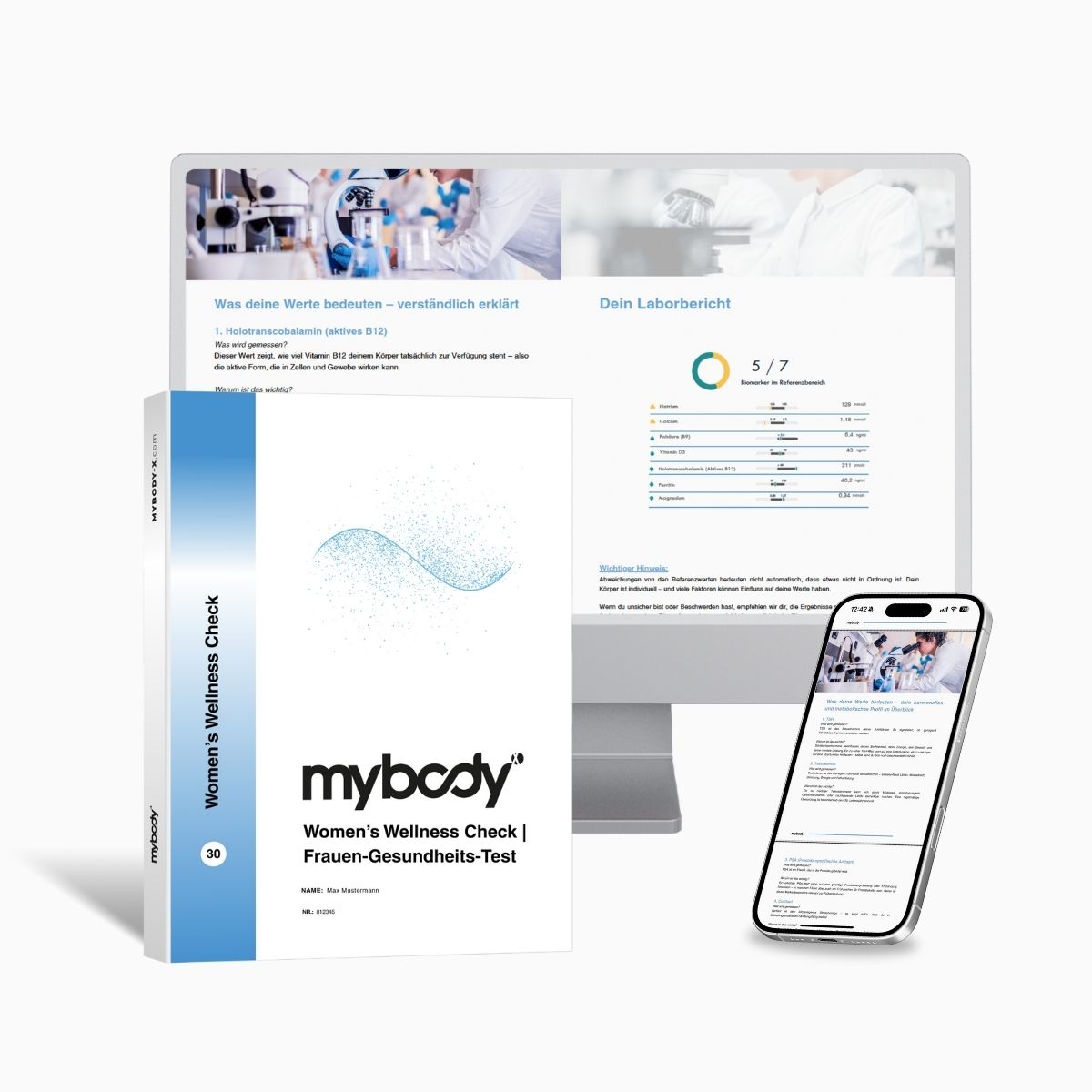
Capillary blood test
Women’s Wellness Check
In addition to cortisol, it includes a thyroid profile with TSH, fT3, and fT4, as well as prolactin, SHBG, ferritin, vitamin B12, vitamin D3, blood lipids, liver and kidney values, HbA1c, and CRP. What the test does not provide: it measures a cortisol level at the time of sampling, not the daily pattern. It is not a diagnostic route for Cushing syndrome and replaces neither the dexamethasone suppression test nor ACTH measurement. The product page does not list cycle hormones such as estradiol, progesterone, and FSH.
Laboratory analysis 3–5 business days after receipt of the sample
Product-page information without location, accessed 27 August 2026
One detail is intentionally omitted here. On 27 August 2026, the product page lists several different numbers of included biomarkers side by side. As long as this contradiction remains, this article gives no single number, but rather the list of values.
How to interpret a notable result
Suppose the result is available and the cortisol value is above the stated range. The first question, before considering the number, is: At what time was the sample taken, and what medications do you take?
A single elevated cortisol value is not a diagnosis but a reason to take a closer look.
Reference ranges depend on the laboratory, method, and age. The information on your own result is always what matters—not figures from an article and not a comparison with an acquaintance’s result.
What to do with the result
A result belongs in a conversation, and that conversation will be shorter if you bring three things: the result itself, the time the sample was taken, and the complete list of medications, including contraception.
If signs from Chapter 4 are also present, that should be stated explicitly. The sentence “my cortisol level is elevated” opens a different conversation than “my cortisol level is elevated, I have had new red stretch marks for six months, and I am finding it harder to climb the stairs.”
And if the result is unremarkable but your symptoms remain, the question stays open and moves on. A normal cortisol value rules out neither a thyroid disorder nor iron deficiency nor a depressive episode.
Who a measurement may be useful for—and who it may not be
It may be useful for you if …
you have been exhausted for months, do not have any of the signs from Chapter 4, and are looking for a baseline value for a discussion at your doctor’s office.
you also want to have your thyroid, iron stores, and vitamin D checked because these values can explain the same symptoms.
you want to track your levels over time and are prepared to take the sample at the same time each time.
Probably not if …
you notice one of the signs from Chapter 4. Then making an appointment is the right order of things, and your own result only delays the evaluation.
you want to rule out Cushing syndrome. That requires the combination of cortisol, ACTH, and a suppression test under medical supervision, not a blood sample taken at home.
you take corticosteroid medication. In that case, the treatment itself is the obvious explanation, and the assessment belongs with the prescribing practice.
you use estrogen-containing contraception and want to interpret the value without providing that information. It is then systematically shifted upward and is not meaningful on its own.
Limitations: what a single cortisol value cannot clarify
The first limitation is timing. A value describes a point in time, but the hormone describes a pattern over the course of the day. That is why a number without a time tells you almost nothing.
The second limitation is interpretation. A value outside the reference range indicates a state. The result does not say whether that exact state is causing your exhaustion, weight gain, or irregular cycle.
The third limitation is the most important and the reason for the caution throughout this article. Cushing’s syndrome is diagnosed through a multistep process involving cortisol, ACTH, and a suppression test, along with imaging procedures. No capillary blood test covers this process, and none replaces it.
The fourth limitation concerns the opposite direction. A normal result only rules out this one question. It says nothing about the thyroid, iron stores, menstrual-cycle hormones, or mental health.
This is not an argument against measuring. It is an argument against expecting a number to replace a medical evaluation.
What ultimately matters
If you take away one action from this article, let it be this: Write down your complete medication list before measuring anything. Contraception, corticosteroid medications in any form, thyroid hormones.
The reason is unremarkable, yet it carries more weight than any number. Two of the three most common explanations for an elevated cortisol level in a woman are found on this very list. Without them, a measurement is a data point without context; with them, it becomes information.
At the beginning was the question of which symptoms in women really suggest excess cortisol. The honest answer is uncomfortable: very few of the symptoms that brought you here. It is not the feeling that matters, but the pattern—and the pattern is recognized through the combination, not an individual sign.
If you are unsure whether your symptoms belong in a doctor’s office or should first be observed: The consultation at mybody®x is free, and it will not sell you anything.
Frequently asked questions
What symptoms suggest high cortisol levels in women?
It is not an individual sign but the combination that is meaningful. The German Society of Endocrinology (2026) lists marked weight gain around the torso, high blood pressure, diabetes, osteoporosis, and depressive moods as typical. New reddish-purple stretch marks and muscle weakness in the thighs and upper arms may also occur. Fatigue, abdominal fat, and sleep problems alone are nonspecific and occur with many other causes as well.
When should suspected excess cortisol be evaluated by a doctor?
As soon as any of the signs from Chapter 4 applies: new, wide red or purple stretch marks; muscle weakness when climbing stairs; increased size around the torso and face while the arms and legs become thinner; newly developed high blood pressure or elevated blood sugar; bone fractures without adequate cause; or bruises from the slightest bumps. This also includes any long-term use of corticosteroid medications. In that case, an at-home test is the wrong order of steps.
Can I rule out Cushing’s syndrome with an at-home test?
No. According to the guideline of the German Society for Endocrinology, the evaluation is based on cortisol, ACTH, and the 1-mg dexamethasone suppression test (AWMF 089-004, 2025). The suppression test is not a measurement value but an intervention followed by measurement and requires a prescribed medication. The Women’s Wellness Check provides a cortisol value at the time of sample collection and is expressly not a diagnostic pathway for this condition.
Why is my cortisol level high even though I don’t feel particularly stressed?
There are several explanations for this that have nothing to do with your stress level. Estrogen-containing contraceptives increase the cortisol-binding transport protein in the blood; after discontinuation, total cortisol fell by an average of 56 percent in a study by Koops, Heijboer, Bisschop, and Hillebrand in the Journal of Clinical Endocrinology & Metabolism (2026). Pregnancy, cortisone-containing medications, high alcohol consumption, and the time of sample collection can also shift the result.
Is stubborn belly fat proof of excessive cortisol?
No. The pattern matters, not the weight gain. In Cushing’s syndrome, the National Library of Medicine describes weight gain in the upper body together with thin arms and legs (MedlinePlus, as of 2025). Even weight gain throughout the body does not fit this picture. More often, other causes underlie the combination of weight gain, menstrual irregularities, and skin changes, such as polycystic ovary syndrome, which according to the guideline of the German Society for Endocrinology affects 8 to 13 percent of all women of reproductive age (AWMF 089-004, 2025).
Next step
The list comes first, then the number
If none of the signs from Chapter 4 apply to you and you are looking for a baseline value to discuss, the Women’s Wellness Check measures thyroid function, iron stores, and vitamin D in addition to cortisol. The article on testing explains how to collect the sample and why the time of day determines the result.
Women’s Wellness Check Measure cortisol at homeRead more
You might also be interested in this
In case your symptoms point in the other direction: weakness, low blood pressure, and salt cravings.
What can be changed in everyday life regarding sleep, exercise, and recovery when high stress is the starting point.
Sources
- German Society for Endocrinology (DGE): Cushing’s Syndrome – Four Years Until Diagnosis (2026) – endokrinologie.net
- German Society for Endocrinology (DGE): S2k Guideline on the Diagnosis and Treatment of Polycystic Ovary Syndrome, AWMF Registry Number 089-004 (2025) – register.awmf.org
- National Library of Medicine: Cushing's Syndrome, MedlinePlus (as of 2025) – medlineplus.gov
- German Medical Journal: Systemic Cortisone Therapy – Cushing’s Syndrome Requires Timely Medical Intervention, Issue 37 (2012) – aerzteblatt.de
- Cadegiani FA, Kater CE: Adrenal fatigue does not exist – a systematic review. BMC Endocrine Disorders 16:48 (2016) – bmcendocrdisord.biomedcentral.com
The verbatim quotation about late detection, the figure of approximately four affected people per 100,000, the time to diagnosis of four years in Germany and 2.8 years internationally, the average of 4.6 medical practices visited, and the list of typical signs come from source [1]. The prevalence of polycystic ovary syndrome of 8 to 13 percent, the mention of Cushing syndrome as a differential diagnosis, and the three components of the diagnostic assessment—cortisol, ACTH, and the 1-mg dexamethasone suppression test—come from [2]. The classification as a rare disease, the mention of synthetic hormone preparations as a cause, and the description of the pattern of weight gain come from [3]. The figure that around two-thirds of long-term users of systemic glucocorticoids develop iatrogenic Cushing syndrome is based on an analysis of more than 7,000 patients from British general practices, reported by [4]. The classification of the term “adrenal fatigue” and the number of 58 studies evaluated come from [5]. The figures for cortisol-binding globulin and total cortisol after discontinuing estrogen-containing contraceptives come from a study by Koops, Heijboer, Bisschop, and Hillebrand in the Journal of Clinical Endocrinology & Metabolism (2026); it is attributed in the body text with the authorship, journal, and year and is therefore not included in this list. The same applies to the Robert Koch Institute’s figure on perceived stress levels from the “Health in Germany” panel survey, conducted in 2024. Information on price, range of values, sample type, and laboratory comes from the mybody®x product page, accessed on 27.08.2026; processing times follow the central specification for blood tests. All sources were accessed and checked on 27.08.2026.

mybody®x Editorial & Specialist Team
Laboratory diagnostics Blood analysis interpretation Hormones and metabolism Nutritional science
This article was created by the mybody®x editorial and specialist team. The team combines laboratory diagnostics, the interpretation of blood analyses, and nutritional science. Those who contribute to it are listed on the authors’ page.
Published on 22.08.2025 · Last updated on 27.08.2026
The content is for general informational purposes and does not replace medical advice, diagnosis, or treatment. Reference ranges depend on the laboratory, method, and age—your test report always takes precedence.




Share now:
Test for lactose intolerance and finally gain clarity
Measuring cortisol: what tests are available and who orders them