
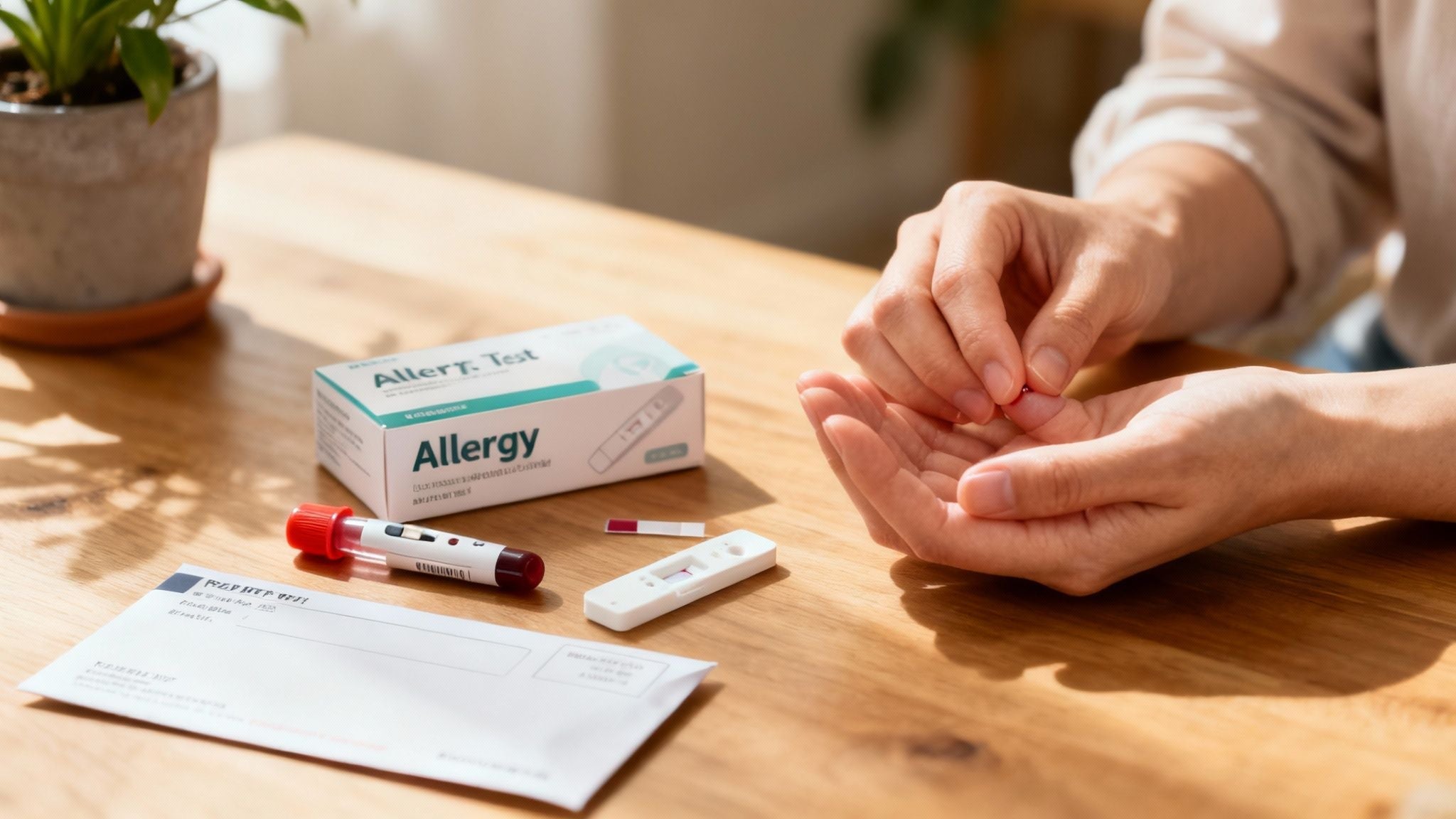
Take an allergy test yourself: Your path to greater clarity
Constantly dealing with a runny nose, itchy skin, or unexplained gastrointestinal problems? If you are looking for the cause of your symptoms, a do-it-yourself allergy test can be the first step toward greater clarity. This way, you can quickly and conveniently get initial clues from the comfort of your own home—without long waits for a doctor's appointment.
Finally gain some initial clarity about allergy symptoms

Many people know this feeling: You simply do not feel well, but you cannot pinpoint why. You are absolutely not alone. Many health-conscious people like you are looking for an uncomplicated way to better understand their bodies and get some initial clues before seeing a specialist.
This is exactly where a home allergy test, such as the one from mybody-x, comes in. It gives you the opportunity to quickly and discreetly find out whether your immune system is overreacting to certain substances.
Why a self-test is a sensible first step
The constant uncertainty about what is behind your symptoms can be genuinely exhausting. A self-test helps you overcome this initial hurdle and gives you back a sense of control. Imagine being able to confirm a suspicion with a simple blood test: Could your morning fatigue be related to a house dust mite allergy? Or could certain foods be behind your skin problems?
The goal is to give you a solid foundation so that you can make informed decisions about your health.
A home allergy test does not replace a medical diagnosis, but it is the perfect starting point. With specific information in hand, your conversation with your doctor will be much more focused, and further investigation can proceed considerably faster.
Allergies are more widespread than you think
A look at the figures in Germany shows how relevant the issue is. According to a forsa survey, 36 percent of people suffer from a medically diagnosed allergy. If you include those who suspect they have an allergy but do not yet have a diagnosis, the proportion even rises to 50 percent. The most common culprits? Hay fever and house dust mites. You can find more fascinating insights in the results published by the AOK Federal Association.
A self-test can help you better identify the causes of your symptoms. Sometimes the reactions aren’t clear-cut and overlap with those of an intolerance. For example, did you know that foods such as avocados contain a lot of histamine and can therefore cause allergy-like symptoms? If you’re interested in the topic, take a look at our article explaining what histamine is and what role it plays.
A mybody-x blood test analyzes the specific IgE antibodies in your blood—these are the proteins your immune system produces in response to allergens. This gives you a clear picture of what your body reacts to, allowing you to plan the next steps to specifically improve your well-being.
How to prepare for the test
Good preparation is essential for a reliable test result. If you do everything correctly, you’ll end up with a report you can truly rely on. With a few simple tips, you can make sure everything goes smoothly.
Take a moment to create a quiet, clean environment. The kitchen table is perfect for this. Lay out all the components of your mybody-x test kit in front of you and compare them with the checklist in the instructions. This way, you can make sure everything is really there.
The right time and what you should keep in mind
One of the most common questions we receive concerns medication. And yes, certain medications—especially antihistamines—can affect your test results. Their purpose is to suppress your body’s allergic reaction, which can lead to a false-negative result in a test.
Important: Be sure to read the instructions for your test carefully. They clearly state which medications you may need to stop taking for a certain period. However, please always discuss any interruption of medication with your doctor beforehand—your health always comes first.
If you’d like to explore the topic in more depth, we have an in-depth article in our health portal on preparing for an allergy test and dealing with antihistamines for you.
The good news: Unlike some other blood tests, you don’t need to fast for the mybody-x allergy test. You can eat and drink normally as usual. A glass of water before collecting the blood sample may even help, as it stimulates circulation.
The little bit of mental preparation for a smooth process
Admittedly, the idea of pricking your own finger can take some getting used to at first. That’s completely normal, and many people feel the same way. Just take a few deep breaths and mentally go through the steps in the instructions. The more relaxed you are, the easier it will be.
At-home tests are incredibly popular in Germany. Many people simply want to investigate things themselves first before going to the doctor. A YouGov study shows that up to 50 percent of Germans believe they have an allergy. This explains the great demand for simple and accessible testing options that enable you to take responsibility for your health.
See? Good preparation takes away your uncertainty and lets you start with confidence.
Collecting a blood sample simply and safely
For many people, the idea of pricking their own finger initially sounds like a small test of courage. But don't worry: mybody-x blood tests are designed to make the entire process surprisingly simple, quick, and virtually painless. We'll guide you through it step by step so you feel completely confident.
The key to a successful sample is good circulation. A simple but extremely effective trick is to warm your hands thoroughly beforehand. Simply hold them under warm water for a minute or massage them vigorously. This helps widen the small blood vessels in your fingertips so the blood can flow more easily.
The small prick that leads to a great result
As soon as your hands are warm and you have everything ready, you can begin. Disinfect the fingertip of your choice with the enclosed alcohol swab. The middle or ring finger is best, as these fingers are often used the least in everyday life. Then let the alcohol air-dry briefly.
Now take the lancet, the small lancing device, and place it lightly against the side of the fingertip. Firm pressure activates the mechanism. You will feel only a tiny prick, nothing more.
A practical tip: Many people make the mistake of pricking directly in the center of the fingertip. The sides are often less sensitive and bleed better.
This infographic gives you another overview of the most important preparation steps at a glance, so the process runs as smoothly as possible.
The graphic makes it clear: With a clear sequence and just a few steps, everything is ready for a successful blood draw.
Collecting the blood for analysis
After the prick, gently massage your finger from the palm toward the fingertip. This will form a nice, large drop of blood. Now fill the sample tube up to the mark.
Be careful not to squeeze your finger. This could contaminate the sample with tissue fluid. Gently stroking the finger is perfectly sufficient.
Once the tube is full, seal it securely and slowly tilt it back and forth a few times, exactly as described in the guide. This mixes the blood with the stabilizing fluid in the tube—a crucial step for the subsequent laboratory analysis.
For detailed visual guidance, we have also put together a comprehensive capillary blood test guide that shows you every step with images.
- Don’t rush: Take as much time as you need. There is absolutely no reason to hurry.
- Additional lancets: Your mybody-x kit contains spare lancets. So if it does not work the first time, it is not a problem at all.
- Have a bandage ready: After collecting the sample, simply apply the enclosed bandage to the puncture site. The bleeding usually stops immediately.
As you can see, collecting the sample is really not difficult. With a little preparation and composure, you can confidently master this practical part of your allergy test.
Preparing your sample correctly for shipping
Great, you have already mastered the most important part! The blood sample has been collected—now all that remains is to send it safely to our laboratory. Proper packaging is essential so that your sample arrives undamaged and we can analyze it under perfect conditions.
Take the tightly sealed sample tube and place it in the protective packaging included with the kit. This small, sturdy container is worth its weight in gold because it protects the tube from the bumps and temperature fluctuations that can occur during transport.
This is how easily your sample gets to the laboratory
To make everything as easy as possible for you, we have already fully prepared the return shipment for your mybody-x test kit. You do not need to do anything else.
- The return envelope: Simply grab the enclosed envelope. It already has postage paid for you.
- Everything in its place: Put the protective container with your sample inside. Very important: Don’t forget to include the signed test activation form—without it, our laboratory experts will not know who the sample belongs to.
- Seal securely: Now all you need to do is carefully seal the envelope. It is ready for its journey to our certified specialist laboratory in Germany.
A question we often receive: “Do I need to send the sample immediately?” Ideally, you should drop the envelope into a Deutsche Post mailbox on the same day. If you cannot manage that, the next business day is perfectly fine too. Until then, simply store the sample at normal room temperature.
Important shipping information
The outside temperature usually does not matter much. However, extreme heat in midsummer or severe frost could theoretically affect the quality of the sample. So it is best not to leave the envelope in a hot car for hours, and do not put it in a mailbox on Friday if it will not be emptied until Monday.
Shipping checklist:
- Sample in the protective container? The blood sample tube is safely secured in the transport container.
- Form included? The completed and signed form for test activation is enclosed.
- Envelope sealed? The return envelope is securely sealed.
- Send it promptly? Ideally, put it in the mailbox today or tomorrow.
By following these simple points, you can ensure that your do-it-yourself allergy test runs smoothly. Your sample will arrive quickly and safely, allowing our specialists to provide you with a reliable, meaningful result.
Understanding your results report correctly

The moment you have been waiting for is here: Your results are now available online in your mybody-x account. At last, you hold the key to getting to the bottom of your symptoms. But what do the colorful charts and the various values in your report mean?
Don’t worry, we won’t leave you to figure this out alone. Your results report is designed to show you at a glance what your immune system reacts to. The IgE level is central to this. It measures the concentration of specific antibodies against certain allergens in your blood.
Decoding IgE levels
An elevated IgE level for a specific allergen—say birch pollen or milk protein—indicates that your body is sensitized to it. This means it has already produced antibodies and is virtually “on standby” to trigger an allergic reaction upon renewed contact.
To make the interpretation easier for you, your mybody-x report divides these reactions into different levels:
- No or very weak reaction: Great, your body shows no significant sensitization here. An allergy to this substance is very unlikely.
- Weak to moderate reaction: This indicates sensitization. These allergens could be responsible for your symptoms, especially if the timing and location match your symptoms.
- Strong to very strong reaction: A clear signal! With these allergens, there is a high probability that they are triggering your symptoms.
Imagine your report shows a strong reaction to dust mites and you suffer from a blocked nose every morning. That is an extremely specific clue you can now investigate.
You must always view a result in the context of your personal symptoms. Sensitization alone does not automatically mean that you will have severe symptoms. The test shows you what your body reacts to—you are the expert on how that feels.
From the number to concrete action
What will you do with this knowledge now? A positive result is no reason to panic, but your first, huge step toward feeling better. It gives you the power to make targeted changes.
For example, if you have a strong reaction to grass pollen, you can use the pollen forecast to plan outdoor activities more intelligently. This is becoming increasingly important because the effects of climate change in Germany are leading to a longer and more intense pollen season. Pollen often starts circulating earlier and remains in the air longer, triggering allergic symptoms in more and more people.
To help you interpret your results even better and take action right away, we recommend our Test Result Analysis Booklet as a valuable supplement.
Your mybody-x report is an extremely valuable foundation. It provides the well-supported starting point for beginning a conversation with a doctor or therapist. Instead of groping in the dark and wondering for weeks, you go to the practice with a concrete finding.
This enables a much faster, more targeted diagnosis and the development of an individual treatment plan. Based on your report, your doctor can decide whether further tests, such as a skin prick test, are necessary or whether treatment, such as allergen immunotherapy, can be started immediately. You’ve completed the important groundwork and can now plan the next steps for your well-being together.
Still have questions? Here are the answers
A home allergy test is new territory for many people. So it’s understandable that one or two questions may arise—this is completely normal! To help you feel confident and know exactly what to expect, we’ve collected the answers to the most common questions here.
How reliable is a blood test at home, really?
Many people wonder whether the result of a home test is really just as reliable as a test conducted by a doctor. The short answer: yes. A mybody-x blood test is not a simple rapid test. Your sample is sent to an ISO 15189-certified medical laboratory in Germany.
This is exactly the kind of laboratory that medical practices also send their samples to. Your blood sample is tested there for specific IgE antibodies using scientifically validated methods. You therefore receive a highly precise analysis of which substances your immune system reacts to.
This gives you a sound basis for having a focused conversation with your doctor or therapist. It is an important first step, but of course it does not replace a complete medical diagnosis, which also includes your personal medical history and a physical examination.
What should I do if I simply can’t get enough blood?
We can completely put your mind at ease about that concern. It happens from time to time and is absolutely no reason to panic! Sometimes you’re a little nervous, or your fingers are simply cold. So if it doesn’t work right away, take a deep breath. A few simple tricks are usually all it takes.
Proven tips for better blood flow:
- Warmth works wonders: Hold the hand you want to take the sample from under warm, running water for a few minutes. This widens the blood vessels.
- Drink a glass of water: If you’re well hydrated, your blood will flow better too.
- Gently massage: Stroke a few times from your wrist toward your fingertip. This promotes blood circulation.
- A little exercise: A few arm circles or squats get your circulation going and help as well.
Every mybody-x test kit contains several safety lancets. So you have a second attempt without any stress if the first try did not provide enough blood for the sample.
Does the self-test replace a visit to the doctor?
There is an extremely important question with a clear answer: No. A mybody-x blood test is a valuable, scientifically sound source of guidance. It quickly and easily provides you with concrete indications and can save you weeks or months of uncertainty.
With the knowledge gained from the test, you can often achieve a significant improvement in your well-being through small adjustments to your daily routine.
However, the test does not replace a comprehensive medical history, diagnosis, and final treatment planning by a specialist. It’s best to view the test as the perfect preparation. Instead of going to the practice with a vague suspicion, you’ll arrive with an informative laboratory report.
This saves time and enables your doctor to carry out much more targeted diagnostics. This makes your at-home allergy test a crucial building block on your journey toward better health and quality of life.
Are you ready to finally gain clarity and better understand your body? At mybody-x, you’ll find the right blood test to get to the bottom of potential allergies easily and reliably. Explore the options now at https://mybody-x.com.



Share now:
Micronutrient analysis at the family doctor: What costs can you really expect?
What are cross-allergies, and what can you do about them?