

What are cross-allergies, and what can you do about them?
You take a delicious bite of an apple, and suddenly your mouth starts itching and tingling? If you have hay fever, this is often not a coincidence but what is known as a cross-allergy. Your immune system reacts to certain foods because their proteins look confusingly similar to those in pollen. A harmless case of mistaken identity with often unpleasant consequences—but one you can get under control.
What exactly are cross-allergies?
Imagine your immune system as a well-trained but sometimes slightly overzealous bouncer. With a pollen allergy, this bouncer has learned to recognize certain proteins—such as those from birch pollen—as “unwanted” and immediately sound the alarm. This is a protective mechanism that is actually meant to protect you from real dangers.
This is what happens with a cross-allergy: You eat an apple, a carrot, or a hazelnut. The proteins in these foods resemble the “stored” pollen proteins so closely that your immune system’s bouncer cannot tell them apart. It assumes there is an intruder and mistakenly triggers a defensive reaction.
A cross-allergy is therefore not a new, independent allergy. Rather, it is a direct consequence of an existing allergy, usually to pollen. Your body reacts to harmless foods because it confuses them with the actual allergens.
This table summarizes the most important facts about cross-allergies and gives you a quick overview of the topic.
Cross-allergy at a glance
| Aspect | Brief explanation |
|---|---|
| What is it? | An allergic reaction to foods triggered by an existing pollen allergy. |
| Cause | The immune system confuses similar protein structures in pollen and foods. |
| Typical triggers | Birch pollen, grass pollen, mugwort pollen. |
| Typical symptoms | Tingling/itching in the mouth, swelling (lips, tongue), gastrointestinal symptoms. |
| Most common form | Oral allergy syndrome (OAS). |
| Important to know | Cooking or heating the foods can often destroy their allergenic effects. |
Understanding these connections is the first step toward getting your reactions under better control and understanding your body.
The scientific explanation behind it
At a molecular level, the core of the problem lies in this confusion. The allergy-triggering proteins in pollen and certain foods have such a similar biochemical structure that your immune system’s antibodies (specific IgE antibodies) can attach to both—and thus trigger a reaction.
This also explains why the symptoms usually occur directly in the mouth and throat, the first point of contact. Experts refer to this as oral allergy syndrome (OAS), which manifests through symptoms such as itching, tingling, or mild swelling.
This phenomenon is more widespread than many people assume. Estimates suggest that around 4.7 percent of adults in Germany suffer from a food allergy. Remarkably, around 60 percent of these cases are due to cross-reactions resulting from an existing pollen allergy.
Why this knowledge is important for you
If you know the cause of your symptoms, you can take targeted action. Many people affected initially suspect a classic food intolerance, even though the root of the problem is actually their hay fever.
Understanding cross-allergies helps you correctly interpret your body’s signals and identify the true triggers. A blood test, such as the one available at mybody-x.com, can help you distinguish between an allergy and an intolerance. It provides valuable clues as to whether specific IgE antibodies—the messengers of a true allergy—are elevated in your blood. To learn more about the various testing options, read our article on testing for food intolerance. This way, you can regain control and consciously adjust your diet without unnecessarily giving up valuable foods.
The most common triggers and their symptoms
Okay, the principle of mistaken identity is clear. But which pollen and foods form the most common “look-alike” pairs? There are a few classic connections that cause trouble particularly often. If you know them, you can better understand your body’s reactions.
By far the most common cross-reactions are caused by birch pollen. So if you struggle with hay fever in spring, there’s a good chance your body also reacts to certain raw fruits. Your immune system mistakes the birch proteins for those found in pome and stone fruits—a classic.
Classic pollen–food pairs
The similarity of protein building blocks is the key to understanding why the same combinations keep appearing. Essentially, there are three main groups of pollen known as primary triggers of cross-allergies.
- Birch pollen (as well as alder and hazel): This group is the clear frontrunner. Reactions here occur primarily with raw stone fruits and pome fruits, such as apples, cherries, peaches, or plums. Nuts—especially hazelnuts and almonds—kiwis, and even some vegetables such as raw carrots or celery can also cause problems.
- Mugwort pollen: As a typical summer and late-blooming plant, mugwort often triggers reactions to certain vegetables and spices. The best-known association is the celery-carrot-mugwort syndrome. Spices such as anise, fennel, coriander, or caraway may also be involved.
- Grass pollen (such as rye and wheat): People with grass allergies react to foods less often, but it does happen. Possible cross-reactions may occur with tomatoes, legumes (such as peanuts and soy), or certain types of grain.
This simplified illustration shows how your immune system is “trained” by pollen and then mistakenly reacts to a structurally similar food—such as an apple.
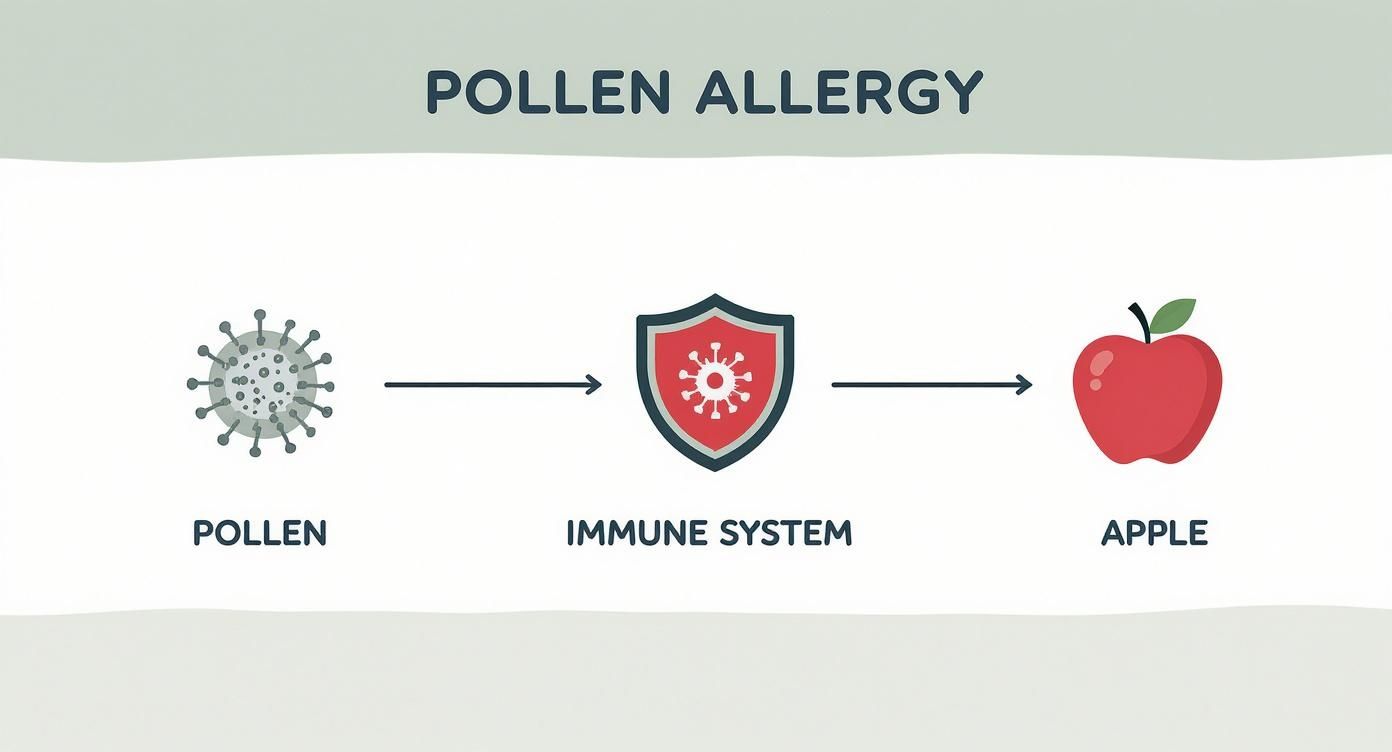
The infographic clearly illustrates the path from the original pollen allergy to the unexpected reaction to a food.
To give you an even better overview, we have summarized the most common culprits in a table.
Typical cross-allergies between pollen and foods
This table shows the best-known cross-reactions between certain types of pollen and the associated foods.
| Triggering pollen type (primary allergen) | Foods that commonly cause cross-reactions |
|---|---|
| Birch, alder, hazel | Apple, pear, peach, nectarine, plum, cherry, kiwi, hazelnut, almond, walnut, celery, carrot, raw potato |
| Mugwort | Celery, carrot, fennel, chamomile, anise, coriander, caraway, bell pepper, mango, lychee, sunflower seeds |
| Grasses and grains | Tomato, potato, melon, peanut, soy, lentils, wheat and rye flour |
| Ragweed | Banana, melon (cantaloupe, watermelon), zucchini, cucumber |
However, keep in mind that these are only the most common associations—the reactions can vary greatly from person to person.
From tingling in the mouth to gastrointestinal problems
The symptoms of a cross-allergy can vary considerably, but they usually occur within a few minutes to two hours after eating. The most common—and fortunately also the mildest—form is oral allergy syndrome (OAS).
This causes local reactions exactly where the food comes into contact with the mucous membranes—in the mouth and throat. Typical signs include:
- An unpleasant tingling or itching on the lips, tongue, and roof of the mouth.
- A burning sensation in the mouth.
- Mild swelling of the lips or tongue.
Oral allergy syndrome is generally harmless, and the symptoms quickly subside on their own. However, it is a clear warning from your body that a cross-reaction has occurred.
Sometimes, however, the symptoms extend beyond the mouth and affect the whole body. These include skin rashes such as hives, gastrointestinal problems such as abdominal pain or diarrhea, and, in very rare cases, even breathing difficulties. Such stronger reactions are a sign that the allergens were not rendered harmless by saliva and stomach acid.
Interestingly, some of these symptoms can resemble those of histamine intolerance. If you would like to learn more about the role of histamine in food, take a look at our article about histamine-containing foods.
Incidentally, preparation is often a decisive factor in determining the severity of the reaction. Many of the proteins responsible are heat-sensitive. This means that an apple that causes severe problems when raw is often completely harmless as applesauce or in a cake. Cooking, baking, or frying changes the structure of the proteins so that your immune system no longer recognizes them as “dangerous.” A simple trick you can use in everyday life.
What is actually behind the allergic reaction?
Why does your immune system suddenly go haywire just because you bite into an apple, even though it is actually trained to respond to birch pollen? To understand this, we need to take a look at what happens inside your body on the smallest scale. Essentially, it is a fascinating but unfortunately misguided protective mechanism.

The main role in this drama is played by special proteins produced by your immune system: immunoglobulin E antibodies, or IgE for short. If you have a birch pollen allergy, for example, your body produces huge amounts of these IgE antibodies. You can think of them as tiny, highly specialized sniffer dogs trained to follow just one trail—the trail of birch pollen.
These IgE antibodies attach themselves to specific cells of your immune system, known as mast cells. They are essentially your body’s fully loaded ammunition depots, packed with messenger substances such as histamine. If you want to learn more about the role of this important substance, take a look at our article explaining what histamine is.
The Allergy as a Lock-and-Key Problem
Simply imagine the IgE antibodies as a lock. This lock is waiting for a very specific key. In a birch pollen allergy, the birch allergen protein is the one perfectly fitting key. As soon as this key is inserted into the lock, the mast cell immediately sounds the alarm.
And what happens then? The mast cell releases its entire supply of messenger substances, above all histamine. This is what causes typical allergic reactions such as itching, a runny nose, or swollen mucous membranes.
A cross-allergy develops because the proteins in certain foods (e.g., in an apple) are structurally so similar to the pollen proteins (e.g., birch pollen) that they fit into the same IgE lock like a duplicate key.
Your immune system cannot tell the difference. It cannot distinguish this “duplicate key” from the original and triggers exactly the same defensive response as if you had come into direct contact with birch pollen.
To better understand this process, it is worth taking a look at the basic functions of the immune system.
Why you should know your IgE levels
This knowledge is incredibly important because it shows that a cross-allergy is not a completely new, independent allergy. Rather, it is the direct consequence of an existing allergy to something you inhale, such as pollen. Your body already has the appropriate antibodies ready—and unfortunately, these now also react to certain foods.
This is exactly where mybody-x.com’s blood tests come in. A blood test for specific IgE antibodies can uncover these connections. In the laboratory, it is precisely measured whether and how many of these specific IgE antibodies against certain pollens and foods are present in your blood.
The benefits of such a test at home are obvious:
- Targeted investigation into the cause: You can find out which primary allergy (e.g., to which type of pollen) is actually responsible for your symptoms.
- Uncover cross-reactions: The test can show you which foods your body is also likely to react to because of this primary allergy.
- Take responsibility for your health: With concrete results in hand, you can take control and speak with your doctor or naturopath in a much more targeted way.
A self-test from mybody-x.com therefore provides valuable initial clues. It helps you better understand the complex connections in your body and find the root of your problems—the best basis for successfully managing your symptoms.
How to reliably diagnose a cross-allergy
Suspecting a cross-allergy can be quite unsettling. Suddenly, foods you have always eaten without problems seem to trigger symptoms, and you may wonder what you can eat at all. But don't worry: there are clear steps to shed light on the situation and find out what is really behind your symptoms.
Arriving at a reliable diagnosis is a process based on careful observation and targeted tests. The good news is that you can lay the most important foundation yourself.
The first step: your own detective work
The most important source of information is your own body. A detailed conversation with a doctor or allergist, known as the medical history, is therefore always the starting point. You will be asked in detail about your symptoms, lifestyle, and medical history.
To be fully prepared for this conversation, a food and symptom diary is worth its weight in gold. It helps you and your doctor identify patterns that could otherwise easily go unnoticed.
Here's the best way to proceed:
- Note everything you eat and drink: Be as precise as possible, including the time and quantity. Don't forget small snacks, spices, or drinks in between meals.
- Record your symptoms: What symptoms occur (e.g., tingling in the mouth, itching, stomach pain)? When do they start, and how long do they last?
- Document external circumstances: Are there any unusual factors? Is it currently pollen season? Are you feeling stressed? All these factors can influence your body's reaction.
This diary is your most important tool. It provides crucial clues about which foods, in combination with which type of pollen, may be potential triggers for your cross-allergy.
Medical tests to confirm the suspicion
If your diary and conversation with the doctor strengthen a specific suspicion, specific allergy tests may be used. They are designed to scientifically prove your body's reaction.
The most common methods are listed here:
- The prick test: In this test, small drops containing various allergen extracts (from pollen and foods) are placed on the skin of your forearm. The skin is then lightly scratched at these points. If redness or a small wheal, similar to a mosquito bite, develops, this indicates an allergic reaction.
- The blood test for specific IgE antibodies: This test measures the concentration of IgE antibodies against specific allergens in your blood in a laboratory. It is particularly informative because it detects exactly those antibodies responsible for the allergic reaction.
Your path to initial insights—conveniently from home
Perhaps you would like to have more clarity before visiting a doctor or specifically substantiate your suspicion. This is exactly where a food intolerance test from mybody-x.com comes in. Our blood tests allow you to conveniently collect a sample at home and have it analyzed in our certified laboratory.
Such a blood test for specific IgE antibodies can provide you with valuable initial answers. You learn which primary allergens, such as birch, grass, or mugwort pollen, your body reacts to. At the same time, the test can also indicate possible cross-reactions with certain foods. You can find more information on how to take an allergy test yourself in our detailed guide.
The benefits of a self-test as a first step are clear:
- Guidance and clarity: You receive well-founded indications of which allergens could be relevant to you.
- Efficient preparation: With the results in hand, you can have a much more focused conversation with your doctor.
- Strengthen self-responsibility: You actively take control and gain a better understanding of the connections within your body.
It is important to emphasize, however, that a self-test is a valuable guide, but does not provide a definitive medical diagnosis. The final diagnosis and any treatment should always be discussed with a specialist. The test is your ideal partner for approaching this journey in an informed and confident way.
Practical tips for everyday life with a cross-allergy
Being diagnosed with a cross-allergy can initially feel like a huge jungle. But don't worry: You don't have to turn your whole life upside down or give up everything that tastes good. It's more about learning a few clever strategies and better understanding your body's signals. This way, you can regain control and enjoy things again without worry.

The best news comes right at the start: Many foods you cannot tolerate raw suddenly become easier to eat when boiled, fried, or baked. Why? The allergy-triggering protein structures are often rather delicate and extremely heat-sensitive. Heat changes their shape so dramatically that your immune system no longer recognizes them as a threat.
The heat trick: How to make foods less reactive
This simple trick opens up a whole world of possibilities. The apple that causes tingling in your mouth when raw is often completely harmless when baked, in a cake, or as compote.
- Fruit: Apples, pears, cherries, or plums are great for turning into purée or compote. They are also usually well tolerated as a warm filling in pastries or on pancakes.
- Vegetables: Carrots, celery, or potatoes, which often cross-react with birch or mugwort pollen, become much less problematic when cooked in soups and stews.
- Nuts: Heating can help with nuts too. Some people with allergies tolerate roasted hazelnuts or almonds better. But be careful: nut proteins are often more stable, so ease into this slowly.
An important note: Unfortunately, this heat trick is not a cure-all. Particularly stable allergens, such as those found in celery or peanuts, can still trigger severe reactions even after cooking. So take it slowly and carefully test what works for you.
Shopping and planning wisely
Managing your cross-allergy smartly starts in the supermarket. A quick glance at the ingredient list can save you a lot of trouble later, especially with processed foods.
What you should look out for
- Read ingredient lists: Hidden allergens lurk everywhere. Common examples include nuts in pesto, celery in stock cubes, or soy in ready-made meals.
- Plan for seasonal fluctuations: Your sensitivity is not the same all year round. When the pollen that triggers your allergy is in the air (e.g. birch pollen in spring), your immune system is in a state of emergency. During this time, you will probably react much more strongly to foods than in autumn or winter.
- Try different varieties: Not every apple is the same. Old varieties such as Boskop or Santana are often better tolerated than modern cultivars like Braeburn or Gala. Sometimes simply switching varieties is enough to bring back the enjoyment.
- Peeling can help: Many of the culprits—the allergenic proteins—are located directly beneath the skin. If you thoroughly peel fruit and vegetables, you can often reduce the amount of allergens so much that a reaction does not occur.
Additional factors that influence your reaction
It is not always just the food itself. Sometimes other factors come into play that push your personal "allergy bucket" over the edge. If you know these co-factors, you can better manage your risk.
Avoid combining potentially problematic foods with these triggers:
- Alcohol: It can make the intestinal lining more permeable. As a result, allergens enter the bloodstream more easily and can trigger stronger reactions.
- Stress: When you are stressed, your immune system is also on high alert. This makes you more sensitive to allergic reactions.
- Physical exertion: Going for a jog right after eating can intensify symptoms. This phenomenon is also known as exercise-induced anaphylaxis.
With these tips, you will be well prepared to manage everyday life with a cross-allergy independently and, above all, enjoyably. It is not about strict avoidance, but about clever management that gives you back a significant measure of quality of life.
Frequently asked questions about cross-allergies
Now that we have explored the topic in depth, you may still have a few unanswered questions. That is completely normal! That is why we have collected the most frequently asked questions about cross-allergies here and answered them briefly and concisely, so you can clear up any remaining uncertainties.
Can a cross-allergy suddenly develop in adulthood?
Yes, absolutely—that is actually quite typical. A cross-allergy can develop even if you have been living with a pollen allergy for years. Your immune system is not a static system; it changes and can develop new sensitivities over time.
Sometimes, you only notice it when you eat a particular food precisely when the pollen you react to is at its peak. So it is entirely possible that you tolerated apples without any problems for years and suddenly feel that typical tingling in your mouth.
Can a cross-allergy go away on its own?
Because a cross-allergy is always linked to an existing allergy—usually hay fever—a spontaneous and complete cure is unfortunately rare. However, the severity of the symptoms can change. They may be more or less pronounced over the years.
One promising approach is hyposensitization (also called specific immunotherapy) against the primary allergen itself, such as birch pollen. In many cases, successful treatment of the pollen allergy also causes cross-allergy symptoms to significantly improve or even disappear completely. However, there is no guarantee.
Although a cross-allergy usually persists, you are not helplessly at its mercy. Targeted treatments or small changes to your daily routine can significantly improve the symptoms. It is a dynamic process, not an unchangeable fate.
How dangerous are cross-allergies really?
The good news first: In the vast majority of cases, cross-allergies are annoying but harmless. They usually manifest as mild, localized reactions in the mouth and throat, known as oral allergy syndrome.
Truly severe reactions affecting the entire body—even leading to anaphylactic shock—are fortunately very rare. However, the risk is higher with certain particularly stable allergens. Well-known examples include the mugwort-celery-spice syndrome and the latex-fruit syndrome. As soon as you notice symptoms extending beyond the mouth (shortness of breath, dizziness, severe skin rash, or circulatory problems), you should call for medical help immediately.
Does peeling fruit before eating really help?
Yes, this simple trick can make a surprisingly big difference! Many of the proteins that trigger the allergy are located directly in or just beneath the skin of fruits and vegetables.
If you peel fruit thoroughly, you often significantly reduce the amount of allergens you ingest. For many people affected, this is enough to prevent a reaction or at least greatly reduce its severity. This effect is particularly well known with apples. Of course, this is not a 100% guarantee, as the flesh may still contain allergens—but it is definitely worth a try.
Do you finally want clarity about which allergens could be behind your symptoms? The blood tests from mybody-x.com offer you a convenient and reliable way to obtain important initial clues from the comfort of your home. Find the cause of your reactions and take control of your health. Discover the right tests for you now at mybody-x.com.



Share now:
Do an allergy test yourself: Your path to greater clarity
Iron and vitamin B12 deficiency symptoms: recognize and take action