
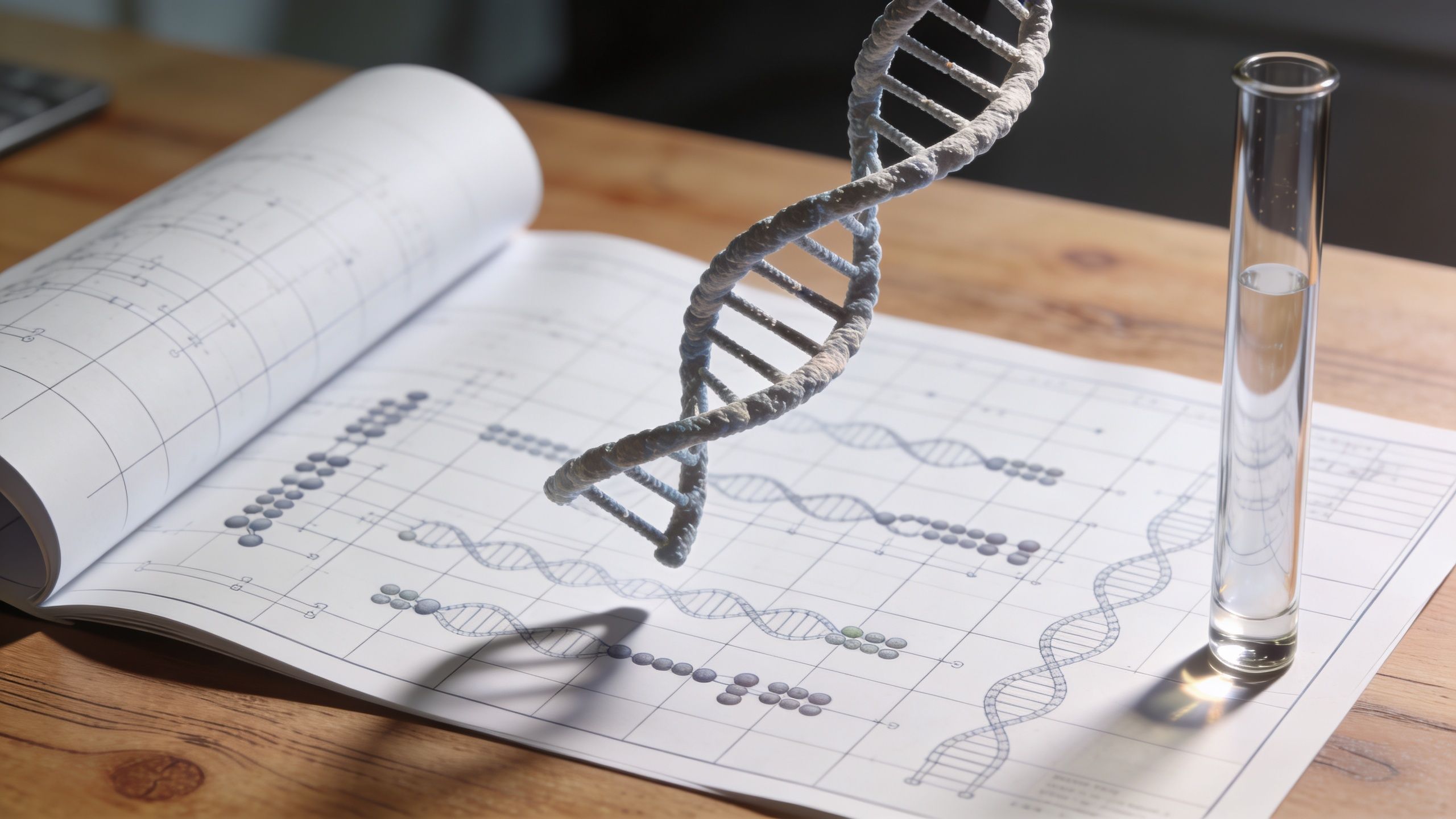
How is DNA structured? Your blueprint for health
You have probably already experienced that a nutrition tip works remarkably well for others but not at all for you. Someone feels great with lots of protein and few carbohydrates, while after a few days you are simply tired, irritable, or constantly hungry. Or coffee barely affects your colleague in the evening, while after a late cup you lie awake in bed for a long time.
Such differences are not a sign that anything is wrong with you. Above all, they show that your body has its own biological blueprint. If you want to understand how DNA is structured, this is not just biology knowledge from school. It is about why your body reacts the way it does, and why health is often more personal than many nutrition guides suggest.
Your personal blueprint: why you are unique
You can think of your DNA as your body’s user manual. It does not only contain information about the physical traits you inherit. It also influences how your body responds to food, exercise, and certain environmental stimuli.
This explains why two people can eat the same plate of pasta and feel completely different afterward. One person has stable energy, while the other quickly feels hungry again. One can fall asleep easily after an espresso, while the other lies wide awake. Your everyday life therefore constantly gives you small clues that your body operates according to individual rules.
Why one-size-fits-all solutions often fail
Many health concepts act as though there were one perfect solution for everyone. In practice, that is rarely the case. Your body does not process stimuli in exactly the same way as your friend’s, your partner’s, or your training buddy’s.
That is precisely why foundational knowledge matters. Anyone who wants to explain health clearly or develop digital solutions for it needs sound biological logic and effective systems behind the scenes. An interesting insight into this area is SaaS development for healthcare companies, because it shows how digital health services can make meaningful use of structured data.
You do not have to judge your body by someone else’s standards. You will benefit more from understanding its own language.
DNA as a guide, not a verdict
Your DNA is not a verdict on your health. It is more like a guide filled with many clues. Some sections relate to traits you notice easily. Others work more behind the scenes, such as how your metabolism processes certain nutrients.
If you want to delve deeper into the basics, the introduction Genetics Explained Simply can also help. Especially if you quickly get confused by terms such as gene, chromosome, or mutation, it often provides clarity.
In short: Your DNA does not make you better or worse than others. It makes you biologically unique. And that is precisely why it is worth truly understanding its structure.
The Building Blocks of Life: Nucleotides
Before understanding the overall shape of DNA, it is worth looking at its smallest building block. This building block is called a nucleotide. If DNA were a long recipe book, nucleotides would be the individual letters from which all the recipes are written.

Each nucleotide consists of three parts: a phosphate group, the sugar deoxyribose, and an organic base. The bases are adenine, thymine, guanine, and cytosine. These four bases are the alphabet of your DNA. It is not that your eye color or your reaction to food is written out somewhere as words; rather, the sequence of these four building blocks carries the information.
This is what a nucleotide looks like in simplified form
You can think of it like a LEGO brick:
- The sugar forms part of the basic framework.
- The phosphate connects the building blocks.
- The base is the variable part—the actual letter A, T, G, or C.
The clever point is this: The basic framework repeats constantly, while the base sequence changes. This creates a vast information chain from simple elements.
Why the backbone is so important
DNA would be useless if its information constantly fell apart. That is precisely why it has a stable outer framework. According to StudyHelp’s explanation of DNA structure, the backbone is formed by covalent bonds between the third carbon atom, the 3' end, of the sugar molecule of one nucleotide and the phosphate group of the next nucleotide. A phosphate group is located at the 5' end, while an OH group is located at the 3' end. These phosphodiester bonds give the DNA strand mechanical stability and form the outer sides of the typical ladder-like structure.
Remember: The bases carry the information. Sugar and phosphate hold the chain together.
Many people confuse structure and content at this point. That is a common stumbling block. The sugar-phosphate backbone is not the text itself. It is more like the paper and binding of a book. The actual content lies in the sequence of the bases.
Why this is relevant to your health
When your body needs to store, copy, and use information, it requires precisely this arrangement. The genetic information can remain reliably preserved only because the basic structure is so stable. This is also why genetic analyses are possible in the first place. Laboratories do not read some vague signal from the body; they examine a clearly structured biological entity.
The twisted rope ladder: structure of the double helix
A single DNA strand is only half the story. The form that almost everyone associates with DNA is the double helix. It looks like a twisted rope ladder. This shape is not just attractive for textbooks; it is also biologically very useful.
The two outer rails of this ladder consist of the stable backbone. The bases lie in the middle, positioned like rungs between the two sides. This creates a structure that is stable while also flexible enough to make the information accessible.

The most important rule in the middle of the ladder
Not every base can connect with every other base. There is a fixed pairing rule:
| Base | Pairs with |
|---|---|
| Adenine | Thymine |
| Cytosine | Guanine |
This rule is called complementary base pairing. It ensures that genetic information remains precisely organized. Adenine pairs only with thymine. Cytosine pairs only with guanine.
If you imagine it like a zipper, it becomes easier to understand. The teeth do not fit together arbitrarily. Only the correct counterparts interlock. This allows DNA to remain stably closed while still being able to open again when needed.
What holds the two strands together
The connection between the matching bases is formed by hydrogen bonds. These bonds are weaker than the covalent bonds in the outer backbone. That is exactly the key. The middle holds together reliably, but can also be separated again when the cell needs to copy or read the information.
The information at Studyflix on DNA is explained clearly: DNA consists of two antiparallel, meaning oppositely oriented, single strands that are connected by hydrogen bonds between complementary base pairs. Adenine pairs exclusively with thymine, and cytosine with guanine. This complementarity makes it possible to reconstruct the complete genetic information from a single DNA strand.
Once you understand the pairing rule, you understand the core of the double helix.
Why running in opposite directions matters
The term antiparallel may initially seem cumbersome. It simply means that the two strands are oriented in opposite directions. They therefore do not run in the same direction. For many readers, this is the moment when biology suddenly starts to sound complicated. In reality, it is merely a structural principle that allows the strands to fit together correctly and be processed by the cell.
For everyday purposes, you do not need to remember every chemical detail. What matters is that DNA is structured to store information securely and make it accessible when needed. That is exactly why it works like a clever combination of an archive and a zipper.
From Thread to Book: Packaging into Chromosomes
If you look at DNA only as a fine double helix, it still seems manageable. But inside the cell, it does not lie loose. It must be packaged extremely neatly. Otherwise, this delicate strand would become tangled, damaged, or simply not fit inside the cell nucleus.
Imagine a very long sewing thread that you have to fit into a tiny box. If you simply stuff it in, it will become a mess. If you wind it up neatly, it remains organized and usable. The cell organizes its DNA in the same way.

How the packaging works
The long DNA strand is wrapped around special proteins. These proteins are called histones. The result looks somewhat like a string of beads. This structure is then folded further and packed more tightly.
In the end, a highly condensed form is created. You call this form a chromosome. A chromosome is therefore not a different substance from DNA, but the same information in compact packaging.
Why this organization is biologically smart
Packaging serves several purposes:
- Protect the information. The DNA is not left exposed and uncontrolled.
- Save space. A great deal of information fits into a very small space.
- Create order. Specific sections remain easy to find.
- Enable cell division. When genetic information is passed on, everything must be neatly organized.
A good analogy is a cookbook in a kitchen drawer. Loose sheets get lost. A bound, organized book remains useful.
What chromosomes mean for your understanding
Many people equate DNA, genes, and chromosomes. This quickly leads to confusion. A more practical distinction is:
- DNA is the material—the information strand.
- Genes are specific sections on this strand.
- Chromosomes are the packaged form of this strand.
So if you ask how DNA is structured, this packaging is part of the answer. The body stores its blueprint not only with chemical precision but also in a well-organized spatial form. Without this packaging, the cell could hardly work efficiently with its genetic information.
Common misconceptions about DNA explained
There are many half-truths surrounding genes. Some sound intriguing but lead in the wrong direction. If you want to take a self-directed approach to your health, it is worth clearing up these misconceptions properly.
Myth: Genes are your fixed destiny
You hear this often. When something is genetically influenced, many people believe there is nothing they can do anyway. It is not that simple. Your genetic code remains the same, but how your body works with this foundation also depends on your everyday life, diet, sleep, exercise, and environment.
That does not mean genes are unimportant. It simply means that genes do not act in isolation. They are more like the basic equipment. What results from this in everyday life depends on several levels.
Myth: You use only a small part of your DNA
This statement persists, but it is misleading. It creates the impression that huge, useless areas inside you are lying dormant. In reality, DNA is not storage filled with meaningless filler that you could somehow “activate” someday.
Many sections do not function the way non-experts expect classical genes to. They do not directly create a visible trait. Nevertheless, they can play important roles in control and regulation.
Myth: A DNA test tells you exactly what you have to eat
That would also be too simplistic. A genetic test is neither an oracle nor a machine that dispenses the perfect meal for every Tuesday evening. It provides clues about biological tendencies and differences. These clues only become valuable when you connect them with your everyday life.
What makes sense instead
A sober perspective is more helpful than myths:
- Genes provide clues rather than absolute instructions.
- Lifestyle remains relevant. Sleep, stress, exercise, and diet influence how well you manage your genetic starting point.
- Interpretation matters. Raw data alone is of little use if you cannot translate it into practical decisions.
For more on how the environment and lifestyle interact with your genetic foundation, see this article about epigenetics explained clearly.
Good health decisions rarely arise from fear of genes. They arise from understanding.
Your Genetic Cookbook: What a DNA Test Really Measures
Once you know how systematically DNA is structured, it also becomes clearer what a nutrition test actually examines. It does not read your complete DNA like an endless novel. Instead, it looks specifically at certain regions that may be relevant to nutrition and metabolism.
It is a bit like looking through a large cookbook without studying every page, instead searching specifically for recipes that are important to you in everyday life. You want to know which ingredients are good for you, how your body reacts to certain foods, and where individual differences might lie.

What is analyzed in a test like this
The focus is on specific gene variants. These are small differences in the DNA sequence. Your entire genetic blueprint is not completely different from one person to another. Often, the relevant differences are small deviations at individual positions that may have biological significance.
A sample can generally be collected easily at home, often using saliva. A laboratory can extract DNA from these cells and analyze the desired regions.
How you can use it in practice
The real added value lies not in biology alone, but in translating it into everyday life. In other words, in questions such as:
- Which foods are more suitable for you
- Where you should take a closer look
- Which patterns stand out in terms of energy, satiety, or tolerance
- How you can plan your nutrition more individually
This approach can be especially helpful if you have already tried many general nutrition rules and still feel that your body reacts differently than expected.
The connection to the individual cookbook and recipe book
If nutrition often feels like guesswork to you, a genetic perspective can provide structure. The mybody-x nutrition DNA test with an individual cookbook and recipe book is one example of this approach. It combines DNA analysis with practical nutrition recommendations for everyday life. The practical goal is not to overwhelm you with laboratory terminology, but to translate genetic information into concrete meals and suitable recipe ideas.
Anyone who would first like to gain a broader overview of the topic can find more information in the DNA test knowledge and basics section about how such analyses work and where their limitations lie.
A good DNA test does not replace your sense of your body. It helps you interpret it better.
Conclusion: Use the knowledge in your genes for your health
Your DNA is not an abstract biology topic from school. It is the precise blueprint stored in your body. You have seen that it is made up of nucleotides, arranged into a double helix, and then packaged so that the cell can work with this information.
For your everyday life, one thing is particularly important. This structure is not only fascinating but also practically relevant. If you understand how your genetic information is organized, you will also better understand why personalized health makes more sense than one-size-fits-all rules.
What you can take away from this topic
- DNA stores information in a clear chemical structure.
- Small differences in this information can influence how your body responds to diet.
- Knowledge creates room for action. Not because genes determine everything, but because they provide you with useful clues.
Many people spend years trying to “repair” their bodies with standard advice. Often, the problem is not a lack of discipline but a lack of fit. If you want to tailor your diet more precisely to yourself, it may be worthwhile to take your genetic profile into account.
You can find more information about how genetic analysis is used in practice in the overview of DNA analysis for individual health questions.
Ultimately, it is not about memorizing every base in your DNA. It is about making smarter decisions in your everyday life. When you know how DNA is structured, you understand the first and most important step. Your body follows a plan. And the better you know it, the more precisely you can support it.
If you no longer want to base your diet solely on trends but instead on your own biological foundation, MYBODY Lab GmbH offers DNA analyses and easy-to-understand health reports that translate scientific findings into practical recommendations for everyday life. This turns genetic knowledge from theory into concrete support for shopping, cooking, and lifestyle choices.



Share now:
How many genes do humans have: the surprising number
Gene meaning: What your DNA reveals about you