

Healthy eating weekly plan that really suits you
You’ve decided to eat more healthily, and a ready-made healthy eating weekly plan seems like the perfect solution. A great first step! But the honest truth is that most “one-size-fits-all” plans are doomed to fail. Why? Because they completely ignore the most important component—you and your unique body.
That’s why this guide gives you more than just a practical 7-day plan. Much more importantly, we show you how to adapt it so that it really works for you and you can stick with it in the long term.
Why a standard weekly plan often does not suit you
A nutrition plan can be as healthy and balanced as possible—but if it does not fit your metabolism, goals, and everyday life, you will hardly be able to stick to it.
Imagine knowing exactly whether your body processes carbohydrates better than fats or which nutrients you are genetically predisposed to absorb particularly well. This is where the key to success lies.
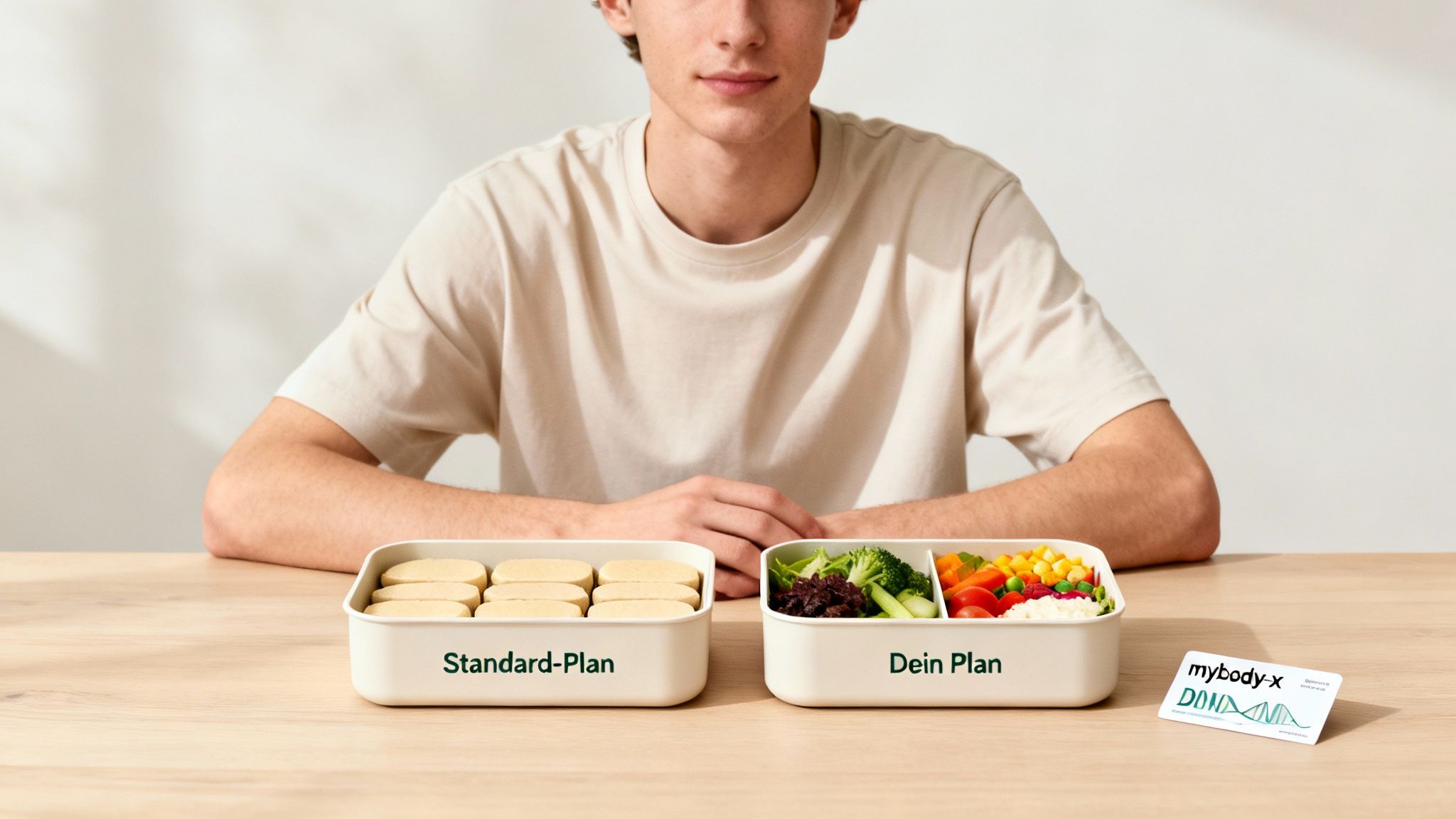
The difference between “good” and “right for you”
A standard plan may work great for one person but cause fatigue or cravings for you. This is due to highly individual factors:
- Your metabolism: Everyone processes macronutrients (carbohydrates, fats, and proteins) differently. A plan that does not suit your metabolic type feels like a constant brake.
- Your goals: Do you want to lose weight, build muscle, or simply have more energy in everyday life? Your plan must be precisely tailored to this; otherwise, you’re working against yourself.
- Your genetics: Your DNA provides clear indications of which form of nutrition suits you best. These insights are the ultimate guide to your personal success.
Your body is not a machine that functions according to a universal manual. It is a complex biological system that deserves an individualized approach.
Science as your guide
This is exactly where modern health analyses come in. A mybody-x DNA metabolism test provides the scientific basis for turning a good plan into YOUR perfect plan. Instead of guessing, you get clear facts about what your body really needs.
This way, you’ll not only eat healthily but also see results and feel completely comfortable. Read more about this fascinating topic in our article on personalized nutrition.
The desire to eat healthily is huge in Germany. According to the BMEL Nutrition Report 2025, taste is decisive for 98 percent of respondents, closely followed by the healthiness of the food for 90 percent. Nevertheless, the DKV Report 2025 shows that only two percent of Germans actually meet all the criteria for a healthy lifestyle.
This gap between desire and reality can often be explained by a lack of personalization.
Your flexible 7-day weekly plan to get started right away
Now let's get specific. This healthy eating weekly plan is your perfect springboard to a more mindful diet—without overwhelming you. Think of it as a flexible foundation that you can gradually adapt to your preferences and needs.
We're starting with a plant-focused, high-protein approach. Every meal is designed to provide you with steady energy, keep you feeling full for a long time, and supply your body with everything it needs. Here you'll find specific suggestions for every day of the week, from Monday to Sunday, including breakfast, lunch, and dinner.
And don't worry, you don't have to be a master chef. The recipes are deliberately simple, the ingredients are available in every supermarket, and the portion sizes are realistic for everyday life. It's important to us that healthy food tastes good and is enjoyable, rather than becoming an annoying chore.
So don't view this plan as a rigid set of rules, but rather as a kind of building-block system. For many dishes, we give you options for variations, so you can easily replace ingredients you don't like or tolerate. Along the way, you'll learn the principles behind a balanced meal and develop a sense of what makes you feel good.
The cornerstones of the weekly plan
Before we look at the individual days, here are the simple rules this plan is based on:
- Every meal includes a source of protein: This is the key to feeling full and is important for your muscles. Think of lentils, chickpeas, tofu, eggs, Greek yogurt, fish, or lean poultry.
- Vegetables in every color: The goal is to put at least two different types of vegetables on your plate with every main meal. This gives you a broad range of vitamins, minerals, and phytonutrients.
- Complex carbohydrates for energy: Instead of empty calories from white flour, we focus on whole grains, quinoa, oats, and sweet potatoes. They release their energy slowly and keep your blood sugar levels stable.
- Healthy fats are essential: You absolutely need avocados, nuts, seeds, and high-quality oils such as olive oil, for example, for hormone production and the absorption of fat-soluble vitamins.
This approach has many similarities to diets based on real, unprocessed foods. If you would like to explore different concepts in more depth, you will find valuable insights in our article about 7 examples of diet types.
This is what your day with the weekly plan could look like
To give you a better idea of how simple and delicious such a day can be, here is a brief overview.
| Meal | Suggested dish | Meal focus |
|---|---|---|
| Breakfast | Protein porridge with berries & flaxseed | Long-lasting energy & fiber |
| Lunch | Large salad with chickpeas & avocado | Vitamins, healthy fats & plant-based protein |
| Dinner | Oven-baked salmon with sweet potato & broccoli | High-quality protein (omega-3) & complex carbohydrates |
This sample schedule illustrates the principles of the weekly plan—balanced, easy to prepare, and nutrient-rich.
Your 7-day meal plan in detail
Here are some specific suggestions to make getting started as easy as possible. The portion sizes are intended as guidelines—listen to your body and adjust them to your individual hunger and goals.
Monday
- Breakfast: Protein porridge. Bring 50 g oats to a boil with water or (plant-based) milk. Stir in a scoop of protein powder (optional) and a handful of berries. Top with a tablespoon of flaxseed.
- Lunch: Large mixed salad. A base of leafy greens with cucumber, tomatoes, and bell pepper. Add 150 g chickpeas, half an avocado, and a dressing made from olive oil, lemon juice, salt, and pepper.
- Dinner: Lentil bolognese with zucchini noodles. Cook red lentils with strained tomatoes, carrots, and celery to make a sauce. Use a spiralizer to turn the zucchini into “zoodles” and serve with the sauce.
Tuesday
- Breakfast: Greek yogurt (or soy alternative) with nuts. 200 g yogurt with a handful of walnuts and a little cinnamon.
- Lunch: Leftover lentil bolognese from the previous day. Meal prep is your best friend—it saves time and reduces stress!
- Dinner: Oven-baked salmon with sweet potato and broccoli. Bake a salmon fillet (approx. 150 g) with a diced sweet potato and broccoli florets on a baking tray with olive oil, herbs, salt, and pepper for approx. 20 minutes at 200 °C.
Everyday tip: Always cook a slightly larger portion in the evening. That way, you have a quick and healthy lunch ready the next day and won't be tempted to reach for unhealthy snacks.
Wednesday
- Breakfast: Scrambled eggs or tofu scramble. Sauté two eggs or 150 g crumbled natural tofu with a handful of spinach and diced tomatoes in a pan. Serve with a slice of whole-grain toast.
- Lunch: Quinoa salad. Mix cooked quinoa (approx. 60 g dry) with diced cucumber, parsley, mint, and a lemon dressing.
- Dinner: Chicken or tofu curry. Simmer 150 g diced chicken breast or tofu with plenty of vegetables (e.g., bell peppers, zucchini, snow peas) in coconut milk and curry paste. Serve with a small portion of brown rice.
Thursday
- Breakfast: Protein porridge (as on Monday).
- Lunch: Leftover curry from the previous evening.
- Dinner: Large vegetable stir-fry with shrimp or tempeh. Sauté assorted vegetables of your choice (e.g., mushrooms, onions, broccoli), deglaze with soy sauce. Add 150 g shrimp or tempeh and sauté briefly.
Friday
- Breakfast: Greek yogurt (as on Tuesday).
- Lunch: Leftover vegetable stir-fry.
- Dinner: Homemade whole-wheat pizza. Spread tomato sauce over a whole-wheat pizza crust and top generously with vegetables such as bell peppers, mushrooms, onions, and a little low-fat cheese or a vegan alternative.
The weekend is yours
On Saturday and Sunday, you can get creative: Repeat your favorite meals from the week, try new healthy recipes, or simply use up the leftovers. The weekend is also the perfect time to prepare your meals for the coming week (meal prep).
This plan is a fantastic starting point. The next step is to truly make it your own. In the following sections, we will show you how to personalize this plan based on your individual goals and even your DNA. A mybody-x DNA metabolism test and the associated mybody Foodbook can help you determine exactly which foods and nutrient distributions are optimal for you. Imagine knowing exactly whether you should incorporate more carbohydrates or more healthy fats into your plan to achieve your goals even more effectively.
Your shopping list and meal prep routine for less stress
A good healthy eating weekly plan stands or falls with preparation. So you do not have to think from scratch every day about what to serve, we have put together the perfect shopping list for the 7-day plan. This takes the mental work off your hands and ensures that you always have the right ingredients ready.
Smart preparation, often called meal prep, is your best protection against reaching for unhealthy ready meals on stressful days. With just a few hours of preparation at the weekend, you lay the foundation for a relaxed and healthy week.
Your strategic shopping list
To make shopping as easy as possible, the list is organized by food groups. This helps you find your way around the supermarket quickly and saves valuable time.
Fresh vegetables & fruit (the foundation of everything):
- Leafy greens: Spinach, mixed leafy salads
- Cruciferous vegetables: Broccoli, cauliflower
- Fruit vegetables: Bell peppers (mixed colors), cucumbers, tomatoes, zucchini
- Root vegetables: Carrots, sweet potatoes, onions, garlic
- Fruit for energy & vitamins: Berries (fresh or frozen), avocados, lemons
High-quality sources of protein (for satiety & muscles):
- Plant-based: Red lentils, chickpeas (canned or dried), plain tofu, or tempeh
- Animal-based (optional): Eggs, Greek yogurt (or a soy alternative), salmon fillet, chicken breast
Complex carbohydrates (for long-lasting energy):
- Grains: Rolled oats (quick or old-fashioned), quinoa, brown rice
- Bread & more: Whole-grain toast, whole-grain pizza dough, or whole-grain wraps
Healthy fats & more (for flavor & nutrients):
- Nuts & seeds: Walnuts, flaxseeds
- Oils & dressings: High-quality olive oil
- Basic ingredients: Strained tomatoes, light coconut milk, vegetable broth, curry paste, soy sauce, spices (salt, pepper, cinnamon, dried herbs)
A well-prepared day is the key to success, as the following graphic also illustrates simply.
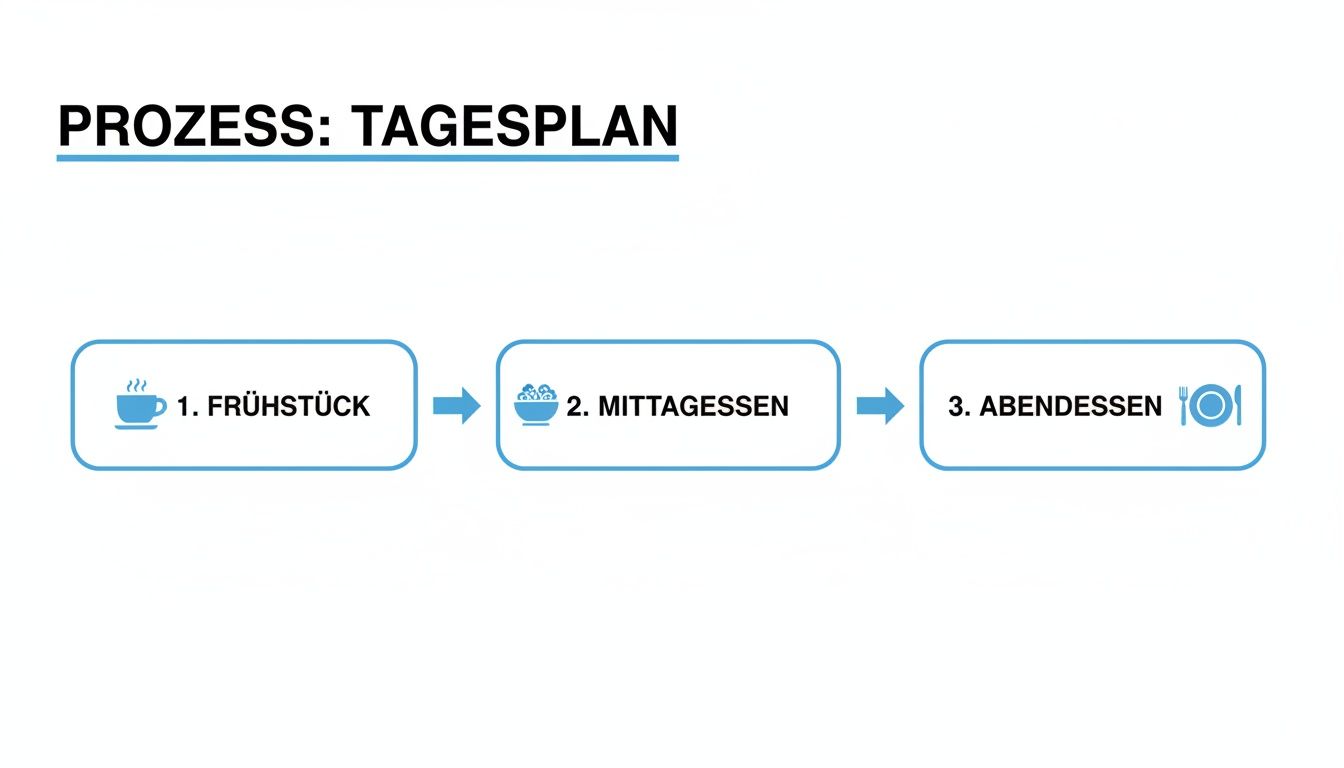
The graphic shows how simple a structured day with breakfast, lunch, and dinner can be—all a matter of preparation.
Your weekend meal-prep routine
Simply set aside two to three hours on Sunday. That may sound like a lot at first, but this investment gives you an incredible amount of freedom and mental relief during the week.
1. Prepare components, not entire meals
The real trick is to pre-cook individual components that you can then combine in many different ways.
- Cook grains: Cook a larger quantity of quinoa or brown rice. Stored in an airtight container in the refrigerator, it keeps well for 3–4 days.
- Chop vegetables: Wash and chop vegetables such as bell peppers, carrots, or broccoli. Stored in separate containers, they are ready to use immediately for salads or stir-fries.
- Prepare proteins: Cook a portion of lentils or fry some tofu. That way, you always have a quick source of protein on hand.
2. Mix dressings & sauces
Mix a large glass of your favorite dressing (e.g., from olive oil, lemon juice, and herbs). Homemade tomato sauce or the base for a curry can also be prepared in advance and stored in the refrigerator.
Meal prep is your insurance against cravings. When healthy options are already waiting in the fridge, you are much less likely to reach for unhealthy alternatives.
With this simple routine, you can start the week perfectly prepared. The stress of cooking every day disappears, and you ensure that your healthy eating weekly plan does not remain merely a plan on paper. You can also find inspiration for more quick dishes among our healthy nutrition recipes, which are ideal for meal preparation.
How to personalize your weekly plan with your DNA
Okay, the flexible 7-day plan is ready. You now have a great foundation, a shopping list, and know how to save time with meal prep. But now comes the truly exciting part, which turns a good healthy eating weekly plan into YOUR perfect plan—personalization.
Every one of us is different and reacts differently to food. What gives your friend energy might make you tired or lead to cravings. The key to making a lasting change lies precisely here: adapting the plan to your very personal needs. Whether you want to lose weight, build muscle, or simply feel fitter throughout the day—this is the real game changer.
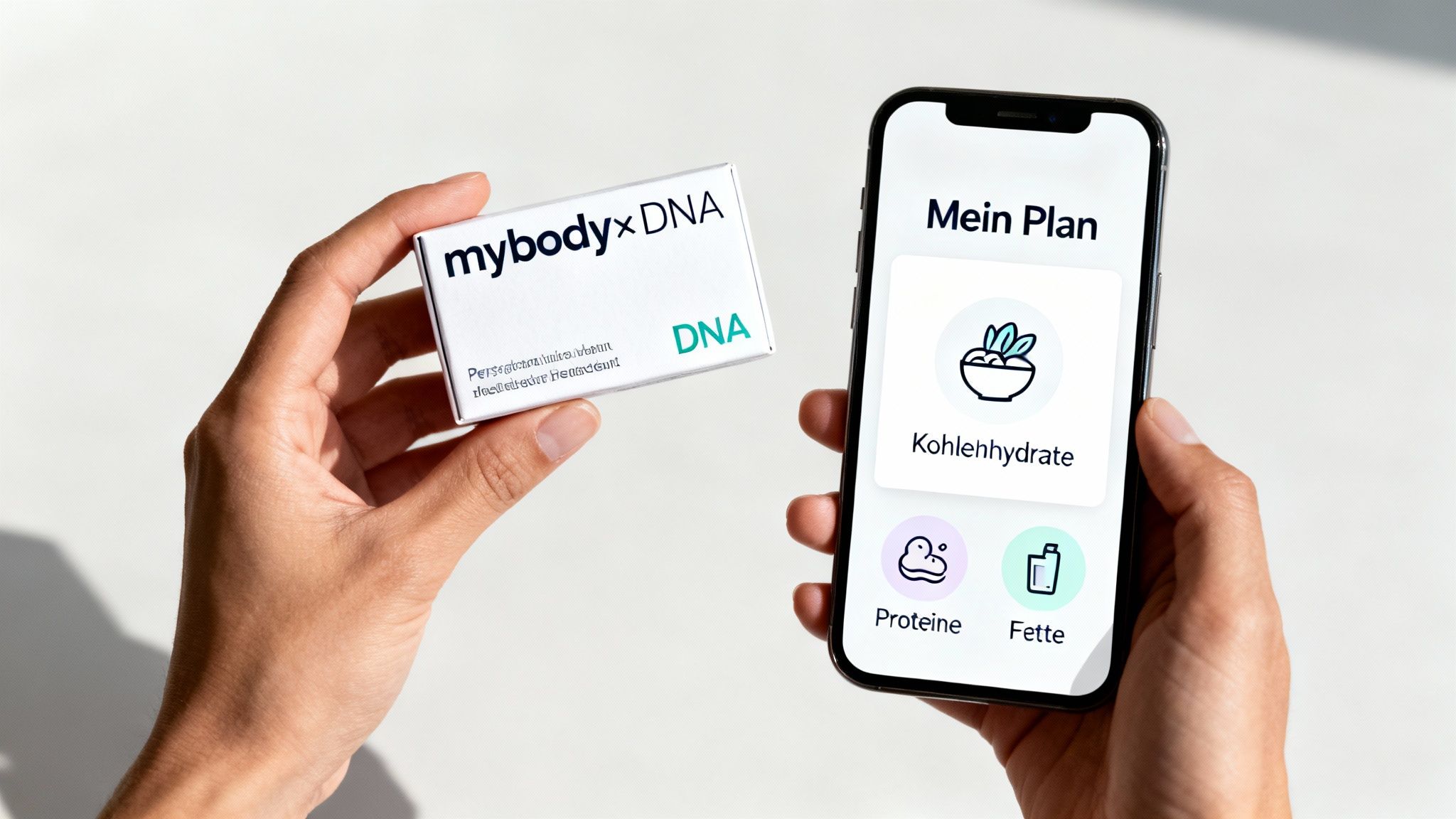
Why your DNA is the best nutrition advisor
Imagine no longer having to guess which type of diet works for you. Instead of chasing every new trend, you would have a scientifically sound roadmap tailored precisely to your body. That is exactly what DNA-based nutrition makes possible.
A mybody-x DNA metabolism test analyzes how your body metabolizes fats, carbohydrates, and proteins based on your genes. This information is pure gold because it shows you which levers to adjust in your weekly plan to achieve the best results.
Your genetic code is like an instruction manual for your body. It tells you what fuel you need to perform at your best. Instead of stumbling around in the dark, you get clear facts to work with.
These insights are all the more valuable because nutrition trends come and go. The 2025 Nutrition Trend Report shows that personalized nutrition—based on genetic factors—is one of the most important developments alongside a plant-focused diet. Experts see it as the future for achieving individual health goals.
Your metabolic type as the basis for adjustments
After a DNA test, you know which metabolic type you belong to. This gives you clear guidance on the ideal distribution of macronutrients for you. Let’s take a look at how you can use this to adjust the basic weekly plan in practical terms.
Example 1: You are a “protein type” (Type P)
Your results show that your body uses protein particularly well for energy production. You therefore benefit from a higher-protein diet.
- Adjusting the weekly plan: Increase the protein source slightly at each meal. Instead of 200 g of yogurt for breakfast, simply have 250 g of low-fat quark. At lunchtime, add an extra handful of lentils to your salad, and in the evening, the piece of fish or tofu can be a little larger.
- Your advantage: You’ll feel fuller and have more energy. The typical craving for sweets, often caused by fluctuating blood sugar levels, will noticeably decrease.
Example 2: You are a “carbohydrate type” (Type C)
Your genetics indicate that you metabolize carbohydrates very efficiently and that they should be your primary source of energy.
- Adjusting the weekly plan: Include a high-quality, complex carbohydrate source with every main meal. For breakfast, you could add half a banana to your porridge. At lunchtime, add a small portion of quinoa to your salad, and in the evening, increase the amount of sweet potatoes or brown rice.
- Your advantage: You’ll notice your physical and mental energy increasing. Instead of feeling sluggish, you give your body exactly the fuel it can use best.
Example 3: You are a “mixed type” (Type M)
Your body handles both fats and carbohydrates well. A balanced combination is ideal for you.
- Adjusting the weekly plan: The basic weekly plan is already an excellent foundation for you. You can focus on optimizing the quality of the ingredients. Pay particular attention to healthy fats from avocados, nuts, and high-quality oils.
- Your advantage: You have maximum flexibility and can focus fully on variety and nutrient density to maximize your well-being.
If you’d like to learn more about how this type of analysis works, you’ll find all the important information about the DNA test for nutrition in our detailed article.
The mybody Foodbook as your personal chef
Knowing the theory is one thing. Bringing it into your everyday life in a delicious and uncomplicated way is quite another. And that’s exactly where the mybody Foodbook comes in. It’s much more than a cookbook—it’s your personal guide that translates your DNA results directly into delicious meals.
What the Foodbook offers you:
- Over 100 recipes: All are tailored to the different metabolic types.
- Simple labeling: At a glance, you can see which dishes are particularly suitable for your type (P, C, or M).
- Flexible building blocks: You’ll learn how to easily adapt and vary recipes so things never get boring.
Imagine opening your Foodbook as a protein type and finding a recipe for lentil dal that not only perfectly matches your genetics but also tastes fantastic. No more guessing or laborious nutritional calculations. You simply cook according to the plan—your personal plan.
The combination of the insights from your DNA metabolism test and the practical recipes in the mybody Foodbook makes your healthy eating weekly plan an extremely powerful tool. You work with your body instead of fighting against it. That’s the difference between a short-term diet and a successful, long-term dietary change that feels good and delivers real results.
Practical everyday tips for staying motivated in the long term
Congratulations, you’ve completed the first week with your new nutrition plan! But honestly, the real challenge is only just beginning. How do you stick with it when the initial euphoria fades and everyday life—with all its temptations—returns?
Long-term success has much less to do with iron discipline than most people think. It’s about smart habits that support you instead of wearing you down. Here are some realistic, practical tips to help you overcome motivation slumps and make healthy eating second nature.
Find your balance with the 80/20 rule
Perfection is the greatest enemy of progress. Trying to eat 100% “clean” almost always ends in frustration and the feeling that you have failed. Much more sustainable and relaxed is the 80/20 rule.
The principle is simple: 80 % the time, you stick to your nutritious, balanced plan. The remaining 20 % are reserved for flexibility—for a piece of cake at a birthday party, pizza with friends, or ice cream on a hot summer day. This approach takes the pressure off and prevents the typical “all-or-nothing thinking.” A slip-up doesn’t mean the end of your plan; it’s a planned part of it. This way, you can continue to enjoy food while building a healthy relationship with your diet.
Mindfulness instead of distraction while eating
Be honest: How often do you eat while scrolling on your phone, working, or watching TV? Mindful eating means focusing fully on your meal—the smell, taste, and texture. Consciously take your time, sit at a table, and put your smartphone away.
When you eat slowly and chew thoroughly, you give your brain the necessary time (around 20 minutes) to receive satiety signals. You’ll notice much better when you’re truly full and avoid clearing your plate out of sheer habit.
Your body sends you clear signals. Learn to listen to it again. Mindfulness is the tool that helps you distinguish between genuine hunger, appetite, and emotional eating.
Strategies for restaurant visits and social occasions
A healthy eating weekly plan shouldn’t socially isolate you. Eating out or being invited to friends’ homes is part of life. With a few simple tricks, you can handle these situations without abandoning your goals:
- Check the menu in advance: Take a look at the menu online beforehand. That way, you can calmly find a good option and won’t feel overwhelmed by the choices when you arrive.
- Order dressing & sauces on the side: A simple request that makes a big difference. Ask for dressings and sauces to be served separately so you can control the amount.
- Set priorities: What do you really feel like eating? Perhaps you’ll choose a lighter main course and treat yourself to dessert instead.
- Water as a companion: Drinking a large glass of water before and during a meal fills your stomach and can curb initial cravings.
These small adjustments make a huge difference. They allow you to enjoy social occasions without feeling guilty.
The trend toward a more mindful diet has also reached society as a whole. The German Nutrition Society’s nutrition report shows that vegetable consumption has risen to an average of 111 kilograms per person per year. In addition, 37 percent of Germans follow a flexitarian diet, while 71 percent eat fruit and vegetables every day. This makes it much easier today to find delicious, plant-focused dishes in restaurants. You can read more about current eating habits in Germany on apotheker.com.
Your weekly plan in practice: The most frequently asked questions answered
Great, the plan is set! But before you get started, a few questions often come up in everyday life. That’s completely normal. So you can get started confidently and without any lingering doubts, I’ve collected the most important answers for you here.
Do I have to stick rigidly to every single day?
Absolutely not! Think of this plan as a flexible framework, not a rigid law you have to follow blindly. Life gets in the way, plans change—and your nutrition plan should adapt to you, not the other way around.
Feel free to swap Tuesday with Thursday, eat dinner leftovers for lunch the next day, or replace one recipe with another that suits you better at the moment. The only important thing is to maintain the basic idea: a large serving of vegetables, a high-quality protein source, and ideally complex carbohydrates. The plan should reduce your stress, not create more.
What if I don’t like or tolerate an ingredient?
It’s simple: swap things out! A nutrition plan only works in the long term if you truly enjoy the food. You’re in charge here.
- Not a fan of broccoli? No problem. Use cauliflower, zucchini, or green beans instead.
- Not a fan of lentils? Chickpeas, black beans, or tofu are fantastic alternatives.
Most foods within a group (e.g., low-starch vegetables or legumes) are so similar nutritionally that you can easily replace them. Be creative and find out what you enjoy!
How do I adjust the plan if I want to lose weight?
To lose weight, you need a slight calorie deficit. The easiest way to achieve this is by slightly adjusting the portion sizes of energy-dense ingredients.
For example, slightly reduce the amount of carbohydrates (rice, pasta, potatoes) and healthy fats (nuts, oils, avocado). At the same time, increase the amount of vegetables and lean protein. This way, you stay full for longer and remain well nourished while still saving calories.
The decisive factor: A mybody-x DNA metabolic test can show you exactly whether reducing carbohydrates or fats is the faster way to reach your goal for your individual metabolic type.
Does the weekly plan also work for a vegetarian or vegan diet?
Yes, absolutely. The plan is deliberately designed to be based heavily on plant-based foods. Animal protein sources such as chicken or fish can be replaced very easily 1:1 by replacing them with tofu, tempeh, lentils, or other legumes. Dairy products such as yogurt can easily be replaced with plant-based alternatives such as soy or coconut yogurt.
Are you ready to make your nutrition plan not only healthy, but perfectly tailored to you? With the analyses from mybody® Lab GmbH, you gain the scientific foundation to understand what your body really needs. Discover your metabolic type and turn guesswork into knowledge.
Start your journey toward personalized nutrition now at mybody-x.com


Share now:
Your wild herb recipe for more energy and well-being in everyday life
10 Healthy Dishes You Should Know