

Coffee intolerance: symptoms, causes & what really helps
There it is again—that wonderful aroma of freshly brewed coffee in your nose, but a queasy feeling is already spreading in your stomach? If your body suddenly rebels after drinking coffee with stomach pain, a racing heart, or inner restlessness, you are not alone. The beloved morning ritual becomes a problem—and there are solid reasons for that.
When coffee suddenly becomes a problem

For most of us, a cup of coffee in the morning is much more than just a pick-me-up. It is a familiar anchor in everyday life, a moment of calm before the hustle and bustle begins. But what if this faithful companion suddenly causes chaos in your body?
This phenomenon is more widespread than you might think. Symptoms that suddenly appear after drinking coffee can be quite frustrating, especially if you have tolerated everything perfectly for years. But don't worry—this is not about banning coffee forever. It's about finally interpreting your body's signals correctly and understanding what is behind them.
Finding the cause
Your reactions are not imaginary, but tangible biochemical processes. The only crucial question is: What exactly triggers them? In most cases, it is not “the coffee” itself, but certain ingredients that your system struggles with. The usual suspects are:
- Caffeine: The classic culprit. This well-known stimulant can cause nervousness, heart palpitations, or sleep problems in sensitive people.
- Coffee acids: Certain acids, such as chlorogenic acid, can upset a sensitive stomach and cause heartburn or pain.
- Histamine: Coffee itself is low in histamine, but it can stimulate the release of the body's own histamine. If you have histamine intolerance, that is often enough to trigger symptoms.
It's important to understand that an intolerance rarely develops overnight. It is often the result of gradual changes in the body—perhaps your digestive system is under stress, your gut flora has become unbalanced, or you have developed a new sensitivity.
Why is my body reacting right now?
Your body is not a machine, but a dynamic system that is constantly adapting. Factors such as stress, changes in eating habits, medication, or hormonal fluctuations can shift your personal tolerance threshold. What was completely unproblematic yesterday may suddenly cause discomfort today.
Genetics become particularly fascinating here. How quickly your body breaks down caffeine is determined by your DNA. Some people are naturally “slow metabolizers.” In their case, caffeine remains in the system longer and therefore has a stronger effect. If you’re curious about how your genes play a role, you’ll find fascinating insights into the interplay between genes, sleep, and caffeine in our health portal.
In this article, we’ll guide you through the causes of your symptoms. We’ll show you which symptoms are typical, how to distinguish a coffee intolerance from a true allergy, and what you can do specifically to soon enjoy your coffee again without worry.
The typical warning signs: How coffee intolerance makes itself known

The cup is empty, but instead of the hoped-for energy boost, a queasy feeling spreads. Does that sound familiar? The signals your body sends when you have a coffee intolerance are often subtle and easy to overlook. You may blame them on stress or lunch. The trick is to listen closely and recognize the patterns that recur after drinking coffee.
You can think of your digestive system as a delicate, sensitive surface. The acids in coffee can act like an overly aggressive cleaning agent here—they irritate the mucous membranes and trigger a chain reaction. But the symptoms are not limited to the abdomen. They can appear throughout the body and are often more varied than you might think.
Stomach and intestines: The center of the action
It usually starts in the stomach. The acids and bitter compounds in coffee stimulate the production of stomach acid. For an already sensitive stomach, this is often too much.
Watch out for these typical symptoms:
- Heartburn: An unpleasant burning sensation that rises from the stomach into the esophagus.
- Stomach pain or cramps: Often a dull, pressing pain that occurs shortly after drinking coffee.
- Bloating and a feeling of fullness: Your stomach feels like an inflated balloon.
- Diarrhea: Caffeine can stimulate bowel activity so strongly that it causes a sudden urge to have a bowel movement.
The tricky thing is that these symptoms are completely nonspecific. But if they keep occurring after your coffee break, that is a pretty clear sign that your gut is trying to tell you something.
When the heart acts up
Do you feel not just awake after drinking coffee, but really wound up, almost nervous? Caffeine is a powerful stimulant that acts directly on your central nervous system. An exaggerated reaction often indicates caffeine sensitivity.
Your body isn’t reacting “wrongly”; it’s simply more sensitive. Think of it like the volume control on a stereo: for some people, it is naturally more finely tuned. Even a small turn—a cup of coffee—causes a loud reaction.
The following signs may appear shortly after drinking:
- Rapid heartbeat or palpitations: Your heart beats noticeably faster or irregularly.
- Inner restlessness and nervousness: A driven feeling that you simply can’t shake.
- Shaky hands: A fine, uncontrollable trembling in your fingers.
- Hot flashes: Suddenly sweating even though you aren’t exerting yourself.
When your head and the rest of your body join the conversation
Coffee intolerance doesn’t just affect your stomach or heart. Your head and overall well-being can suffer too, sometimes only hours later.
The following table gives you a quick overview of which symptoms could be triggered by which compounds in coffee.
Typical symptoms and their possible triggers
An overview of the most common symptoms of coffee intolerance and which compounds in coffee may be responsible for them.
| Symptom | Possible trigger in coffee | Brief explanation |
|---|---|---|
| Stomach problems, heartburn | Chlorogenic acid, caffeine | Stimulate stomach acid production and can irritate the mucous membrane. |
| Rapid heartbeat, nervousness | Caffeine | Stimulates the central nervous system and can cause overstimulation in sensitive people. |
| Headaches, migraines | Caffeine, histamine | Caffeine can constrict blood vessels, while histamine can trigger migraines in some people. |
| Skin rash, itching | Histamine, mold metabolites | Can trigger reactions in people with histamine intolerance or mold sensitivity. |
| Sleep disturbances | Caffeine | Blocks adenosine receptors in the brain that are responsible for drowsiness. |
So there is a whole range of possible reactions your body can show. That doesn’t make things any easier, but it helps to know what to look out for.
Many people in Germany suffer from coffee intolerance, often without knowing it. Diagnosis usually begins with careful self-observation. That’s why a food diary is often the first step toward seeing the connection between coffee consumption and symptoms in black and white. If you’d like to explore the topic further, you can find more information about coffee intolerance at lykon.de.
Other possible signs include:
- Headaches or migraines: Paradoxical, right? While coffee helps some people with headaches, it can be the trigger when you have an intolerance.
- Sleep disturbances: Even a cup in the early afternoon can completely disrupt the sleep-wake cycle in sensitive people.
- Skin problems: In rarer cases, rashes or itching may also occur, especially when histamine is involved.
Recognizing these patterns is the most important step. Stop ignoring your body’s signals. When you consciously connect them with your coffee consumption, you regain control and can actively look for a solution.
The Real Causes: Caffeine, Acidity, and Histamine
If you struggle with stomach rumbling, a racing heart, or other symptoms after drinking coffee, your first thought is often: “I simply can’t tolerate coffee anymore.” But that is usually only half the truth. Instead of banning the drink altogether, it is worth taking a closer look.
It is rarely the coffee as a whole that causes the problems. Rather, there are three main suspects that can trouble your body: caffeine, acidity, or histamine. Think of it like an investigation: we have three potential culprits and now need to find out which of them is responsible for your symptoms. That is the only way to take targeted action without having to give up your beloved coffee completely.
Suspect No. 1: Caffeine
Caffeine is probably the best-known ingredient in coffee and the reason we love it so much—it wakes us up, helps us focus, and gets us going in the morning. But this is often where the problem lies. We need to distinguish between the normal effect, increased sensitivity, and a genuine intolerance.
A normal reaction is the familiar energy boost. With caffeine sensitivity, you are practically the lightweight boxer among coffee drinkers: even a small amount of caffeine knocks you out. A racing heart, nervousness, or trembling hands occur much more quickly and intensely than in others.
A genuine caffeine intolerance is a step beyond that. It is often caused by a genetic predisposition that severely slows caffeine breakdown in the liver. The caffeine effectively builds up in the body. A single cup can then trigger severe reactions such as sweating, intense stomach cramps, or even anxiety attacks.
Suspect No. 2: Coffee Acids
Does your path after coffee lead straight to heartburn or stomach pain? Then we should take a closer look at the second suspect: acidity, above all chlorogenic acid. It stimulates the production of stomach acid—and for a sensitive stomach, that can quickly be too much of a good thing.
The good news is that you have the acidity of your coffee in your own hands. What matters most here is the bean, the roast, and the preparation method.
- The bean: Arabica beans are naturally lower in acidity than their stronger counterparts, Robusta beans.
- The roast: The longer and more gently a bean is roasted, the more acids are broken down. Light roasts may look modern, but they are often the real acid bombs.
- The preparation: Espresso is often easier to tolerate than filter coffee. Why? The water is in contact with the grounds for only a very short time, which extracts fewer acids and irritants.
Suspect No. 3: Histamine
And then there's a third suspect that is often completely overlooked: histamine. Coffee itself contains very little, but it acts as what is known as a histamine liberator. This means it can stimulate your body to release its own histamine.
Picture your personal “histamine bucket.” For people with histamine intolerance, this bucket is already quite full naturally because the body can break down histamine only very slowly. The coffee then provides the final drop that makes the bucket overflow.
The symptoms are often diffuse and range from headaches and skin flushing to a runny nose, digestive problems, or heart palpitations. So if you suffer from symptoms after drinking coffee that you have previously been unable to classify, this could be the answer. Want to explore the topic in greater depth? In our guide, you'll learn exactly what histamine is and how it works in the body.
If you know these three main causes, you can interpret your body's signals much better. Pay close attention: Do your symptoms point more toward the nervous system (caffeine), the stomach (acidity), or are they nonspecific and allergy-like (histamine)? This is the first and most important step toward finding the right solution for you.
How to determine whether you have a coffee intolerance with certainty
So you feel that your body and your morning coffee are somehow no longer on the same wavelength? But this vague discomfort doesn't really get you anywhere. To finally gain clarity, you need a concrete plan—essentially, a little detective work for your own body.
Don't worry, it's easier than it sounds. The first step begins with a simple but incredibly effective tool. I'll now guide you step by step from the initial suspicion to clear insight, so you can regain control over your well-being.
Step 1: The food diary as your most important piece of evidence
The absolutely crucial first step is to become an observer of yourself. A food diary is your best tool for this. It helps you recognize patterns that would otherwise get completely lost in the hectic pace of everyday life.
This isn’t about counting calories. Instead, you’re documenting precisely how your coffee consumption and well-being are connected. Keep it simple and note the following points:
- When? Write down the exact time you drink coffee.
- What? Which variety (e.g., Arabica, Robusta)? How was it prepared (filter, espresso, with milk)?
- How do you feel? Note exactly when each symptom occurs—whether it’s heartburn 30 minutes later or inner restlessness in the afternoon.
- What else? Was your stomach empty? Were you stressed just then?
This turns vague feelings into concrete data. You’ll often see clear patterns after just one or two weeks: Do the stomach aches always come after your morning coffee? Or the racing heart only after the second espresso?
These records can quickly show you where the cause of your symptoms might lie. The following infographic provides a simple decision-making aid.
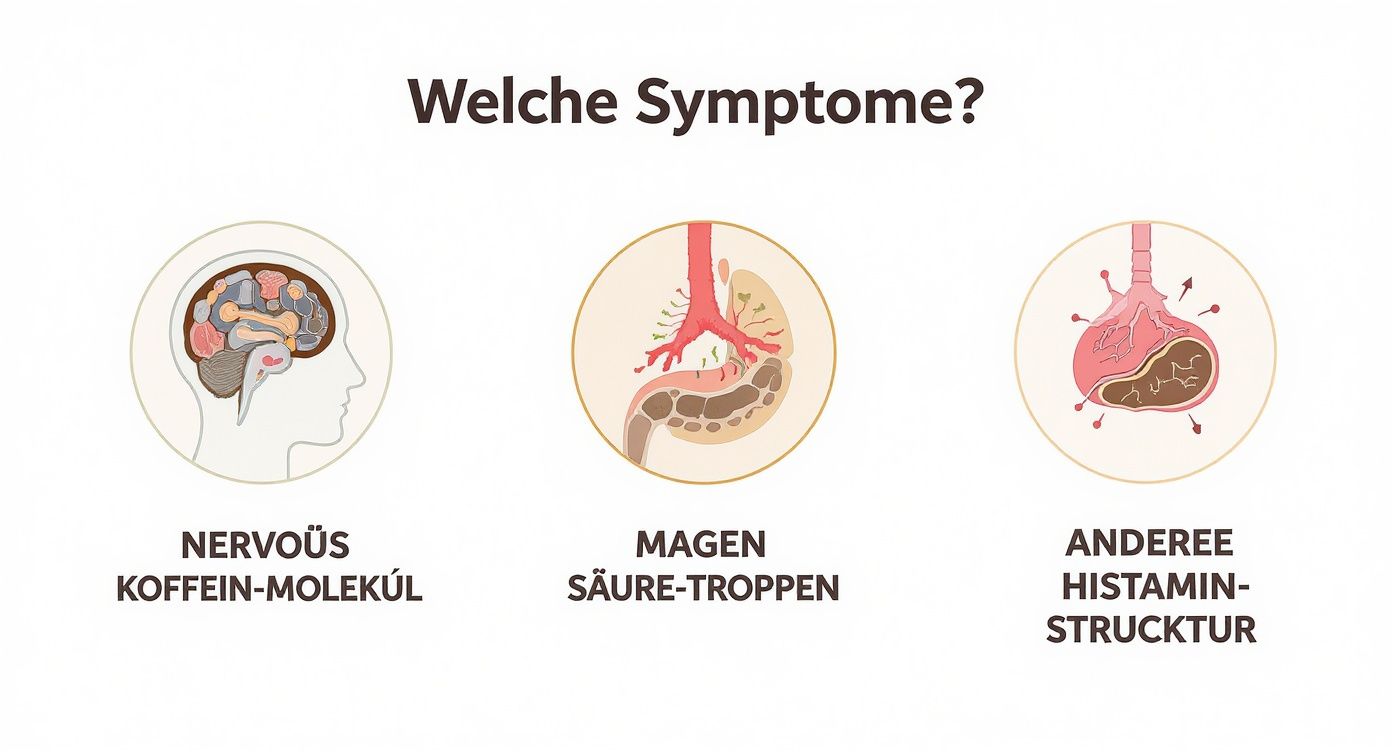
As the graphic shows, symptoms such as nervousness strongly point to caffeine, while stomach problems may be more attributable to acidity or other histamine-related reactions.
Step 2: The elimination diet for definitive clarification
If your diary strengthens your suspicion, the next logical step is an elimination diet. That sounds stricter than it actually is. Basically, you simply take a deliberate coffee break for a limited period—ideally two to four weeks.
During this time, avoid all coffee consistently and carefully observe how your body changes. Do the stomach aches disappear? Do you suddenly sleep better? Do you feel calmer overall? If so, you’re already damn close to figuring it out.
After the break comes the decisive test: controlled reintroduction. Drink a single cup of your “suspect” coffee and wait. If the old symptoms promptly return, you have your proof. This process is one of the most reliable methods for uncovering an intolerance. If you want to learn more, you can find detailed information in our guide on how to test for a food intolerance.
Step 3: Professional tests to resolve any remaining doubt
Self-observation is essential, but sometimes professional evaluation is simply necessary. Especially if your symptoms are very severe or you even suspect a true allergy, seeing a doctor is unavoidable.
There are various ways to gain clarity:
- Allergy test (blood test): An IgE blood test can confirm—or rule out—a true coffee allergy. This is important because an allergy is a genuine immune reaction and must be taken more seriously than a mere intolerance.
- Specific tests: If histamine intolerance is suspected, a doctor can, for example, measure the activity of the DAO enzyme in the blood, which is responsible for breaking down histamine.
- Medical history interview: Your food diary is worth its weight in gold here! It provides your doctor with crucial information for ruling out other causes and making a well-founded diagnosis.
With this roadmap, you’ll be well prepared. You’ll proceed systematically and turn a vague suspicion into a clear understanding of your body.
Practical tips for enjoying coffee comfortably

For many people, a diagnosis of “coffee intolerance” initially feels like a bitter blow. Does the beloved morning coffee now have to disappear from the menu forever? The good news: usually not!
An intolerance to coffee is not a final verdict, but rather an opportunity to rethink and become more mindful about your coffee consumption. With a few clever adjustments, you can often reduce the typical irritants enough to enjoy your coffee again without feeling guilty. Consider the following tips your personal checklist for adjusting the key factors—from the bean to the preparation method.
Choosing the right bean and roast
It all starts with choosing the coffee beans. Not all beans are the same, and especially when your body is sensitive, the variety and roast make a huge difference.
When buying, look for Arabica beans. They are naturally lower in acidity than their robust relatives, Robusta beans, and are therefore often much gentler on the stomach.
However, the roast is at least just as crucial. Industrially produced coffee is often roasted in a rushed process at extremely high temperatures. Although this saves time and money, it leaves many harsh acids in the beans, which can later cause trouble in the stomach.
Instead, opt for coffee made using traditional drum roasting. Here, the beans are given much more time and slowly and gently refined at lower temperatures. This has one decisive advantage: The undesirable acids break down almost completely, while the fine aromas can fully develop.
Preparation makes all the difference
Have you found the perfect beans? Great! Now it's time to prepare them, because there's plenty you can do here to improve tolerability as well.
One of the best methods for sensitive stomachs is Cold Brew. The coffee grounds steep in cold water without any heat for 12 to 24 hours. This slow process is incredibly gentle: It extracts up to 70% fewer acids and bitter compounds from the coffee than conventional brewing methods. The result is a wonderfully mild yet aromatic concentrate.
Interestingly, many people with intolerances often tolerate espresso better than classic filter coffee. This is due to the gentler roasting process and the extremely short contact time between the water and coffee grounds. As a result, fewer irritants end up in the cup. A small tip: A glass of still water alongside your espresso can further improve its tolerability.
Small habits with a big impact
Sometimes, it's the small everyday routines that make the biggest difference. Try incorporating the following habits into your day:
- Never on an empty stomach: Coffee stimulates the production of stomach acid. Without a protective base in your stomach, this can irritate the lining. Even something small beforehand, such as a banana, yogurt, or a slice of bread, can work wonders.
- A splash of milk as a buffer: A small splash of milk or a plant-based alternative can help neutralize the acids in coffee and make it noticeably milder. But beware: This naturally only works if you don't also suffer from lactose intolerance.
- Watch the amount: Find out where your personal limit lies. Often, it isn't the first cup in the morning that causes problems, but the third one in the afternoon that pushes you over the edge.
The connections between coffee and our gut are fascinatingly complex. If you want to dive deeper into the topic, take a look at our article about the connection between coffee and digestion.
When nothing else works: Enjoyable alternatives
If your symptoms persist despite all the tricks and adjustments, it may be time for a coffee break. But don't worry, that doesn't mean you have to give up your beloved, invigorating hot drink in the morning.
The market now offers fantastic alternatives:
- Grain coffee: Made from roasted grains such as spelt or barley. It has a pleasantly roasted flavor, but is naturally completely caffeine- and acid-free.
- Lupin coffee: Made from the seeds of sweet lupin. This alternative comes surprisingly close in flavor to real coffee and is also caffeine-free.
- Matcha or green tea: They also contain caffeine, but it is released into the body more slowly and is considered easier to tolerate. An added bonus: They are packed with valuable antioxidants.
- Chicory coffee: Made from the roasted root of chicory. It has a slightly caramel-like note and is a traditional, very stomach-friendly alternative.
Your most pressing questions about coffee intolerance
Now that we've worked our way through the symptoms, causes, and solutions, you're sure to still have a few specific questions on your mind. That's completely normal! Here are the answers to the most common questions—brief, concise, and to the point, so that by the end you'll really know what's what.
Can a coffee intolerance come out of nowhere?
Yes, absolutely. You may have enjoyed your coffee without any problems for years, and then suddenly your body no longer tolerates it. This is often a real shock, but it actually makes perfect sense because our bodies aren't rigid systems; they're constantly changing.
The causes can be very different. Perhaps your gut flora has changed, you're going through a stressful period in your life that's pushing your digestive system to its limits, or hormonal fluctuations are throwing everything out of balance. A gradually developing histamine intolerance can also be the last straw. Suddenly, you've exceeded your tolerance threshold—and what was fine yesterday causes problems today.
Is a coffee allergy the same as an intolerance?
No, and this distinction is extremely important. The two terms are often lumped together, but they describe two fundamentally different reactions in your body.
- Coffee allergy: This is a genuine immune system reaction. It mistakenly classifies certain proteins in the coffee bean as a threat and launches a counterattack. The symptoms are often severe, appear quickly, and can range from skin rashes and hives to breathing difficulties.
- Coffee intolerance: Your immune system is not involved here. The problem lies instead in how your body processes substances. Your body has difficulty properly breaking down ingredients such as caffeine, acids, or histamine. The result is usually digestive or nervous system symptoms—such as stomach pain, bloating, a racing heart, or inner restlessness—that can occur even hours later.
Does decaffeinated coffee help with stomach problems?
That depends entirely on what exactly is bothering you. Decaffeinated coffee can be a great solution, but it is not a cure-all for every type of intolerance to coffee.
Do you mainly react to the caffeine with a racing heart, trembling hands, or inner restlessness? Then decaffeinated coffee is the perfect alternative for you. But if it is the coffee acids that irritate your stomach and cause heartburn, you probably will not notice any improvement with the caffeine-free version either. The acids are still present.
The key, then, is to find out exactly which ingredient is causing the problem. Only then can you choose a suitable alternative without having to give up your beloved coffee flavor entirely.
Does the quality of the coffee matter?
And what an influence it has! Quality has a huge impact on how well you tolerate your coffee, especially if you have a sensitive stomach.
Cheap industrial coffee from the supermarket is often roasted quickly using hot air. Although this is fast, aggressive acids such as chlorogenic acid remain in the beans in high concentrations—and these are precisely what can seriously irritate your stomach lining.
The situation is completely different with traditional drum roasting, as practiced by good specialty roasters. Here, the beans are given time. They are roasted slowly, gently, and at lower temperatures. This process effectively breaks down the irritating acids, making the coffee noticeably milder and easier to digest. Investing a few extra euros in high-quality coffee is therefore a direct investment in your well-being.
Do you finally want to know what is really behind your symptoms? An intolerance to coffee is often only one piece of the puzzle. With the scientifically based tests from mybody-x.com, you can find out specifically which foods your body reacts to and how your metabolism works. Take your health into your own hands now and discover what really does you good. Find the right test for you here at https://mybody-x.com.



Share now:
Diet and Cholesterol: How to Lower Your Levels with Simple Tips
Nutrition for an underactive thyroid: 8 tips for your thyroid health