
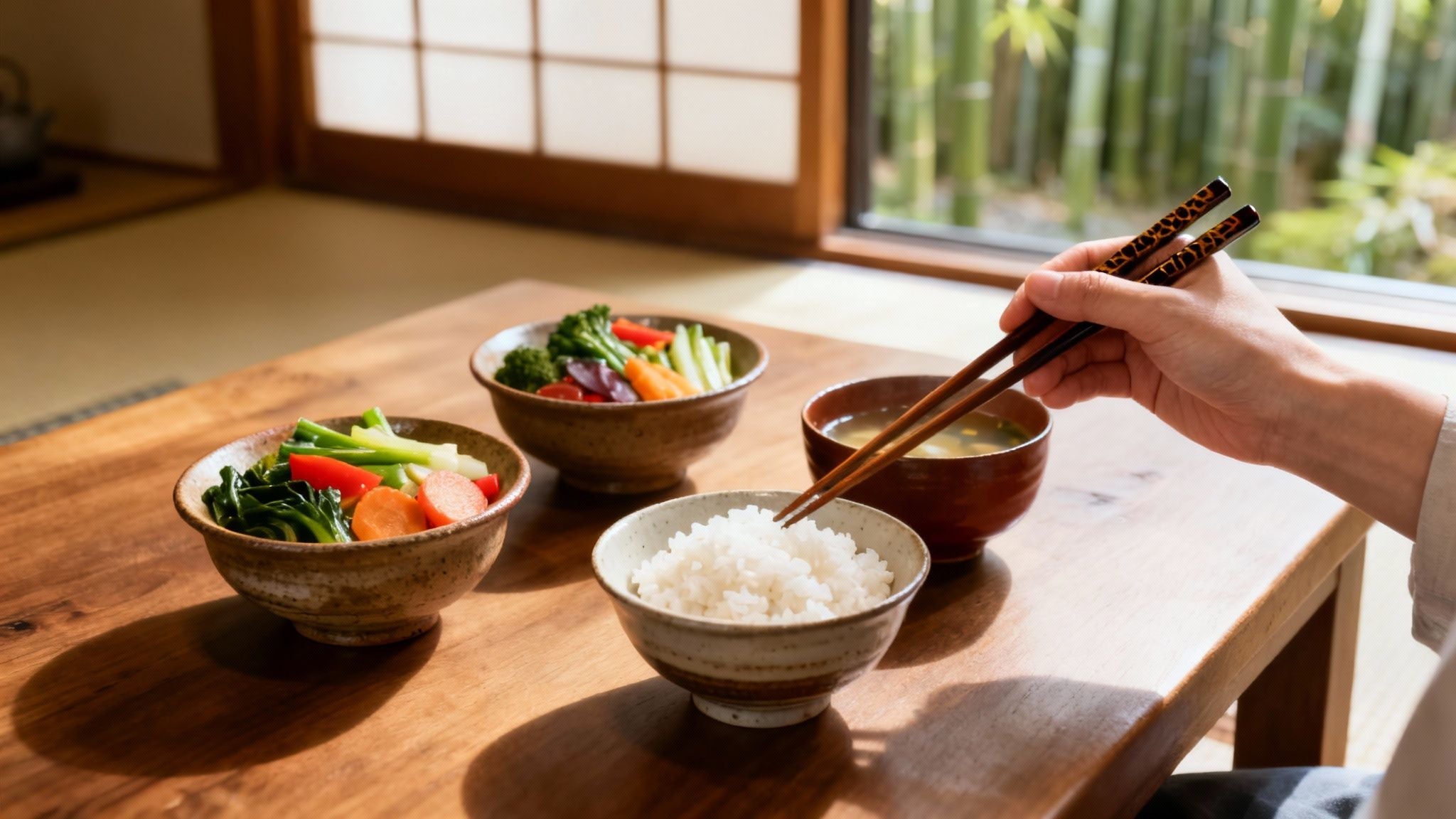
Hara Hachi Bu: what the 80-percent rule proves and what it does not
The essentials at a glance
Hara Hachi Bu refers to the habit of ending a meal when the stomach is about eight-tenths full. The expression comes from Okinawa, a prefecture in southern Japan. It describes neither a dietary program nor a nutrient rule, but a point in time: the moment when you stop before the feeling of fullness sets in.
A story has grown up around this rule that goes far beyond the rule itself. This article separates the two. Wherever something can be substantiated with an institution and year, it is presented here with the institution and year. Where a frequently cited figure has no verifiable origin, it does not appear in the text; instead, the absence of a source is stated.
You will first read what the expression means and what is documented about the region. Then the article covers the delay between bites and the feeling of satiety, the criticism of the story about the long-lived regions, and what has actually been studied about eating speed. The second part is practical: implementation, common mistakes, predisposition, and the limits of this rule.
What to expect in this article
1. What Hara Hachi Bu literally means
2. Okinawa: what is documented about the region and what is merely told
3. Why satiety lags behind eating
4. What eight-tenths means mathematically and what it does not
5. The criticism of the story about the long-lived regions
6. What has actually been studied about eating speed
7. Hara Hachi Bu alongside three other ways to control portion size
8. How to apply the rule in everyday life
9. Three points at which the rule breaks down
10. What predisposition has to do with satiety and where a test ends
11. Limits: what this rule is not
12. Who the rule works for and who it does not
13. What matters in the end
Frequently asked questions
Sources
What Hara Hachi Bu literally means
The expression is made up of the Japanese word for belly and a quantity indicating eight out of ten parts. Translated, it therefore means roughly: belly eight-tenths full. Linguistically, that is all it says.
It is an everyday saying, not a teaching system. In Okinawa, it has been passed down as a table saying spoken before or during a meal. Anyone who develops it into a method is putting something into the three words that is not actually there.
In German-speaking countries, the expression only became known through guidebooks, along with an explanation that it never provided itself. That is why most people here encounter it not as a table saying, but as a weight-loss tip with a percentage in its name.
Key point
Hara Hachi Bu governs not what is on the plate, but when you stop. The rule says nothing about foods, nutrients, or mealtimes.
Why a fraction specifically, and not an amount
A quantity stated in grams or kilocalories presupposes that someone measures it. A fraction of one's own feeling of fullness requires only that someone pay attention to their sensations. That is the real difference from everything else typically found in nutrition guides.
This shifts the task. The rule requires no calculation, but awareness. That is precisely where it also fails for some people, and a separate chapter below addresses this.
To distinguish this within our advice section: This article concerns a culturally transmitted rule and the evidence supporting it. Why some people do not experience a feeling of fullness in the first place is discussed in our article on lack of satiety; how satiety arises physically is explained in understanding satiety.
Okinawa: what is documented about the region and what is merely told
Okinawa is an island chain and a prefecture in southern Japan, with its own history, cuisine, and around 1.5 million residents. It is not a backdrop for health promises, but a place where people live and work.
From the 1970s onward, the region became internationally known because an unusually large number of very old people were reported there. Over the decades, this observation developed into a narrative in which diet, everyday physical activity, and Hara Hachi Bu in particular are offered as explanations.
The calorie figure that appears everywhere and is substantiated nowhere
In almost every German-language text on this subject, a figure for the daily energy intake of older people in Okinawa appears, usually between 1,800 and 1,900 kilocalories. This figure is deliberately not presented here as a statement, but as an example.
The reason is simple. The figure has been passed from article to article for years without naming a surveying institution, year, or method. A figure without a source is not a figure, but a claim with a decimal point. We do not present as fact anything we cannot substantiate.
For comparison, a figure with a documented source: According to the results of the GEDA 2019/2020-EHIS study, 53.5 percent of adults in Germany are overweight, measured by a body mass index of 25 or higher. The body mass index is nothing more than body weight divided by height squared. Obesity, defined as a body mass index of 30 or higher, is present in 19.0 percent of adults (Robert Koch Institute, Journal of Health Monitoring 3/2022).
This figure is backed by an institution, a survey year, and a method. That is the difference between a number and one that has merely been repeated often enough. It is also why this article gives no figure at several points, even though one might be expected there.
What the region eats today does not fit the narrative
The University College London statement of 13 September 2024 on the work of demographer Saul Newman explicitly points to a contradiction: Although vegetables and sweet potatoes are marketed as staple components of the Okinawan diet, according to the Japanese government, people in Okinawa eat the least vegetables and the fewest sweet potatoes in Japan and have the highest body mass index.
This figure is cited secondhand in the UCL statement; it is therefore a reproduction of government data, not the original version. It is still sufficient for a sober observation: What was said about a region fifty years ago does not necessarily describe how people there eat today.
Why satiety lags behind eating
If there is anything physiologically plausible about Hara Hachi Bu, it is this point. There is a delay between the moment there is enough food in your stomach and the moment you notice it.
Documented source
“The feeling of satiety generally sets in only about 15 to 20 minutes after the meal begins.”
German Nutrition Society (DGE)
Enjoying meals, dge.de, accessed on 27 August 2026
This delay explains a phenomenon many people know from everyday life. If you eat a portion in ten minutes, you have finished it before the signal even arrives. The amount has already been determined by the time the feedback reaches you.
The DGE also describes the consequence on the same page: “People who eat quickly usually do not notice that they have already eaten enough.” This is precisely where Hara Hachi Bu comes in, without the rule needing to provide a rationale for it. It places the endpoint before the feedback arrives.
Why satiety is more than fullness
The stomach mainly signals distension. The gut additionally signals what the food bolus contains, and in the brain both converge with the expectation you had when you sat down at the table. That is why the same number of calories produces different levels of satiety depending on how much volume and fiber it provides.
For the rule, this means a limitation that is rarely mentioned. Eight-tenths of a very energy-dense meal is different from eight-tenths of a vegetable stir-fry. The rule controls the endpoint, not the energy content up to that point.
In practical terms, applying the rule without changing the composition of one’s diet merely shifts the point at which one stops eating. That is little, but it is still the point at which most people can change something at all without restructuring their meal plan.
The DGE identifies a second benefit of eating slowly that has nothing to do with weight: “Eating calmly also helps distinguish hunger from other internal states such as imbalance, tension, stress, or dissatisfaction.” Someone who recognizes the difference makes a different decision from someone who does not.
What eight-tenths means mathematically—and what it does not
There is no measurement that shows eight-tenths of stomach fullness. No one eats with a fullness indicator. The figure is a self-assessment and varies from day to day, meal to meal, and person to person.
The conclusion is this: Anyone who calculates that eight-tenths automatically means 20 percent less energy is working with a figure that does not exist. The actual saving depends on where your previous stopping point was.
What controlled calorie reduction has shown in humans
There is one controlled study on what a moderate, sustained reduction in energy intake does in healthy people. In the CALERIE study, participants reduced their daily energy intake by around 12 percent over two years and lost an average of about 10 percent of their body weight (National Institutes of Health, press release dated July 11, 2019, on Kraus and colleagues, The Lancet Diabetes and Endocrinology, 2019).
What this study measured were risk factors for heart disease and metabolic disorders. What it did not measure was the participants’ lifespan. It can therefore be concluded that a moderate reduction leads to measurable changes in blood pressure, blood lipids, and blood sugar regulation. It cannot be concluded that someone will live longer as a result.
This distinction is the heart of the entire issue. Between a changed risk factor and a longer life lies a chain of evidence that no one has yet completed in humans. Anyone who skips over it promises something they cannot deliver.
Criticism of the narrative about long-lived regions
Since the 2000s, some regions of the world have been described as places where people grow unusually old. Okinawa is one of them, and Hara Hachi Bu is regularly cited in this account as one of the explanations.
This account has been under attack for several years—not from the arts pages, but from demography. Demographer Saul Newman of University College London examined age datasets from around the world to determine where unusually large numbers of extremely old people are reported and what characteristics these places share.
According to the University College London announcement of September 13, 2024, three characteristics predict the highest rates of extreme old age: high poverty, the absence of birth certificates, and a lower number of 90-year-olds. As an example of the state of the data, the same announcement states that the world's oldest man had three birthdays. Newman received the 2024 Ig Nobel Prize for Demography for this work.
What is widespread and what is documented
Widespread
“People in Okinawa live especially long because they follow Hara Hachi Bu.”
Documented
According to Saul Newman's study, the reported concentration of exceptionally high ages is associated with poverty, missing birth certificates, and fewer people aged 90, that is, with indicators of data quality (University College London, 2024).
Widespread
“Okinawan cuisine is particularly rich in vegetables; that is the reason.”
Documented
According to the government figures reproduced in the UCL announcement, people in Okinawa eat the least vegetables in Japan and have the highest body mass index (University College London, 2024).
Widespread
“Eating less has been proven to extend life.”
Documented
The controlled CALERIE study measured risk factors for heart disease and metabolism over two years, not lifespan (National Institutes of Health, 2019).
What this criticism does not mean
At the time of the UCL announcement, Newman's paper was a preprint, meaning a publication that had not completed peer review. Treating it as definitive proof makes the same mistake as those who passed on the original story without checking it. Just in the opposite direction.
The criticism targets the claim that an extremely long lifespan in certain regions can be explained by diet. It does not target the rule of eating slowly and stopping before feeling full. This rule does not stand or fall with a birth registry in Japan.
What was actually studied about eating speed
Hara Hachi Bu is difficult to study as a rule because an individual's level of satiety cannot be measured objectively. Eating speed, by contrast, can be assessed through questionnaires, and there is a pooled analysis on this.
Yang and colleagues evaluated 29 studies involving a total of 465,155 participants in Frontiers in Nutrition (2021, DOI 10.3389/fnut.2021.700936). In the pooled analysis, eating quickly was associated with a higher occurrence of metabolic syndrome, with an odds ratio of 1.54 and a 95% confidence interval of 1.27 to 1.86. For abdominal obesity, the figure was also 1.54, with an interval of 1.37 to 1.73.
Metabolic syndrome is not a single disease, but a collective term for the simultaneous occurrence of several unfavorable measurements: waist circumference, blood pressure, blood lipids, and blood sugar regulation. The 95-percent confidence interval, in turn, indicates the range in which the true value is highly likely to lie. If it does not include 1, the association is considered statistically supported.
An odds ratio of 1.54 means that, in the analyzed data, the characteristic occurred about one and a half times as often among fast eaters as among slow eaters. It does not mean that eating slowly prevents the characteristic.
An association in observational data is a clue, not a cause.
The limitations identified by the authors themselves
An association in observational data is a clue, not a cause. The study identifies three factors that limit the result: eating speed was recorded differently in the individual studies and was based on self-report, the definition of metabolic syndrome was not the same everywhere, and most of the included studies came from Asian countries, especially Japan.
The last point is particularly important for this topic. Anyone who draws conclusions about everyday life in Germany from predominantly Japanese data also transfers portion sizes, eating culture, and meal patterns along with the result.
What remains is still valuable. It is a documented association from a large body of data, and it points in the same direction as the DGE's observation about delayed feelings of satiety. Two independent approaches arriving at the same point are more than a guess.
Hara Hachi Bu alongside three other ways to control the amount eaten
The rule is one of several ways to limit the amount of food eaten. The following comparison places it alongside three common alternatives, using the same four questions.
| Criterion | Hara Hachi Bu | Counting calories | Fixed portion guideline | Eating window |
|---|---|---|---|---|
| What you orient yourself by | based on your own feeling of satiety during the meal | based on a number determined before the meal | based on plate size or a measured amount | based on the time, not the amount |
| Everyday effort | no accessories, but sustained attention | Tracking every meal, usually via an app | One-time change of tableware | Planning meal times |
| What it says about food | nothing | only indirectly through energy density | nothing | nothing |
| Where it typically fails | when the feeling of satiety is weak or perceived inaccurately | when tracking becomes a full-time preoccupation | away from home, where you do not choose the dishes | when the shorter the eating window, the faster one eats |
| Documented effect on lifespan | no documented statement in the source material used | no documented statement in the source material used | no documented statement in the source material used | no documented statement in the source material used |
The last row is the most honest one in the table. We have no documented statement about the lifespan for any of these four approaches, which is why all four fields contain the same thing.
How the rule can be implemented in everyday life
The practical difficulty is not the rule but recognizing the point. The following four steps build on one another and can be practiced individually for one week each.
Extend one meal per day
Not all of them. One. The goal is an eating duration that extends beyond the DGE’s recommended 15 to 20 minutes.
Pause once halfway through
Put down your cutlery, take one breath, and tune in to your abdomen. A single interruption is enough.
Record the endpoint
After each practiced meal, write down a digit from 1 to 10. Only the sequence shows where your endpoint lies.
Only then change something
If you reach 10, aim for 9 at first. The jump from 10 to 8 in one step rarely lasts longer than three days.
The scale in step 3 is not a measuring device but a memory aid. 1 stands for starving, 5 for neutral, 8 for pleasantly full and light, and 10 for the overly full feeling that leaves you sluggish. The numbers are comparable because you assign them yourself.
Two environmental factors make things easier without requiring you to change anything about yourself. People who portion food in the kitchen instead of putting serving bowls on the table reach for more less often. And those who do not look at a screen while eating notice their body’s feedback earlier.
Eating out changes only the starting conditions, not the rule. The portion is predetermined; your endpoint is not. Leaving something on the plate is the most uncomfortable but most honest option.
The most common objection at this point is justified: With a thirty-minute break in a cafeteria, it is hardly possible to slow down a meal. In that case, step 2 alone is enough. A single mindful pause halfway through takes no extra time and still creates a moment between the portion and the endpoint.
One more note about the timeframe. A new eating habit takes weeks, not days, and progress first shows up in your awareness and only later in any number. If you feel nothing after a week, you have done nothing wrong.
Three points where the rule goes off track
A rule built on self-awareness has different weak points from one built on numbers. These three occur most often.
When a rule becomes control
The transition from mindful eating to constant self-monitoring is gradual. Anyone who checks after every meal whether they followed the guideline has turned a relief into a task.
For people with an eating disorder or a history of one, this rule is therefore not appropriate. A guideline to consciously stay below satiety can reinforce disordered eating. That belongs in a conversation with a doctor, not in a guide article.
When the endpoint was already too late beforehand
Someone who has eaten until clearly uncomfortably full for years may regard that feeling as the normal endpoint. Eight-tenths may then feel not pleasant, but unfinished.
Getting there takes weeks, not one meal. That is why step 4 of the process above includes an intermediate stage. An endpoint that shifts gradually lasts longer than one you simply resolve to adopt.
When the rule is supposed to replace content
Hara Hachi Bu says nothing about food. Someone who eats eight-tenths of a very one-sided diet is eating less of a one-sided diet. The rule does not replace adequate nutrient intake and does not answer any question about composition.
Key point
Hara Hachi Bu is a rule about the endpoint of a meal. It is not a diet plan or a weight-loss program, and it is not suitable for people with an eating disorder.
What predisposition has to do with satiety—and where a test stops
People differ in how clearly they perceive satiety and how quickly they eat. The fact that genetic makeup also plays a role in this is an established topic in research on eating behavior. This explains why the same rule is easy for one person but takes effort for another.
This is where a qualification belongs that speaks against our own product range. In 2022, a working group of the German Nutrition Society published a position paper in Molecular Nutrition and Food Research stating the following about the evidence for gene-based dietary recommendations: “evidence for the success of gene-based dietary recommendations is still generally lacking” (Holzapfel, Waldenberger, Lorkowski, Daniel and the Personalized Nutrition Working Group, DOI 10.1002/mnfr.202200077). In essence: There is still no evidence that gene-based dietary recommendations lead to better outcomes.
Our position on this is matter-of-fact: We do not sell a weight-loss recommendation, but rather a way to put things into context. A DNA test describes predispositions. It does not promise success, nor does it predict whether Hara Hachi Bu will be easier or more difficult for you than for others.
What the product page says—and what it does not
Before publishing this article, we checked whether the topic of satiety appears at all on the product page for mybody®x's WeightLoss SLIM DNA Test (MYBODY Lab GmbH). The result: it does not appear there. The page mentions genetic indicators related to the processing of macronutrients and metabolic patterns, but contains no section on satiety, appetite, or eating speed. Macronutrients are the three energy-providing components of food: carbohydrates, fat, and protein.
This makes the connection between this article topic and this product weak, and we would rather say so than pretend otherwise. The test is not an answer to this topic. It provides context for a related question: how your body processes carbohydrates, fats, and protein.

DNA test from a saliva sample
WeightLoss | SLIM DNA Test
The product page describes genetic indicators related to the processing of macronutrients and metabolic patterns, and explicitly presents the recommendations as suggestions “without medical claims.” What the test does not provide for this article topic: The product page contains no report on satiety, appetite, or eating speed. It therefore does not predict whether you will find Hara Hachi Bu easy, nor does it make any statement about life expectancy.
Laboratory evaluation 15–25 business days after receipt of the sample
Product page information without location, accessed 27 August 2026
The guiding principle that appears above all our DNA topics applies especially here: Predisposition is not destiny. Anyone who knows that portion control takes more effort for them than for others should look for strategies that target precisely that issue, rather than condemning themselves for a lack of discipline.
Chapter at a glance
How clearly someone perceives satiety is partly determined by genetic predisposition. In 2022, a working group of the German Nutrition Society stated that evidence for the success of gene-based dietary recommendations is still lacking. The WeightLoss SLIM DNA test product page contains no report on satiety or eating speed. The product connection is therefore weak for this article topic, and that is how it is stated here.
Limits: what this rule is not
Hara Hachi Bu is not a treatment. It has no effect on any disease and does not replace medical evaluation.
It is also not a statement about your weight. Whether reaching an earlier stopping point changes what the scale shows over several months depends on how far away your previous stopping point was and what you ate up to then. We have no figure we could give you for this.
Nor is it a proven means of extending life. This sentence appears here because almost every text on the subject implies the opposite. The evidence on this is discussed in the chapter criticizing the narrative about long-lived regions.
Another point concerns transferability. The reliable data on eating speed come predominantly from Japan, and the rule itself comes from a food culture with different portion sizes and different tableware. What works as a dining formula in Okinawa is a conscious choice against the surrounding environment in a German cafeteria.
And finally, there is the limit of self-awareness. If you notice that you can no longer feel fullness at all, using a rule is the wrong approach. The cause must be addressed first, and our article Understanding eating behavior is dedicated to that.
Who the rule is suitable for and who it is not
The following comparison is deliberately honest in both directions. The right-hand column contains reasons for exclusion, not merely reduced benefits.
Useful for you if …
you regularly eat quickly and feel sluggish afterward. That is precisely where the delay described by the DGE comes into play.
you struggle with counting and weighing and are looking for a rule that requires no equipment.
you do not know your own stopping point at all and want to observe it first.
you want to build a habit over several weeks and do not expect results within days.
Not really, if …
you have or have had an eating disorder. A requirement to remain below fullness can reinforce disordered eating.
you are losing weight unintentionally or already eat too little. In that case, limiting the amount is the wrong tool.
you have a condition for which a specific energy or nutrient intake has been prescribed by a doctor.
you expect it to have an effect on your lifespan. The source material does not support this claim.
What ultimately matters
If you take away just one action from this article, let it be this: After your next ten main meals, assign a number between 1 and 10 to the point at which you stopped eating. Ten numbers on a piece of paper, nothing more.
The reason is unremarkable. Almost no one knows where their own stopping point is, and without that knowledge, any target is a guess. Someone who stops at 9 has a different task ahead of them than someone who stops at 10.
It began with the question of what the 80-percent rule does and does not establish. The honest answer is inconveniently divided: What is established is the delay in the feeling of fullness and a connection between eating quickly and unfavorable metabolic markers. Nothing said about lifespan has been established. That does not make the rule worse. It simply makes it smaller than the story has made it.
Frequently asked questions
What exactly does Hara Hachi Bu mean?
The expression originates from Okinawa in southern Japan and is made up of the word for belly and a quantity indicating eight out of ten parts. It means ending a meal when you feel about eight-tenths full. It is a table phrase about when to end a meal, not a diet program. It says nothing about foods, nutrients, or meal times.
Does Hara Hachi Bu extend life?
There is no evidence for this. The controlled CALERIE study on moderate calorie reduction measured risk factors for heart and metabolic health over two years, not lifespan (National Institutes of Health, 2019). The narrative about particularly long-lived regions is also being criticized: According to a 2024 statement from University College London, high reported maximum ages are associated with poverty, missing birth certificates, and fewer people aged 90 and older.
How do I recognize when I am at 80 percent?
Not by measuring, but by observing. After each meal, assign a number from 1 to 10 to your endpoint and collect ten of them. It is also helpful to extend the meal beyond the 15 to 20 minutes after which, according to the German Nutrition Society, the feeling of satiety usually sets in. The target range feels light, not full.
Who is this rule not suitable for?
For people with an eating disorder or a history of one. A guideline to consciously remain below satiety can reinforce disordered eating. It is also unsuitable in cases of unintentional weight loss or when a specific energy or nutrient intake has been prescribed by a doctor. In these cases, the question belongs in a medical practice.
Can a DNA test show whether Hara Hachi Bu comes easily to me?
No. The WeightLoss SLIM DNA Test product page mentions genetic indicators for the processing of macronutrients and metabolic patterns, but does not include a report on feelings of satiety, appetite, or eating speed. In 2022, a working group of the German Nutrition Society also noted that there is still no evidence that gene-based dietary recommendations are effective. The test describes predispositions; it does not predict an outcome.
Next step
Your own endpoint first, then everything else
Ten digits on a piece of paper cost nothing and clarify more than any rule. If you then want to know how your body processes carbohydrates, fats, and protein, the WeightLoss SLIM DNA Test provides the appropriate context. It says nothing about satiety itself.
WeightLoss | SLIM DNA Test How satiety developsRead more
You may also be interested in
In case your body’s feedback does not arrive in the first place and a rule therefore comes to nothing.
The broader context from which the Okinawa narrative originates.
Sources
- German Nutrition Society (DGE): Enjoying meals (accessed 27 August 2026) – dge.de
- University College London (UCL): UCL demographer’s work debunking Blue Zone regions of exceptional lifespans wins Ig Nobel Prize (13.09.2024) – ucl.ac.uk
- Robert Koch Institute (RKI): Overweight and obesity among adults in Germany, results of the GEDA 2019/2020-EHIS study, Journal of Health Monitoring 3/2022 (14.09.2022) – rki.de
- National Institutes of Health (NIH): Moderate calorie restriction in young, middle-aged adults significantly reduces heart, metabolic risk factors (11.07.2019) – nih.gov
The verbatim quote about the moment when the feeling of satiety occurs, as well as the two other quotes about eating quickly and distinguishing internal states, come from source [1]. The information about Saul Newman’s study, the 2024 Ig Nobel Prize, and the Japanese government data on vegetable consumption and body mass index reproduced there comes from [2]; at that time, the paper was available as a preprint, as stated in the text. The prevalence figures for overweight and obesity in Germany come from [3]. The information about the CALERIE study, involving an approximately 12 percent calorie reduction over two years, comes from [4], and the associated academic journal is named in the main text. The analysis of eating speed by Yang and colleagues (Frontiers in Nutrition, 2021) and the position paper by Holzapfel and colleagues from the DGE Working Group on Personalized Nutrition (Molecular Nutrition and Food Research, 2022) are attributed in the main text with the authorship, academic journal, and year and are therefore not included in this list. Information on price, sample type, and analysis comes from the mybody®x product page, accessed on 27.08.2026; processing times follow the central specifications for DNA tests. All sources were accessed and reviewed on 27.08.2026.

mybody®x editorial & expert team
Nutritional science Nutrigenetics Laboratory diagnostics Blood analysis interpretation
This article was created by the mybody®x editorial and expert team. The team brings together nutritional science, nutrigenetics, and laboratory diagnostics. The people who contribute to it are listed on the authors’ page.
Published on 02.12.2025 · Last updated on 27.08.2026
The content is intended for general information and does not replace medical advice, diagnosis, or treatment. The DNA analysis is intended to provide nutrition and lifestyle guidance. It is not a diagnostic procedure, does not predict disease, and does not replace a medical examination or consultation. Genetic variants describe probabilities in population groups, not predetermined outcomes for individuals.



Share now:
Self-tests: Everything you need to know about medical home tests
Calorie Needs Calculator: Find out what your body really needs