
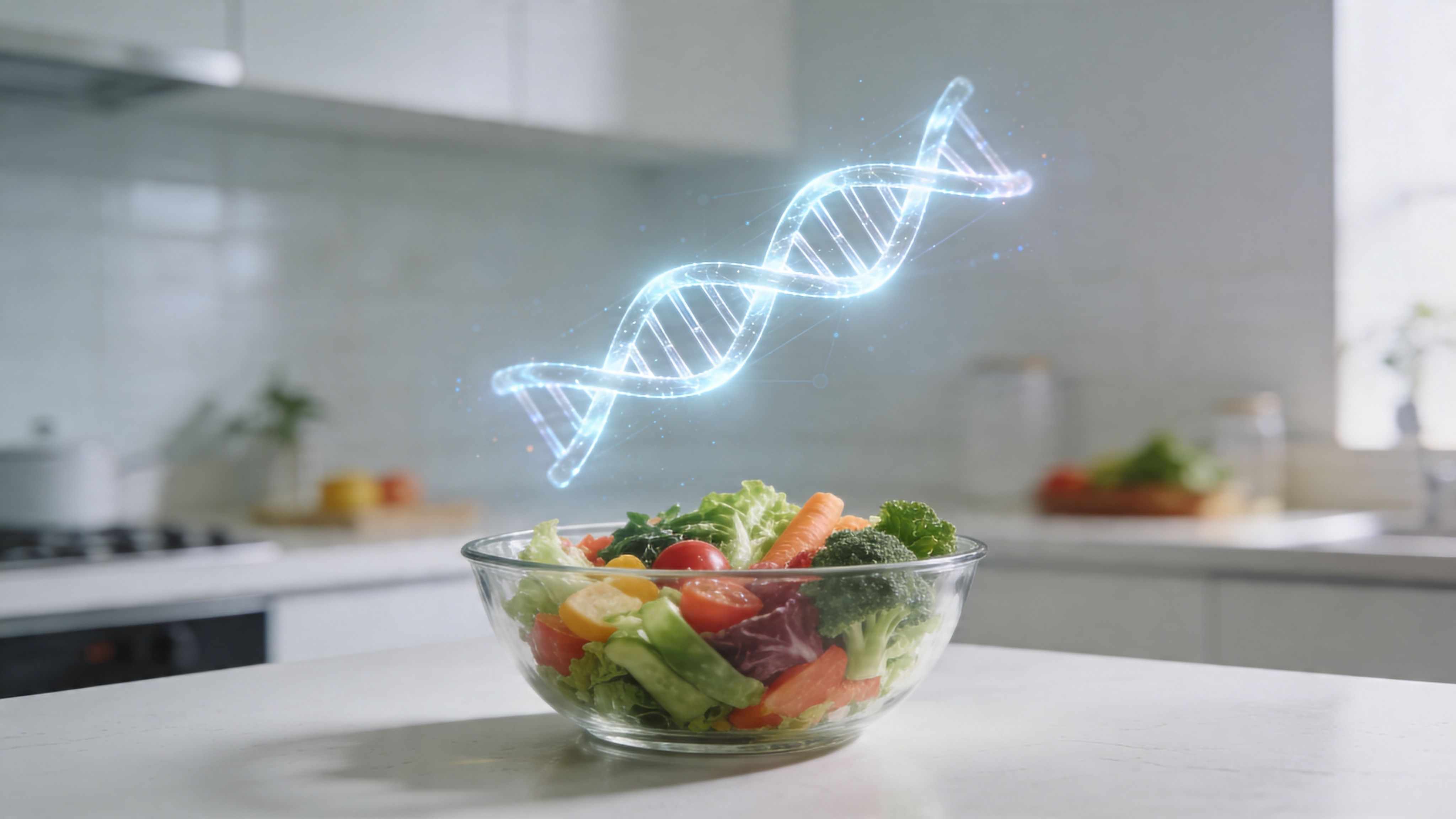
Personalized nutrition recommendations through DNA analysis
You may know the feeling: You make an effort, eat more vegetables, buy whole grains, reduce sugar, and follow what is widely considered healthy. Even so, you do not automatically feel more energetic. Perhaps the desired effect on your weight also fails to materialize, or your stomach reacts sensitively even though you are “actually doing everything right.”
This is exactly where the topic of nutrition recommendations becomes interesting. General rules are helpful, but they do not always explain why your body reacts differently from your friend’s, partner’s, or colleague’s. What works well for one person may only be a moderate fit for another.
The good news is that this does not mean you lack discipline. It may simply mean that you have been navigating with a map that was too general. When you understand where traditional recommendations help, where they end, and what your genes and metabolism reveal in addition, nutrition suddenly becomes much clearer.
Why the perfect diet for everyone does not exist
Many people start with the same intentions. More salad. Fewer snacks. More water. Fewer processed foods. That makes sense. But after a few weeks, frustration often sets in because the result does not match the effort.

Let’s take a simple example. Two people eat oatmeal with fruit and nuts in the morning. For one person, it keeps them full for a long time; for the other, hunger returns by late morning. Neither has eaten the “wrong” breakfast. But their bodies do not necessarily process the meal in the same way.
The same rules, different reactions
The biggest misconception about nutrition is often this: If something is healthy, it should work equally well for everyone. In practice, that is often simply not true.
There are several reasons for this:
- Your genetics influence how you process hunger, satiety, and individual nutrients.
- Your metabolism also determines whether you respond better to more protein, more carbohydrates, or a different meal structure.
- Your gut microbiome also influences which foods your body tolerates and processes particularly well.
General dietary rules are a starting point. They are not yet a personal roadmap.
Many people therefore experience something contradictory. They follow a sensible nutrition recommendation, but their body does not provide the expected feedback. Self-criticism can quickly arise. In reality, the problem is often not the effort, but the fit.
Why you can let that take the pressure off
If you have already tried several dietary approaches without really finding what works for you, this is not proof that you “don’t follow through.” It may simply mean that you have been working with average values so far, even though your body responds individually.
A good nutrition recommendation should therefore combine two levels. First, the general foundations of healthy eating. Second, your personal biological profile. Only then does good theory become something that truly suits you in everyday life.
What is a general nutrition recommendation
A general nutrition recommendation provides guidance for the wider population. It is intended to help prevent nutritional deficiencies, prevent illness, and establish a healthy foundation for everyday life. In Germany, such recommendations come from organizations including the German Nutrition Society.
What such recommendations are for
These guidelines are not aimed at one individual person, but at many people at the same time. They are based on what is generally sensible for large population groups. This is important because not everyone has an individual analysis from the outset.
A classic example is the recommendation to eat fruit and vegetables. The DGE recommends at least five portions of fruit and vegetables per day, around 650 g. At the same time, only 30 to 40% of the population in Germany reaches this amount, and women eat fresh fruit and vegetables significantly more often, at 69%, than men, at 49%, as described in the summarized information on the DGE recommendation and the RKI nutrition survey. You can find the basis for this in the DGE recommendations on eating and drinking well.
This shows two things at once. First, general recommendations are useful and concrete. Second, a clear recommendation does not mean that it will automatically be implemented in everyday life.
What general recommendations do well
General guidelines are especially strong when it comes to the basics. They help you identify obvious weaknesses and build healthier routines.
| Area | Typical strength of general recommendations |
|---|---|
| Orientation | They give you simple ground rules for everyday life |
| Prevention | They reduce the risk of eating a highly unbalanced diet over the long term. |
| Clarity | They make healthy eating tangible and practical |
Especially if your diet has been chaotic so far, such a foundation can provide enormous relief. You do not have to start from scratch.
Where they intentionally remain vague
The disadvantage lies in the principle itself. A recommendation for millions of people is inevitably general. It does not automatically take into account whether you feel full more quickly, react sensitively to certain foods, or have different needs regarding protein, fiber, or fat distribution.
Key takeaway: A general dietary recommendation answers the question “What is sensible on average?” It does not automatically answer the question “What is optimal for me?”
That is why you should not view such guidelines as a rigid verdict, but as a solid foundation. They are the starting point. For many health goals, that already goes a long way. For more specific questions such as weight management, energy, digestion, or long-term optimization, more than standard rules is often needed.
When general advice reaches its limits
The idea behind standard recommendations is sound. Nevertheless, many people realize after some time that they do not resolve all their outstanding questions. This is often where confusion arises. If so many rules are already known, why do so many problem areas remain?

A look at the nutritional situation makes this understandable. More than half of men and the majority of women in Germany do not reach the DGE reference value of 30 g of fiber per day. At the same time, more than 80% of people in Germany have vitamin D levels below the reference values. These figures are presented in the summary of the nutrition survey and the DGE references at UGB in its classification of the nutrition survey in Germany.
This does not mean that general recommendations are worthless. However, it clearly shows that broad rules alone do not automatically close individual nutritional gaps.
Three typical reasons for this gap
First, people do not eat strictly according to the textbook. Daily routines, shift work, stress, family life, and personal preferences influence what actually ends up on the plate.
Secondly, not every organism responds in the same way. Some people do wonderfully on a carbohydrate-focused diet, while others feel hungry or sluggish more quickly.
Third, many issues are not immediately visible. If you consume too little fiber or have certain nutrient gaps, you often notice it only over time. Then the impression arises: “But I already eat healthily—why does something still not feel right?”
Why averages do not always meet your needs
General advice works with groups. But your body works individually. This includes, among other things:
-
Hunger and satiety
Some people need a different macronutrient distribution to feel steadily satisfied. -
Digestion and tolerance
A high-fiber diet is not immediately comfortable for every gut when the microbiome or established habits are different. -
Metabolic responses
Whether you stay energetic after a meal or experience a slump can vary greatly.
If you feel that your body is “not cooperating,” it is often worth taking a closer look at your personal metabolism. A good starting point is the article about the slow metabolism type, because it clearly explains why classic diet logic does not always work.
Many people do not fail at nutrition. They fail with a diet that does not fit them exactly.
One-size-fits-all solutions are practical, but not precise
Standard advice is like off-the-rack clothing. It fits many people approximately. It often becomes truly comfortable only when something is tailored to your own body.
That is why the key question is not only, “Is this diet healthy?” A better question is, “Is this diet healthy and right for me?” This question leads to the next step: not just eating healthier, but eating more purposefully.
The science behind your personalized nutrition
As soon as you stop viewing nutrition merely as a set of rules and start seeing it as biology, many things become clearer. Personalized nutrition is based primarily on three pillars: genetics, metabolism, and the microbiome. These three levels influence how you process food, which meals keep you feeling full, and which strategy suits you in the long term.

Nutrigenetics in everyday life
The word nutrigenetics sounds technical, but it describes something very practical. It is about how genetic differences influence what works well for you nutritionally.
One well-known example is the FTO gene. According to the provided data, genetic variants in the FTO gene can influence individual protein requirements by up to 20%. People with a particular allele, the TT allele, have a 1.67-fold higher risk of obesity because their satiety signals in the brain function differently. A personalized recommendation with a higher proportion of protein can be decisive in such cases. You can also find an easy-to-understand introduction in the article what nutrigenetics is and how it shapes our lives.
What does this mean in practice? Two people can eat the same number of calories and still feel differently satiated. A light breakfast may be enough for one person, while a meal higher in protein is much more helpful for another in avoiding cravings.
Why protein is more important for some people
If your feeling of satiety is regulated somewhat differently due to genetics, the classic recommendation to “just eat less” can even backfire. You are then not only struggling against habits, but also against biological signals.
A personalized approach therefore looks not only at “healthy or unhealthy,” but at questions such as:
-
How do you respond to protein?
For some people, a higher proportion of protein is particularly helpful for satiety and structure. -
How easily do you fall into snacking patterns?
This may be related to your individual hunger regulation. -
Which meal structure fits your everyday life
Small, quick carbs between meals do not work equally well for everyone.
Those who understand their biology have to guess less and can make more targeted decisions.
Metabolism is more than calories in and calories out
Metabolism describes how your body obtains, stores, and uses energy. In everyday life, this means that not everyone benefits from the same distribution of carbohydrates, fats, and protein.
That is why some people achieve good results with a more Mediterranean pattern, while others feel more stable with slightly more protein and clearer meal structures. Personalized nutrition aims not to leave these responses to chance.
A brief comparison makes the difference tangible:
| Level | General approach | Personalized approach |
|---|---|---|
| Protein | Average requirements | Needs are adjusted to individual predisposition |
| Satiety | “Eat less” | Satiety mechanisms are taken into account |
| Meals | Standard recommendations | Selection based on personal response |
The microbiome plays a major role
Your gut is not only responsible for digestion. The composition of your gut bacteria also influences which foods you process well and how your body responds to certain dietary patterns.
The available data show that Prevotella-dominated profiles benefit particularly from a plant-based diet, while Bacteroides-dominated profiles may respond better to healthy animal fats. This is a good example of why two people can react differently to the same “healthy” eating plan.
So when someone says, “More raw food is always better” or “Fat is the solution for everyone,” caution is advisable. That may be true for some people, but not in the same way for others.
The insight behind personalized nutrition
The most important insight is not that general rules are wrong. It’s that they remain incomplete when your goal becomes more individual. As soon as you want to manage your weight, improve your energy, understand your digestion, or eat more purposefully over the long term, your personal biology plays a greater role.
That’s why personalized nutrition is not just a buzzword. It is an attempt to turn general recommendations into a plan that suits your body.
Your path to a personalized nutrition recommendation
Knowledge alone does not change a meal. What matters is how you translate those insights into a clear everyday action. A personalized nutrition recommendation usually does not emerge from a single moment of insight, but from a manageable process.

Step one is measuring instead of guessing
The first step is analysis. Instead of constantly trying out new diets, you look at which biological insights your body already provides. With DNA-based nutrition analysis, this typically involves an at-home saliva sample that is evaluated in a laboratory.
This type of analysis can provide insights into how your body processes certain macronutrients, how your satiety response is shaped, or what you should pay particular attention to in your nutrition strategy. If you’d first like to learn more about the topic, the DNA testing knowledge hub provides a good overview of typical questions and possibilities.
Step two is understanding instead of collecting data
The real problem is rarely a lack of information. It’s the translation. No one needs a report full of technical terms if it doesn’t lead to a practical action for everyday life.
A useful report therefore answers practical questions:
-
Which nutrition strategy is more suitable for me
For example, whether you could benefit from more protein, more structured meals, or a different nutrient distribution. -
Where might potential sticking points lie
For example, in hunger regulation, snacking tendencies, or fluctuating energy after eating. -
What exactly should I change in my everyday life
So, no abstract gene designations, but clear guidance for breakfast, main meals, and food choices.
Good diagnostics aren't complicated. It only becomes complicated when results aren't translated into your everyday life.
Step three is implementation without reinventing everything
This is where it becomes clear whether personalized nutrition is truly useful. The best analysis is of little help if you then find yourself standing in front of the fridge again thinking: “Good to know, but what am I actually going to eat now?”
That's exactly why implementation is so important. When your results lead to suitable meals, shopping guidance, and recipes, science becomes practical for everyday life. One example is the DNA Nutrition Test with an individualized cookbook and recipe book from MYBODY Lab GmbH. The product combines DNA analysis with a cookbook and recipe book tailored to the results, turning genetic insights into concrete meal ideas.
Why the gut also fits into the picture
Not all personalized nutrition has to be based solely on genes. The microbiome can further refine the recommendations. The available data show that Prevotella-dominant profiles in adults may benefit particularly from plant-based diets, while Bacteroides-dominant profiles tend to respond to healthy animal fats, which may strengthen the gut barrier.
This is important in practice. Perhaps you respond exceptionally well to a very high-fiber diet. Perhaps you need a different approach for your gut to adjust. Personalization therefore doesn't just mean “knowing your DNA”; it also means taking your digestive reality seriously.
What a realistic start looks like
You don't have to turn your entire life upside down for this. Often, a clean start with a few clear steps is enough:
-
Define your own goals
Is your focus weight, energy, digestion, or prevention? -
Assess the biological foundation
DNA, metabolism, or the microbiome can provide clues. -
Translate results into meals
Not in theory, but with recipes that fit your everyday life. -
Observe and adjust
Your body provides the feedback. Not every recommendation has to be perfect right away.
This is how dietary confusion turns into direction. Not because everything suddenly becomes complicated, but because you finally have to guess less.
Frequently asked questions and next steps
Many people find the idea of personalized nutrition exciting but are still unsure. That is perfectly normal. Especially when it comes to health, it makes sense not to simply follow every trend.
Is a DNA test like this complicated
Generally not. These tests are designed for use at home and usually involve a simple saliva sample. The key point is less the sample collection than the quality of the analysis and the clarity of the report.
Will this really benefit me if I already know a lot about nutrition
Often, yes. Even sound nutritional knowledge remains general unless it is linked to your own biology. The available data show that global studies associate an unpersonalized diet with higher mortality due to insufficient whole grains and fruit and excessive sodium, and that genetic variants can influence the success of a diet by 30 to 50%. You can find an accessible introduction to making practical decisions at Taking a DNA test and interpreting it meaningfully.
What about my data
Data privacy is particularly important when it comes to genetic information. Reputable providers use clear data protection processes, pseudonymized samples, and transparent information about what is and is not analyzed. Always examine these points carefully before choosing a test.
What is the most sensible next step
If you have been wavering between dietary rules, diets, and well-intentioned advice for years, the next logical step is not more guesswork. It makes more sense to put your diet on a more personal footing. Then you will make decisions not just based on trends, but on information that suits your body.
If you no longer want to base your diet on average values but instead want to better understand what suits your body, you can explore the offerings from MYBODY Lab GmbH. The most sensible starting point is often an analysis that turns general recommendations into a concrete, actionable plan for your everyday life.



Share now:
Keto Diet: Science, Benefits, and Risks 2026
Leaky Gut Diet Table: Gut Health in 2026