
Online nutrition test: How it works and how to recognize a reputable provider
The key points at a glance
An online nutrition test is an analysis that you start from home: You answer a questionnaire or collect a sample, send it to a laboratory, and receive a digital report. It provides guidance for your diet—but it does not replace a medical diagnosis or personal nutritional counseling.
The term is not protected. “Online nutrition test” encompasses very different services: purely self-reported information collected via questionnaire, genuine laboratory analyses of a saliva or blood sample, and combinations of both. The quality of a provider therefore depends less on marketing than on four verifiable points: Who performs the measurement, exactly what is measured, what happens to the data, and how honestly the limitations are communicated.
This article guides you through the entire decision-making process: Chapter 2 compares the three options, Chapter 3 explains the process step by step, Chapter 4 puts into perspective what a test cannot provide compared with qualified counseling, Chapter 6 provides the evaluation checklist, Chapter 7 covers data protection, and Chapter 8 offers an honest decision-making aid.
What to expect in this article
1. What is an online nutrition test—and what is it not?
2. What options are there for having your diet assessed online?
3. How does an online nutrition test work, step by step?
4. Why an online test is no substitute for nutritional counseling
5. What misconceptions persist about online nutrition tests?
6. How can you recognize a reputable online nutrition test?
7. What happens to your sample and your data?
8. Who can benefit from an online nutrition test—and who cannot?
9. How mybody® applies these criteria
10. Putting it into perspective: What an online test can—and cannot—do
11. Conclusion
Frequently asked questions
Sources
What is an online nutrition test—and what is it not?
An online nutrition test is a collective term for analyses that begin without a visit to a practice and whose results are delivered to you digitally. The term is not protected, so on its own it says nothing about the validity of a specific service.
The difference between the services is greater than their shared name might suggest. A questionnaire records your self-reported information. A laboratory analysis measures a value from your body. Both ultimately arrive as a PDF in the same inbox—but that does not mean they are equally reliable.
The three basic types: questionnaire, laboratory sample, and personal consultation
The first type is a purely online questionnaire. You provide your age, weight, eating habits, and goals; an algorithm processes this information and provides recommendations. Nothing is measured—the analysis can only be as accurate as the information you provide.
The second option is laboratory analysis based on a sample you collect yourself at home. A saliva sample provides genetic variants, while a blood sample provides current measurements. This produces a genuine finding that is independent of your self-assessment.
The third option is not a type of test, but the alternative to one: qualified nutritional counseling. According to the Institute for Quality and Efficiency in Health Care (IQWiG, 2021), nutritional counseling is offered “in nutritional counseling practices, doctors’ offices, gyms, and some companies.” It does not collect laboratory values, but it supports you over a longer period.
What the German Nutrition Society understands by personalized nutrition
According to the German Nutrition Society's (DGE, 2025) blog post “Personalized Nutrition – How Does It Work?”, a DGE working group describes personalized nutrition as “a comprehensive approach in which recommendations and services or products are offered that are tailored to individuals’ needs and requirements.”
According to the same article, this model considers “not only conventional factors such as lifestyle, health status, and risk factors, but also a person’s abilities, capacities, goals, and constraints.” An online test always covers only part of this list — namely, what can be measured.
Key message: An online nutrition test provides data about you. It does not automatically translate that data into your everyday life — shopping, cooking, habits, and constraints.
Where this article fits — and where the related articles can help
This article is the decision-making guide: process, provider evaluation, data protection, and results. The overview article explains which types of tests generally exist and how they differ from a professional perspective Nutrition test. The article that explores the genetic details — which gene variants are examined at all and what follows from them — DNA nutrition test.
What options are available for having your diet assessed online?
There are three realistic options, and they answer different questions. The online questionnaire organizes your self-reported information, the DNA test using a saliva sample reveals genetic predispositions, and qualified nutritional counseling provides personal support. The following overview compares them using the same criteria.
Where the reviewed source material does not provide reliable information, this is explicitly stated in the cell instead of providing an estimate.
| Criterion | Online questionnaire without a laboratory sample | DNA test using a saliva sample | Qualified nutritional counseling |
|---|---|---|---|
| What is measured? | Your self-reported eating habits, weight, and goals. No physical measurement is taken. | Genetic variants from a saliva sample. With NutriCare | INFINITY: more than 140 genetic variations (mybody®, as of August 3, 2026). | Your dietary and lifestyle history discussed in a personal consultation, supplemented by medical findings depending on the purpose. |
| What do you receive at the end? | An automatically generated analysis. The scope and depth are not described consistently in the source material used. | A written findings report; with NutriCare | INFINITY: 54 analysis reports in 8 chapters covering around 200 pages (mybody®, as of August 3, 2026). | Personal support. According to IQWiG (2021), nutritional counseling normally serves preventive purposes. |
| Who performs the analysis? | A computational model without a personal consultation. The source material used contains no substantiated information about the providers’ qualifications. | An analytical laboratory. At mybody®, the analysis is carried out under ISO 27001 certification (as of August 3, 2026). | According to IQWiG (2021), recognized qualifications include dietetics with a state-recognized vocational-school diploma, ecotrophology and nutritional science with additional training, as well as doctors with additional training in nutritional medicine. |
| How much time does it take? | No substantiated time estimate is provided in the source material used. | Approx. 20–25 working days after the sample arrives at the laboratory (mybody®, as of August 3, 2026), plus shipping. | No substantiated time estimate is provided in the source material used; the duration depends on the purpose and provider. |
| What is it not suitable for? | For any form of diagnosis. A questionnaire cannot identify a deficiency or intolerance. | For a diagnosis and current care status. A DNA test replaces neither a hydrogen breath test nor a medical provocation test. | For laboratory values. Counseling itself does not measure values from blood or saliva. |
| Does the health insurance fund contribute to the costs? | For self-tests, IQWiG (2021) does not provide for any cost sharing; the regulation explicitly concerns counseling. | Also no — a home laboratory test is not nutritional counseling within the meaning of this regulation either. | According to IQWiG (2021), only if the counseling is explicitly intended for prevention and the provider is qualified. |
The comparison leads to an uncomfortable but useful insight: the three approaches do not compete with one another; they complement each other. A laboratory test without implementation remains a PDF, while counseling without measured values relies on your self-assessment.
How does an online nutrition test work, step by step?
An online nutrition test with a laboratory sample takes place in four stages: ordering and collecting the sample at home, returning it to the laboratory, analysis and report preparation, and translating the results into everyday life. The fourth stage is the one most often underestimated.
Order the test and collect the sample at home
The kit arrives by mail. With a DNA test, you collect a saliva sample using a cotton swab, with no needle required.
Return to the laboratory
The sample is sent to the laboratory in the enclosed return envelope. A reputable provider specifies which laboratory performs the analysis and how it is certified.
Analysis and report
The laboratory analyzes the sample and prepares the report. For mybody® DNA metabolism tests, this takes approximately 20–25 business days after the sample arrives at the laboratory.
Translating results into everyday life
This is where the benefit arises: shopping list, meal schedule, portion sizes. Without this step, every report remains without practical consequences.
Why sample collection affects the quality of the result
With a self-test, you are part of the laboratory yourself. A saliva sample collected too briefly or directly after eating can make the analysis more difficult. The enclosed instructions are therefore part of the method, not an information leaflet to skip.
What is actually included in a test report
A good report clearly separates three levels: the measurement result, the professional interpretation, and the recommendation derived from it. When these three levels blend together, a finding imperceptibly becomes a sales argument.
Also check whether the report cites the generally applicable reference values from the DGE and compares your values with them.
Why an online test does not replace nutritional counseling
An online test provides data; nutritional counseling provides support. This is not a quality judgment about tests, but a description of two different services — and the difference matters more to your decision than any product feature.
In its guide “Nutritional Counseling and Nutritional Therapy” (as of 2021), the Institute for Quality and Efficiency in Health Care (IQWiG) explains what nutritional counseling is actually intended for. The key sentence is:
“
“Nutritional counseling normally serves prevention, that is, preventing diseases and their consequences.”
Institute for Quality and Efficiency in Health Care (IQWiG)
“Nutritional Counseling and Nutritional Therapy,” gesundheitsinformation.de, 2021
Which qualifications are recognized according to IQWiG
According to IQWiG (2021), three professional groups are recognized providers of nutritional counseling: dietitians with a state-recognized specialized college qualification, ecotrophologists and nutrition scientists with additional training, and physicians with additional training in nutritional medicine.
This list is a useful benchmark, even if you are not seeking counseling at all. It shows the qualification level considered the reference standard in healthcare — an automated questionnaire does not meet it.
Does the health insurer contribute to the costs?
According to IQWiG (2021), a health insurer contributes to the costs only if the counseling is explicitly intended as preventive care and the provider is qualified. According to the same source, a doctor's recommendation is not required for this.
This rule does not apply to self-tests. An online nutrition test that you order and carry out yourself is not nutritional counseling within the meaning of this cost-coverage rule — you bear the full cost yourself. Anyone expecting a test to be “covered by their health insurer” is planning contrary to reality.
Key point: An online nutrition test and qualified nutritional counseling are not alternatives to each other. The test provides measurements; counseling provides professional support — and according to IQWiG (2021), only the latter is eligible for any contribution from a health insurer.
What misconceptions persist about online nutrition tests?
Two assumptions repeatedly arise in connection with online nutrition tests. Both sound plausible, but neither withstands the available evidence. Addressing them openly is not a disadvantage for test providers — it protects against disappointment.
What the 2022 DGE statement says in detail
The DGE statement describes the effectiveness of personalized nutrition as disappointing so far — even though corresponding services have been commercially available for more than 20 years. This context belongs in every honest article about nutrition tests, including one that ultimately presents a product.
The 2025 DGE blog post also reproduces an individual expert opinion that considers genetic tests for weight-loss recommendations unnecessary “from a scientific perspective.” Important context: This is the assessment of a single expert voice reproduced in the post, not an institutional position of the DGE.
The same article states the following about tests sold directly to consumers: “Researchers found that tests offer no added value for people who, for example, want to lose weight.” Anyone hoping a test will help them lose weight should know this before ordering.
How can you recognize a reputable online nutrition test?
You can assess credibility based on six points, all of which must appear on the provider’s website—without calling, asking questions, or searching the fine print. If one is missing, that alone is not necessarily a reason to rule out the provider. If several are missing, it is.
Checklist: six points to check before ordering
- ✓ Traceable information about the laboratory and certification – The provider names where the analysis is performed and which standard the laboratory follows.
- ✓ Clear statement of what is and is not measured – It explicitly states which markers or genetic variants are examined and which questions remain unanswered.
- ✓ Transparent price with a date – The full price is visible, including the analysis and return shipping, and is dated.
- ✓ GDPR-compliant data processing with a deletion period – It is clearly stated when the sample and data will be deleted or destroyed.
- ✓ No promises of healing or weight loss – A test that promises weight loss in kilograms or the cure of ailments promises more than an analysis can deliver.
- ✓ Identifiable team of specialists – There is a page stating which fields of expertise are represented in the evaluation.
Laboratory and certification: Who analyzes your sample?
The most important information is rarely in the marketing copy, but in the product details. Reputable providers name the analytical laboratory, its location, and its certification, for example according to ISO standards. If this information is missing entirely, you do not know who processes your sample.
Scope of analysis: What is examined—and what explicitly is not?
A reliable offer clearly lists the scope of the analysis: which genetic variants, which markers, and how many reports. The converse is just as important. A provider that openly states which questions its test does not answer gives you more confidence than one that seems able to do everything.
Price and date: Why a date next to the price matters
Prices change and promotions expire. A price without a date is therefore a snapshot without context. Also check whether the analysis and return shipping are included.
Promises: How to recognize misleading wording
Warning signs include specific promises of success, countdown timers, claims of limited stock, and wording that suggests a diagnosis. A test may provide indications; it cannot diagnose a disease or guarantee weight loss. Anyone who promises this anyway is selling an expectation, not a result.
In brief
You can recognize a reputable online nutrition test by six details, all of which are visible before purchase: the laboratory and certification, the scope of testing together with explicit limitations, a transparent price with an as-of date, GDPR-compliant data processing with a deletion period, no claims of healing or weight loss, and an identifiable team of experts. If one detail is missing, it is worth asking; if several are missing, caution is advised. What matters is not how much a provider promises, but how precisely it describes what it actually measures.
What happens to your sample and data?
With an online nutrition test, you hand over health data—and with a DNA test, even genetic data. How a provider handles it is therefore not a minor aspect of the order, but a key criterion.
A reputable provider tells you not only what it measures, but also when it will delete your sample and data. This information belongs on the product page or in the privacy policy, not only in response to an email inquiry.
A reputable provider tells you not only what it measures, but also when it will delete your sample and data.
Pseudonymization: Why your name does not belong in the laboratory
With pseudonymized processing, your sample carries an identification number instead of your name. The laboratory therefore analyzes a number, not a person. The link to you is kept separately—this reduces the risk if data falls into the wrong hands.
Transmission and storage: SSL, GDPR, and deletion periods
You should find three points on the provider's website: SSL-encrypted transmission of your results, GDPR-compliant processing, and a specific period after which sample material and analysis data are destroyed. The third piece of information is missing most often—and is also the most revealing.
At mybody® (MYBODY Lab GmbH), the saliva sample and DNA sequence are destroyed two months after the analysis, transmission is SSL-encrypted, and the samples are processed using pseudonymization. Such information can be looked up and, if in doubt, requested—this is precisely what makes it useful.
Sharing with third parties: the question you should ask
Genetic data is particularly sensitive because it cannot be changed. Therefore, check whether a provider shares data for research purposes and whether you have to actively consent to this. A default setting that you first have to opt out of is a bad sign.
Who is an online nutrition test useful for—and who is it not suitable for?
An online nutrition test is a structuring tool, not a diagnostic tool. It is suitable for people who want to consciously change their diet and are looking for a starting point to do so. It is not suitable for people who need a medical answer.
Useful for you if …
… you want to change your diet and are looking for a structured starting point rather than another diet idea.
… you are curious and enjoy understanding your genetic predispositions as an additional perspective.
… you are already following the DGE basic recommendations and want to take the next step toward fine-tuning.
… you are prepared to actually translate the results into your shopping choices and daily life afterward.
Probably not if …
… you need a diagnosis. That is the responsibility of a medical practice, not a self-test.
… you have acute or persistent symptoms. These should be medically evaluated first, before ordering any test.
… you expect a weight-loss guarantee. There is no such guarantee—according to the DGE (2022), analyses of personalization generally found no statistically significant improvements in eating behavior.
… you are not yet following the basic recommendations at all. Anyone still well below the DGE guideline values will gain little from a detailed analysis.
The last point deserves a number. According to the DGE (as of 2021), the guideline value for fiber is at least 30 g per day, and for adults aged 19 to 65, the DGE (as of 2025) specifies a reference value of 0.8 g of protein per kilogram of body weight per day—that corresponds to approximately 57 g daily for men and 48 g for women. These values apply regardless of any test result.
Those who have not yet achieved this foundation will gain little from a detailed analysis. Those who have achieved it may find the next adjustment point in a test. That is the most honest order that can be derived from the available evidence.
How mybody® applies these criteria
mybody® (MYBODY Lab GmbH) offers DNA metabolism tests that begin as at-home self-tests: collect a saliva sample, send it in, and receive a report. The analysis is ISO 27001 certified, data processing complies with the GDPR, and the editorial and scientific team brings together expertise in nutrigenetics, nutritional science, and laboratory diagnostics.
What these tests explicitly are not: diagnostic procedures. They show genetic predispositions, not a disease, an existing intolerance, or current nutritional status. For lactose intolerance, the hydrogen breath test remains the medical standard; for a food allergy, the physician-supervised provocation test is the standard.
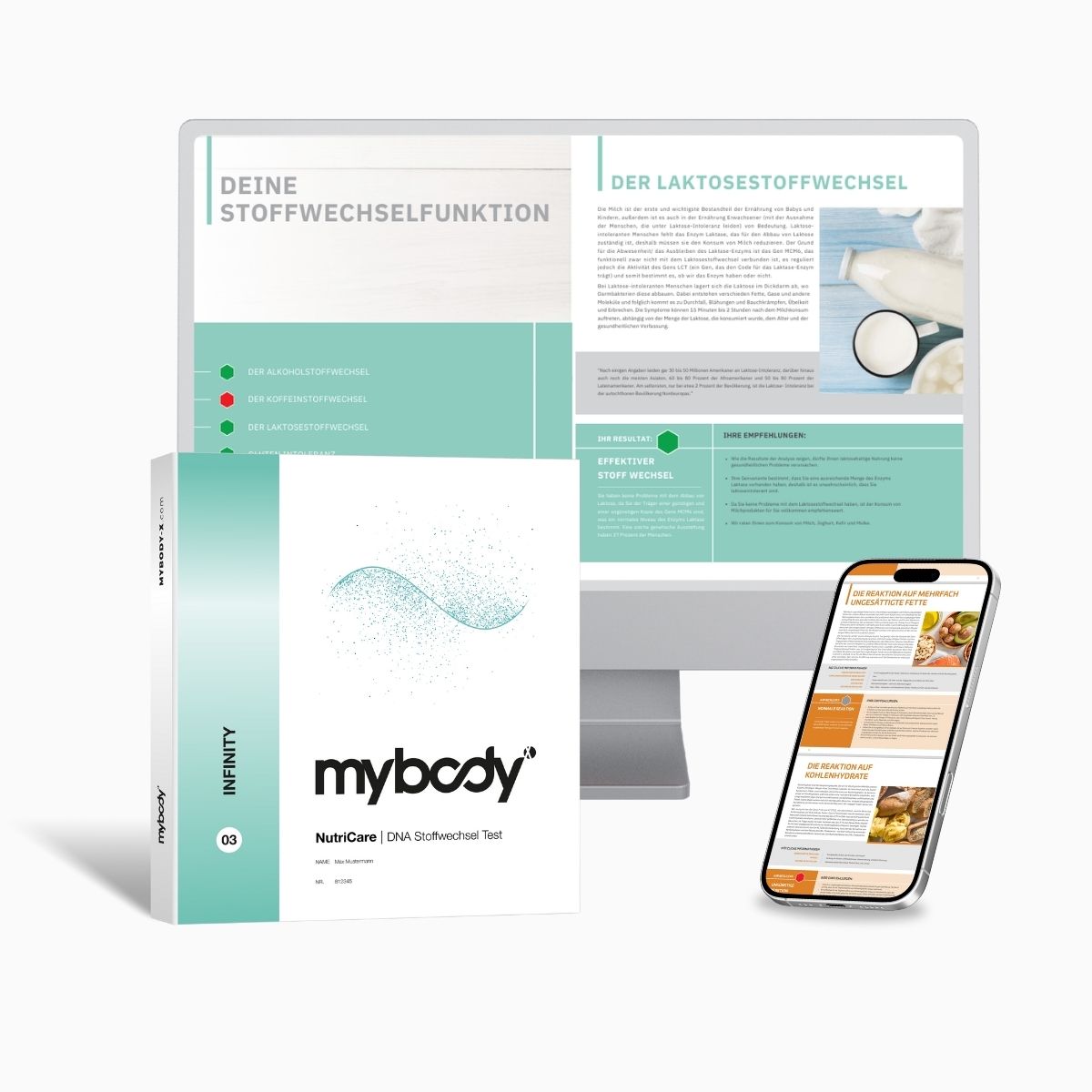
NutriCare | INFINITY DNA Test
Over 140 gene variants from a saliva sample, evaluated in 54 analysis reports across 8 chapters and approximately 200 pages, plus a personalized nutrition plan with recipes and a food table containing over 1,000 analyzed foods. What the test does not do: It does not provide a diagnosis, measure current blood values, or predict weight-loss success. The four tolerance reports in the “mybody® Metabolic Type” chapter—alcohol metabolism, caffeine metabolism, lactose metabolism, and gluten intolerance—do not replace a medical evaluation.
Price: €269.00 · Sample type: saliva sample · Processing time: approx. 20–25 business days · Laboratory: ISO 27001-certified laboratory analysis
About NutriCare | INFINITYAnyone who wants to purchase the transition from analysis to everyday life from the outset will find a ready-made implementation framework in the second option. This is where online tests most often fail: not in the analysis, but in the translation.

DNA Metabolism Analysis including 28-day plan & recipe book
The more compact option: over 80 genetic variants from a saliva sample, 24 analyses in 5 chapters, supplemented by a 28-day plan with 60 recipes. The plan is what translates the results into concrete meals. What the test does not do: It does not replace medical evaluation, diagnose an intolerance, or guarantee weight loss.
Price: from €197.00 (instead of €298.00) · Sample type: saliva sample · Processing time: approx. 20–25 business days · Laboratory: ISO 27001-certified, GDPR-compliant
About the DNA Metabolism AnalysisAll price and service information is current as of August 3, 2026. Prices, processing times, and scope of services may change; the relevant product page is always authoritative.
Context: What an online nutrition test can—and cannot—do
An online nutrition test can give you a structured starting point and highlight topics you might not otherwise have considered. It cannot diagnose a disease, predict weight-loss success, or replace professional advice.
A DNA test is not a diagnostic procedure
A DNA test reveals predispositions, meaning probabilities. Whether a predisposition actually affects your life depends on diet, exercise, sleep, and many other factors. The IQWiG guide to lactose intolerance (as of 2024) lists the hydrogen breath test, the lactose tolerance test, and the elimination test as diagnostic methods—but does not list a genetic test.
The evidence for personalized nutrition is sobering
According to the DGE statement “Rethinking Personalized Nutrition” (2022), analyses used for personalization, such as genetic and blood analyses or microbiome data, generally showed no statistically demonstrable improvements in dietary behavior. According to the statement, moderate effects were evident through increased motivation.
This motivational effect is not nothing—but it is something different from a biologically grounded advantage.
The basic recommendations still apply
No test result overrides the general reference values. According to the DGE, a balanced mixed diet should contain limited amounts of fat and more than 50 % of energy intake in the form of carbohydrates; the guideline value for fat is 30 % of total energy intake for adults between 19 and 65 years of age.
Physical activity remains unaffected as well: The World Health Organization (WHO, 2020) recommends that adults engage in 150–300 minutes of moderate-intensity or 75–150 minutes of vigorous-intensity aerobic activity per week, along with muscle-strengthening activities on at least two days. No nutrition test changes that.
Key message: An online nutrition test is a starting point, not an endpoint. It replaces neither medical evaluation when symptoms occur nor qualified nutritional counseling—and it does not override the DGE’s general reference values.
Conclusion
An online nutrition test is worthwhile if you are looking for a structured starting point and are prepared to put the results into practice afterward. It is not worthwhile if you expect a diagnosis, a guaranteed way to lose weight, or a substitute for professional guidance.
The practical recommendation is therefore: Before ordering, check the six points from Chapter 6—laboratory and certification, scope of measurement and its limitations, price with the date it applies, the retention period for samples and data, no promises of cures, and an identifiable team of specialists. If a provider transparently discloses all six details, you have a sound basis for your decision.
And if persistent symptoms led you to take the test: have them medically evaluated first. A self-test is a useful tool for curiosity and structure—it is not a tool for unresolved medical questions.
Frequently asked questions
What does an online nutrition test really do?
An online nutrition test gives you a structured starting point: with a questionnaire, an organized evaluation of the information you provide; with a laboratory test, an actual report based on a saliva or blood sample. The most substantial proven effect comes from engaging more intensively with your own diet—according to the DGE statement “Rethinking Personalized Nutrition” (2022), analyses of personalization generally found no statistically significant improvements in dietary behavior, although moderate effects were evident through increased motivation.
When should you see a doctor instead of taking an online test?
Whenever symptoms are involved—persistent abdominal pain, diarrhea, unintended weight loss, blood in the stool, or severe fatigue—they should be medically evaluated before ordering a self-test. An online nutrition test cannot detect a disease or provide a diagnosis. If a food allergy is suspected, you should also consult a medical practice—for diagnosis, the IQWiG (2023) states that a provocation test under medical supervision is usually necessary.
Can a DNA metabolism test detect lactose intolerance?
No. A DNA test shows genetic predispositions, not an existing intolerance. The IQWiG guide on the causes and diagnosis of lactose intolerance (as of 2024) lists the hydrogen breath test, the lactose tolerance test, and the elimination diet as diagnostic methods—a genetic test is not listed as a diagnostic procedure. The report on lactose metabolism in NutriCare | INFINITY is therefore an indication of a predisposition, not a diagnosis.
Does health insurance cover an online nutrition test?
No cost coverage is provided for self-tests. According to IQWiG (2021), health insurance covers the costs only if nutritional counseling is explicitly intended as preventive care and is provided by a qualified provider. This regulation applies to the counseling, not to a test you order yourself and perform at home. According to the same source, a doctor's recommendation is not required for the counseling to be covered.
How long does an online nutrition test take from ordering to receiving the results?
That depends on the type of test. For mybody®'s DNA metabolism tests, evaluation takes approximately 20–25 business days after the sample arrives at the laboratory, plus shipping time to and from the lab (as of August 3, 2026). For online questionnaires without a laboratory sample, the source material used here does not provide a documented timeframe—the only reliable information is the respective provider's statement on its product page.
Do you want to base your diet on a reliable foundation?
mybody®'s DNA metabolism tests begin with a saliva sample collected at home and end with a written report including a nutrition plan. Take a closer look at exactly what is evaluated—and what explicitly is not.
View NutriCare | INFINITY All DNA metabolism testsYou might also be interested in this
→ What does a DNA metabolism test reveal?
An honest assessment of which questions a genetic test answers and which remain open.
→ DNA Analysis for Weight Loss: What Does It Really Cost?
Price ranges, scope of services, and what you ultimately pay for.
→ Macronutrients: An Overview of Carbohydrates, Fats, and Proteins
The fundamentals that apply regardless of any test result.
Sources
- Institute for Quality and Efficiency in Health Care (IQWiG): Nutritional Counseling and Nutrition Therapy (2021) — gesundheitsinformation.de
- German Nutrition Society (DGE): Announcement “Personalized Nutrition Reconsidered” (2022) — dge.de
- German Nutrition Society (DGE): Blog post “Personalized Nutrition – How Does It Work?” (2025) — dge.de
- German Nutrition Society (DGE): Reference Values for Fiber (as of 2021) — dge.de
- German Nutrition Society (DGE): Reference Values for Protein (as of 2025) — dge.de
- World Health Organization (WHO): Guidelines on Physical Activity and Sedentary Behaviour (2020) — ncbi.nlm.nih.gov
The institute quotation, recognized qualifications, and cost-sharing arrangement are based on [1]. The assessment of the evidence comes from [2], while the definition and the quoted expert opinion on genetic tests come from [3]. The reference values for fiber and protein come from [4] and [5], and the physical activity recommendation from [6]. Product information comes from the mybody® product pages, accessed on August 3, 2026. All other sources mentioned in the text are identified directly at the relevant point by institution and year.

mybody® Editorial & Expert Team
Nutritional Science Nutrigenetics Laboratory Diagnostics Data Protection in Healthcare
This article was created and medically reviewed by the mybody® Editorial and Expert Team. The team brings together expertise in nutrigenetics, microbiome and gut science, blood analysis interpretation, nutritional science, and laboratory diagnostics.
Published on August 3, 2026 · Last updated on August 3, 2026
Medical notice: This article is intended for general information and does not replace medical advice, diagnosis, or treatment. An online nutrition test is not a diagnostic procedure. If you have persistent symptoms, unexplained weight loss, or suspect a food allergy, please consult a doctor.




Share now:
Regeneration: What your body really needs after training, stress, and during sleep
Foods to Avoid with High Cholesterol: The List That Doesn’t Exist