
Forbidden foods for high cholesterol: the list that does not exist
The most important points at a glance
There is no list of forbidden foods for high cholesterol. According to IQWiG, what demonstrably drives LDL levels upward is saturated and trans fats—not the cholesterol in food itself. That is why most lists of forbidden foods get it wrong: eggs and shrimp are high in cholesterol but low in fatty acids.
The difference may sound like nitpicking, but it is crucial in practice. Someone who cuts out eggs but continues eating sausage, puff pastry, and fried foods has not addressed the relevant lever. Conversely, someone who focuses on fatty acids hardly has to ban anything—above all, they need to make substitutions.
This article explains it step by step. First, what cholesterol does in the body and at what level it is considered elevated. Then, what actually affects the levels, which food groups play a role, and what has no place on the circulating lists of forbidden foods. Finally, it covers how to find out your own levels and where nutrition reaches its limits.
What to expect in this article
1. What cholesterol actually does in the body
2. When is the level considered elevated?
3. What actually affects blood levels
4. Which food groups really matter
5. What belongs on lists of forbidden foods—and what does not
6. How to find out your own levels
7. Who would benefit from a measurement
8. What nutrition cannot do
9. What ultimately matters
Frequently asked questions
Sources
What cholesterol actually does in the body
Cholesterol has a bad reputation that does not reflect its function. The body produces it itself because it needs it—for cell walls, hormones, and bile acids.
“
“Cholesterol is an important building material in all the body’s tissues and is needed in many areas of metabolism.”
Institute for Quality and Efficiency in Health Care (IQWiG)
Elevated cholesterol levels, as of 2025
Most of it does not come from your plate
The key point for the entire debate about forbidden foods is already contained in the definition: cholesterol is a building material that the body produces itself. It does not depend on getting it from food.
This results in a feedback loop that never appears on lists of forbidden foods. If more cholesterol comes in through food, the body’s own production can be reduced. If less comes in, production increases. At this point, the body does not behave like a bucket that can be made fuller or emptier, but like a system with counterregulation.
The extent to which this counterregulation takes effect varies from person to person, and the source material used here does not provide a reliable figure for it. For practical purposes, the direction is enough: omitting a food because it is high in cholesterol targets something the body regulates on its own anyway.
LDL and HDL are not two types of cholesterol
Cholesterol is not water-soluble, so it is transported through the blood in small carrier packages. LDL and HDL are these packages, not two different substances. That is why the everyday formula of good and bad cholesterol misses the point.
LDL transports cholesterol from the liver throughout the body. If too much of it remains in circulation over time, it can accumulate in the vessel walls and increase the risk of cardiovascular disease. HDL takes up excess cholesterol and carries it back to the liver.
HDL requires a qualification that many guides leave out: According to IQWiG, the long-assumed protective effect of a high HDL level has not been confirmed in more recent studies (as of 2025). A high HDL level is therefore not a free pass, and a food that supposedly raises HDL is not a counterbalance to everything else.
Key message
It is not primarily the cholesterol in food that determines blood cholesterol levels, but rather the type of fatty acids consumed with it.
At what point is the level considered elevated?
Elevated cholesterol levels are not a marginal phenomenon. According to IQWiG, more than half of adults have total cholesterol above the level considered optimal (as of 2025).
Source: Institute for Quality and Efficiency in Health Care (IQWiG), 2025
Why the number alone does not determine anything
An elevated level is not a diagnosis and, by itself, is not an indication for treatment. What matters is the overall risk: age, blood pressure, smoking, diabetes, and family history. Two people with identical LDL levels may therefore receive completely different recommendations.
This explains why the search for the forbidden food comes up empty. It treats a number as if it were the disease. But the number is one component of a risk assessment that can only be put together by a doctor.
Why there are two units of measurement
Laboratory results list cholesterol levels sometimes in milligrams per deciliter and sometimes in millimoles per liter. Both describe the same quantity, just calculated differently—one by weight, the other by number of particles.
Practically speaking: 200 mg/dl and 5.2 mmol/l are the same threshold. When comparing two test results from different laboratories, you should check the unit first before wondering about an apparent jump.
Familial hypercholesterolemia is the exception that changes everything
An estimated 0.3 percent of all people have familial hypercholesterolemia—a genetically caused disorder of lipid metabolism. In this condition, levels are greatly elevated from birth, regardless of how someone eats.
Anyone with a family history of early heart attacks or notably high levels should discuss it with a doctor. In these cases, diet is not irrelevant, but it is secondary.
What actually affects blood values
IQWiG names two dietary factors that contribute to elevated LDL levels: a diet high in saturated fatty acids and trans fats. Limited physical activity also plays a role (as of 2025).
What is striking is what is missing from this list: dietary cholesterol. Yet that is exactly what the circulating lists of prohibited foods focus on when they put eggs, organ meats, and shrimp at the top.
Saturated fatty acids: the real issue
Saturated fatty acids are found mainly in animal fats and in some processed products: fatty meat, sausages and other processed meats, butter, cream, high-fat cheese, puff pastry, many baked goods, and ready-made meals.
This is not a list of prohibitions, but a question of quantity. One piece of cheese will not alter a blood value. Eating cheese, sausage, and butter as daily staples for months will.
Most of these fatty acids do not come, in everyday life, from where you might expect. The main source is not the visible fat along the edge of a chop, but the invisible fat in sausages and other processed meats, cheese, baked goods, and ready-made meals. If you only cut away the visible fat, you have removed the smaller part.
One practical consequence is that the cold cuts on your breakfast bread are often more relevant over the course of a week than the Sunday meal. They simply do not stand out because they are part of the basic routine and are not counted as an indulgence.
Trans fats: the less conspicuous half
Trans fats are formed, among other ways, during the industrial hardening of vegetable fats and when foods are heated intensely. The IQWiG text places them on an equal footing with saturated fatty acids.
In everyday life, they are harder to identify because they are rarely listed. A useful clue is the ingredients list: if it says hydrogenated or partially hydrogenated vegetable fat, they are a concern. Fried foods and deep-fried products kept warm for a long time also belong in this category.
The ingredients list is more informative than the nutrition facts table, and for a simple reason: trans fats are generally not listed separately there. What you see is the total amount of fat and the proportion of saturated fatty acids—the trans fats are hidden in the difference.
Product groups where it is especially worth taking a closer look include long-life baked goods, puff and shortcrust pastry products, coatings and icings, ready-made soups and instant products, and anything that has been deep-fried. This is not a list of prohibited foods—it is the list where checking the ingredients pays off most.
Why the amount over time matters, not the individual meal
Blood lipid levels reflect habits, not isolated events. One barbecue evening does not shift a lab result, and one salad does not save it. That is the real relief lost in the logic of prohibition.
For making the change, this means the relevant measure is the week, not the plate. Anyone who eats differently on six out of seven days has achieved more than someone who is strict for two weeks and then relapses. And anyone who allows themselves an exception has not undone anything—they have simply made an exception.
Why dietary cholesterol was in focus for so long
The lists of prohibited foods did not come out of nowhere. They are the remnant of an older interpretation according to which the cholesterol in food ends up directly in the blood in the same amount. This idea is easy to grasp, and that is precisely why it persists.
What gets overlooked is that many cholesterol-rich foods are also high in fat—butter and high-fat cheese, for example. With these foods, the old recommendation happens to produce the right result, but for the wrong reason. With eggs, shrimp, and organ meats, the two characteristics diverge, making the error in reasoning visible.
In practical terms, this means that anyone working through a list of prohibited foods gets it right in roughly half of cases and wrong in the other half. Anyone who focuses instead on fat quality gets it right in both.
What exercise and weight contribute
Alongside diet, IQWiG explicitly lists too little physical activity as a factor and recommends, among lifestyle changes, not smoking, getting enough exercise, and losing weight if overweight (as of 2025).
These three points do not appear on any list of prohibited foods because they cannot be marketed as a list. They are nevertheless the part found in the same source as the dietary recommendation—and not the less important part.
In brief
According to IQWiG, a diet high in saturated and trans fats, along with too little physical activity, promotes elevated LDL levels. The cholesterol in the food itself is not mentioned in this list. So anyone who wants to influence their levels through diet should focus on fat quality—in sausages, high-fat cheese, puff pastry, and fried foods—not on the breakfast egg.
Which food groups really matter
Before looking at food, it is worth looking at the values themselves. After all, which value is actually elevated for you determines which recommendation applies.
| Criterion | Total cholesterol | LDL cholesterol | HDL cholesterol |
|---|---|---|---|
| What the level describes | The total cholesterol transported in the blood | Transport from the liver to the body | Transport of excess cholesterol back to the liver |
| Considered optimal | below 200 mg/dL (5.2 mmol/L) | below 100 mg/dL (2.6 mmol/L) | from 40 mg/dL (1.0 mmol/L) upward |
| Slightly elevated | 200 to 239 mg/dL (5.2 to 6.2 mmol/L) | 130 to 159 mg/dL (3.4 to 4.1 mmol/L) | No “slightly elevated” category is defined for HDL |
| Significantly elevated | from 240 mg/dL (above 6.2 mmol/L) | 160 to 189 mg/dL, from 190 mg/dL: very high | not applicable – here, a low level is considered unfavorable |
| What diet influences | Essentially follows the LDL level | Saturated fatty acids and trans fatty acids promote a high level | No documented dietary information in the source material used |
Thresholds and classification: Institute for Quality and Efficiency in Health Care (IQWiG), 2025
Four swaps that deliver more than four prohibitions
Starting points with the greatest leverage
- ✓ Reduce sausage and fatty meat – the densest everyday source of saturated fatty acids, often without it being noticeable.
- ✓ Use spreadable fats and cream more mindfully – do not eliminate them, but portion them and avoid having them at every meal.
- ✓ Check ingredient lists for hydrogenated fats – the only practical way to identify trans fatty acids in your shopping cart.
- ✓ Eat fried foods less often – intense heating is one of the ways trans fatty acids are formed.
- ✓ Treat exercise as a separate point – it appears in the same recommendation as diet, not as an addition to it.
What goes on the plate when there is less sausage on it
A change rarely fails because something is omitted; it almost always fails because of the gap left behind. Anyone who removes sausage from their bread and puts nothing in its place will be eating sausage again three days later.
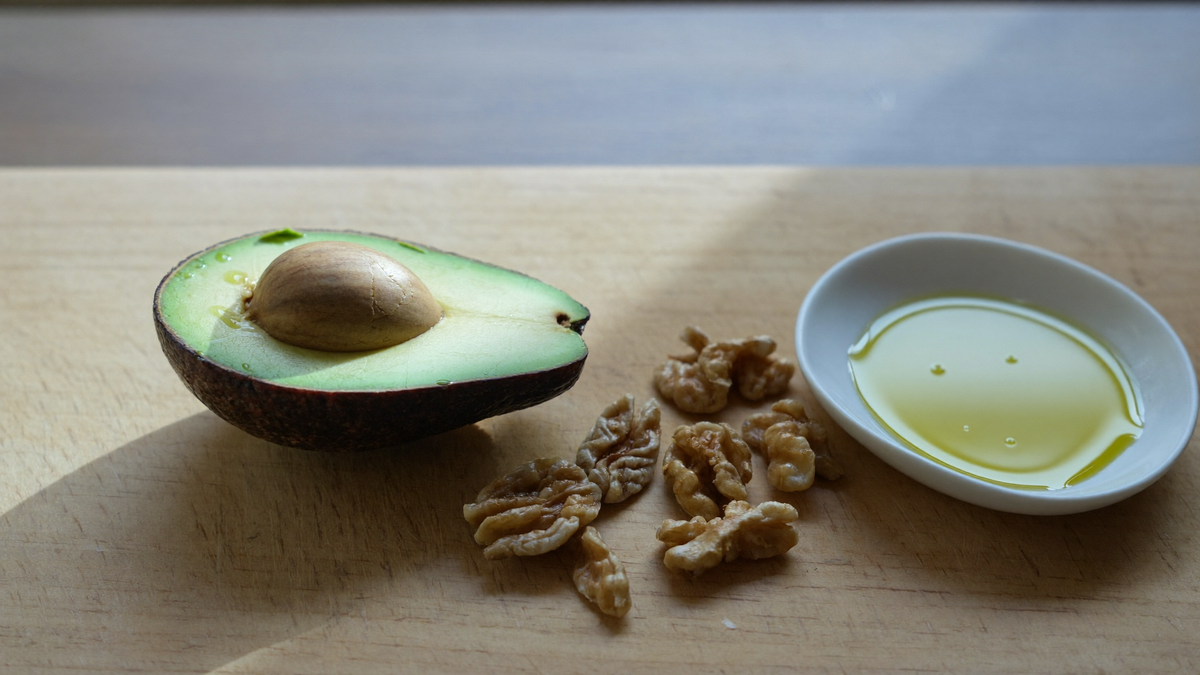
Sustainable alternatives come from two directions. One is plant-based fats: oils, nuts, seeds, and avocado. They provide predominantly unsaturated fatty acids—exactly what the criticized fats do not provide.
The other option is foods that simply contain less fat: legumes, whole-grain products, vegetables, and low-fat dairy products. They do not replace sausage in terms of taste, but they fill out the meal and prevent the gap that leads to relapse.
One limitation should be noted: how strongly each of these swaps affects blood values is not quantified in the source material used here. What is established is the direction—saturated fatty acids and trans fatty acids promote elevated LDL levels—not the size of the effect for each food.
What appears on the prohibited-food lists but does not belong there
Three statements appear on almost every list. All three can be checked against the same source from which the reference ranges are taken.
The third point is the most important because it applies to all three: A measure that changes a number is not necessarily a measure that prevents something. According to IQWiG, this has been demonstrated for statins—they can demonstrably reduce the risk of cardiovascular disease and extend life expectancy (as of 2025).
How to recognize an unreliable list
There are three characteristics by which you can assess a prohibited-food list before examining its contents. They do not eliminate the need for research, but they save time.
First: It cites no source with a publication year. Reference ranges and recommendations change, and a list without a date cannot be properly assessed.
Second: It categorizes foods by cholesterol content rather than by fatty acids. This is the clearest sign because it reflects exactly the misconception discussed in this article.
Third: It promises a reduction by a specific percentage within a specific period. There is no basis for such assurances—the effect of a change varies greatly from person to person.
How to find out your own values
The entire discussion about permitted and prohibited foods misses one key point: Most people do not know their own values. Without a baseline, it is impossible to assess whether action is needed at all or whether a change has made any difference.
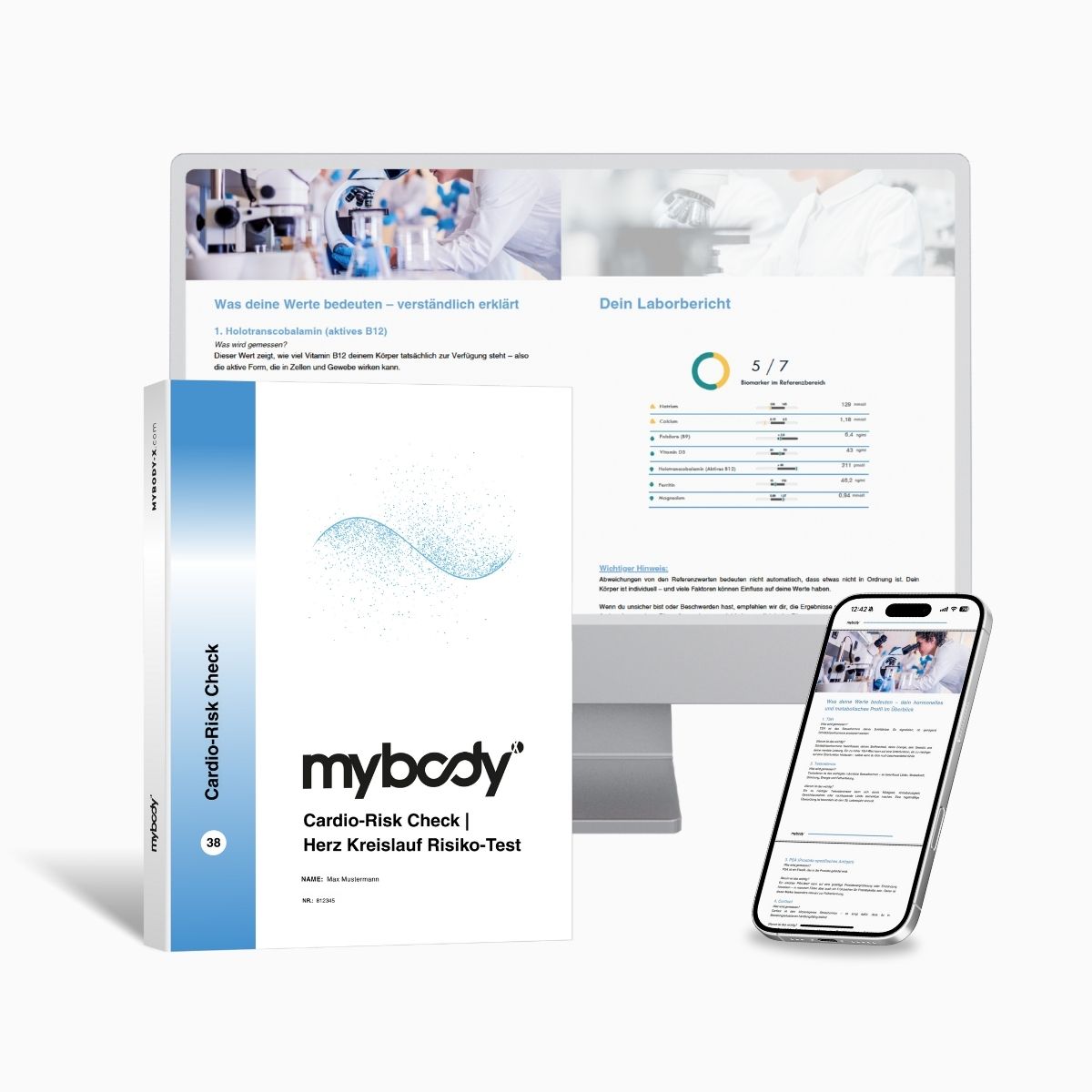
The usual route to get there is through your general practitioner's office. If you want an interim update between two appointments, you can also collect a sample from capillary blood at home and have the values analyzed in a laboratory. mybody®x (MYBODY Lab GmbH) offers a test for this purpose that measures blood lipids together with an inflammation marker.
Cardio Risk Check | Cardiovascular risk test
Measures ten markers from capillary blood: total cholesterol, LDL, HDL, triglycerides, lipoprotein(a), apolipoprotein A1, apolipoprotein B, C-reactive protein, sodium, and calcium. What the test does not do: It does not calculate overall cardiovascular risk and does not replace a medical assessment—for that, blood pressure, age, smoking status, and family history are needed. It also cannot diagnose familial hypercholesterolemia.
Price: €129.00 · Sample type: Capillary blood · Processing time: Kit shipping 1–3 business days, laboratory analysis 3–5 business days after receipt of the sample · Laboratory: ISO-certified laboratory analysis in Germany
About the Cardio Risk CheckOne point belongs here because it is otherwise easy to overlook: an abnormal result from a self-test is not a diagnosis, but a reason to make an appointment. And a normal result does not mean you can stop keeping an eye on your blood pressure and smoking status.
What a single value does not tell you
Blood lipid levels fluctuate. They depend on when and what you last ate, whether you have been ill, and how much you exercised in the preceding days. A single value is therefore a snapshot, not a trend.
It only becomes meaningful through comparison: the same value, measured several months later under comparable conditions. Anyone wanting to assess a change therefore needs two points in time—before and after—not one particularly good day.
Then there is the interpretation, which no measurement provides. Whether your LDL level requires action depends on factors that no blood test can read: age, blood pressure, smoking status, diabetes, and family history. That is why every measurement ends with a conversation, not a decision made at the kitchen table.
All prices and service details as of August 5, 2026. Prices and the scope of services may change; the respective product page always takes precedence.
Who may benefit from a measurement
Not everyone needs an additional measurement, and doing one without a specific reason gives you a number without any context. The following comparison will help you decide.
Worthwhile for you if …
… you haven’t known your values for years and want to find out whether anything needs attention at all.
… you made changes a few months ago and want a progress check before your next doctor’s appointment.
… early cardiovascular disease runs in your family and you want to address the issue.
Probably not if …
… you already have an appointment with a blood draw in a few weeks—then the measurement is redundant.
… you are already taking cholesterol-lowering medication; monitoring your progress should then be handled by your treating medical practice.
… you hope to use the level to assess your risk—the assessment only emerges together with your blood pressure, age, and medical history.
What diet cannot do
The most honest statement on this subject is also the least popular: How much cholesterol levels can be lowered through dietary changes varies greatly from person to person—and the source material used here does not provide a reliable percentage.
What follows from this is not resignation, but an order of priorities. Changing your diet is sensible, free, and has no side effects. However, it is not sufficient in every case, and knowing that can spare you frustration after three months without sausage.
With familial hypercholesterolemia, the effect of diet is limited from the outset because the cause is genetic. Here, the path forward is medical treatment, while dietary changes are a supplement, not an alternative.
And finally: Cholesterol is one risk factor among several. Smoking, high blood pressure, and diabetes are also factors and cannot be offset by lowering LDL levels.
One more word about the products advertised for precisely this purpose. The standard applied by IQWiG is not whether a product improves a number, but whether it can prevent cardiovascular disease. That is a much higher hurdle—and it explains why a product with persuasive study results may nevertheless not be recommended.
According to IQWiG, the evidence for statins has been established. Whether they are suitable for you is a medical decision that depends on your overall risk, not solely on your LDL level. Changing your diet does not replace them, nor does it make them unnecessary—it is an additional measure.
What ultimately matters
Looking for forbidden foods is understandable, but it focuses on the wrong issue. According to IQWiG, what promotes higher LDL levels is saturated and trans fats—and these are found in sausages, full-fat cheese, puff pastry, and fried foods, not in the breakfast egg.
Instead of a list of forbidden foods, a list of swaps is more helpful. Improving the quality of your dietary fat, exercising more, and not smoking covers the three points listed alongside diet in the same recommendation.
Equally important is what this change is not: a guarantee. How strongly the levels respond depends to a considerable extent on individual predisposition, and with familial hypercholesterolemia, the scope for improvement is limited from the outset. Knowing this beforehand helps prevent people from giving up disappointed after the third month.
Your next step: Look at your latest laboratory report. If it includes an LDL value, you have your baseline. If it does not, or if the report is more than two years old, that is the real reason to make an appointment—not the question of whether you should stop eating eggs.
Frequently asked questions
Which foods are actually prohibited if you have high cholesterol?
None. There is no list of prohibited foods. IQWiG identifies a diet high in saturated fatty acids and trans fatty acids as dietary factors contributing to an elevated LDL level. This is a question of quantity and frequency, not prohibition: sausages, fatty meat, butter, cream, high-fat cheese, puff pastry, and fried foods are the relevant groups—not as individual servings, but as daily habits.
Do I have to avoid eggs if I have high cholesterol?
According to IQWiG’s description, there is no evidence of this. The factors listed there as promoting an elevated LDL level include saturated fatty acids, trans fatty acids, and insufficient exercise—cholesterol in food itself is not included in this list. Eggs feature prominently on circulating lists of prohibited foods mainly because they are high in cholesterol, not because they are high in fat.
At what level is cholesterol too high?
According to IQWiG, a total cholesterol level below 200 mg/dl (5.2 mmol/l) is considered optimal, 200 to 239 mg/dl slightly elevated, and 240 mg/dl or higher significantly elevated. For LDL cholesterol, below 100 mg/dl (2.6 mmol/l) is considered optimal, while 190 mg/dl or higher is considered very high. However, a single value is not a diagnosis—whether action is needed only becomes clear from the overall risk, including age, blood pressure, smoking status, and medical history.
How quickly does changing my diet lower my levels?
The source material used here does not provide a reliable time frame or percentage, and an estimate would be misleading in this context. What is clear is that the effect varies greatly from person to person and is limited from the outset in cases of a genetically caused lipid metabolism disorder. A check after a few months makes sense—before then, it is not possible to properly assess a change anyway.
Can I measure my cholesterol levels at home?
The blood sample from the fingertip can be taken at home; a laboratory then performs the analysis. This gives you your values, but does not replace a medical assessment: a risk profile only emerges together with blood pressure, age, smoking status, and family history. An abnormal result therefore belongs in a discussion with a doctor, not in an independent treatment decision.
First the baseline, then the change
Without a baseline value, it is impossible to assess whether a change made any difference. Blood lipid levels can be determined from capillary blood—as an interim result to discuss with your doctor, not as a substitute for medical advice.
View Cardio Risk Check Nutrient VitalCheck CompleteYou might also be interested in
→ Lower cholesterol with the right diet
Looking at the other side: not what is removed, but what is added.
→ What do electrolytes in the blood indicate?
Classification of other laboratory values that are often measured together with blood lipids.
Sources
- Institute for Quality and Efficiency in Health Care (IQWiG): Elevated Cholesterol Levels, as of 2025 — gesundheitsinformation.de
The definition and function of cholesterol, the distinction between LDL and HDL, all threshold values in Chapters 2 and 4, the information on prevalence and familial hypercholesterolemia, the dietary and lifestyle factors mentioned, and the classification of dietary supplements and statins are based on source [1]. Product information is taken from the mybody®x product pages, accessed on August 5, 2026. The classification of individual food groups as sources of saturated and trans fats reflects general nutritional science and is not supported by numerical values in the text.

mybody®x Editorial & Medical Team
Blood Values Lipid Metabolism Nutritional Science
This article was created and medically reviewed by the mybody®x Editorial and Medical Team. The team brings together expertise in nutrigenetics, microbiome and gut science, blood analysis interpretation, nutritional science, and laboratory diagnostics.
Published on August 5, 2026 · Last updated on August 5, 2026
Medical notice: This article is intended for general information and does not replace medical advice, diagnosis, or treatment. The treating physician decides how to manage elevated cholesterol levels based on the overall risk; prescribed medications must never be discontinued without authorization.




Share now:
Online nutrition test: How it works and how to recognize a reputable provider
Fruit High in Iron: Why the Question Is Misleading