
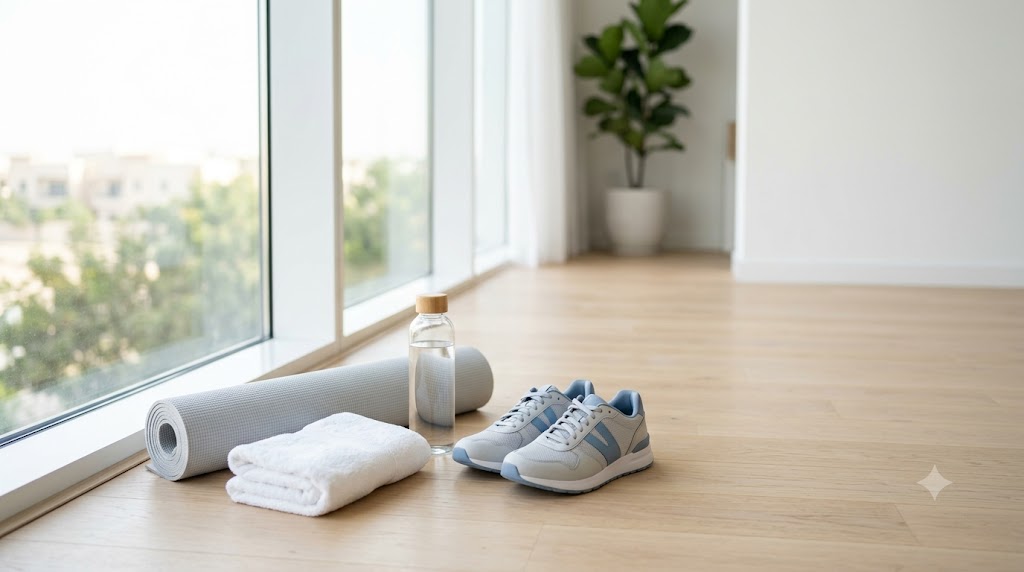
Recovery: What your body really needs after training, stress, and during sleep
The essentials at a glance
For recovery, your body needs four things: sufficient sleep, genuine breaks between training stimuli, enough protein and fluids, and a level of strain that fits your everyday life. If one of these factors is missing for weeks, adaptation to training fails to occur—and fatigue becomes the norm rather than the exception.
This guide examines the three areas of training, everyday life, and nutrition based on documented figures, citing the institution and year for each statement. It shows how much recovery a training session actually requires, why too little sleep measurably changes hunger, and what role protein intake plays in this. It also explains when persistent exhaustion is no longer a training issue but something that belongs in a doctor’s office.
Read Chapter 3 on recovery after training, Chapters 5 and 6 on sleep and stress, Chapter 7 on nutrients—and Chapter 9 if you are considering whether a test is right for you.
What to expect in this article
2. How much strain and how much recovery does a body need?
3. What do your muscles need after training?
4. Why does fatigue persist despite regular training?
5. What role does sleep play in recovery?
6. How do stress and everyday demands affect recovery?
7. Which nutrients does your body need for recovery?
8. How do fluids and everyday movement contribute to recovery?
9. Who is a DNA test useful for here—and who is it not useful for?
10. How mybody® can help
11. Putting it into perspective: What a DNA test can—and cannot—do
12. Conclusion
Frequently asked questions
Sources
What happens in the body when it recovers?
Recovery is the phase in which your body processes a strain and adapts to it. The training stimulus itself does not improve performance—it initially only disrupts the balance. Adaptation occurs afterward, during recovery.
The term encompasses more than the time after exercise: it also includes recovery from work-related strain, insufficient sleep, a cold, or a week of high psychological stress. The body does not clearly distinguish between athletic and non-athletic strain.
Key message: Recovery is not an afterthought to training, but the phase in which adaptation to the strain actually takes place. Without sufficient recovery, the training stimulus mainly leaves you with fatigue.
Which components are part of recovery?
Four components can be described using documented figures: sleep, rest from training, protein intake, and everyday movement. Two additional factors are harder to quantify: fluid intake and psychological stress.
In its Guidelines on Physical Activity and Sedentary Behaviour (2020), the World Health Organization (WHO) gives adults a framework of 150 to 300 minutes of moderate aerobic activity per week—while also indicating how much room for recovery a normal week allows.
How Does This Article Differ from the Related Articles?
This guide focuses on recovery itself: training, sleep, stress, and nutrients. By contrast, How Do I Activate My Metabolism? explains how to incorporate exercise and nutrition into your daily routine. If your starting point is more like “nothing has changed for me in months,” Slow Metabolism: What Can I Do? is the right place to start. And Nutrient Deficiency Test explains how to determine whether you have a nutrient deficiency in the first place.
How Much Strain and How Much Recovery Does the Body Need?
Regular moderate exercise is not the opposite of recovery, but its prerequisite. In its recommendation “Stay Active and Pay Attention to Your Weight” (2024), the German Nutrition Society (DGE) specifies an amount that can be achieved in everyday life.
“
“Around 30 to 60 minutes of moderate physical activity per day promotes health, stimulates muscle growth, and helps regulate weight.”
German Nutrition Society (DGE)
Recommendation “Stay Active and Pay Attention to Your Weight,” 2024
These 30 to 60 minutes describe moderate activity, not a hard training session: brisk walking, cycling to work, or gardening are included.
The WHO (2020) sets a somewhat broader weekly framework: 150 to 300 minutes of moderate or 75 to 150 minutes of vigorous aerobic activity, plus muscle-strengthening activity on at least two days per week. Taken together, the two recommendations provide a realistic picture—and explicitly allow days without structured training.
Why Rest Is Part of the Training Plan
When the WHO (2020) recommends muscle-strengthening activity on at least two days, the converse is also true: the remaining days are intended for recovery. A training week without rest days is not a more ambitious version of this recommendation, but a different load structure.
How long recovery takes after a single workout depends on intensity, training status, sleep, and everyday stress. There are no reliable blanket figures for this—anyone who gives an exact number of hours for “muscle regeneration” is generalizing more than the available data supports.
A more useful benchmark is this: If performance is stable or better in the next workout, the rest period was sufficient. If it declines over several workouts despite the same effort, the rest period was too short.
What do muscles need after training?
After a training stimulus, muscles primarily need three things: time without renewed maximal exertion, protein as a building material, and sleep. Unremarkable—but these three factors account for most of the effect.
Muscle tissue is not passive. According to a tissue analysis by Wang and colleagues (American Journal of Clinical Nutrition, 2010), skeletal muscle consumes around 12.6 kcal per kilogram per day, whereas fat tissue consumes around 4.4 kcal per kilogram per day. Building or maintaining muscle therefore also changes energy expenditure at rest.
For recovery, another point is more important: Muscle tissue is broken down during phases of insufficient energy and protein. A hard training week combined with a strict diet therefore works against your own goal.
How can you tell that you are not getting enough recovery?
A single signal does not say much. The pattern becomes meaningful when several of these points occur simultaneously over a period of weeks.
Signs of insufficient recovery
- ✓ Performance declines despite the same effort – across several workouts, not just once.
- ✓ Muscle soreness lasts unusually long – and the next workout feels harder.
- ✓ Sleep gets worse even though you are more tired – falling asleep or staying asleep changes.
- ✓ Infections become more frequent – recurrent colds should be medically evaluated, not worked into a training plan.
The important point is the appropriate response: If you notice these signals, you do not need a harder workout but more recovery—not a setback, but the missing part of your training so far.
Key message: Declining performance despite the same training load is a sign of insufficient recovery, not insufficient dedication. Persistent exhaustion, recurrent infections, or unintentional weight loss should be medically evaluated.
Why does the fatigue persist despite regular training?
Regular training makes you more capable over time—but only if recovery keeps pace. If you increase your training volume while leaving sleep duration, protein intake, and rest days unchanged, you gradually shift the balance between stress and recovery in one direction.
In addition, training is only one part of the overall load: A 50-hour workweek, young children, or a sleepless night all count toward the body's total burden.
Example: Nina, 34
Fictional scenario for illustration
Nina has been training five times a week for six months: running three times and strength training twice, in addition to a full workday spent sitting. Nevertheless, she feels constantly tired, and her running times are getting slower instead of faster. Her week contains not a single day without training; she usually sleeps about five hours and often eats only a salad for lunch. The most plausible explanation here is not a single cause but a combination: she has no recovery days at all, her sleep duration is well below the 7.7 hours at which the Taheri et al. cohort (PLOS Medicine, 2004) found the lowest BMI, and with five hours of training per week, her protein requirement according to the DGE (as of 2025) is more likely to be 1.2 to 2.0 g per kilogram of body weight than the 0.8 g recommended for recreational athletes. Whether there is also a nutritional deficiency, such as iron deficiency, cannot be determined from this scenario; that would require a medically ordered blood test.
The pattern is typical: It is not a single factor that determines the outcome, but the sum of them. Keeping three factors slightly too low at the same time has a stronger effect than one that falls significantly short.
Persistent exhaustion can also have causes unrelated to the training plan—from thyroid disorders and anemia to depressive episodes. If fatigue persists for weeks even though sleep, breaks, and nutrition are adequate, it should be addressed by a doctor, not a self-test.
What role does sleep play in recovery?
Sleep is the only component of recovery for which there is no substitute. No dietary supplement, training plan, or recovery technique can permanently make up for too little sleep.
How quickly too little sleep can have measurable effects is shown by a controlled laboratory study by Spiegel and colleagues (Annals of Internal Medicine, 2004): With 4 instead of 10 hours in bed, the satiety hormone leptin fell by 18%, the hunger hormone ghrelin rose by 28%, and feelings of hunger increased by 24%.
The same pattern is found outside the laboratory. In a population cohort by Taheri and colleagues (PLOS Medicine, 2004), 5 instead of 8 hours of sleep were associated with 15.5% lower leptin levels and 14.9% higher ghrelin levels; the lowest BMI was observed with a sleep duration of 7.7 hours.
These figures describe hormonal shifts, not destinies. But they do explain why appetite changes after several short nights, even though nothing about the training has changed.
Sleep is the only component of recovery for which there is no substitute.
What does this mean for your own sleep duration?
The 7.7 hours from the analysis by Taheri and colleagues (2004) are a statistical value from a cohort, not an individual prescription. Individual needs vary, and a single short night is not a problem.
A pragmatic perspective is therefore more useful than an optimization routine: If your sleep duration remains significantly below what you need to wake up without an alarm for weeks on end, that is the first place to start. By contrast, people who begin measuring and evaluating their own sleep often create additional pressure—recovery benefits from regularity, not perfection.
How do stress and everyday demands affect recovery?
The body counts the total load, not where it comes from. A demanding workweek or an illness uses recovery capacity that is then unavailable for training.
Sitting is a frequently underestimated factor. In its recommendation “Stay active and keep an eye on your weight” (2024), the DGE states verbatim: “Prolonged, uninterrupted sitting increases the risk of numerous diseases, such as back pain, type 2 diabetes, obesity, high blood pressure, cardiovascular disease, and cancer.”
What is remarkable is the order: The issue is not too little exercise, but too much uninterrupted sitting.
The scope for variation in this category is considerable: According to von Loeffelholz and Birkenfeld (Endotext, as of 2022), the difference in everyday movement—technically NEAT, non-exercise activity thermogenesis—between two people of the same size can amount to up to 2,000 kcal per day.
The following overview summarizes the four points at which a demanding day can realistically be managed—without adding training time.
Protect sleep duration
The BMI minimum in the cohort studied by Taheri et al. (2004) was 7.7 hours of sleep.
Break up sitting time
The DGE (2024) identifies prolonged, uninterrupted sitting as an independent risk factor, regardless of exercise.
Dose your training load
The WHO (2020) recommends muscle-strengthening activity on at least two days per week—the remaining days provide room for recovery.
Distribute protein intake
The DGE (as of 2025) specifies 0.8 g of protein per kilogram of body weight per day for recreational athletes, and 1.2 to 2.0 g after about five hours of training per week.
None of these four steps requires more effort. They simply shift how an already demanding day is structured—and that is precisely where the amount of recovery left is determined.
Which nutrients does your body need for recovery?
Protein comes first: it provides the building blocks the body uses to build and remodel muscle. Without an adequate intake, there is not enough material for adaptation after training.
For recreational sports—30 minutes four to five times per week—the German Nutrition Society (as of 2025) recommends an intake equal to the recommended 0.8 g of protein per kilogram of body weight per day. A special diet is therefore not necessary at this level.
The situation is different from around five hours of training per week onward. For ambitious athletes and competitive female and male athletes, the DGE (as of 2025) recommends a flexibly adjusted protein intake of approximately 1.2 to 2.0 g per kilogram of body weight per day—citing the International Society of Sports Nutrition and the American College of Sports Medicine.
A third value concerns age: From the age of 65, the estimated value according to the DGE (as of 2025) is 1.0 g of protein per kilogram of body weight per day. Preserving muscle mass becomes the central issue of recovery with age.
Iron as an example: why a single nutrient influences resilience
Iron illustrates how strongly a single nutrient can influence the ability to recover. In its reference values for nutrient intake (as of 2023), the DGE states: “Iron deficiency can impair physical performance, disrupt the body's temperature regulation, and increase susceptibility to infections."
The reference values themselves are 11 mg of iron per day for men aged 19 and over and 16 mg per day for women aged 19 to 50, according to the DGE (as of 2023). The higher value for women is related to losses from menstruation.
Whether you actually have too little iron cannot be determined from how you feel or from your diet. It requires a blood test, usually measuring ferritin: The Institute for Quality and Efficiency in Health Care (IQWiG, 2025) gives a reference range of 9 to 140 µg/l for women and 18 to 360 µg/l for men over 18.
A single laboratory value is not a diagnosis. According to IQWiG (2025), an elevated ferritin level often does not indicate iron status but rather inflammation—interpretation belongs in the hands of a doctor.
Key message: According to the DGE (as of 2023), iron deficiency can impair physical performance and increase susceptibility to infections. It can only be identified through a blood test—a DNA test shows predispositions, not iron status.
How the four building blocks of recovery compare
The following overview compares sleep, taking a break from training, protein, and everyday movement according to the same three criteria. It lists only magnitudes for which a named source with a year is available.
| Building block | What it is crucial for | Evidence-based magnitude | How quickly it takes effect |
|---|---|---|---|
| Sleep | Hormonal regulation of hunger and recovery | 4 instead of 10 hours in bed: leptin −18%, ghrelin +28%, feeling of hunger +24% (Spiegel et al., 2004); BMI minimum at 7.7 hours (Taheri et al., 2004) | Short term: the hormonal shift occurred under controlled laboratory conditions with restricted time in bed |
| Training break | Adaptation to the training stimulus | 150–300 minutes of moderate or 75–150 minutes of vigorous aerobic activity per week, with muscle-strengthening activities on at least two days (WHO, 2020) | Immediately adjustable: the weekly structure can be changed right away |
| Protein | Building material for muscles | 0.8 g per kg of body weight per day in recreational sports; approx. 1.2–2.0 g after around five training hours per week; 1.0 g from age 65 onward (DGE, as of 2025) | Can be implemented daily; becomes apparent only after weeks of regular intake |
| Everyday movement | Total energy expenditure and sitting time | Difference between two people of the same size: up to 2,000 kcal per day (Endotext, as of 2022); around 30–60 minutes of moderate activity per day (DGE, 2024) | Immediately: works in small units spread throughout the day |
The overview reveals a pattern: taking a break from training and everyday movement can be changed immediately, while protein and sleep require somewhat more planning—but they also have the clearest figures.
What do fluids and everyday movement do for recovery?
Fluid is the easiest item on the list to correct—and the one most often overlooked. When you sweat, your body loses water and minerals; if neither is replaced, recovery feels more arduous than it needs to.
A blanket fluid intake recommendation cannot be given responsibly. Requirements depend on temperature, the duration and intensity of exertion, body weight, and the rest of the diet—vegetables, fruit, and soups contribute to intake.
A useful basic principle is therefore: drink throughout the day rather than consuming a few large portions, and also drink during long or hot sessions. If you wait until you are very thirsty to drink, you are usually already falling short of your needs.
Why everyday movement helps on rest days
A recovery day is not a day on the sofa. Light movement—walking, cycling at an easy pace, climbing stairs—is compatible with recovery and maintains everyday activity, whose range, according to Endotext (as of 2022), can be as high as 2,000 kcal per day.
For recovery, this means two things. First, everyday movement does not replace a break from intense stimuli. Second, a completely sedentary day is not better recovery either—the DGE (2024) explicitly identifies prolonged, uninterrupted sitting as a risk in its own right and recommends around 30 to 60 minutes of moderate activity per day.
In brief
There is no reliable one-size-fits-all amount for fluid intake: Requirements depend on exertion, temperature, and diet, so drinking regularly throughout the day is more useful than aiming for a fixed target. Everyday movement, on the other hand, has a documented impact—according to Endotext (as of 2022), up to a difference of 2,000 kcal per day. A recovery day is therefore a day with light movement, not a day without any movement at all.
Who is a DNA test useful for here—and who is it not useful for?
A DNA test answers a different question than “Am I currently recovered?” It shows unchanging predispositions—for example, in the areas of sports and fitness, metabolic function, or vitamin and mineral requirements—but not your current status. This distinction determines whether a test makes sense for you.
Makes sense for you if …
… you train regularly and want to align your nutrition with your predispositions over the long term.
… you want to know which genetic traits you have in the areas of sports and fitness—the fitness | The VITALITY DNA Test alone contains ten reports on this.
… you prefer a one-time analysis: Your DNA does not change, so the report does not need to be repeated.
… you are looking for guidance on food choices and want to work with a table containing more than 1,000 evaluated foods.
Not really, if …
… you have been exhausted for weeks and want to determine the cause. Persistent exhaustion should be medically evaluated—a DNA test is not a priority here and has no diagnostic value.
… you want to know whether you are currently lacking a nutrient. A DNA test does not measure nutritional status; this requires a blood test, such as measuring ferritin levels (IQWiG, 2025).
… you want to quantify your current recovery status or training load. A saliva sample measures neither.
… you need a quick result: The analysis takes approximately 20 to 25 business days after the sample is received.
The honest conclusion: A test does not replace any of the four pillars of recovery. It can provide guidance for long-term planning—the recovery itself is controlled through sleep, breaks, nutrition, and everyday movement.
This is how mybody® can help
mybody® offers a DNA test for long-term planning that analyzes over 100 genetic variations from a saliva sample—ISO-certified, with data processing in accordance with ISO 27001.

Fitness | VITALITY DNA Test
The Fitness | The VITALITY DNA Test analyzes more than 100 gene variants from a saliva sample and summarizes the results in 32 analytical reports across 6 chapters over approximately 160 pages—including Nutrition & Diet, Vitamin & Mineral Requirements, Metabolic Function, Body & Detoxification Process, and Cardiovascular System.
For the topic of this article, the Sport & Fitness / Muscle Cells chapter with ten reports is particularly relevant. It also includes a food table with more than 1,000 evaluated foods.
Explicitly not included is any statement about your current condition: The test does not measure nutrient status, recovery level, or training load. It does not provide a diagnosis.
Price: €197.00 · Sample type: saliva sample · Processing time: approx. 20–25 business days after sample receipt · Laboratory: ISO-certified laboratory analysis, ISO 27001
For Fitness | VITALITY DNA TestPrice information as of July 28, 2026. Prices, report scope, and processing times may change—the linked mybody® product page (MYBODY Lab GmbH) is always authoritative.
For context: mybody® is part of MYBODY Lab GmbH and works with an ISO-certified partner laboratory. Samples are processed pseudonymously, transmitted using SSL encryption, and data processing complies with the GDPR.
Context: What a DNA test can—and cannot—do
A DNA test does not measure recovery. It reads genetic characteristics that do not change over the course of your life—and that is precisely where its limitations arise.
First, a DNA test does not provide a diagnosis. A predisposition is neither a finding nor a disease; it describes a probability, not a condition.
Second, a DNA test does not measure your current nutrient status. Whether you are iron deficient today is shown by a blood test—for example, the ferritin level, with a reference range of 9 to 140 µg/l for women and 18 to 360 µg/l for men (IQWiG, 2025)—interpreted by a medical professional.
Third, a DNA test measures neither your recovery status nor your training load. How recovered you are, how much you trained this week, and how well you slept cannot be found in a saliva sample.
Fourth, no test replaces the building blocks discussed in this article. If you sleep too little for weeks, do not plan rest days, and eat too little protein, an analysis will not change that.
And fifth, medical evaluation takes precedence. If persistent exhaustion, unintentional weight loss, shortness of breath, a racing heart, or recurrent infections occur, a doctor’s office is the first step—not a self-test.
Conclusion
Recovery is not an add-on program; it is the part of training in which adaptation takes place. Four building blocks drive the effect: sleep, training breaks, protein, and everyday movement—along with sufficient fluids.
The figures put things into perspective: Compared with 10 hours in bed, 4 hours shifted leptin by −18% and ghrelin by +28% in the study by Spiegel and colleagues (2004). The WHO (2020) recommends 150 to 300 minutes of moderate activity per week and muscle-strengthening sessions on at least two days. The DGE (as of 2025) recommends 0.8 g of protein per kilogram of body weight for recreational athletes, and approximately 1.2 to 2.0 g from around five hours of training per week.
In practical terms: Schedule days without structured training, keep your sleep duration consistent, spread protein across meals, drink regularly, and break up long periods of sitting. These five points are the evidence-based toolkit—and they cost nothing.
If you are also looking for long-term guidance on nutrition and training, a DNA test can provide a basis. If the exhaustion persists even though sleep, breaks, and nutrition are adequate, the next step is medical evaluation.
Frequently asked questions about recovery
Do you want to align your diet and training with your predispositions?
The Fitness | The VITALITY DNA Test analyzes more than 100 gene variations from a saliva sample and provides 32 analysis reports in 6 chapters, including ten on sports & fitness. Results are available approximately 20–25 business days after the sample is received. The test shows predispositions—not nutrient status or recovery status.
For Fitness | VITALITY DNA Test View all DNA testsYou might also be interested in
→ How Can I Activate My Metabolism?
Putting it into practice in your daily routine: when each lever can realistically take effect in everyday life.
→ Nutrient Deficiency Test
How to determine whether you have a nutrient deficiency—and why this requires a blood test.
Sources
- German Nutrition Society (DGE): Stay Active and Pay Attention to Your Weight (2024)
- German Nutrition Society (DGE): Reference Values for Protein (as of 2025)
- World Health Organization: Guidelines on Physical Activity and Sedentary Behaviour (2020)
- Spiegel K. et al.: Sleep curtailment, leptin, ghrelin and appetite. Ann Intern Med 141(11) (2004)
- Taheri S. et al.: Short sleep duration is associated with reduced leptin, elevated ghrelin and increased BMI. PLOS Medicine (2004)
- Wang Z. et al.: Specific metabolic rates of major organs and tissues across adulthood. Am J Clin Nutr 92(6) (2010)
The institute quotation and the information on moderate activity and sitting time are based on [1], the protein values on [2], and the weekly exercise recommendations on [3]. The sleep data come from [4] and [5], and the tissue values from [6]. The reference values for iron (DGE, as of 2023), the normal ferritin ranges (IQWiG, 2025), and the information on everyday movement (Endotext, as of 2022) are cited directly at the relevant point in the text with the institution and year; the same applies to all other studies mentioned. All product information on mybody® (MYBODY Lab GmbH) comes from the official product pages at mybody-x.com (as of July 28, 2026).

mybody® Editorial & Expert Team
Regeneration Sleep & recovery Nutritional science Laboratory diagnostics Nutrigenetics
This article was created and medically reviewed by the mybody® editorial and expert team at MYBODY Lab GmbH. The team combines expertise in nutritional science, laboratory diagnostics, blood analysis interpretation, microbiome research, and nutrigenetics. Learn more about the people behind it on the mybody® authors' page.
Published on July 28, 2026 · Last updated on July 28, 2026
Medical note: This article is for general information and does not replace medical advice, diagnosis, or treatment. Self-tests provide indications, not diagnoses. If you experience persistent fatigue, unintentional weight loss, shortness of breath, a racing heart, recurrent infections, or other unexplained symptoms, please consult a doctor. If you take medication, are pregnant, or are breastfeeding, discuss dietary changes and nutritional supplements with a doctor beforehand.



Share now:
Why am I not losing weight with intermittent fasting? The most common reasons
Online nutrition test: How it works and how to recognize a reputable provider